🟠 MSTR ≈$90.95M $95 Calls: The October Leg Opened in Full, the August Leg Closed — This Was a Roll Out, Not a Two-Expiration Bet
📅 2026-08-11 | 🤝 Floor Block Detected
🔄 Updated 2026-08-12 pre-market — the next-day OPRA open interest resolved both legs, and the August leg inverted. The October $95 calls opened as predicted (592 → 44,846, +44,254 against a 44,215-lot print — above our published 40,000–45,000 window). The August $95 calls did not: open interest fell 47,089 → 36,278 (−10,811), where an opening would have pushed it toward ≈91,000. We said flatly that falling open interest would mean that leg closed. It fell. So the structure is a roll out in time at the same strike — August exposure reduced, October exposure created — not a doubled-up bet across two expirations. See the ✅ RESOLVED box.
🎯 The Quick Take
At 10:43:56 ET, a floor-negotiated package crossed 44,215 contracts of the $95 call in TWO expirations at once — October 16 and August 21 — for a combined ≈$90.95M of premium on MSTR, formerly MicroStrategy. This was a negotiated block, not a lit sweep, and the feed's per-leg BUY/SELL tag is not reliable here — we'll explain exactly why below. What's not in question: this is a large, deliberate options position on a 3.5-beta bitcoin proxy trading at a discount to the bitcoin it holds.
🏢 Company Overview — And a Correction Before We Start
Strategy Inc (NASDAQ: MSTR), formerly MicroStrategy, rebranded in August 2025 and runs two businesses of wildly different size: a bitcoin treasury holding 840,447 BTC (≈$53.3B market value) funded by common-equity ATM sales, convertible notes and perpetual preferred stock, and a much smaller enterprise software unit (Strategy One analytics, Strategy Mosaic) that did $122.4M in Q2 2026 revenue, up 6.9% year over year. The software business is roughly 0.2% of the company's asset base — this is a levered bitcoin instrument with a software business attached. Market cap is $36.82B; sector is Information Technology, industry Software — Application.
⚠️ Before anything else: MSTR at ≈$96 is NOT a split artifact. The last split was a 10-for-1 forward split on August 8, 2024 — there has been no split, forward or reverse, in 2025 or 2026. The move down from a 52-week high of $414.36 is a real −75.77% 52-week decline. If you remember MSTR trading in the $300s–$400s, that memory is correct — the stock is genuinely down three-quarters, not showing a pre-split number.
The reason it's down that much: bitcoin fell ≈49.7% from its October 2025 high of $126,080 to ≈$63,467 today, and Strategy's average cost basis on its 840,447 BTC is $75,385 — the treasury is sitting on an unrealized loss of roughly 16%. On top of that, Strategy's own stock now trades at 0.69× basic mNAV: the market cap is worth 31% less than the bitcoin the company holds, because $15.46B of preferred liquidation preference and $6.67B of convertible debt sit ahead of the common. That premium-to-discount flip broke the "issue stock, buy more bitcoin, repeat" flywheel that built the position in the first place — and on July 31, 2026, the company disclosed plans to sell up to $5 billion of bitcoin to build cash reserves. Strategy is now, for the first time in years, a net bitcoin seller.
💰 The Option Flow Breakdown
📊 What Just Happened
- 🤝 Floor block, both legs printed at 10:43:56 ET as
MULTI_LEG_FLOOR_TRADE— a negotiated package matched off the lit book, not urgent buying pressure. - 44,215 contracts of the $95 call in the 2026-10-16 expiration at $14.27 → ≈$63.09M.
- 44,215 contracts of the $95 call in the 2026-08-21 expiration at $6.30 → ≈$27.86M.
- Combined: ≈$90.95M changed hands. Spot at the print was $97.97, so the $95 strike sat ≈3.0% in the money on both legs.
- Extrinsic (time) value: the October leg carried ≈$11.30 of time value over $2.97 of intrinsic; the August leg carried ≈$3.33 over the same intrinsic. The desk paid up much more for the far-dated leg's time, which is exactly what you'd expect from a longer runway to expiration.
Full trade details:
| Time (ET) | Buy/Sell | Call/Put | Expiration | Premium | Strike | Volume | OI | Size | Spot | Option Price | Option Symbol | Order Type | Strategy |
|---|---|---|---|---|---|---|---|---|---|---|---|---|---|
| 10:43:56 | BUY* | CALL | 2026-10-16 | ≈$63.09M | $95 | 44,000 | 592 | 44,215 | $97.97 | $14.27 | MSTR20261016C95 | ✅ BTO (open confirmed: 592 → 44,846) | Same-Strike $95 Roll Out (Aug reduced → Oct opened) |
| 10:43:56 | BUY* | CALL | 2026-08-21 | ≈$27.86M | $95 | 44,000 | 47,089 | 44,215 | $97.97 | $6.30 | MSTR20260821C95 | 🔄 Closed — resolved 2026-08-12 (OI fell 47,089 → 36,278); was BTO ⏳ | Same-Strike $95 Roll Out (Aug reduced → Oct opened) |
*See "What This Actually Means" below — we do not trust the per-leg BUY label on this print, and we're not asserting it.
🤝 Mechanism note: this is a floor block, meaning brokers negotiated it directly on the exchange floor with a known counterparty on the other side. It is not aggressive lit-market buying, and there's no urgency signature to read here — treat the size and the strike as the story, not the "speed" of the trade.
✅ RESOLVED — October Opened in Full; August Closed. This Is a Roll Out
Updated 2026-08-12 pre-market. Resolving OPRA snapshot timestamped August 12 (reflects the August 11 close, after this print); baseline is the August 11 snapshot (reflects the August 10 close, before this print).
| Leg | Baseline (Aug-11) | Resolving (Aug-12) | Δ | Print size | What we published | Verdict |
|---|---|---|---|---|---|---|
| Oct-16 $95 call | 592 | 44,846 | +44,254 | 44,215 | "jump to roughly ≈40,000–45,000" | ✅ OPEN — above the window, ≈100% of size |
| Aug-21 $95 call | 47,089 | 36,278 | −10,811 | 44,215 | "if OI is flat or falls, that leg closed" | 🔄 CLOSE — was BTO ⏳ |
The October leg is as clean as size-versus-open-interest gets. Open interest rose 44,254 against a 44,215-lot print — slightly more than the block, so essentially none of it was absorbed as transfer. Forty-four thousand new October $95 calls genuinely exist tonight, and that is the position worth paying attention to.
The August leg went the other way, and it settles the structure. We refused to guess and named both branches; open interest fell 10,811. Against 44,215 contracts printed, that means no new August exposure was created — net 10,811 contracts of existing August $95 open interest were retired, with the balance changing hands between existing holders.
Control check. The surrounding August-21 strikes were static across the same window — $85 call 588 → 589, $90 call 899 → 901, $100 call 12,658 → 13,018, $105 call 10,473 → 10,578. Only the $95 line moved, so this is attributable to the package rather than an expiration-wide event.
What changes below. The analysis describes a same-strike calendar package as "two expirations, one Bitcoin bet" — ≈$91M of exposure spread across an August and an October leg. Measured by surviving open interest, that is not what exists. August $95 exposure shrank while October $95 exposure was created, which is the signature of a roll out in time: an existing near-dated position at the $95 strike was reduced and re-established nine weeks further out. The economic consequence matters for readers — the trade is not "more exposure," it is "the same strike, more time." Anything below that treats the August leg as fresh conviction, or that adds the two legs into a single ≈$91M directional commitment, should be read with that correction in mind. The genuinely new money here is the ≈$63.09M October leg.
One caveat we already carried, now more important. The article notes we do not trust the per-leg BUY label on this floor print. The resolution supports that caution: a leg tagged BUY whose open interest falls is doing something other than opening a long. Open interest is market-wide, so we can prove August $95 interest shrank as October $95 interest was created — we cannot prove one account did both sides.
🤓 What This Actually Means — Plain English
Here's the honest, unglamorous read on this one.
A "calendar" trade means the same strike, two different expiration dates. In a textbook calendar spread, you're long one date and short the other — you sell the near-dated option and buy the far-dated one (or vice versa) to collect or pay for the difference in time decay between them. That's a spread, and it should show up on the tape as one leg BUY and the other leg SELL.
That's not what the feed shows here. Both the October leg and the August leg are tagged BUY, for the full premium on each — ≈$63.09M and ≈$27.86M, summing to the full ≈$90.95M rather than a smaller net debit you'd expect from a real spread. That is mechanically impossible for a genuine calendar spread — someone has to be on the other side selling one of these legs. The reason the feed can get this wrong: on a negotiated multi-leg floor print, the exchange's own allocation engine assigns buy/sell tags across the legs of a package trade, and that per-leg allocation is known to be unreliable — it's the same limitation that makes per-leg aggressor reads untrustworthy on any multi-leg cross or auction.
So we're being straight with you: we do not know which side was actually bought and which was actually sold on this package, and we are not going to invent a bullish or bearish story to fill that gap. There are at least three honest possibilities: (1) this really is a calendar spread and the feed mislabeled the short leg as a buy; (2) this is two separate, deliberate long-call positions bought together as one package — effectively a double bet on bitcoin across two different time horizons, with real capital committed on both legs; (3) something closer to a roll, where the near-dated August position (which sits at an OI level where we can't prove open vs. close) is being unwound while the further-dated October position is freshly opened, extending the same directional exposure further out in time. All three are structurally consistent with what printed. The strike, the size, and the timing tell us this was one deliberate package — the direction of money is the part we won't overstate.
What we can say with confidence: whoever built this position — long, short, or a mix — put real size behind the $95 strike across both expirations on the same underlying stock, at a moment when that stock is a leveraged, discounted claim on bitcoin.
On the mNAV point, in plain terms: MSTR's stock currently trades at 0.69× the value of the bitcoin it holds — you're paying about 69 cents on the dollar for the underlying BTC exposure, after backing out what's owed to preferred and convertible-debt holders ahead of common shareholders. That sounds like a discount worth buying, and bulls frame it that way — if bitcoin rallies and the discount merely closes back to 1.0×, the stock could rise faster than bitcoin itself. But the same math cuts the other way: the reason the discount opened is that Strategy stopped being bitcoin's biggest buyer and became a seller, and every dollar of stock issued below 1.0× mNAV now dilutes existing shareholders' bitcoin-per-share instead of growing it. A call option on a stock that's already a leveraged, discounted claim on a volatile asset is leverage on leverage — size accordingly.
📈 Technical Setup / Chart Check-Up
YTD Chart
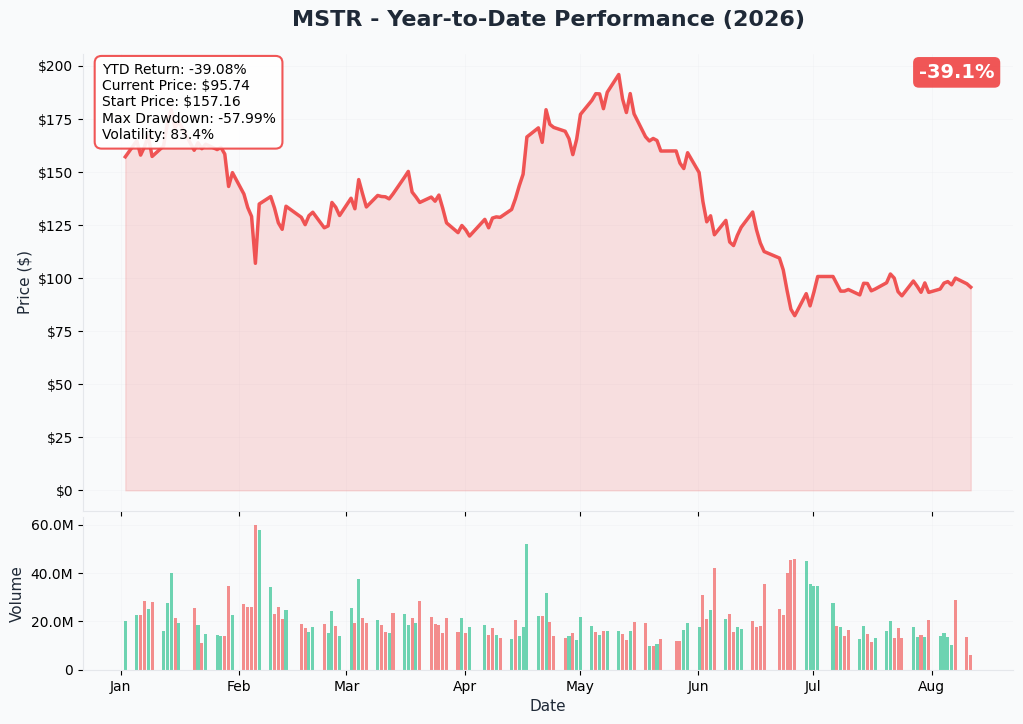
MSTR spent the back half of 2025 well above $200 before the collapse: roughly flat near $150 through early June 2026, then a −32.7% July to $100.77, and another ≈−4.7% in early August to ≈$96 — a 52-week range of $81.81–$414.36. The stock is bumping along multi-month lows, below both its 50-day and 200-day averages.
Gamma-Based Support & Resistance
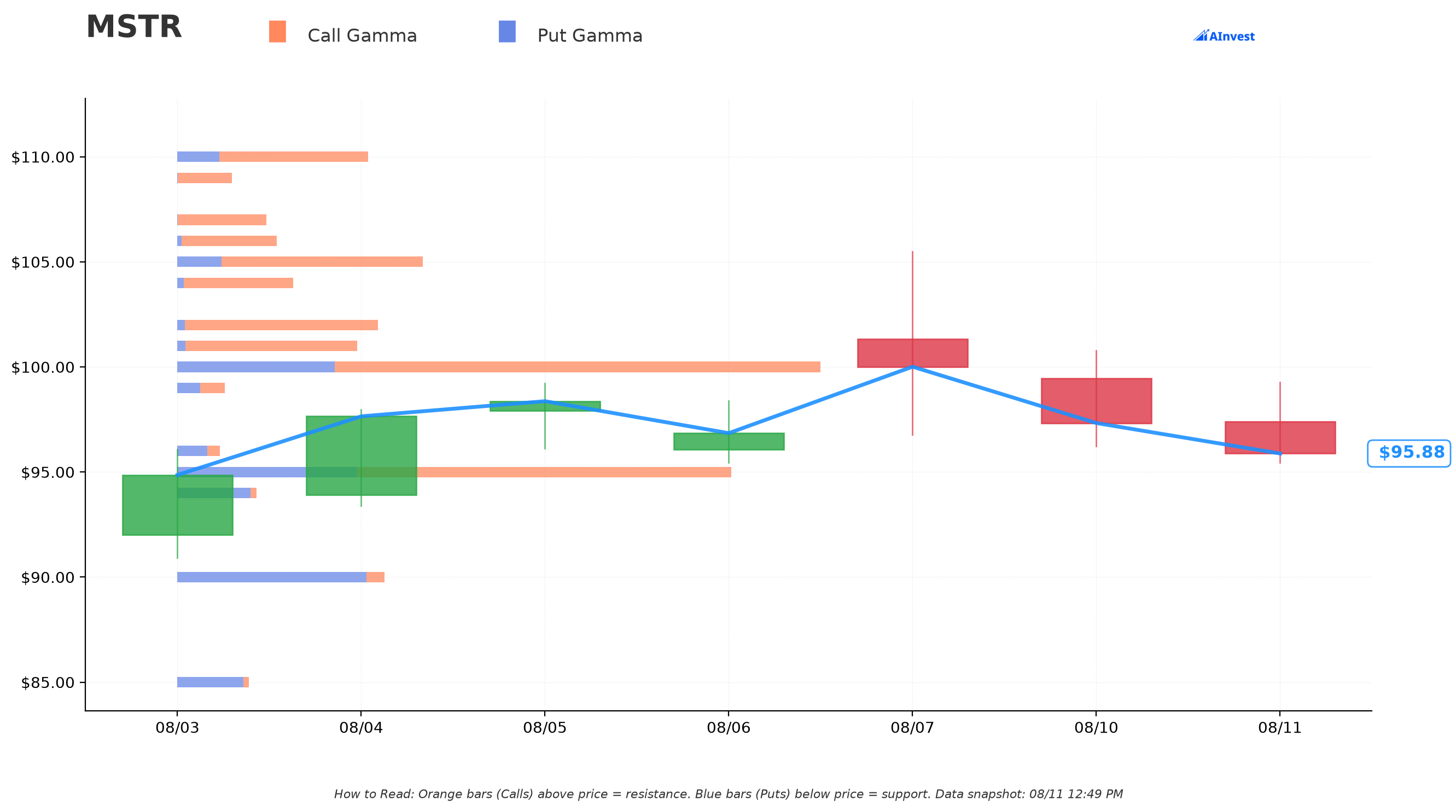
Reading the options market's own positioning (current price in the gamma snapshot: $95.90):
- 🔵 $95 — Very Strong support, the single largest gamma concentration on the board (total GEX ≈26.3, call GEX ≈17.8 vs. put GEX ≈8.5), sitting almost exactly at spot (≈0.9% away). This is precisely the strike this trade bought on both legs — heavy call open interest here can act as a magnet/floor as dealers hedge.
- 🔵 $90 — Strong support, ≈6.2% below spot, with a net negative gamma reading (put-dominated), meaning dealer hedging could amplify a move lower if price breaks below $95.
- 🟠 $100 — Very Strong resistance, ≈4.3% above spot, the largest call-gamma wall on the chain (call GEX ≈23.1). This is the next real ceiling.
- 🟠 $105 / $102 — additional resistance walls further out, ≈9.5% and ≈6.4% above spot respectively.
In plain terms: the market's own options positioning has built a floor almost exactly where this trade bought its calls ($95) and a ceiling ≈4% higher at $100 — a tight range the stock has been oscillating inside.
Implied Move
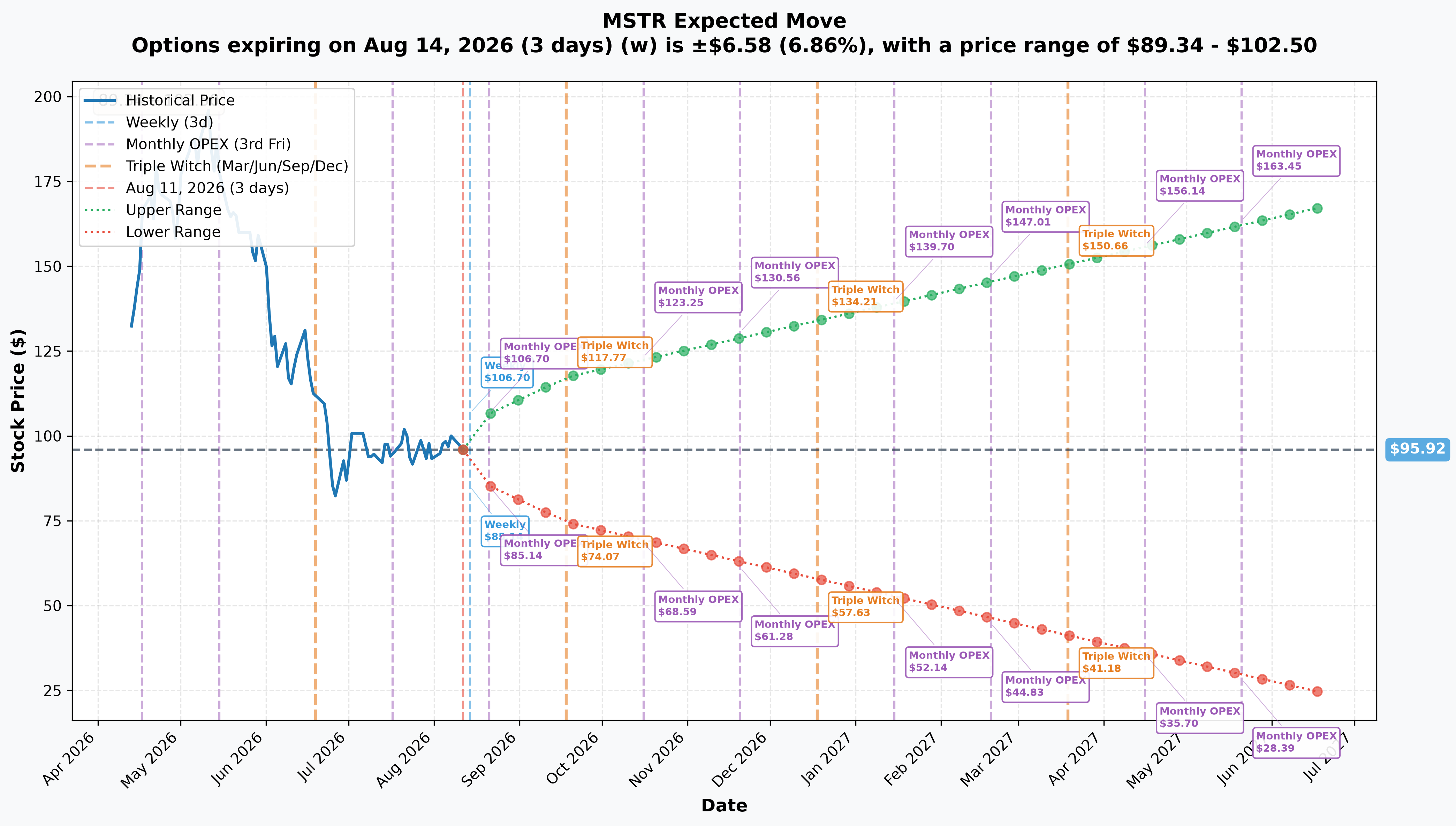
Options pricing (current price $95.92) implies the following ranges:
- Weekly (Aug 14, 3 DTE): ±6.86% → $89.34 to $102.50
- Monthly OPEX (Aug 21, 10 DTE — matches the August leg's expiration): ±11.24% → $85.14 to $106.70
- Quarterly triple witch (Sep 18, 38 DTE): ±22.39% → $74.44 to $117.40
- October OPEX (Oct 16, matches the October leg's expiration): implied range ≈$68.59 to $123.25
Both $95-strike calls sit inside their respective implied ranges near the low end of upside — meaning the market is pricing real odds of the stock reaching or exceeding $95 by both expirations, but it's not pricing a guaranteed breakout. A move to the $100 gamma wall by August 21 (+4.3%) is well within the implied ±11.2% monthly range; the October window's ±wide range (down to $68.59, up to $123.25) simply reflects that bitcoin — and therefore MSTR — can move a great deal in nine weeks.
🎪 Catalysts
🎯 Inside the August 21, 2026 expiration (≈10 calendar days) — genuinely catalyst-empty
There is no scheduled earnings report, index review, debt maturity, or convertible put date between now and August 21. The only dated company events in this window:
- Monday, August 17, 12:00 PM ET — a live investor Q&A with Michael Saylor and CEO Phong Le, streamed on X and YouTube with a replay on the investor-relations site, announced today. This is a headline-risk event, not a numbers event, but with the company mid-pivot on its bitcoin-sale program it could move the stock either direction.
- Monday, August 17 — the weekly 8-K disclosing the prior week's ATM raises, bitcoin buys/sells, and USD reserve balance, following the observed Monday filing cadence.
Everything else pressuring the August leg is simply bitcoin's spot price, every hour of every day. Anyone calling this leg "positioned into a catalyst" is mis-describing it.
🎯 Inside the October 16, 2026 expiration (≈9 weeks) — more news flow, still no earnings
- ≈8–9 more weekly 8-K disclosures tracking the pace of the $5 billion bitcoin monetization program.
- ≈September 1 and ≈October 1 — STRC preferred dividend-rate declarations, the cleanest public read on funding stress; the rate was held at 12% in August after a 50bp July hike.
- ≈September 8 — management's own target date for the STRC preferred to recover toward its $99–$100 par value, laid out on the Q2 2026 earnings call. Hitting it could ease pressure to sell more bitcoin; missing it extends the sell-BTC-to-fund-dividends loop.
- ≈Early October — announcement of the Q3 2026 earnings date (not the report itself).
- Any start of the $1.0 billion common stock buyback authorization — at a 0.69× mNAV discount, the single most accretive use of company cash on the table, and an untapped one as of this writing.
What does NOT fall inside the October window: Q3 2026 earnings are not yet scheduled, but on precedent they'd land in late October or early November — after the October 16 expiration. Neither the December 2026 Nasdaq-100 reconstitution review (MSTR currently ranks #97 of ≈101 by market cap) nor any convertible note maturity or put date (the earliest is September 15, 2027) falls inside this window either.
Bottom line on catalysts: both $95 calls are, first and last, a levered bet on the price of bitcoin, with the October leg buying additional weeks of monetization-pace and STRC-recovery news flow but stopping short of the next earnings print.
🎲 Price Targets & Probabilities
Using the gamma walls and implied-move ranges together:
- Base case: price gravitates toward the $95–$100 zone, where the heaviest options positioning (both the Very Strong $95 support and Very Strong $100 resistance) sits. This is also where both calendar legs are struck.
- Bull case: a break above $100 (the resistance wall, +4.3%) opens room toward $105–$110, which lines up near the top of the August monthly implied range ($106.70) and comfortably inside the October range ($123.25 upper bound).
- Bear case: a break below $95 risks a slide toward the $90 support wall (−6.2%), which carries negative net gamma — meaning dealer hedging flows could accelerate a move lower rather than cushion it. The October implied range's lower bound of $68.59 reflects how far bitcoin-driven downside could realistically stretch over nine weeks.
Sell-side consensus (15 analysts) is "Strong Buy" with an average target of $229.07, and even the lowest street target ($125, Barclays) sits ≈30% above spot — though six firms cut targets in the eleven days before this trade, most recently Mizuho to $165 from $213 on August 10. That dispersion is itself a statement about how much of MSTR's value is a leveraged call option on bitcoin's future price.
💡 Trading Ideas
🛡️ Conservative
Skip individual options here. If you want bitcoin-treasury exposure with a metered risk budget, a small MSTR common-stock position sized to withstand a 30–50% further drawdown (given 3.55 beta and an underwater BTC cost basis) is more forgiving than options on either leg of this trade — no expiration, no time decay eating the position while you wait for bitcoin to find a bottom.
⚖️ Balanced
If you want to express a view using the same $95 strike this flow used, the October 16 $95 call (≈$14.27, ≈9 weeks to expiration) gives more time for a bitcoin recovery to play out and avoids betting on the catalyst-empty August window. Consider defining risk with a vertical (buy $95C / sell a higher strike like $110C) rather than an outright long call, given how much extrinsic value you're paying for on a name this volatile.
🚀 Aggressive
The August 21 $95 call (≈$6.30, ≈10 days) is a short, cheap-in-dollar-terms, high-gamma bet that bitcoin holds or rises into the August 17 Saylor/Le Q&A and stays above $95 through expiration. This is a pure, undiversified bet on a single week of bitcoin price action with no scheduled fundamental catalyst behind it — size it as a lottery ticket, not a core position, and be prepared to lose the full premium.
👥 Four Ways to Read This Trade
YOLO trader
The August 21 $95 call (≈$6.30, ≈10 days to expiration) is what you'd reach for here, and you should know exactly what you're paying for: time you have no scheduled reason to need. There is no earnings report, no index decision, no debt event inside this window — just bitcoin's spot price and one webcast (the August 17 Saylor/Le Q&A). You are buying ≈$3.33 of pure extrinsic value on a 3.55-beta proxy for an asset that is already ≈50% off its high, betting that ten catalyst-free days move in your favor before theta and a flat tape eat the premium. That's a lottery ticket, not a thesis — size it like one and be fully prepared to watch it decay to zero.
Swing trader
Here's the honest answer, not the exciting one: we cannot even tell you which leg of this trade was bought and which was sold. The multi-leg floor engine tagged both the October and August legs BUY, which is not literally possible for a same-strike calendar — so there is no clean directional signal in this print to swing-trade off. Don't let anyone (including us) manufacture a bullish or bearish story out of an allocation the tape itself can't confirm. What you can trade is the level structure independent of this flow: $95 is the strongest gamma support on the board, $100 is the strongest resistance, and price has been oscillating in that band. Trade the range and the reaction to Monday's Q&A and 8-K, not a "someone bought $91M of calls" headline.
Premium collector
Flip the trade around: someone was on the other side of ≈$91M of same-strike calls today, whether that's a genuine short leg in a calendar or a dealer/counterparty absorbing this package. Selling calls on MSTR looks like an income trade on paper — $6.30 to $14.27 of premium per contract is real money — but the underlying is a levered bitcoin proxy that can move 10% or more in a single session on nothing more than a weekend bitcoin swing. A short $95 call here is short a huge amount of gamma sitting exactly at spot, in the single densest gamma strike on the chain. If you're collecting premium on MSTR, do it with defined risk (a call spread, not a naked short) and size for the tail, not the theta.
Beginner
The one number to understand before you touch this ticker: MSTR trades at ≈0.69× basic mNAV — the stock is worth about 69 cents for every dollar of bitcoin the company holds, once you back out what's owed to preferred and convertible-debt holders ahead of common shareholders. Buying MSTR is not the same as buying bitcoin. That discount exists because Strategy just flipped from bitcoin's biggest buyer to a disclosed seller, and it can get wider, not just narrower — there's no rule that says it has to close back to 1.0×. Before you buy a call option on top of an already-leveraged, already-discounted bitcoin proxy, make sure you understand that you're adding a second layer of leverage on top of a company-specific discount that has nothing to do with bitcoin's own price action.
⚠️ Risk Factors
Downside: Bitcoin at ≈$63,467 is ≈49.7% below its October 2025 peak and ≈16% below Strategy's own $75,385 average cost basis — with beta 3.55 and ≈$22B of senior claims (preferred + converts) ahead of the common, further bitcoin weakness hits MSTR hard. The 0.69× mNAV discount is self-reinforcing: issuing stock below that level destroys bitcoin-per-share rather than growing it, and the company is now a disclosed net bitcoin seller with an open-ended $5 billion sale program. Shares outstanding are up ≈24.6% year over year from ATM issuance, with ≈$23.5 billion of ATM capacity still authorized. Perpetual preferred dividends (≈$1.76B/year) never mature and must be paid in cash forever. MSTR also sits at rank #97 of ≈101 in the Nasdaq-100 by market cap — a real removal risk at the December 2026 reconstitution.
Upside: No convertible debt matures or can be put before September 15, 2027, and the company has built a ≈$4.65 billion USD reserve (management's own estimate: ≈2.1 years of dividend/interest coverage). A 0.69× mNAV is latent convexity if bitcoin recovers — the stock could re-rate on both bitcoin appreciation and multiple expansion back toward 1.0×. STRC (the swing-factor preferred) has already rebounded 24% off its June low. An untapped $1.0 billion common buyback would be a genuine accretive catalyst if activated.
What the tape cannot prove: We do not know, and are not asserting, which side of this package was bought and which was sold — the multi-leg floor engine's per-leg allocation is unreliable, and both legs printing as "BUY" is not literally possible for a same-strike calendar. We do not know the counterparty's identity, broker, or whether an offsetting stock or futures hedge exists off-tape. The August leg's open/close status is genuinely unresolved until next-day OI confirms it. Options trading, especially on a 3.5-beta bitcoin proxy, carries substantial risk of loss and may not be suitable for all investors — size every position, especially the short-dated leg here, as money you can afford to lose entirely.
🎯 The Bottom Line
Real talk: ≈$90.95M crossed the tape today in the same $95 strike across two MSTR expirations, as a negotiated floor block — not a lit sweep, not proof of bullish conviction, and not something we can confidently call a spread versus two outright longs. The October leg is a confirmed new position (prior OI was just 592); the August leg's open-or-close status won't be known until tomorrow's ≈06:30 ET OI update. What we know for certain is the setting this trade landed in: a stock trading at a 31% discount to the bitcoin it holds, run by a company that just flipped from buyer to seller of that bitcoin, with no earnings between now and either expiration. If you're trading around this, watch the $95/$100 gamma zone, watch bitcoin, and watch tomorrow's OI print before you assume you know which way this package was actually built.
This analysis is for informational purposes only and is not investment advice. Options trading involves substantial risk of loss and is not suitable for all investors.
Last updated: 2026-08-12 (pre-market) — the next-day OPRA open-interest snapshot resolved both legs. Oct-16 $95C 592 → 44,846 (+44,254 against a 44,215-lot print): OPEN, above the published 40,000–45,000 window. Aug-21 $95C 47,089 → 36,278 (−10,811): CLOSE — the provisional BTO label is retired. The structure is restated from a two-expiration same-strike package to a roll out in time, with the ≈$63.09M October leg as the only genuinely new money. The title, both order-type and strategy cells and the combined-exposure framing were updated; the ⏳ callout was replaced with the ✅ RESOLVED box.