🔄 PLTR $18.79M Roll: The October $170s Opened — but the August $140 Calls Changed Hands Instead of Retiring
📅 2026-08-11 | 🤝 Floor Block — Negotiated, Not a Sweep
🔄 Updated 2026-08-12 pre-market — the next-day OPRA open interest resolved both legs, with one clean answer and one honest non-answer. The October $170 calls opened (5,649 → 14,499, +8,850 against a 10,890-lot buy — 81% of size, a little under the ≈16,000+ we published). The August $140 leg is the surprise: open interest barely moved, 20,777 → 20,616 (−161), just 1.5% of the 10,890 printed. We leaned toward a close and said so as an inference, not proof — the print says the contracts did not retire, they transferred to another holder. The roll read still fits this desk, but it is now explicitly unproven on the closing leg. See the ✅ RESOLVED box.
A single desk crossed 10,890 contracts on each side of a long call roll in Palantir today — selling the deep in-the-money August 21 $140 calls and buying the October 16 $170 calls, both printed as one negotiated floor block. Net result: an ≈$18.79M credit collected up front. This is not a fresh bearish bet and it is not a credit spread — it is one position being moved from a strike/expiration that has stopped earning its keep into a new one.
🏢 Company Overview
Palantir Technologies Inc. (NASDAQ: PLTR) builds data-integration and decision software. Its three commercially material platforms are Gotham (defense, intelligence and operational awareness), Foundry (an enterprise "data operating system"), and AIP — the Artificial Intelligence Platform that layers large language models on top of a customer's governed data. Palantir also ships Apollo for continuous software deployment across cloud, on-prem, and classified environments, per its company profile.
- Market capitalization: ≈$418.9B (key statistics)
- Sector / Industry: Technology / Software — Infrastructure; a member of both the S&P 500 and Nasdaq-100
- Q2 2026 revenue: $1.935B, +93% year over year, beating consensus of $1.81B — per the August 3, 2026 release
- Price action context: the stock gapped +29.45% to $162.66 on August 4 after that print, ran to a $175.23 close on August 10, and closed $174.26 on August 11 — but is still ≈−1.8% YTD, sitting ≈15.7% below its November 2025 all-time high of $207.52 (daily history; quote page)
💰 The Trade, in Plain English
At 11:32:47 ET, one package printed: sell 10,890 August 21 $140 calls at $35.10 (≈$38.22M) and buy 10,890 October 16 $170 calls at $17.85 (≈$19.44M). That's a roll up and out — the same holder is closing a position that has almost nothing left to gain from, and re-establishing exposure further out in time and higher in strike. The package collected an ≈$18.79M net credit.
Both legs printed as a 🤝 floor block — a broker-negotiated trade worked on the exchange floor with a known counterparty on the other side, not an aggressive lit-market sweep. No urgency signal here; this reads as a position adjustment, not a chase.
| Field | Leg 1 (closing) | Leg 2 (opening) |
|---|---|---|
| Time | 11:32:47 ET | 11:32:47 ET |
| Buy/Sell | SELL | BUY |
| Call/Put | CALL | CALL |
| Expiration | 2026-08-21 | 2026-10-16 |
| Premium | $38,223,900 (≈$38.22M) | $19,438,650 (≈$19.44M) |
| Strike | $140 | $170 |
| Volume | 11,000 | 11,000 |
| Prior OI | 20,777 | 5,649 |
| Size | 10,890 | 10,890 |
| Spot | $174.94 | $174.94 |
| Option Price | $35.10 | $17.85 |
| Option Symbol | PLTR20260821C140 | PLTR20261016C170 |
| Order Type | ⚠️ STC — unproven (resolved 2026-08-12: OI 20,777 → 20,616, a transfer, not a retirement) | ✅ BTO (open confirmed: 5,649 → 14,499) |
| Strategy | Long Call Roll Up & Out (140 → 170) | Long Call Roll Up & Out (140 → 170) |
| Mechanism | 🤝 Floor block (negotiated) | 🤝 Floor block (negotiated) |
Net premium: ≈$18.79M credit collected.
✅ RESOLVED — The October Open Is Confirmed; the August "Close" Was a Transfer
Updated 2026-08-12 pre-market. Resolving OPRA snapshot timestamped August 12 (reflects the August 11 close, after this print); baseline is the August 11 snapshot (reflects the August 10 close, before this print).
| Leg | Baseline (Aug-11) | Resolving (Aug-12) | Δ | Print size | What we published | Verdict |
|---|---|---|---|---|---|---|
| Oct-16 $170 call (bought) | 5,649 | 14,499 | +8,850 | 10,890 | "rise toward ≈16,000+, though some could be transfer" | ✅ OPEN (BTO) — 81% of size |
| Aug-21 $140 call (sold) | 20,777 | 20,616 | −161 | 10,890 | "fall by up to 10,890 if a close; rise if a fresh short" | ⚠️ TRANSFER — neither branch |
The October leg opened, at 81% of the print. Open interest rose 8,850 against 10,890 bought, landing under our ≈16,000+ figure — exactly the transfer effect we warned about, where roughly 2,040 contracts matched against existing holders rather than creating new ones. The new long position is real: ≈14,500 October $170 calls outstanding, up from 5,649.
The August leg did neither thing we described. We published two branches — a fall of up to 10,890 for a close, a rise for a fresh short — and leaned toward close on the strength of a two-week open-interest downtrend. Open interest moved 161 contracts. That is 1.5% of the print and inside ordinary daily drift. Ten thousand eight hundred and ninety August $140 calls changed hands and the open interest stayed put, which means the buyer on the other side was opening as the seller was closing: the contracts moved to a new owner rather than being extinguished.
Why we are not calling this a proven close. For this specific desk, selling out of a long is entirely consistent with what the tape shows, and the roll framing below — cash the deep-in-the-money August calls, fund the October $170s — remains the most natural reading of a same-timestamp paired print. But open interest cannot confirm it, because a transfer looks identical to a close from the desk's side and identical to an open from the counterparty's side. Our published lean toward a close was an inference and it stays an inference. The correct label on that leg is STC (unproven — transferred, not retired).
What this means for readers. One thing genuinely changes: the market's August $140 call position was not reduced. If you were reading the roll as "the crowded August $140 line is emptying out ahead of expiration," that is not what happened — 20,616 contracts are still outstanding at that strike with ten days to run, essentially unchanged. The long exposure moved to a different owner, not off the board.
🤓 What This Actually Means — Plain English
Start with the number that actually tells the story: $0.16. With PLTR at $174.94, the August $140 call is $34.94 in the money. It sold for $35.10 — just $0.16 of time value on a $35 option. That's the tell. This option had stopped behaving like an option; it was trading like 100 shares of stock with almost no optionality left. Selling it is not a bearish signal — it's cashing in a position that has already done its job, ten days before it expires worthless of extrinsic value anyway.
What replaces it: 10,890 October 16 $170 calls, bought for $17.85 each — about $12.91 of that is time value (spot minus strike is only $4.94 of intrinsic). So the trader used part of the $38.22M cashed out of the old position to buy back real optionality — a call that's much closer to the money, with roughly two extra months on the clock. Net, $18.79M came off the table as cash, while the position stays long PLTR calls, just at a higher strike and later date.
The calendar detail that matters most: the October 16 expiration does not contain Palantir's next earnings report. Q2 2026 already reported on August 3 — that's behind the old August 21 leg entirely, which is one reason that strike had nothing left to earn. Q3 2026 is estimated for ≈November 2, 2026, roughly 2.5 weeks after the new October 16 expiration — and that date is not company-confirmed; MarketBeat labels it "Estimated (not yet confirmed)." So this roll buys time and moves the strike up, but it deliberately (or coincidentally) skips the next earnings print. What the October window does capture is the U.S. federal fiscal year start (≈October 1) and the pending FY2027 appropriations decision — relevant given Palantir's government revenue exposure — but not the single highest-magnitude scheduled catalyst on the board.
For context, we also flagged a similar-shaped roll on 2026-08-07 — September $155 calls sold, December $175 calls bought. That December leg does span the estimated Q3 date; today's October leg does not. We're noting this as prior coverage, not as evidence of a pattern — two data points over three sessions isn't a trend, and we have no public source confirming these are related positions or the same counterparty.
📈 Chart Check-Up
1-Year Price Context
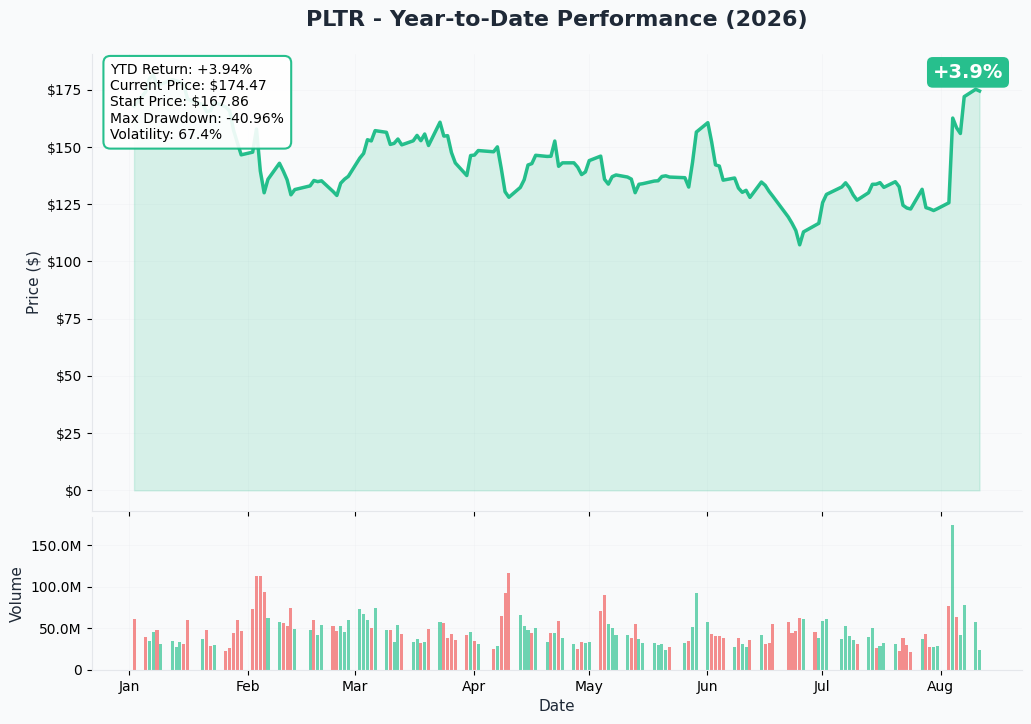
PLTR is still digesting an extraordinary run: from an all-time high of $207.52 in November 2025, down to a 52-week low of $106.37, back up through a violent post-earnings re-rating (+29.45% on August 4 alone) to $174.26 by August 11 — a stock that is simultaneously up ≈64% from its low and still down ≈1.8% for the year.
Gamma Support & Resistance
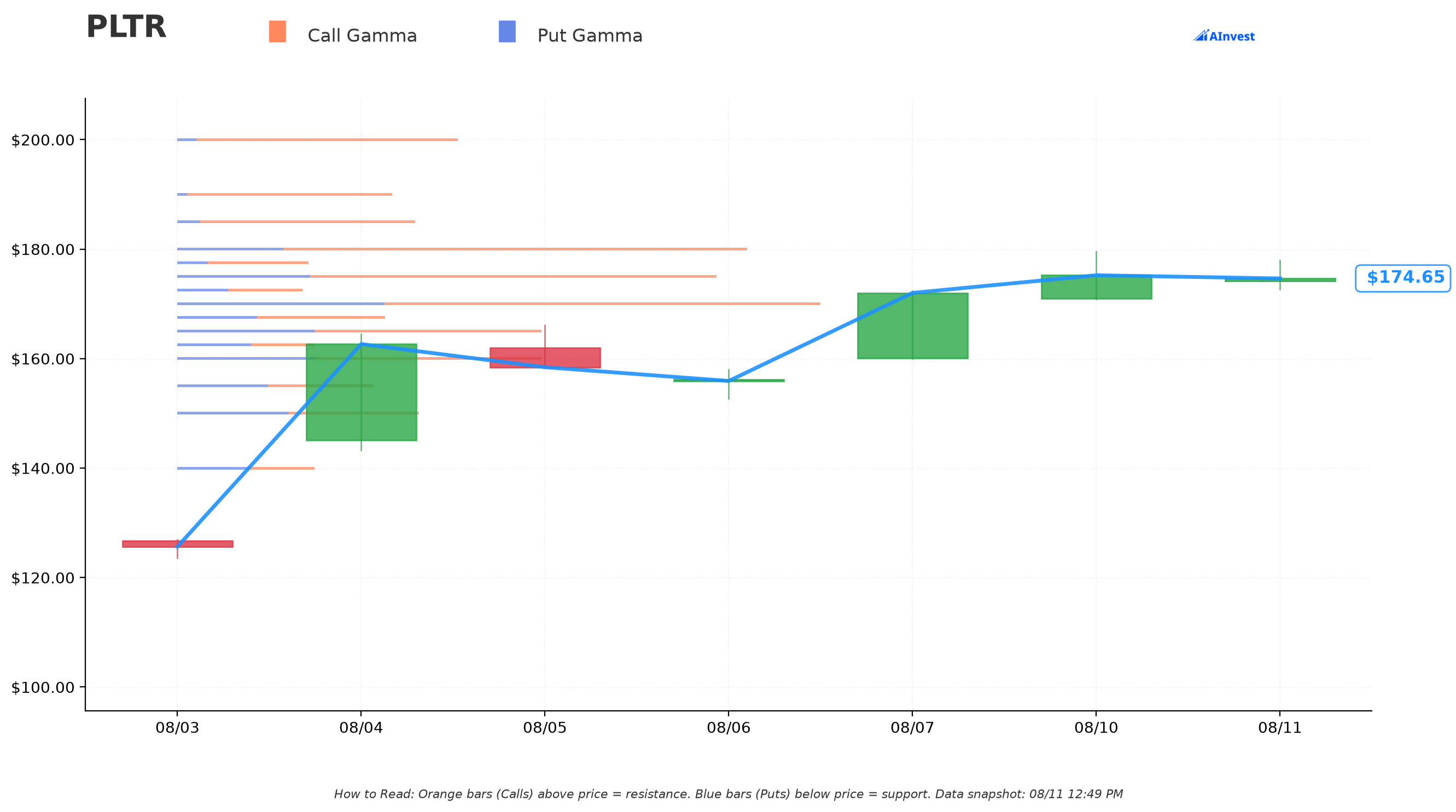
As of this snapshot, PLTR sits near $174.62. The gamma map shows:
- 🔵 Support: $170 is the strongest support wall on the board (Very Strong, ≈2.6% below spot) — notably the exact strike the new October call just bought into. Behind that, $167.50 and $165 (both Very Strong).
- 🟠 Resistance: $175 sits almost exactly at spot (≈0.2% away, Very Strong) — the market is pinned right against it — with $180 as the next major resistance wall (Very Strong, ≈3.1% away), then $185.
- Notably, $140 — the strike just sold — still shows up as a real (if more distant) support wall ≈19.8% below spot, another sign that strike had drifted deep into "stock substitute" territory rather than an actively contested level.
These levels are dynamic and shift daily as dealers rebalance; they describe where options positioning currently creates hedging flows, not a guarantee of price behavior.
Implied Move
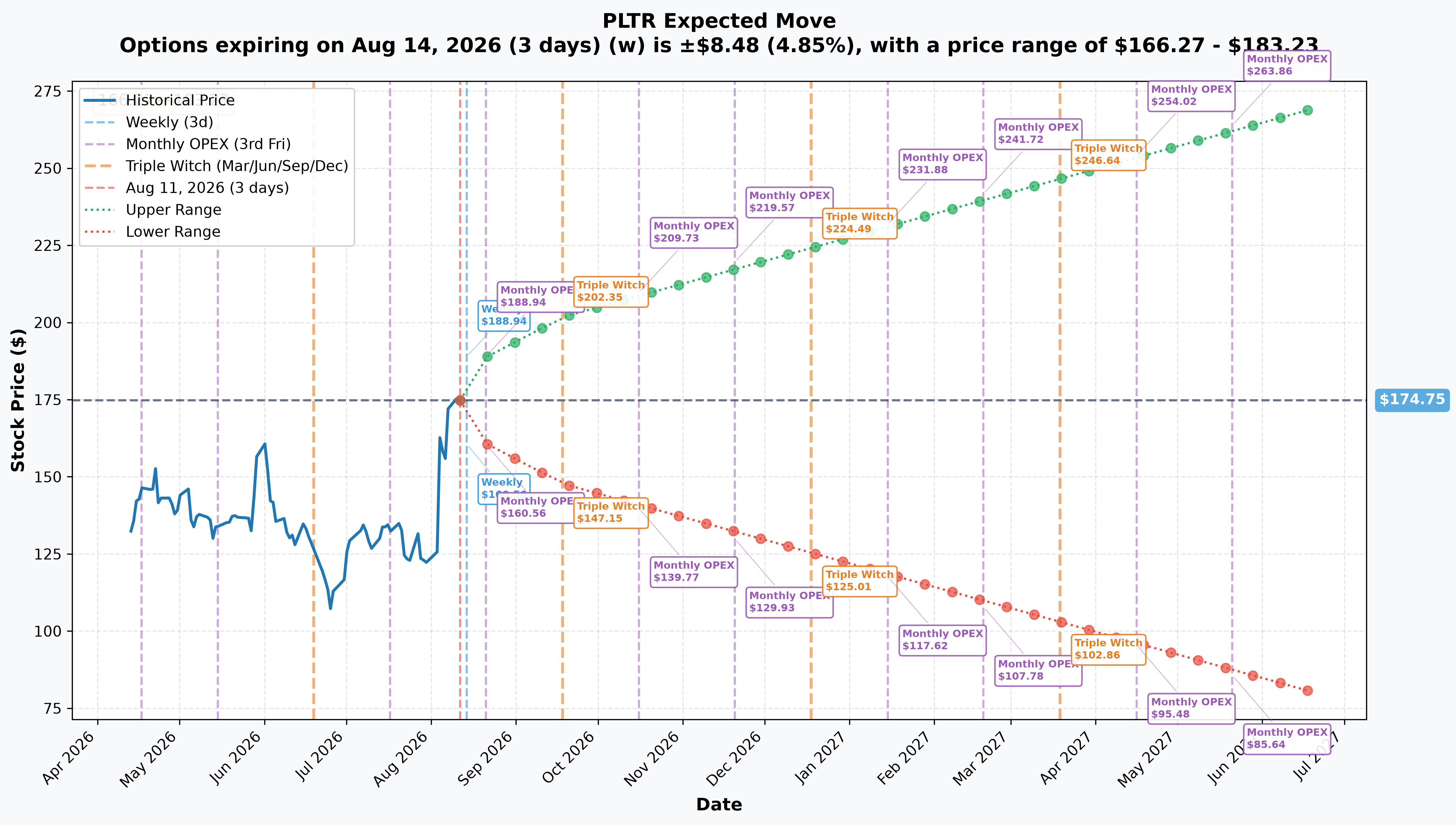
From the options market's own pricing:
| Expiration | Days Out | Implied Move | Range |
|---|---|---|---|
| Weekly (Aug 14) | 3 | ≈4.9% | $166.27 – $183.23 |
| Monthly OPEX (Aug 21 — the closed leg) | 10 | ≈8.1% | $160.56 – $188.94 |
| Triple Witch (Sep 18) | 38 | ≈15.5% | $147.64 – $201.86 |
| Monthly OPEX (Oct 16 — the new leg) | ≈66 | — | $139.77 – $209.73 |
| Yearly LEAPS (Jun 2027) | 310 | ≈53.8% | $80.72 – $268.78 |
The new October $170 call sits comfortably inside that implied range — it's a near-the-money bet on continued drift and momentum persistence, not a bet requiring an outsized move to pay off.
🎪 Catalysts
Already Happened
- August 3, 2026 — Q2 2026 earnings (after the close). Revenue $1.94B vs. $1.81B consensus (+93% YoY); EPS $0.41 vs. $0.3446. U.S. commercial revenue +149% YoY to $764M; Rule of 40 score of 155%; GAAP net income margin 55%. FY2026 revenue guidance raised to $8.150B–$8.158B from a prior $7.66B — per the release. This is entirely behind the August 21 expiration — it is the reason that leg had nothing left to earn.
- August 4–10, 2026 — the re-rating. +29.45% on August 4, +10.32% on August 7, +1.87% on August 10 — daily history. Volume has since collapsed from 174.6M shares on the gap day to 23.4M by August 11, signaling the post-earnings momentum window is closing.
- August 4, 2026 — the sell side fractured. Fourteen firms acted the same day: Deutsche Bank upgraded Hold → Buy ($200 target); Citigroup and Oppenheimer both downgraded; Jefferies reiterated Underperform with an $80 target — per MarketBeat's price-target log. Current average targets cluster $190–$199 across sources, with the $80-to-$255 spread one of the widest on any mega-cap (stockanalysis.com forecast).
Ahead — Inside the New October 16 Window
- ≈October 1, 2026 — U.S. federal FY2027 begins. The House approved a $1T defense bill on June 24, 2026 matching the Pentagon's request, but enactment timing beyond committee approval was not confirmed in available sourcing — per Breaking Defense. A continuing resolution around this date would be relevant given Palantir's $809M-a-quarter U.S. government revenue.
- ≈Mid-October 2026 — Q3 earnings-date announcement (scheduling only), estimated by the same three-week-lead pattern that preceded the August 3 print — precedent.
- August 12, 2026 — U.S. CPI print, flagged as a macro mover for high-multiple names like PLTR — feed.
Ahead — Outside the October 16 Window
- ≈November 2, 2026 (after the close) — Q3 2026 earnings, ESTIMATED, NOT CONFIRMED. MarketBeat's earnings page labels the next report "Estimated (not yet confirmed)" with no date attached — source. This estimate is derived purely from Palantir's own first-Monday-after-quarter-end cadence (Feb 2, May 4, Aug 3, 2026). This is the single highest-impact scheduled event on the board — the last print alone moved the stock +29.45% in one session — and it sits ≈2.5 weeks past the October 16 expiration the new call just bought.
- ≈February 1, 2027 — Q4/FY2026 earnings and first FY2027 guide, ESTIMATED.
Bottom line on timing: neither expiration in this roll owns the earnings print. The August 21 leg had already lived through it; the October 16 leg expires before the next one. Whoever holds this position is trading momentum and the federal-budget decision point, not an earnings event.
👥 Four Ways to Read This
🎰 YOLO Trader
There's nothing here to chase directly — this was a negotiated floor block, not a sweep you can piggyback on with size. If you want the same structural bet, the $170 October calls cost $17.85 with the stock at $174.94 — that's real premium at risk on a name that just had a 29% one-day gap in it, so size down hard relative to a normal position. Remember: this trade is explicitly not an earnings bet — the catalyst you'd actually want (Q3, ≈November 2) isn't inside this expiration.
📊 Swing Trader
The gamma map gives you levels to work with regardless of this specific trade: $175 is resistance sitting almost exactly at spot, and $170 is the strongest support on the board — coincidentally the same strike this roll just bought calls at. A close above $175 with volume would be the tell that dealer hedging starts working in the bulls' favor toward $180. A break below $170 undercuts both the gamma support and the new call's strike.
💵 Premium Collector
This roll is a useful template, not a signal to copy blindly. The mechanics — selling a deep-ITM option once its extrinsic value has decayed to pennies, and redeploying into a longer-dated, closer-to-the-money strike — is a legitimate way to harvest time decay while staying long. If you're running covered calls or cash-secured puts on PLTR, the lesson is the same: don't let a winning call sit at $0.16 of extrinsic value for ten days when you can roll it for real premium further out.
🌱 Beginner
Two things happened at once here, and together they're called a roll: (1) someone sold calls that were deep in the money and about to expire, collecting a big check because those calls were basically worth their intrinsic value; (2) they immediately used part of that cash to buy new calls at a higher strike price, further out in time. Net, they took $18.79M in cash off the table while staying invested in PLTR calls — just repositioned. It is not the same as a bearish bet, and it is not the same as a "credit spread" (which is a different structure entirely, usually opened as one trade at one expiration).
⚠️ Honest Limits — What the Tape Cannot Prove
- We cannot prove the August $140 call sale was a close. Size (10,890) is below prior open interest (20,777). The declining two-week OI trend and the near-zero extrinsic value both point toward a close, but that is an inference — only tomorrow's ≈06:30 ET OI snapshot resolves it definitively.
- We cannot see the counterparty, broker, or customer identity on either side of this floor-negotiated block — only that it was arranged off the open book with a known counterparty.
- We do not know if this position is the trader's entire PLTR options book or one clip of a larger, ongoing position. The 10,890-lot size is what printed; it may not represent full exposure.
- The August 7 roll we referenced is our own prior tape coverage, not a documented market pattern. No public source confirms these two rolls are connected, share a counterparty, or represent a recurring strategy. Two data points across three sessions is not a trend.
- The Q3 2026 earnings date (≈November 2) is an estimate derived from cadence, not a company-confirmed date. If Palantir reports earlier than its established pattern, the October 16 expiration could still capture the print — treat "no earnings inside October" as high-confidence, not certain.
Options trading involves substantial risk, including the potential loss of the entire premium paid, and may not be suitable for all investors. This analysis is informational and does not constitute a recommendation to buy or sell any security or derivative.
Last updated: 2026-08-12 (pre-market) — the next-day OPRA open-interest snapshot resolved both legs. Oct-16 $170C 5,649 → 14,499 (+8,850 against a 10,890-lot buy): OPEN (BTO), 81% of size and under the published ≈16,000+ because ≈2,040 contracts matched against existing holders. Aug-21 $140C 20,777 → 20,616 (−161): neither branch — the contracts transferred to a new owner rather than retiring, so the published lean toward a close stays an inference and the leg is labelled STC (unproven). The market's August $140 position was not reduced. The title, the order-type cells and the "the August line is emptying out" framing were updated; the ⏳ callout was replaced with the ✅ RESOLVED box.