⚡ POWL Someone Collected $7.3M Selling a Call That's Barely Above Spot — Hours Before Confirmed Earnings
📅 August 3, 2026 | 🔥 Unusual Activity Detected
✅ UPDATE — August 4, 2026 pre-market: confirmed an opening call sale. Open interest on the Feb-2027 $220 call rose 829 → 2,922 (+2,093) against a 1,400-lot print — ≈150%, meaning our block plus other sellers all opened. See the ✅ RESOLVED box.
🎯 The Quick Take
A trader sold 1,400 Feb-19-2027 $220 calls on Powell Industries at 10:50:12 ET for $52.40 each, collecting $7.34M in premium — on a strike that sits only ≈3.1% above the $213.34 spot price at the time. That's ≈24.6% of the stock's own price collected just for agreeing to sell shares nearly 6.5 months from now, and it printed hours before Powell reports fiscal Q3 earnings tonight, after the close — a date the company itself confirmed on July 20. We can prove this opened at least in part (size beat prior open interest); we canNOT prove from the tape whether the seller owns the stock (a covered call) or is selling that volatility naked — and the difference matters enormously for how risky this position actually is.
🏢 Company Overview
Powell Industries (POWL) designs, manufactures, and services custom-engineered electrical equipment — integrated power-control room substations, custom-engineered modules and electrical houses, distribution switchgear, medium-voltage circuit breakers, and monitoring/control systems — the essential gear that routes and protects high-voltage power for utilities, oil & gas and LNG facilities, pipelines, refineries, light rail, and increasingly, data centers (stockanalysis.com). Founded in 1947 and headquartered in Houston, Texas, with about 3,143 employees (stockanalysis.com).
- Sector: Industrials — Electrical Equipment & Parts
- Exchange: NASDAQ
- Market cap: ≈$7.83 billion (MarketBeat · stockanalysis.com)
- Spot at trade time: $213.34 (intraday levels ≈$212–$215 today)
- 52-week range: $69.00 – $328.00 (MarketBeat)
- Balance sheet: $544.89M cash vs. just $1.96M debt — effectively debt-free (stockanalysis.com)
- YTD performance: has roughly doubled this year — vendor figures range from ≈83% to ≈101% depending on how each handles the April 2026 3-for-1 stock split's December-31-2025 baseline, so treat any single precise percentage with caution (MarketBeat chart).
- Trailing P/E: ≈42.0x; forward P/E ≈37.0x (stockanalysis.com)
- Average volume: ≈771,000 shares/day — a mid-cap tape, not a mega-cap one (stockanalysis.com)
Powell has become a small/mid-cap AI/data-center darling this year on the back of a rapidly accelerating order book tied to hyperscaler electrical infrastructure buildouts — which is exactly why the option premium on this name is so rich.
💰 The Option Flow Breakdown
📊 What Just Happened
| Time | Symbol | Buy/Sell | Call/Put | Expiration | Strike | Option Price | Premium | Volume (day) | Size (this print) | Prior OI | Spot | Option Symbol |
|---|---|---|---|---|---|---|---|---|---|---|---|---|
| 10:50:12 ET | POWL | SELL | CALL $220 | 2027-02-19 | $220 | $52.40 | $7,336,000 | 2,109 | 1,400 | 829 | $213.34 | POWL20270219C220 |
Flow type: 🤝 Price-Improvement Auction (single-leg — not a negotiated cross, not a lit sweep)
Reconciliation note: the contract traded 2,109 total contracts today, but the block this analysis covers is the single 1,400-lot print at 10:50:12 for $52.40 — the dominant, size-defining trade of the day. The rest of the day's volume was smaller clips and isn't part of this structure.
This traded on a price-improvement auction — a facilitated mechanism where the order was exposed to the market for a brief window to get a better fill, then matched. It is not a pre-negotiated block cross with a known counterparty, and it is not an aggressive lit sweep that tore through the order book. Think of it as "the exchange found this order the best price it could, quickly" — negotiated-style execution, not urgent aggression, but also not a handshake deal between two known parties.
✅ RESOLVED — Next-Day OI Is In (August 4, 2026 pre-market)
The OPRA open-interest snapshot timestamped August 4, 2026 ≈06:30 ET reflects the close of business August 3 — the definitive open-vs-close test we flagged when this published. Here is what it says.
| Leg | Baseline OI (Aug-3 snap) | Resolving OI (Aug-4 snap) | Δ | Print size | Δ as % of print | Verdict |
|---|---|---|---|---|---|---|
| Feb-19-2027 $220 call (sold) | 829 | 2,922 | +2,093 | 1,400 | ≈149.5% | ✅ OPEN (STO) |
Verdict: STO confirmed — a fresh short call, sold hours before earnings. Open interest rose by more than the flagged print, so the block opened and additional sellers opened alongside it. Nobody was closing. This sharpens the risk framing published August 3: the $7.3M collected is premium for a newly created obligation that sits barely above spot and runs through February 2027, with an earnings event immediately in front of it. A seller who was merely closing an old position would carry no such risk; this one does.
🤓 What This Actually Means — Plain English
The mechanics: someone got paid $7.34M to promise they'll sell 140,000 shares of POWL at $220 anytime between now and February 19, 2027.
This is a Sold-To-Open (STO) single-leg call sale — the seller collected premium up front in exchange for taking on an obligation, not a right. Whoever did this wants time to pass and POWL to stay below $220 — or at least below the effective exit price — through next February.
The number that jumps off the page is the premium ratio. $52.40 collected on a $213 stock is ≈24.6% of the entire share price for an option barely 3% out of the money. Back-solving the standard at-the-money approximation implies implied volatility of roughly 80–85% — an enormous number for an industrial name, but an earned one: POWL closed at $309.20 on June 25, 2026, fell ≈39.7% in five weeks to $186.39 by July 29, then snapped back +12.3% in a single session on July 30. That is genuinely wild realized volatility, and the option market is pricing the future to look like the recent past.
Break-even math for the seller (strike + premium — the standard definition):
- Keeps the full $52.40 if POWL is anywhere below $220 at expiration.
- Starts giving back money above $220, and doesn't actually lose money until POWL is above $272.40 ($220 strike + $52.40 premium collected) — that's ≈28% above today's spot.
- Above $272.40, losses are theoretically unlimited if this is a naked short call (no offsetting long stock). If it's a covered call, the "loss" is really just capped upside on shares the seller already owns.
Two comparisons put that $272.40 line in context. POWL closed at $309.20 just six weeks ago (June 25) — about 13.5% above this break-even — and the average analyst target from the four-analyst S&P Global consensus sits at $316.25 (stockanalysis.com forecast), also comfortably above it. In other words, the seller isn't just fading a calm stock — they're fading a level the tape visited six weeks ago and a level the thin sell-side coverage still expects to reach. (A separate, lower $236.67 average target circulates elsewhere, but that figure is dragged down by a stale $116.67 low that is almost certainly a pre-split target left mechanically un-adjusted — the S&P Global figure is the cleaner read.)
Covered or naked — we genuinely cannot tell, and that distinction changes everything:
- If covered (the seller owns ≈140,000 shares or more), this is a classic "I've roughly doubled my money this year, I'm happy to sell it at $272.40 effective, and I'll bank $7.34M either way" trade. Rational profit-taking after a monster run.
- If naked, this is someone explicitly betting POWL doesn't rally another ≈28% from here through next February — a pure short-volatility bet with open-ended risk, made riskier by ≈6.6% short interest and roughly 3 days-to-cover on this name. A short base that size, on a ≈771,000-share average tape, is the exact setup that produced July 30's +12.3% squeeze day — and a strong number tonight could do it again.
The OPRA tape shows us the option print and its NBBO — it does not show us the seller's stock position, their broker, or their identity. This is graded INFERRED, not proven, in either direction.
The timing is the other half of the story. This traded at 10:50 AM ET — and Powell reports fiscal Q3 2026 earnings tonight, after the close, CONFIRMED by the company on July 20, with the conference call tomorrow morning at 11:00 a.m. ET (StockTitan). Selling a $52 call hours before a confirmed earnings release is either supreme confidence that even a strong beat can't clear a ≈28%-above-spot bar by next February, or a case of "I want this hedge/income on the books before the number drops, no matter what it says."
📈 Technical Setup / Chart Check-Up
YTD Chart
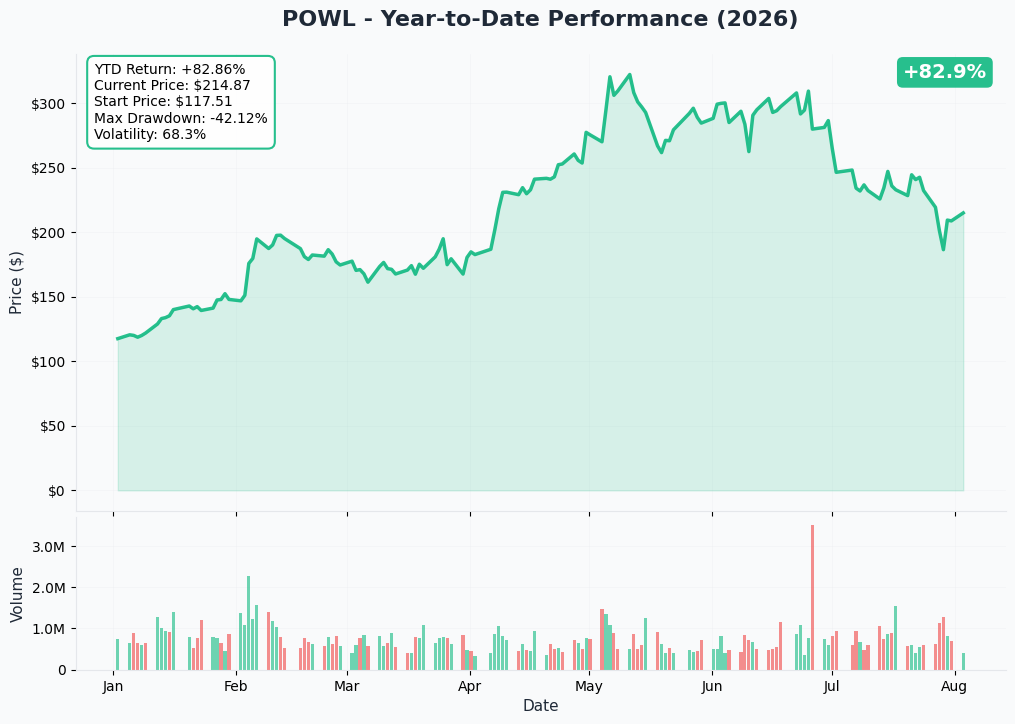
POWL has roughly doubled this year (exact YTD figures vary by vendor because of the April 2026 3-for-1 split baseline — see the company overview note above), but the path was anything but a straight line: a peak close of $309.20 on June 25, a brutal ≈39.7% slide to $186.39 by July 29 with zero company press releases in that entire stretch (May 7 – July 20) — a pure sentiment de-rating, not a fundamental one — and then a sharp +12.3% single-day recovery on July 30. That two-sided violence is exactly why options here carry such a rich premium, and it's the backdrop this call seller is writing against just hours before tonight's number.
Gamma-Based Support & Resistance
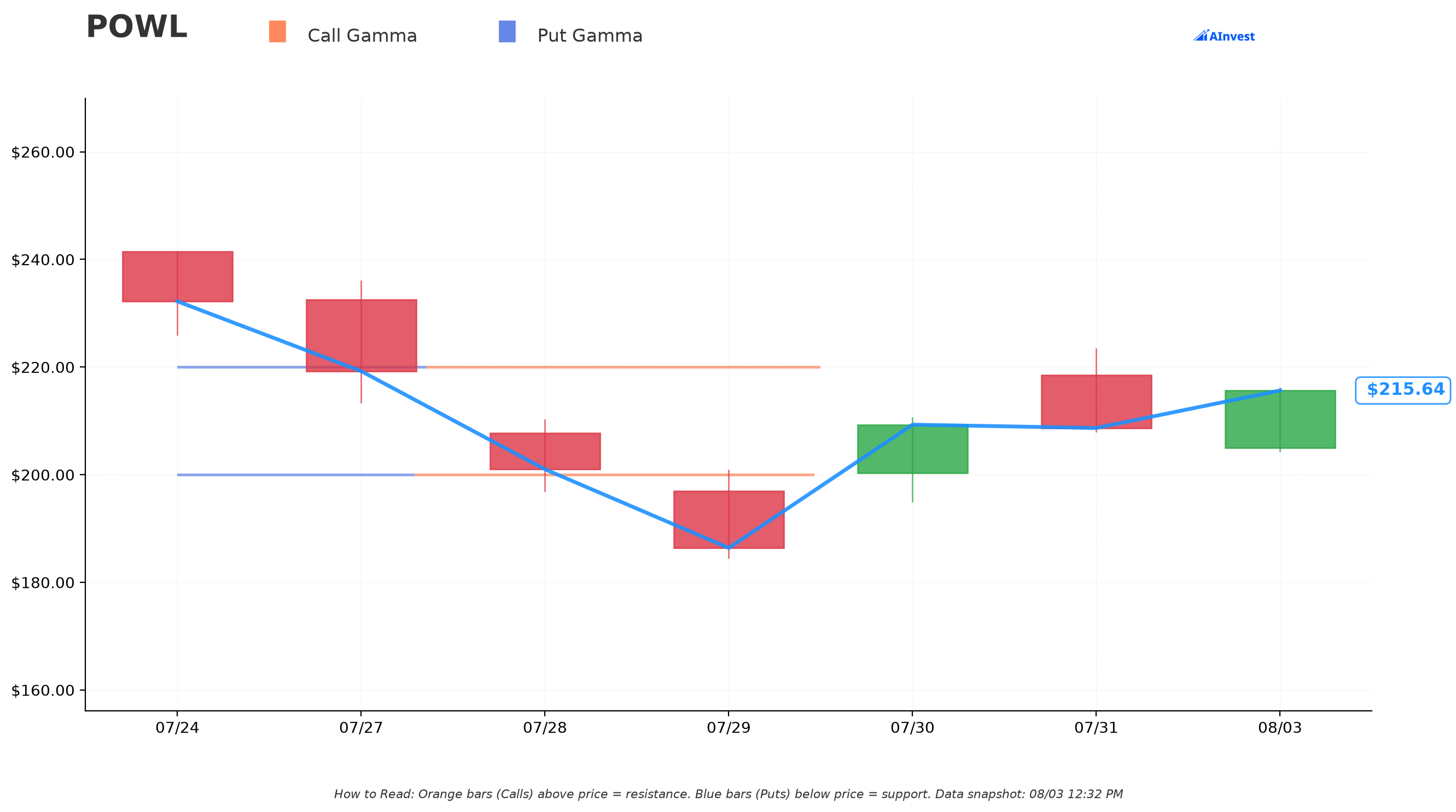
Honesty check: POWL's gamma map is thin, and that's a signal, not an oversight. The underlying gamma data (gex.json) returned open interest at only two strikes total — $200 and $220 — with no computed support levels, resistance levels, or gamma walls (all three came back empty). That lines up with what we independently know about this name's liquidity: average volume is only ≈771,000 shares/day on a $7.83B cap, and option coverage/open interest is correspondingly sparse.
What little gamma data exists:
- $200 strike (≈7.2% below spot): small net-call-gamma tilt (call gamma slightly exceeds put gamma).
- $220 strike (≈2.1% above spot — the strike in this trade): similarly modest net-call tilt.
Two data points do not make a support/resistance map. Treat this as "no reliable gamma floor or ceiling identified" rather than reading false confidence into two thin numbers. For a name this size, that's also a direct warning to retail traders: a chain this sparse usually means wide bid-ask spreads. Trying to replicate a trade like this — or even just buying a single call or put — could mean giving up a meaningful chunk of edge just crossing the spread, especially ≈200 days out in a February 2027 series.
Implied Move
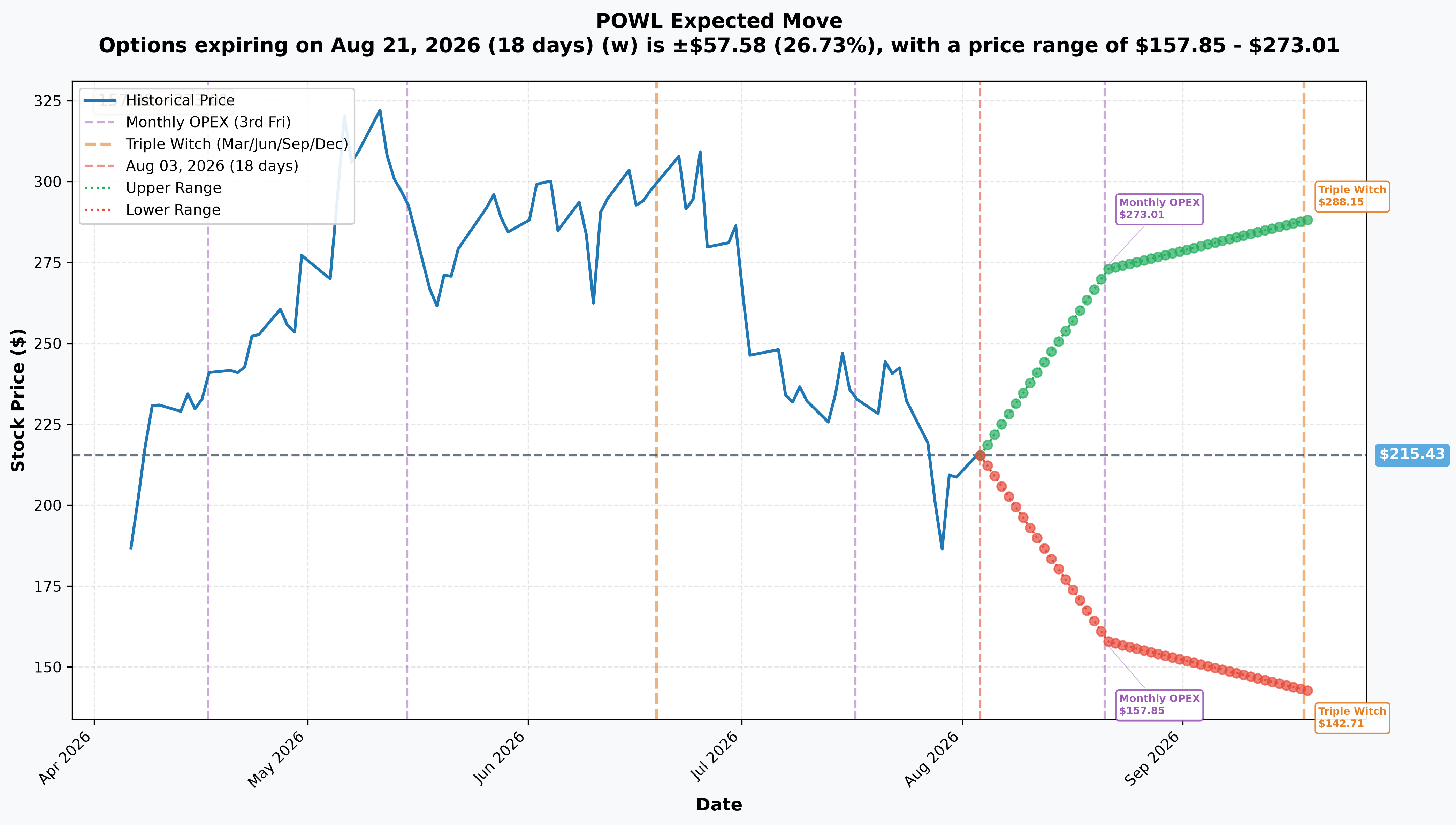
The options market is pricing serious movement around POWL's earnings:
- Monthly OPEX (2026-08-21, 18 days out): implied move ±26.73% (±$57.58), putting the expected range at $157.85 – $273.01.
- Quarterly triple witch (2026-09-18, 46 days out): implied move ±33.76% (±$72.72), range $142.71 – $288.15.
Notice the coincidence: the monthly OPEX upper bound of $273.01 lands almost exactly on this trade's $272.40 break-even. The options market's own implied range for the next three weeks already brackets the exact point where this call seller starts losing money — meaning the seller is essentially betting the stock stays inside (or below the upper edge of) what the market itself considers a "normal" move window, even through tonight's earnings.
🎪 Catalysts
🔜 Upcoming — and the earnings calendar is the whole story here
- Fiscal Q3 2026 earnings — CONFIRMED, tonight, August 3, 2026, after the market close, conference call tomorrow, August 4, at 11:00 a.m. ET, announced by the company on July 20 (StockTitan). Some trackers still label this date "estimated" — that label is stale; treat it as confirmed.
- What to watch tonight: whether backlog (last reported at $1.8B) lands near $2.0–2.2B now that the >$400M data-center megaproject (booked after the March quarter) should finally show up in it; whether book-to-bill holds above ≈1.2x after 1.75x and 1.65x the prior two quarters; whether gross margin clears 30.70% (last year's Q3 print) to show YoY expansion after Q2's slight margin dip; and EPS against a roughly $1.48–$1.52 derived bar (no published Q3-specific consensus was retrievable — this is arithmetic from the annual estimate, not an official number).
- This is the FIRST of THREE earnings prints inside the Feb-19-2027 expiry — not two. Powell's cadence is Q1 in early February, Q2 in early May, Q3 in early August, Q4/full-year in mid-to-late November:
- Tonight — Q3 FY2026 (✅ confirmed).
- ≈mid-November 2026 — Q4 + full-year FY2026 (expected by pattern; last year's Q4 landed November 18) — historically Powell's highest-margin quarter and the natural moment for a first look at FY2027 guidance.
- ≈early February 2027 — Q1 FY2027 (expected by pattern; prior years landed February 3 and February 6) — this print lands only ≈2 weeks before the February 19 expiry, leaving almost no time for a post-earnings gap to decay before the option settles. That's a real, specific risk for whoever is short this call — not a hypothetical one.
- Consensus already models FY2027 revenue of $1.43B (+19%) and EPS of $6.87 (+25%) — a meaningful acceleration from FY2026's roughly +8% revenue growth. If the backlog converts on schedule, that's the bull case; if it doesn't, the ≈37x forward multiple has little support (stockanalysis.com forecast).
✅ Already Happened
- Q2 FY2026 results (May 4, 2026): revenue $296.6M (+6% YoY, a slight miss vs. $298.12M consensus), EPS $1.25 — a miss versus the $1.34 consensus, gross margin 29.65% (down ≈29 bps YoY) — but new orders of $490M (+97% YoY) and backlog surging to $1.8 billion (+33% YoY) (StockTitan). Book-to-bill for the quarter was 1.65x, following 1.75x in Q1 FY2026 — both sharply above the ≈1.09x book-to-bill for all of FY2025. Powell is winning far more work than it's currently converting into reported earnings, and that divergence is the single question tonight's print speaks to.
- Post-quarter data-center win: Powell disclosed a >$400 million "mega data center" order received after the Q2 quarter closed — a single order worth more than 33% of a full year of FY2026 consensus revenue (≈$1.20B) (StockTitan). Tonight is the first quarter this order would show up in reported backlog — a real catalyst, not old news.
- Q1 FY2026 results (February 3, 2026): revenue $251.2M, backlog $1.6 billion, cash/short-term investments of $501M (StockTitan).
- 3-for-1 stock split, effective April 2, 2026 — improved retail accessibility and optionability, but also a classic late-cycle sentiment marker, and the reason per-share figures before and after that date aren't directly comparable (StockTitan).
- Insider selling is a genuine yellow flag: insiders sold $16.07M and bought $0 over the trailing three months, including CEO Brett Cope's sale of 4,440 shares on July 11 (MarketBeat). Likely partly scheduled diversification after a triple-digit run, but it is a one-directional data point worth knowing.
- Analyst coverage is thin and mixed: the S&P Global poll of just 4 analysts carries a Buy consensus and a $316.25 average target (range $252–$360) (stockanalysis.com forecast); recent rating actions have gone both directions (a GLJ Research upgrade to Strong Buy on July 14, a Weiss Ratings downgrade on July 16). With so few analysts, a single new call can swing the "consensus" meaningfully.
What we could not verify and are not asserting: specific utility-capex plans, LNG/oil & gas project award details, capacity-expansion capex, labor/input-cost trends, and the terms of Powell's completed Remsdaq Ltd. acquisition. Powell's investor-relations portal was unreachable during research for this piece, so these remain gaps rather than inferred facts — treat any claim about them from other sources with caution until Powell's own filings confirm it.
The theme: Powell's business is a bet on utility grid upgrades, oil & gas capex, and — increasingly — data-center power infrastructure. The order book has inflected hard and verifiably; the earnings line hasn't caught up yet. That gap, not a single headline number, is what this call seller is implicitly betting resolves without another ≈28% run in the stock.
👥 Four-Reader Interpretation
🚀 YOLO
Buying the $220 call (or higher) outright ahead of tonight's number is the mirror-image bet to this seller's — and it's brutal risk. The market's own 18-day implied move is ±26.73%, realized moves this summer have been even bigger (−39.7% in five weeks, then +12.3% in a day), and a beat could trigger a short squeeze on top of it (≈6.6% short interest, ≈3 days to cover). If you do this, size it like a lottery ticket, not a position.
⚖️ Swing
Watch the $220 area as the psychological line the seller is defending, and the $272.40 break-even as the level where the trade flips from "free money" to "losing money." Also mark early February 2027 on your calendar — the third earnings print inside this option's life lands just ≈2 weeks before expiry, which is a real risk window for anyone short calls into it. Consider waiting for the post-earnings IV crush before putting on directional risk; a defined-risk call spread above $220 is far more survivable than an outright long call bought at today's rich premium.
💰 Premium Collector
This trade is, structurally, the professional version of what a lot of covered-call writers do on a name that's run hard — sell calls modestly above spot, collect outsized premium (here, roughly 80–85% implied vol worth), and accept capped upside. The catch: you cannot replicate this size on POWL's thin chain without paying up in spread, you'd be doing it hours before a confirmed earnings gap, and the position rides through three earnings prints, not one. If you like the structure, consider it after the post-earnings IV crush settles.
🌱 Beginner
This is not the name to learn options on. A thin chain (the gamma data literally only populated two strikes, average share volume is under a million a day), a ±27% implied move into tonight's confirmed earnings, and a $272 break-even nearly 28% away are all signs of a stock where retail-sized orders can get chewed up by the spread before the trade even has a chance to work. Watch and learn from this one; don't trade it.
⚠️ Risk Factors & Honest Limits
- We cannot prove covered vs. naked. The OPRA tape shows the option print and NBBO — never the seller's stock position, broker, or identity. Anyone telling you definitively "this is a covered call" or "this is a naked short" without seeing the account is guessing. We are explicitly not guessing: it's unknowable from this data.
- Thin option chain = real execution risk. The gamma data for POWL returned meaningful open interest at only two strikes, and average equity volume is under 800,000 shares/day on a $7.83B name. A retail trader trying to enter or exit a POWL option position could give up a significant percentage of the trade's edge just crossing the spread.
- Earnings gap risk is immediate, not distant. This position was put on hours before tonight's confirmed release. Whatever direction the stock gaps tomorrow, it happens almost immediately after the trade.
- A third earnings print lands just ≈2 weeks before expiry. Even if the seller survives tonight and the ≈mid-November report, the expected early-February-2027 print leaves very little runway for a bad gap to decay before the option settles — a structurally different risk than a "normal" 6-month option with only one earnings event in it.
- Squeeze risk compounds the naked-short scenario. Short interest sits at ≈6.6% of shares outstanding with only ≈3 days to cover; this stock already produced a +12.3% single-day move on July 30 with no news catalyst. A strong number tonight could do it again, and a naked call seller would feel that immediately.
- Insider selling and thin analyst coverage are yellow flags worth weighing, even though neither proves anything about tonight's print: $16.07M in insider sales against $0 in purchases over the trailing three months, and a consensus price target built from only a handful of analysts (one contaminated data point — a stale, split-un-adjusted low — should not be relied on; we used the cleaner S&P Global figure here).
- Data-quality gaps exist and are disclosed, not papered over: specific utility-capex, LNG/oil & gas award, capacity-expansion, and Remsdaq-acquisition-term details could not be independently verified for this piece and are not asserted.
- Open/close is only partially proven. We can prove at least 571 of the 1,400 contracts are new (size > prior OI by that margin) — we cannot prove all 1,400 are, and next-day OI is the only real test. Don't treat "opening" as 100% settled until that check runs.
- The $272.40 break-even only accounts for premium collected today — it does not include commissions, assignment risk, or any adjustment the seller may make before expiration.
- This is not investment advice. Options trading carries substantial risk of loss and may not be suitable for all investors. Nothing here should be read as a recommendation to buy or sell POWL or any option on it.
This analysis reflects trade data as of 2026-08-03. Come back after tomorrow's ≈06:30 ET open-interest snapshot for the resolved open/close verdict on the remaining contracts, and after tonight's earnings release for updated fundamentals.
Last updated: August 4, 2026 — next-day OPRA open-interest resolution added (✅ RESOLVED box above). Original analysis published August 3, 2026.