🔄 SNDK $30.98M Deep-ITM Call Roll — A 353% Winner Rolls Down and Out, Not Cashing Out
📅 July 31, 2026 | 🤝 Floor-Negotiated Block Detected
✅ UPDATE — August 3, 2026 pre-market: the OI check is in — the August leg opened and the print was NOT busted. Open interest at the Aug-07 $800 call went 30 → 2,053 (+2,023), above our ≈1,530 prediction, because the strike’s entire 2,050-contract day volume opened. A busted trade never reaches open interest, so this settles the bust question raised in the risk section. The expiring Jul-31 leg remains permanently uncheckable (0DTE). See the ✅ RESOLVED box.
🎯 The Quick Take
Someone holding a huge, deep-in-the-money SanDisk call position rolled it today — sold the expiring $1,000 call for $39.33M and bought a new $800 call for $70.31M, a $30.98M net outlay. The vendor data feed labeled both legs "BUY." We're overriding that read, and we'll show you the math that proves it. This is not a new bullish bet — it's someone protecting an enormous existing gain on a stock that's up ≈353% this year, choosing to stay long rather than let a 0DTE option expire or exercise into stock.
🏢 Company Overview
SanDisk Corporation (NASDAQ: SNDK) is one of the five largest NAND flash memory suppliers in the world. It designs and sells 3D NAND flash chips, enterprise and client SSDs, embedded storage (eMMC/UFS), and consumer flash products like memory cards and USB drives. SanDisk doesn't own standalone leading-edge fabs — it's vertically integrated through a long-running joint venture with Kioxia at fabs in Yokkaichi and Kitakami, Japan, and takes a share of the wafer output.
SanDisk spent nine years as part of Western Digital before being spun out as an independent, Nasdaq-listed company in February 2025. It's since been added to the S&P 500 (November 2025) and the Nasdaq-100 (April 2026) — both forced a wave of passive-fund buying that helped fuel the stock's historic run.
- Sector / Industry: Technology — Semiconductors / Computer Storage Devices
- Market cap: ≈$186B at the time of today's trade (148.1M shares outstanding × the $1,257.21 print-time spot)
- YTD performance: +353.0% — from $275.24 at the start of 2026 to ≈$1,247 today, with a max intra-year drawdown of −56.5% and annualized volatility of 121.6%. This is a stock that moves like a leveraged instrument even before you touch options.
💰 The Trade — Plain English
At 13:59:03 ET, a broker worked a floor-negotiated block — two option legs, both size 1,500, printed together as a package. We scanned the entire July-31 and August-07 chain at that exact millisecond and found exactly these two legs, nothing else. Spot averaged $1,257.21 at the print.
- Leg 1 — SELL 1,500 × Jul-31-2026 $1,000 CALL @ $262.20 (0DTE — expires today, deep in the money). Collected $39,330,000.
- Leg 2 — BUY 1,500 × Aug-07-2026 $800 CALL @ $468.70 (also deep in the money, one week out). Paid $70,305,000.
- Net: $30,975,000 (≈$30.98M) debit.
Full trade table
| Time | Symbol | Buy/Sell | Call/Put | Expiration | Premium | Strike | Volume | Prior OI | Size | Spot | Option Price | Option Symbol |
|---|---|---|---|---|---|---|---|---|---|---|---|---|
| 13:59:03 | SNDK | SELL ⚠️overridden | CALL | 2026-07-31 | $39,330,000 | $1,000 | 1,892 | 2,064 | 1,500 | $1,257.21 | $262.20 | SNDK20260731C1000 |
| 13:59:03 | SNDK | BUY | CALL | 2026-08-07 | $70,305,000 | $800 | 2,050 | 30 | 1,500 | $1,257.21 | $468.70 | SNDK20260807C800 |
🤝 BLOCK CROSS tag: this is a floor-negotiated block, not a lit-market sweep. Brokers arranged both legs together on the exchange floor with a known counterparty on the other side — this was never resting on the open order book waiting to be hit. There's no urgency verb that applies here; nobody "slammed" anything. Two desks agreed on a price and it printed.
⚠️ Why we flipped the July $1,000 call from BUY to SELL
The raw feed tagged both legs BUY, and both printed ≈84% of the way across the bid-ask spread — which would normally look like buying pressure. On a floor-negotiated multi-leg package, though, the exchange allocates one net price across the whole structure and the per-leg buy/sell flag is not reliable. We overrode it based on the economics, and here's the case, in plain terms:
- The arithmetic is too clean to be a coincidence. Moving the position from the $1,000 strike down to the $800 strike buys exactly $200 more of intrinsic value per share. On 1,500 contracts (150,000 shares), that's $30.00M. The actual net debit paid was $30.98M — a difference of just $0.98M. That leftover is almost exactly the extra week of time value: the new $800 call carried $11.49/share of time premium versus $4.99/share on the expiring $1,000 call, a $6.50 gap × 150,000 shares = $0.975M. Two people making two independent, unrelated trades don't produce an identity that clean.
- The position's delta barely moved. Before the roll, the $1,000 call carried ≈148,830 shares of delta. After, the $800 call carries ≈143,475 shares — a drop of only ≈5,355 shares. A roll is designed to hold delta roughly constant. Fresh new buying would not.
- There's no paired stock block anywhere near this trade — the only ticker on today's board without one. That's exactly what you'd expect from a package that doesn't change delta: no hedge is needed, so none was traded.
- Paying $4.99 of pure time value for a call with about two hours left to live is a bad trade for a buyer and a good one for a seller. Nobody buys expiring premium on purpose.
Confidence: MEDIUM on the side-flag override, HIGH on the roll structure itself. The feed disagreed with us here, and we're telling you why the economics win.
✅ RESOLVED (Mostly) — With One Leg That Can Never Be Checked
For nearly every provisional trade we flag, the next-day pre-market OPRA open-interest snapshot (≈06:30 ET) settles the open/close question. Here it was split — and the resolvable half is now resolved:
-
✅ Aug-07 $800 call — RESOLVED, confirmed opening, and NO bust. 1,500 contracts traded against prior open interest of just 30 — essentially an untouched strike. The August 3 pre-market OPRA snapshot came back at 2,053 (OI 30 → 2,053, +2,023) — above the ≈1,530 we predicted, because the strike's entire day volume of 2,050 contracts opened, not just the headline block. ΔOI is ≈135% of the 1,500-lot block and ≈99% of the full day's volume.
This also settles the bust question raised at the top of this article. We flagged that SanDisk had a ≈$75M cross busted by the exchange on July 21 roughly 100 minutes after it printed, and warned that this ≈$125M headline was "provisional until tomorrow's pre-market open interest confirms it settled." It settled. A cancelled trade never reaches open interest — the fact that OI rose by more than the block size is affirmative proof this print stands. The premium figure is real.
-
⛔ Jul-31 $1,000 call — PERMANENTLY UNRESOLVABLE, as we said it would be. 1,500 contracts traded against prior open interest of 2,064 — size is below existing OI, so the tape alone could not prove open vs. close by size. And because this leg expired that same day (0DTE), there is no next-day open interest snapshot to check. We confirmed this directly: OPRA published no August 3 open-interest record for this contract, and never will. The strike's last snapshot stands at 2,064 (July 31) and the series is closed. Our SELL/STC read on this leg rests permanently on the roll arithmetic above — it will never be confirmed or denied by open-interest data the way a normal trade would be. That is a structural limit of 0DTE contracts, not a gap in our checking.
🤓 What This Actually Means — Plain English
Think of it like this: someone owned a deep-in-the-money call on SanDisk — basically stock-with-leverage — and that specific contract was about to expire today. Rather than let it get exercised (turning into 150,000 shares of stock) or just evaporate at the close, they rolled it: sold the expiring one and simultaneously bought a new one, further out and at a lower, more deeply in-the-money strike.
- Order type on the July leg: STC (sold to close an existing long position) — this closes out the winning trade, it does not open a new short.
- Order type on the August leg: BTO (bought to open a new long) — but paired with the STC above, together this is a Long Call Roll, not two unrelated trades.
- The genuinely new money here is the $30.98M net debit. Everything else — the $39.33M collected and the $70.31M paid — mostly nets against itself and just extends an existing position for one more week.
- Rolling down in strike (from $1,000 to $800) makes the position deeper in the money. That's a mildly de-risking move: it trades away some leverage for a delta that behaves more like owning the stock outright and less like a lottery ticket. The position stays long roughly 143,475 shares of delta — about $180M of notional exposure at today's spot.
- The context that makes this interesting: SNDK is up ≈353% year to date. Whoever holds this position is sitting on an enormous unrealized gain, and their choice today was explicitly to stay in the trade rather than take the win off the table. That's a real statement of continued conviction, even if the mechanics of the trade itself are "maintenance," not "new bet."
📈 Chart Check — YTD, Gamma, and Implied Move
YTD Performance
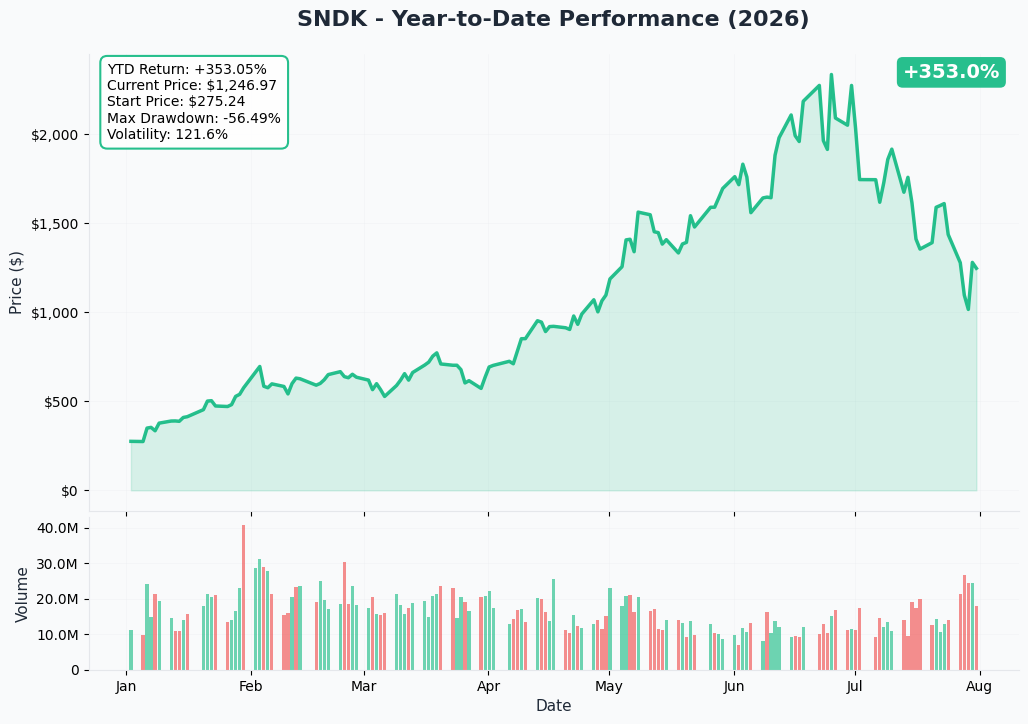
SanDisk's chart tells the whole story of why this roll matters: the stock ran from $275.24 to an all-time closing high near $2,335 in late June, then gave back a huge chunk of that spike, trading around $1,247 today — still +353.0% YTD but ≈46% below its June peak. Annualized volatility of 121.6% and a max drawdown of −56.5% confirm this trades nothing like a typical semiconductor name; it trades like a high-beta cycle stock experiencing a historic re-rating in both directions.
Gamma-Based Support & Resistance — Honestly, There Isn't Much Here
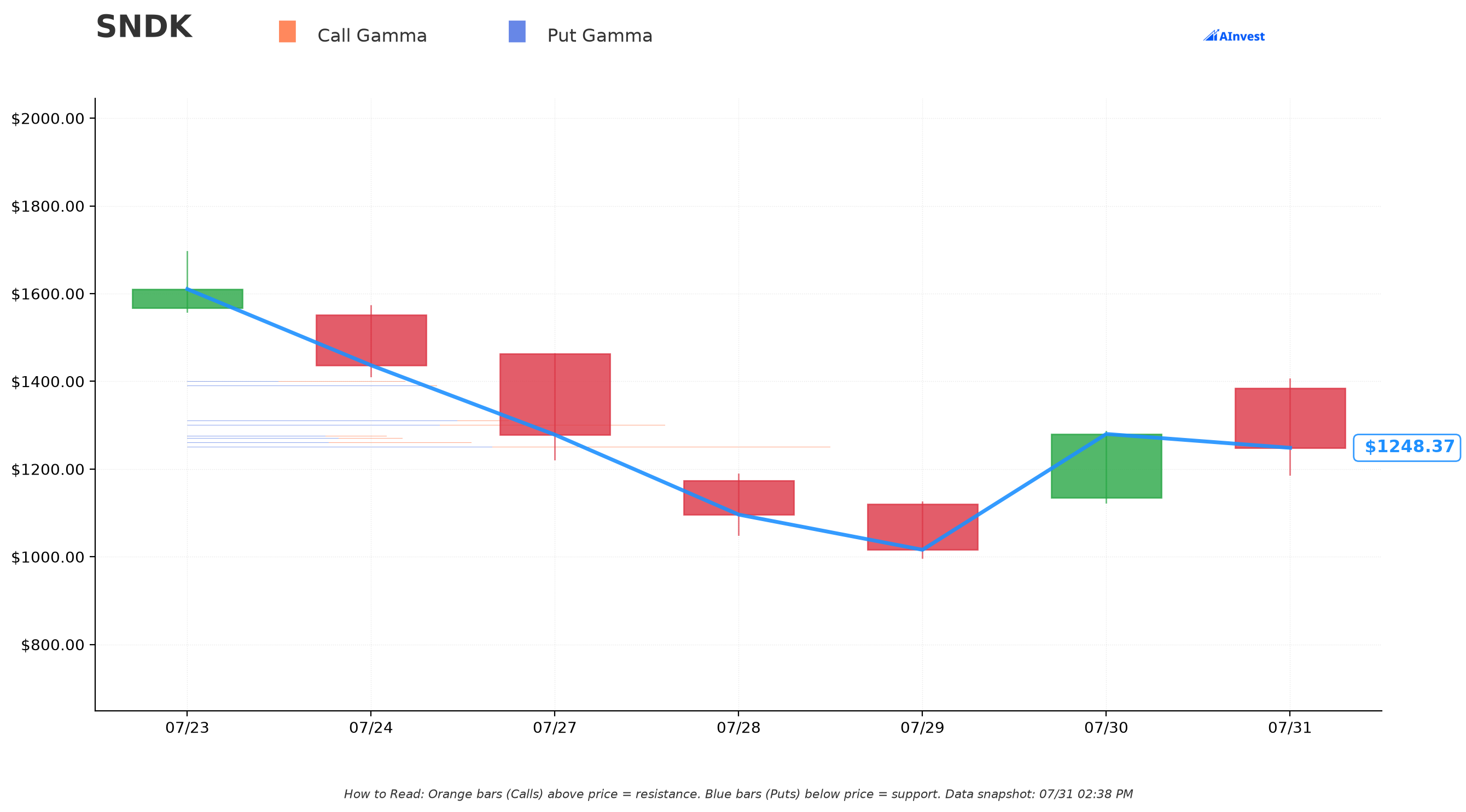
We're not going to invent structure that doesn't exist. Today's gamma scan came back with zero identifiable gamma walls across 99 strikes from $700 to $3,530. The model flagged only one thing worth mentioning: a "Moderate"-strength resistance right at the $1,250 strike, essentially at-the-money (≈0.16% away from spot) — not a real wall, just noise clustering near the current price. Gamma exposure is scattered thin and roughly balanced between calls and puts across the whole strike range, with no single level standing out the way you'd see on a name with a mature, liquid options market.
What this tells you: SNDK's options positioning simply hasn't caught up to the stock's ≈353% move. Open interest is spread across a huge range of strikes from the old, much-lower price regime up through speculative strikes near $3,500, and dealers don't have a concentrated enough book at any one level to create the kind of magnet or ceiling you'd see in, say, AAPL or SPY. Don't trust anyone telling you there's a clean "call wall" or "put wall" on this name right now — the data doesn't support it.
Implied Move — Where the Market Thinks This Goes
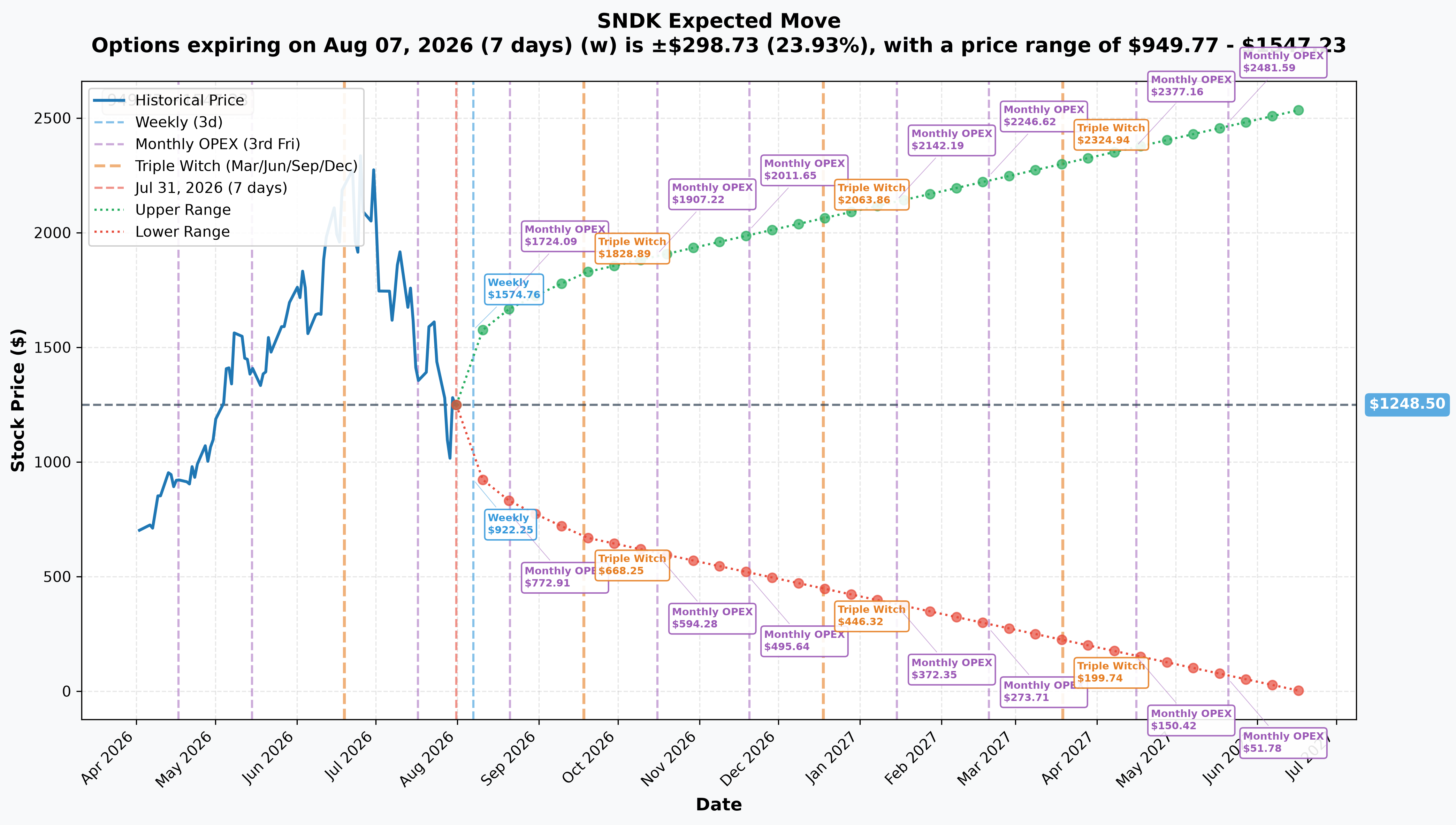
- Weekly (Aug-07-2026, 7 days — the exact expiration this roll bought into): ±23.93% (±$298.73) → range $949.77 – $1,547.23
- Monthly OPEX (Aug-21-2026, 21 days): ±34.22% (±$427.18) → range $821.32 – $1,675.68
- Quarterly Triple Witch (Sep-18-2026, 49 days): ±46.28% (±$577.78) → range $670.72 – $1,826.28
- LEAPS (Jun-17-2027, 321 days): ±103.16% (±$1,287.92) → range $0 – $2,536.42
Notice something: the $800 strike this roll just bought is already below the lower bound of the market's own one-week implied-move range ($949.77). In other words, the options market itself doesn't expect SanDisk to trade anywhere near $800 in the next week — this strike isn't a directional bet on a big move, it's chosen specifically to stay deep in the money and behave like stock. That's consistent with everything else pointing to a maintenance trade, not a fresh conviction play.
🎪 Catalysts
⚠️ Heads up — this roll does NOT dodge the next earnings report
Unlike most short-dated deep-ITM rolls, which are often timed to sidestep a binary event, this one doesn't: SanDisk reports fiscal Q4 and full-year 2026 results on Wednesday, August 5, 2026 at 1:30 p.m. PT (SanDisk newsroom) — two days before the new Aug-07 $800 call expires. Whoever holds this roll now is carrying ≈143,475 shares of delta straight through a binary print, even though the trade itself is proven to be continuation of an existing position, not a fresh earnings bet. Street consensus sits at roughly revenue ≈$8B and adjusted EPS ≈$31.50, against company guidance of $7.75–8.25B revenue and $30.00–33.00 EPS (TradingKey). Goldman Sachs' James Schneider expects a "very strong quarter driven by continued NAND supply tightness," with his CY26 EPS estimate running ≈30% above Street (Insider Monkey).
SanDisk's Investor Day on August 13, 2026 (Businesswire) falls six days after this roll's Aug-07 expiration — that event is genuinely outside the life of the new contract.
What's already happened — why this stock is up 353% and also down 46% from its peak
SanDisk's fiscal Q3 2026 (reported April 30, 2026) was one of the largest beats in recent semiconductor history: $5.95B revenue (+251% YoY), non-GAAP EPS of $23.41 versus a $14.66 estimate, and 78.4% non-GAAP gross margin (Investing.com). The company disclosed ≈$42 billion of minimum contractual revenue from long-term supply agreements signed with AI/datacenter customers, backed by over $11B in enforceable financial guarantees (TIKR). NAND contract prices had surged more than 100% in the first half of 2026 (TrendForce) on AI-driven datacenter flash demand, and the stock's inclusion in the Nasdaq-100 on April 20, 2026 (Nasdaq) added forced passive buying on top of the fundamental story.
Then came the reversal. On July 3, 2026, TrendForce guided 3Q26 NAND contract prices to just +10–15% QoQ, down sharply from the >100% first-half pace, explicitly citing consumers hitting their "affordability limit" (TrendForce). SNDK then took three separate hits in July: −12.63% on July 13 after Korea Investment & Securities cut SK Hynix estimates (Phemex); −11.7% on July 27 the day Chinese memory maker CXMT IPO'd in Shanghai and closed its first day at a $487B market cap, raising fears of Chinese NAND competition eroding SanDisk's ≈71% operating margins (Motley Fool); and −14% on July 28, its third straight double-digit down session, followed by another ≈−7% on July 29 as the broader memory sector sold off alongside Micron (Seeking Alpha, 24/7 Wall St.).
What's still to resolve — beyond the life of this roll
Kioxia (SanDisk's manufacturing JV partner) is raising capex ≈41% YoY to ≈$4.5B in FY2026, with fabs at Yokkaichi and Kitakami running at only ≈50% utilization — a large reserve of latent supply that could eventually pressure NAND pricing back down (TrendForce). TrendForce's most recent published view (July 31, 2026) projects the NAND supply/demand balance tips toward surplus in 2027, even as DRAM stays tight through 2028 — a genuine structural headwind for a pure-NAND name like SanDisk (TechTimes). On the bull side, SanDisk and SK hynix are jointly standardizing High Bandwidth Flash (HBF), a NAND-based answer to HBM aimed at AI inference workloads, with first samples targeted for the second half of 2026 (IndexBox). None of this resolves inside the one-week Aug-07 contract — it's the multi-quarter backdrop this roll is implicitly staying long into.
👥 Four Ways to Read This
- 🎰 YOLO trader: This isn't really a trade for you to copy directly — it's a $30.98M institutional maintenance roll, not a fresh directional signal. If you want the spirit of it without the six-figure-per-contract exposure, a far smaller deep-ITM call in the $900–950 range expiring in a few weeks gives similar stock-like leverage at a fraction of the size. Just know SNDK just had four sessions of double-digit-percentage moves in a row — this is not a name for casual position sizing.
- 📊 Swing trader: The interesting signal isn't the strike, it's the behavior: someone with a huge existing gain chose to stay long into an earnings report rather than cash out or hedge. That's a data point worth weighing alongside your own technical read — but remember the implied move here is enormous (±24% just for the week), so any swing position into August 5 needs position sizing that assumes a genuine double-digit-percent gap is on the table in either direction.
- 💰 Premium collector: There's a real premium-selling angle here, but it cuts against SanDisk's massive realized volatility (121.6% annualized). Selling premium into an event this violent is high-risk, high-reward — size small, and understand you're underwriting a stock that has moved 10%+ in a single session four times in the last three weeks.
- 🌱 Beginner: The single best lesson from this trade is what a "roll" actually is — it's not new buying, it's someone managing an existing position by trading time and strike for a fresh week of exposure. Before trading options on a stock this volatile, it's worth practicing on something calmer; SNDK's ±24% weekly implied move alone tells you the sizing math here is unforgiving.
⚠️ Honest Risk & What the Tape Cannot Prove
- The side-flag override is our read, not a certainty. We're MEDIUM confidence that the July $1,000 call was sold rather than bought — the arithmetic and the delta math are compelling, but the raw feed disagreed, and per-leg aggressor flags are fundamentally unreliable on floor-negotiated packages. We are HIGH confidence on the roll structure itself (that these two legs belong together and form a coherent package).
- The July $1,000 call leg can never be confirmed by open interest. Because it expired the same day it traded (0DTE), there is no next-morning OI snapshot that will ever exist to settle open vs. close on that leg. That's a permanent limitation of this specific trade, not a "check back later" situation.
- Large prints can be busted. Exchanges can cancel ("bust") a large trade hours after it prints — SanDisk itself had exactly this happen to a large options print on July 21, 2026. As of publication, the tape showed zero cancellations on either leg of this roll, and a late bust is always possible on a trade this size. This has now been settled for the August $800 leg: open interest rose 30 → 2,053, and a busted trade never reaches open interest — so that leg is confirmed to have stood. The expiring $1,000 leg cannot be checked this way (0DTE, no next-day snapshot), so its bust risk rests on the tape re-check alone.
- This is not conviction, it's continuation — don't read more into it than that. The proven economics show maintenance of an existing position, not fresh bullish accumulation. The genuinely new capital at risk is the $30.98M debit; reading the full $70.31M "buy" premium as new bullish money would overstate the signal by more than double.
- Six-figure-per-contract exposure. Each contract here controls 100 shares of a stock trading above $1,200 — that's well over $100,000 of notional per contract even before counting leverage. This is emphatically not a retail-sized position, and copying it directly is not something most individual portfolios should attempt.
- No clean gamma structure to lean on. As shown above, the gamma scan found no real support/resistance walls — don't treat any specific price level here as a magnet or ceiling based on dealer positioning, because the data doesn't currently support that read on this name.
- Volatility is extreme and two-directional. A stock that's +353% YTD but also −46% from its own June high, with three straight double-digit-percentage down days in the same month, can move violently in either direction around the August 5 earnings report and August 13 Investor Day.
Disclaimer: Options trading involves substantial risk of loss and is not suitable for all investors. This analysis is for educational purposes only and is not financial advice. The side-flag override described above is our interpretation of the tape, graded MEDIUM confidence — not a certainty. Past performance does not guarantee future results. Always do your own research and consider consulting a licensed financial advisor before trading options, especially on a name with SanDisk's current volatility profile.
Last updated: 2026-08-03 — next-day OPRA open interest confirmed the Aug-07 $800 call OPEN (30 → 2,053, +2,023) and proved the print was not busted. The expiring Jul-31 $1,000 leg is permanently unresolvable (0DTE, no next-day snapshot).