🐋 SNDK $152.6M Put Sale — Sold One Day Before Earnings, Then Hedged It Flat
📅 2026-08-04 | 🔥 Largest Premium Print on Today's Board
🎯 The Quick Take
A desk sold $152.6 million of SanDisk January-2027 $1,650 puts in two prints ≈2.5 minutes apart, collecting $555.00 per contract on 2,750 total contracts. Deep in-the-money put sales like this normally read as "someone is quietly going long the stock" — but the equity tape shows a matching 105,000-share short-stock block printed one minute after the first leg, which flattens out the directional exposure almost completely. This looks like a professional volatility sale timed one day before SanDisk's Wednesday, August 5 earnings call and eight days before its August 13 Investor Day — not a bet on which way the stock jumps.
🏢 About SanDisk (SNDK)
SanDisk is a NAND flash memory and storage company — the maker of flash chips, SSDs, and memory cards, spun out as an independent public company. It sits in a famously cyclical, boom-bust corner of the semiconductor world where storage pricing swings hard with supply and demand. That cyclicality is central to this story: SNDK's stock is up ≈421% over the past year on the 1-year chart, and that run is exactly why the options market is charging such a rich premium for volatility right now. (Note: some longer-dated return figures for SNDK reference a 52-week low around $40, but that figure reflects pre-separation/when-issued pricing from before SanDisk traded as its own company — it is not an apples-to-apples return, so we're not using it here.)
💰 The Option Flow Breakdown
📊 What Just Happened — Full Trade Table
Spot at first print: $1,428.72
| Time (ET) | Buy/Sell | Call/Put | Expiration | Strike | Size | Option Price | Premium | Volume | Prior OI | Spot | Option Symbol |
|---|---|---|---|---|---|---|---|---|---|---|---|
| 12:41:31 | SELL | PUT | 2027-01-15 | $1,650 | 2,500 | $555.00 | $138,750,000 | 2,500 | 2,797 | $1,428.72 | SNDK20270115P1650 |
| 12:44:02 | SELL | PUT | 2027-01-15 | $1,650 | 250 | $555.00 | $13,875,000 | 2,800 | 2,797 | $1,430.00 | SNDK20270115P1650 |
| TOTAL | SELL | PUT | — | — | 2,750 | $555.00 | $152,625,000 collected | — | 2,797 | — | — |
Both prints hit the tape as a stock-plus-options cross (a negotiated block where the option leg and a stock leg are pre-arranged and printed together) — one desk working one order in two pieces, ≈2.5 minutes apart. This is not an aggressive sweep lifting offers in the lit market; a known counterparty took the other side.
✅ RESOLVED — OI Rose: It Opened, but Only About a Third of It Was New
Updated 2026-08-05 pre-market. The ≈06:30 ET OPRA snapshot (reflecting the August 4 close) has published.
| Leg | Baseline OI (Aug-4 snap) | Resolving OI (Aug-5 snap) | Δ | Print size | Δ as % of print | Verdict |
|---|---|---|---|---|---|---|
| Jan-15-2027 $1,650 P (sold) | 2,797 | 3,814 | +1,017 | 2,750 | ≈37.0% | ✅ OPEN (STO) — partial |
Direction confirmed, magnitude smaller than the headline. Open interest rose, which settles the question the article flagged: this was a sell-to-open, not a short position being bought back. The "fresh volatility sale into two catalysts" framing stands.
But be precise about how much of it was new. Only 1,017 contracts of net new open interest were created against a 2,750-contract print — roughly 37%. The other ≈1,733 contracts were bought by a counterparty who was closing an existing long put, so those contracts changed hands rather than being created. In plain terms: the desk did open fresh short-put risk, but the market's total short-put exposure at this strike grew by about a third of what the $152.6M headline premium implies. That is a meaningful distinction if you were reading this as 2,750 contracts of brand-new institutional risk appetite — it's closer to 1,000.
🤓 What This Actually Means — Plain English
Normally, selling a deep in-the-money put — this one has a $1,650 strike against a $1,428.72 stock, so it's $221.28 in the money — reads as a bullish, synthetic-long trade. The seller is effectively saying "I'm fine owning this stock at a discount," collects a fat premium, and if the stock keeps sliding they get assigned shares at an effective price of $1,650 − $555 = $1,095 — about 23% below today's price. That's the textbook read for a lone deep-ITM put sale.
But that's not the whole story here, because of what showed up on the stock tape. One minute after the first print, at 12:42:25, a block of 105,000 shares traded at $1,426.35 on the equity tape. Do the math on the option side: 2,500 contracts × 100 shares × 0.4182 delta = 104,550 shares of directional exposure. That's a 0.4% match to the 105,000-share stock block — close enough to call it the same package.
Translation: this wasn't a naked bullish bet. It was a delta-hedged package. The desk sold the puts (which by themselves would be a bullish/long-delta position) and simultaneously sold stock to cancel out that directional exposure. After the hedge, the position is close to market-neutral — they don't care much whether SanDisk goes up or down from here. What they're actually harvesting is time value and implied volatility, not direction.
Here's why that time value is worth calling out: the option sold for $555.00, and $221.28 of that is pure intrinsic value (how far in the money it already is). That leaves $333.72 per share of pure time premium — on a single contract that's $33,372, times 2,750 contracts. That's the real prize in this trade, and it's a big number precisely because SanDisk's ≈421% one-year run has made its options expensive to buy and lucrative to sell.
Order type, now confirmed: this was a short put (STO) — the next-day OI snapshot showed open interest rising, so the position opened (see the RESOLVED box above). They collected premium rather than paying it, and the matching stock hedge tells us they were managing direction, not chasing it. The one qualifier: only ≈37% of the print created new contracts, so the net-new short-put inventory is about 1,017 contracts, not the full 2,750.
🎪 The Catalyst Context — This Is the Real Story
This premium sale printed one trading day before SanDisk's fiscal Q4 and full-year 2026 earnings call, which the company confirmed on July 9 will happen Wednesday, August 5, 2026 at 1:30 p.m. PT — company-confirmed, not estimated. That same release also confirmed SanDisk will host an Investor Day on Thursday, August 13, 2026 at 9:00 a.m. ET, featuring CEO David Goeckeler and CFO Luis Visoso.
That's two dated, binary events inside nine days — both of them comfortably inside this position's Jan 15, 2027 expiry (≈5.5 months out). Worth being straight with readers: there is no published Q4 consensus estimate on record for SanDisk right now, so we're not framing this as a likely beat or miss — there's no bar to point to.
What we can say: selling $152.6 million of premium, with $333.72-per-share of that being pure time value, immediately ahead of a confirmed earnings print and an investor day — then hedging the direction away with a 105,000-share stock block — is the signature of a desk selling volatility into the event, not gambling on the outcome. That's close to the opposite of a retail trader buying a lottery-ticket call into earnings; it's closer to a professional harvesting the fear premium the options market is charging around two known catalysts.
📈 Technical Setup / Chart Check-Up
YTD Chart
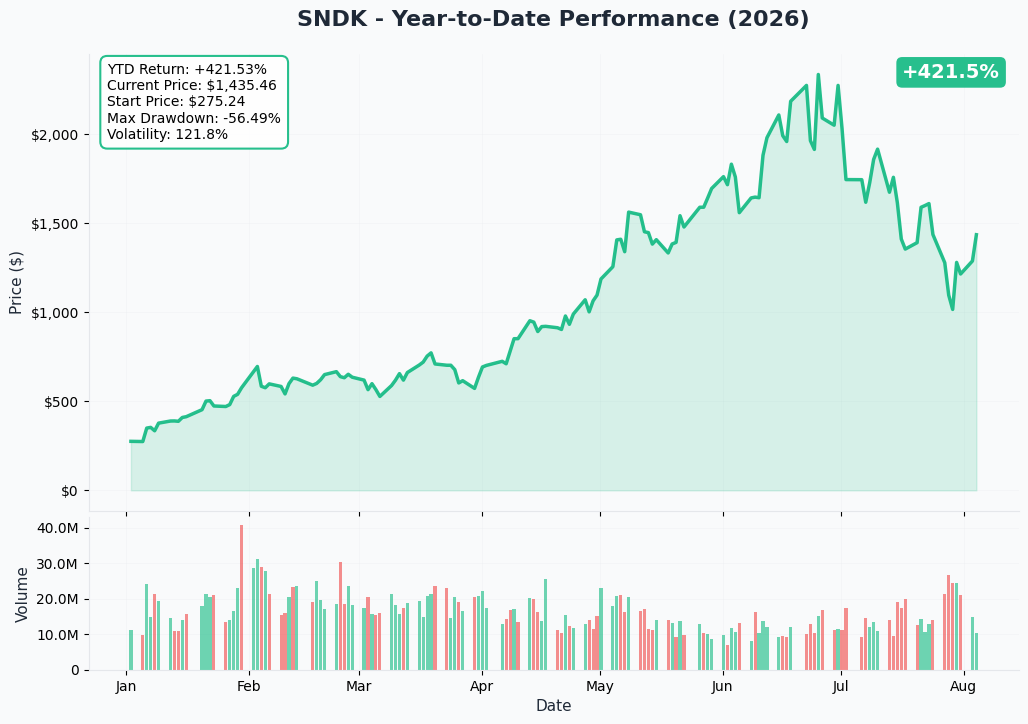
SanDisk is up ≈421% over the past year — a huge, cyclical-NAND-driven run that's also why the options market is pricing rich time premium into every strike, including the deep-ITM put sold here.
Gamma-Based Support & Resistance
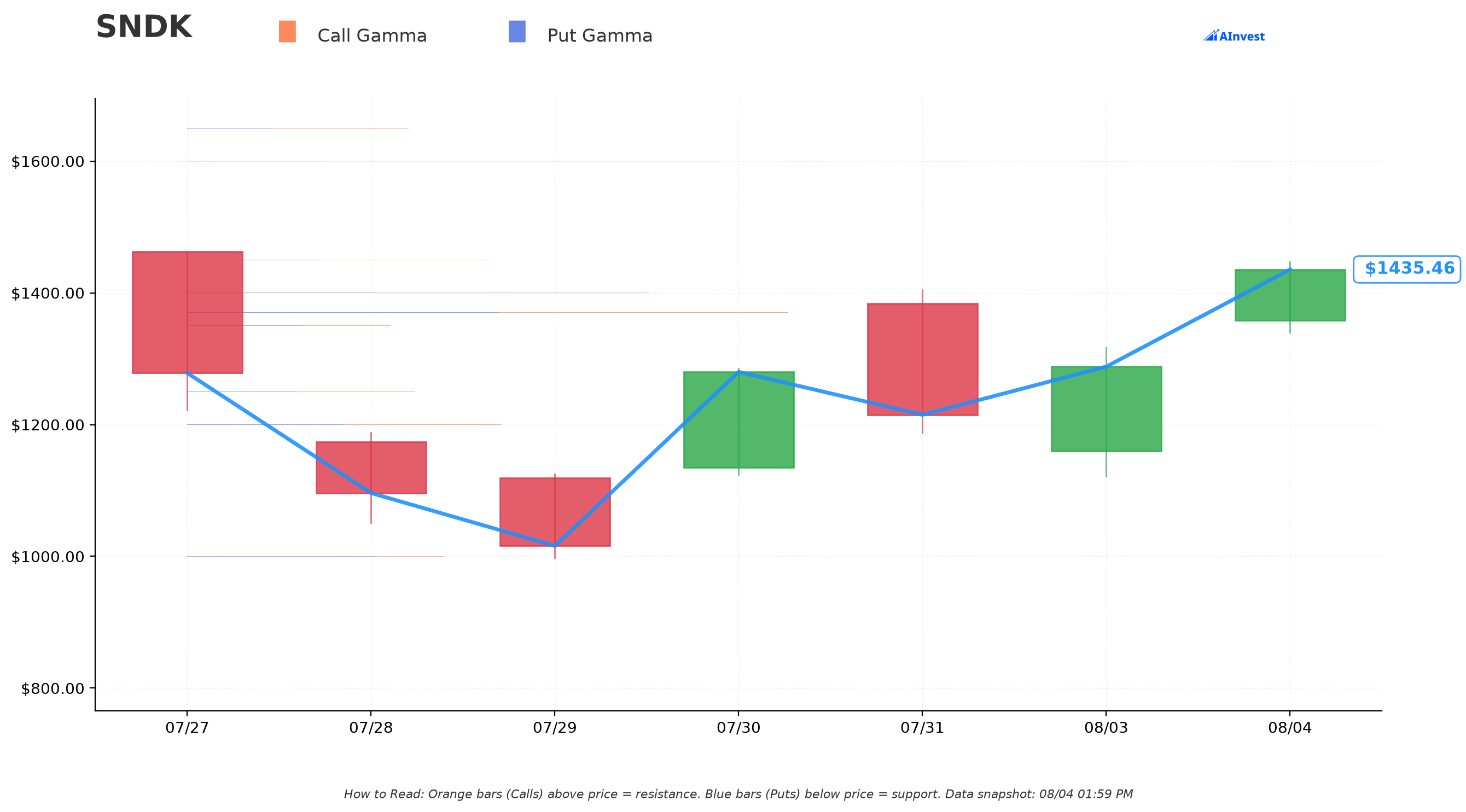
Reading the raw dealer gamma exposure by strike (spot ≈$1,436 at snapshot time):
- 🟠 Call Wall (resistance): $1,600 — the strike with the heaviest call-side gamma at or above spot. This is where dealer hedging tends to act as a magnet/ceiling on rallies.
- 🔵 Put Wall (support): $1,370 — the strike with the heaviest put-side gamma at or below spot, acting as a potential floor.
- 🎯 Key Gamma (largest total exposure): $1,500 — the single strike with the most combined call+put gamma on the board, a level price tends to gravitate toward.
- Net gamma between $1,370 and $1,500 flips sign strike-to-strike rather than trending cleanly one way — a choppy, low-conviction zone right around where the stock is sitting now. That's normal noise, not a strong directional tell.
Notably, the $1,650 strike sold today sits well above both the call wall and the key gamma level — it's deep in the money and far from where dealer hedging flows are concentrated, reinforcing that this trade is about premium and volatility, not a bet tied to near-term gamma magnetism.
Implied Move
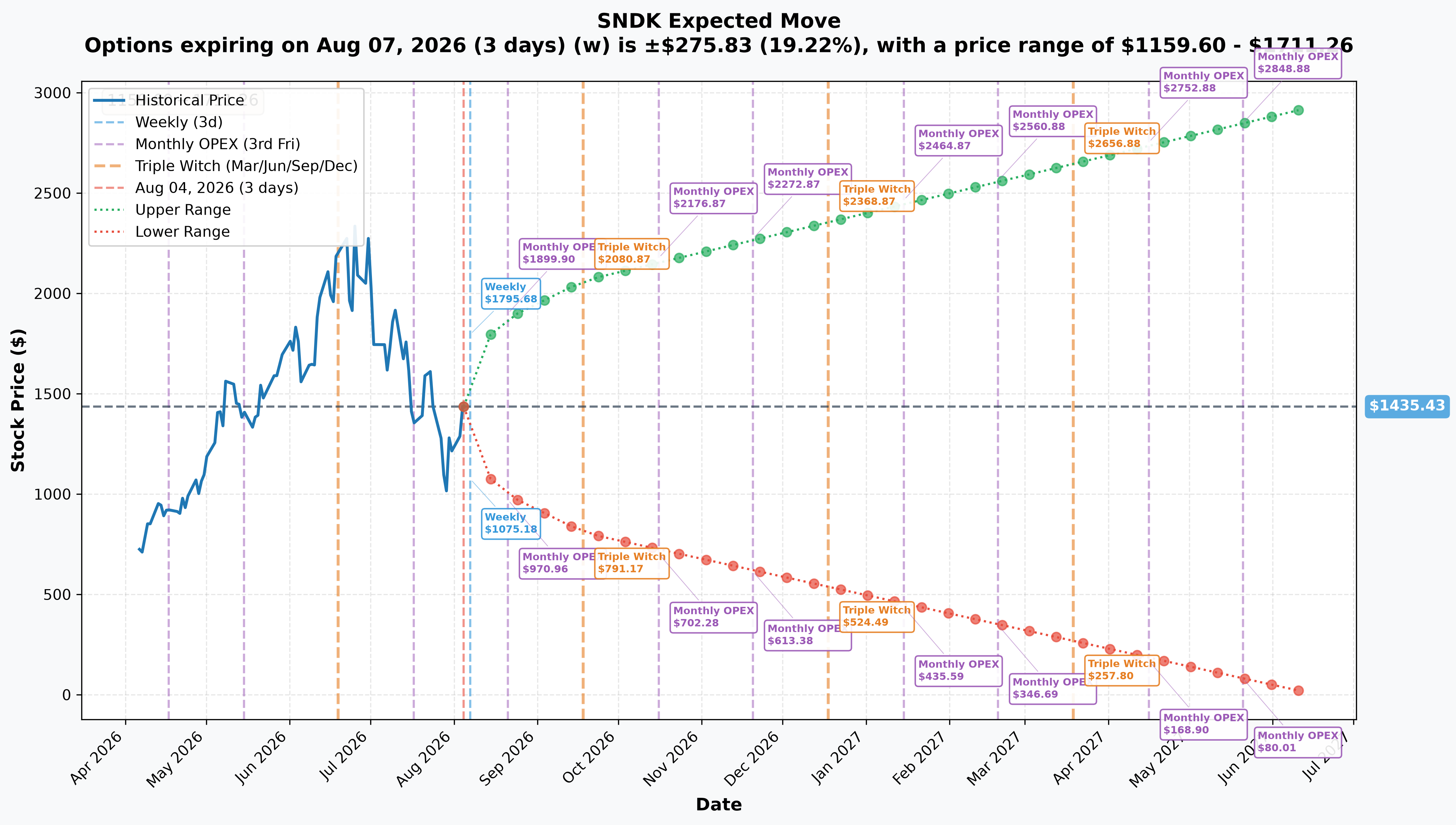
Straight from the options market's own pricing (spot $1,435.43 as of the snapshot):
| Window | Expiry | DTE | Implied Move | Range |
|---|---|---|---|---|
| Weekly | 2026-08-07 | 3 | ≈19.2% (±$275.83) | $1,159.60 – $1,711.26 |
| Monthly OPEX | 2026-08-21 | 17 | ≈31.0% (±$444.67) | $990.76 – $1,880.10 |
| Quarterly (Triple Witch) | 2026-09-18 | 45 | ≈43.9% (±$629.44) | $805.99 – $2,064.87 |
| LEAPS | 2027-06-17 | 317 | ≈104.5% (±$1,499.85) | roughly $0 – $2,935.28 (lower bound clamped; not a real floor) |
The weekly window (3 DTE) already captures the August 5 earnings call, and its ±19.2% implied move ($1,159.60 to $1,711.26) is a stark number for a $1.4 trillion-market-cap-scale stock's weekly options — a direct reflection of how much the market is pricing in around this specific print. That's the volatility premium the $152.6M put sale is harvesting.
🎲 Price Targets & Scenarios
Using the gamma and implied-move data above, plus the two dated catalysts:
- Bull case: Stock holds or extends the run toward the $1,600 call wall on a strong Q4 print or well-received Investor Day framework. The short put stays comfortably out of the money at expiry (Jan 2027) if this direction holds.
- Base case: Stock chops within the monthly-OPEX implied-move range (≈$990.76–$1,880.10) through the two catalysts, gravitating toward the $1,500 key-gamma zone. Time decay does its work either way for the option seller.
- Bear case: A disappointing earnings print or weak investor-day guidance sends the stock down toward or below the $1,370 put wall, deep into the $1,650 strike's intrinsic value, testing the short put more seriously — though the stock hedge cushions the desk's overall P&L versus a naked short put.
💡 Trading Ideas
🛡️ Conservative
Watch from the sidelines through August 5 earnings and August 13 Investor Day. Two binary catalysts inside nine days is a lot of gap risk for a new position either direction — let the dust settle and reassess the trend after both prints.
⚖️ Balanced
If you want defined-risk earnings exposure, a narrow debit spread around the weekly implied-move range (roughly $1,160–$1,710) caps your cost and your risk while still giving you a read on the earnings reaction, without betting the full premium a naked option would cost given how rich implied vol is right now.
🚀 Aggressive
Selling premium into the same two catalysts (what this whale appears to be doing) is a professional-grade play — but doing it unhedged (a naked cash-secured put at a strike like $1,650, or even a much closer strike) means eating the full move if the stock gaps hard on the print. This isn't a beginner trade; size it like the tail risk it is.
👥 Four Ways to Read This
🚀 YOLO Trader: This isn't your trade to copy directly — $152.6M of premium with a matching stock hedge is a market-neutral volatility play, not a directional call. If you want action into earnings, a small defined-risk spread inside the implied-move range is the more honest version of what you're looking for.
📊 Swing Trader: The two-catalyst setup (earnings Aug 5, Investor Day Aug 13) inside nine days is the headline. Watch how the stock behaves relative to the $1,370 put wall and $1,600 call wall through both events — a break of either level with volume tells you more than the headline premium does.
💰 Premium Collector: This is the professional, hedged version of a cash-secured put — sell downside premium, but pair it with a short-stock (or short-futures/short-call) hedge to flatten the directional risk most retail put-sellers skip. If you're running cash-secured puts on SNDK yourself, note how much of this seller's $555 premium was pure time value ($333.72) rather than intrinsic — that's the number that matters for whether a short put is actually attractive here versus overpriced.
🌱 Beginner: A "sold to open a put" headline usually means "bullish, wants to buy the dip." Here, the same desk also sold a big block of stock at nearly the same moment. That combination cancels most of the directional bet — they're not really saying "SanDisk goes up," they're saying "I'll collect a rich premium for taking on volatility risk around two big events, and I don't want to guess which way the stock breaks."
⚠️ Honest Risk & Limits — What the Tape Cannot Prove
- Open vs. close is unresolved. Size (2,750) came in just 47 contracts under prior OI (2,797) — this is genuinely too close to call from today's tape. Check back tomorrow's pre-market OI for the real answer.
- We cannot see the counterparty, broker, or customer identity behind either side of this cross — OPRA data never reveals who's trading.
- We cannot fully verify the hedge is complete or permanent. The 105,000-share block is a strong, close (0.4%) match to the option's delta-equivalent, but we can't rule out additional stock, futures, or other options trades happening away from what we can see on the tape that further adjust this position.
- No published Q4 consensus exists for SanDisk right now — we are not asserting whether the company will beat or miss; there's no official bar to compare against on the record.
- Implied volatility and gamma levels are dynamic — they will shift meaningfully once Wednesday's earnings print, and shift again around the August 13 Investor Day.
Disclaimer: Options trading involves substantial risk and is not suitable for all investors. This analysis is for informational purposes only and does not constitute investment advice. Past performance and options flow do not guarantee future results. Always do your own research and consider your risk tolerance before trading.
Last updated: 2026-08-05 — next-day OPRA open-interest resolution added: confirmed OPEN (STO), but only ≈37% of the print created new contracts.