💾 SNDK — Somebody Sold $286.5M of a Single Put the Day After Earnings, and This One Has No Hedge
✅ Updated 2026-08-07 pre-market — all three legs confirmed opening, and the big one landed on the contract. The January $1,660 put went 660 → 5,660 — up exactly 5,000 against a 5,000-lot sale, a 100.0% match with our prediction. The September strangle legs opened too, by more than the flagged size. See the ✅ RESOLVED box below.
SanDisk Corp designs and sells NAND flash memory and storage products. Sector: Technology / Computer Hardware. Market cap $192.10B, with the stock at $1,289.28, down 4.53% on the session (StockAnalysis). You can follow the name on its SanDisk ticker page.
🤝 The Trade in Plain English
Two separate things happened in SanDisk options today, and the larger one is the biggest single print on this board.
At 11:17:35, with the stock at $1,313, a desk sold 5,000 January-2027 $1,660 puts at $573 a contract — $286,500,000 collected — as a negotiated floor trade. Prior open interest at that strike was just 660, so the position is overwhelmingly new.
Selling a put that far in the money is an obligation to buy SanDisk at $1,660. Against $573 of premium, the effective purchase price is $1,087 — roughly 15.7% below where the stock trades now. In delta terms it is +252,500 shares of long exposure.
Then at 10:27:27, with the stock at $1,268, the same kind of negotiation produced a short strangle: sell 675 September $1,350 puts and 675 September $1,430 calls, both as stock-plus-options floor trades. Both sides sold means the seller profits if SanDisk simply stays between roughly $1,350 and $1,430 into September.
| Time | Buy/Sell | C/P | Expiration | Strike | Size | Volume | OI (prior) | Option Price | Premium | Spot | Option Symbol |
|---|---|---|---|---|---|---|---|---|---|---|---|
| 11:17:35 | SELL | PUT | 2027-01-15 | $1,660 | 5,000 | 5,001 | 660 | $573.00 | $286,500,000 | $1,313 | SNDK20270115P1660 |
| 10:27:27 | SELL | PUT | 2026-09-18 | $1,350 | 675 | 2,191 | 439 | $225.78 | $15,240,150 | $1,268 | SNDK20260918P1350 |
| 10:27:27 | SELL | CALL | 2026-09-18 | $1,430 | 675 | 2,134 | 89 | $129.22 | $8,722,350 | $1,268 | SNDK20260918C1430 |
Net: a $310,462,500 CREDIT. Package delta +254,498 shares. 🤝 BLOCK — negotiated on the exchange floor, not swept through the open market.
✅ RESOLVED — All Three Legs Confirmed Opening
Updated 2026-08-07 pre-market. The ≈06:30 ET OPRA snapshot (which reflects the August 6 close) has published, and all three provisional legs are settled.
| Leg | Baseline OI (Aug-6 snap) | Predicted | Actual (Aug-7 snap) | Δ | Print size | Δ as % of print | Day vol | Verdict |
|---|---|---|---|---|---|---|---|---|
| Jan-15-2027 $1,660 P (sold 5,000) | 660 | ≈5,660 | 5,660 | +5,000 | 5,000 | 100.0% | 5,013 | ✅ OPEN (STO) |
| Sep-18-2026 $1,350 P (sold 675) | 439 | ≈1,100 | 2,284 | +1,845 | 675 | ≈273% | 2,196 | ✅ OPEN (STO) |
| Sep-18-2026 $1,430 C (sold 675) | 89 | ≈760 | 2,150 | +2,061 | 675 | ≈305% | 2,149 | ✅ OPEN (STO) |
The $287M put sale landed on the contract. We predicted 5,660 and open interest printed 5,660 — up exactly 5,000, the full size of the block. There is no ambiguity left: this was brand-new short put inventory, and the unhedged read stands.
The September strangle opened much larger than the flagged block. Both legs grew by roughly three times the 675-lot prints we wrote about, on day volume of ≈2,200 at each strike — so the short strangle was being built by more than one participant, or in more than one clip.
What this confirms, and what it does not. The opens are now proven. What remains unprovable is the seller's underlying position: a short put of this size is either a willingness to own SanDisk far lower, a synthetic long expressed through options, or an obligation someone else is carrying stock against. Open interest cannot tell them apart — and the absent equity hedge, which the article flags, remains the single most important uncertainty here.
⚠️ The Detail That Changes the Read — and It Is a Change From Two Days Ago
On August 4, SanDisk saw a very similar trade: 2,750 of the January $1,650 put sold. That one was delta-hedged — the equity tape carried 105,000 shares against a 104,550-share delta equivalent, a 0.4% match. It was a volatility sale with the direction stripped out.
Today's is different. We looked for the same hedge and could not find it. The entire 11:17–11:19 window shows only 134,152 shares traded, with no block above 20,000, against roughly 252,500 you would expect if this were hedged the same way. The January leg also prints as a plain single-leg floor trade, with none of the stock-plus-options marking that the September legs carry.
So the inference — and it is an inference, not proof — is that this one is directional. A hedge executed at another venue, or spread out over the day, cannot be ruled out from the tape alone. But on the evidence available, somebody took on roughly a quarter of a million shares of long SanDisk exposure and was paid $286.5M for it.
The timing sharpens that. SanDisk reported fiscal Q4 yesterday, August 5 — it beat expectations but guided lower, and the guidance "failed to impress investors," which is why the stock is down 4.53% today (StockAnalysis). This position was put on into that disappointment, at an effective entry 15.7% below the current price.
🤓 What This Actually Means — Plain English
Selling a put is not a bearish trade. You are being paid to promise you will buy the stock at a set price. If the stock stays above that price, you keep the money. If it falls below, you own the shares — at the strike, minus what you were paid.
Here the strike is $1,660 and the payment was $573, so the real commitment is to buy at $1,087. That is why the delta is positive: this is a bullish-leaning position dressed up in put clothing.
The strangle is a different animal. Selling both a put and a call means betting the stock doesn't move much. It makes money from time passing and from volatility falling. It loses if SanDisk breaks out of the $1,350–$1,430 band in either direction — and unlike the put sale, the call side has no natural ceiling on the loss.
Why the hedge question matters so much: if a big put sale comes with an offsetting stock trade, the seller is harvesting time value and does not care much where the stock goes. Without the hedge, they are simply long. Same headline number, completely different bet.
📊 The Charts
One-Year Price Action
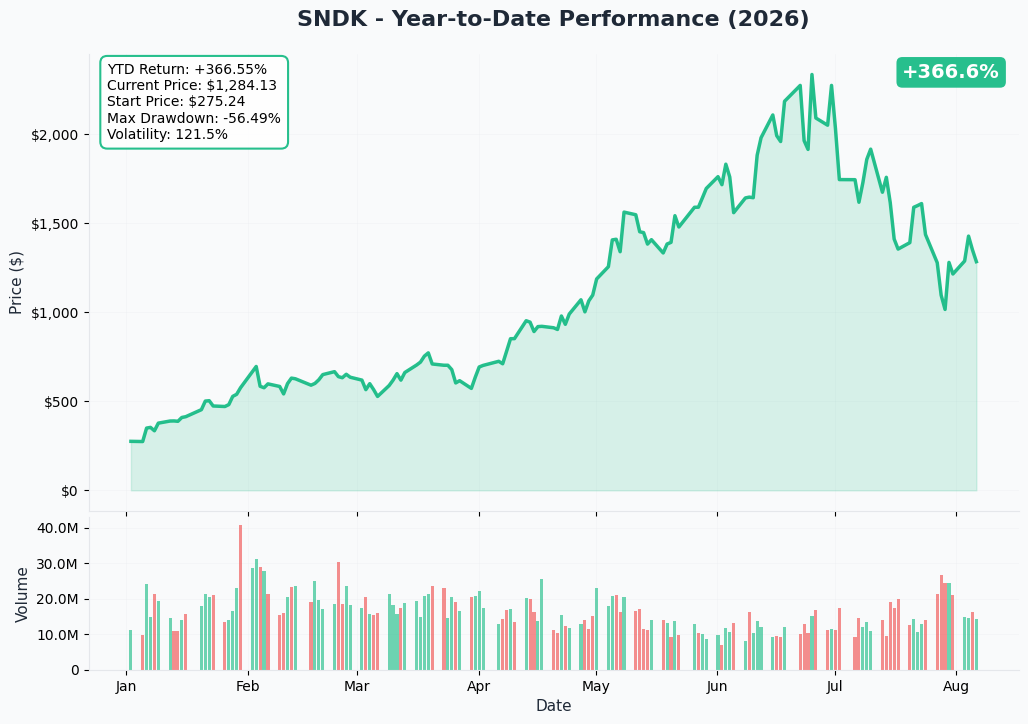
The stock is up ≈366.6% over the past year. A note on the numbers you may see elsewhere: the widely quoted 52-week range of $40.53–$2,354.39 spans a pre-separation share history and is not an apples-to-apples comparison — the chart above is the honest picture.
Gamma Support and Resistance
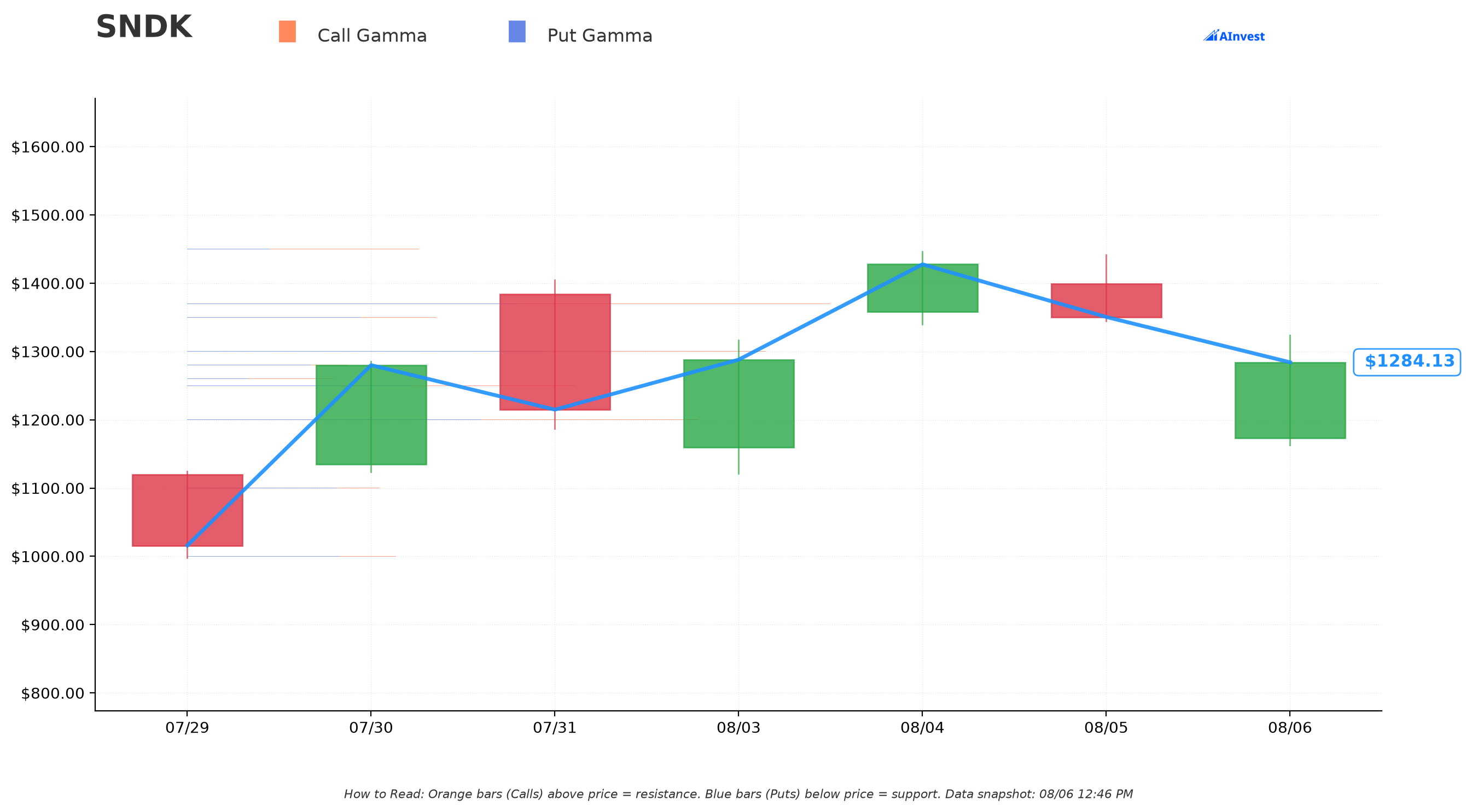
Dealer gamma is thin and unclustered in SanDisk at the moment — the model returned no strong support or resistance shelf near the $1,280 area. In practice that means there is no dealer-hedging cushion to lean on here; the stock is free to move on news, which is exactly what happened yesterday.
Implied Move
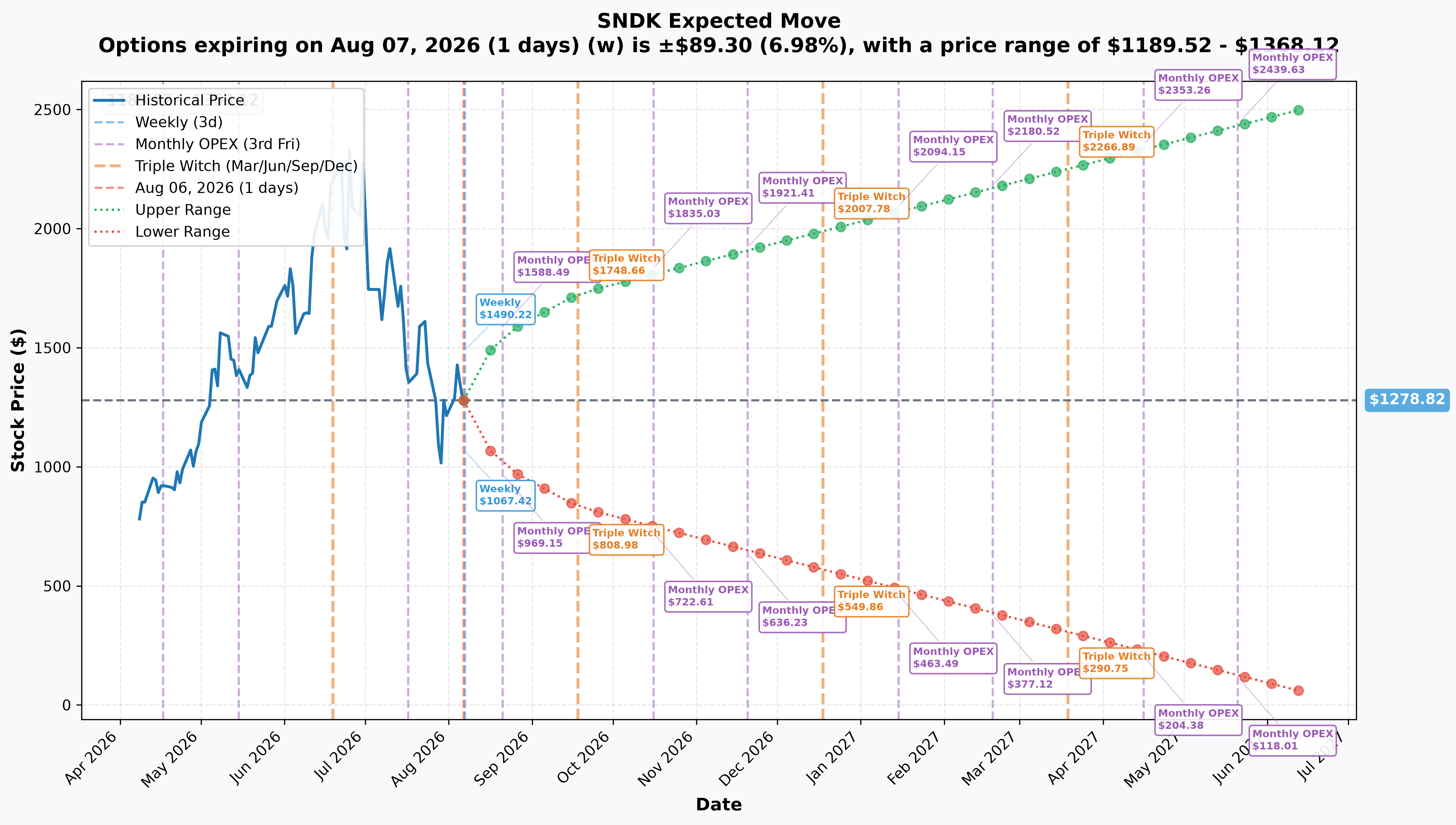
The options chain itself is pricing enormous ranges: ±6.98% by tomorrow ($1,189.52–$1,368.12), ±21.84% by August 21 ($999.59–$1,558.05), and ±35.16% by September 18 ($829.13–$1,728.51).
Hold that against the trades. The September strangle needs SanDisk to finish between $1,350 and $1,430 — a band far narrower than the ±35% the chain says is plausible. The seller is taking the other side of the market's own volatility estimate, which is precisely how you get paid $24M for 675 contracts.
📅 Catalysts
- Earnings are behind us, and they are the story. Fiscal Q4 landed August 5 — a beat, but with guidance that disappointed (StockAnalysis). No forward earnings date has been published, so we will not guess one.
- Analyst targets are being cut today, and the disagreement is extreme. The average sits at $2,148.68 across 23 analysts with a Buy consensus, but same-day revisions run from RBC at $1,300 to Evercore ISI at $2,800 (StockAnalysis). A 2.15× spread between the low and high target means the street has no shared view of the NAND cycle.
- NAND pricing remains the dominant swing factor for the business, and memory is a famously cyclical industry.
👥 Four Ways to Read This
🎲 The YOLO trader — there is nothing to copy here. Selling a $1,660 put means being ready to buy over $500,000 of stock per contract. The premium looks enormous because the obligation is enormous.
📈 The swing trader — the interesting signal is the entry: someone chose to establish long exposure the day after a guide-down, at an effective $1,087. That is a value-buyer's move, not a momentum one. Whether they are right is a separate question from whether the trade is informative.
💰 The premium collector — this is your strategy at institutional scale, and the contrast with August 4 is the lesson. Same shape, but that one carried a stock hedge and this one appears not to. Most retail put-sellers never hedge, which means they are taking the directional risk without deciding to.
🌱 The beginner — the takeaway is that "sold a put" does not mean bearish. Read the delta, not the word. And notice that the largest number on today's board belongs to a trade whose meaning changes completely depending on a stock trade you would never see in the options data.
⚠️ Honest Risk and Limits — What the Tape Cannot Prove
- We cannot prove the January put is unhedged. We can only say no matching block appears on the visible tape in that window. A hedge placed elsewhere or worked over hours would not show up.
- We cannot see who traded, their existing position, or their cost basis. A short put may offset something we cannot observe.
- Open versus close is proven here by size, but the intent behind it is inference.
- The size cuts both ways. A quarter-million shares of exposure is a large commitment on a stock that just guided lower and fell 4.5%, in a sector where estimates move fast.
Nothing here is investment advice. Large trades tell you what somebody with capital did — not that they were right.
Last updated: 2026-08-07 — next-day OPRA open interest resolved all three provisional flags: all OPEN (STO). The January $1,660 put printed exactly 5,660 (+5,000, a 100.0% match with the prediction); both September strangle legs opened at ≈3× the flagged size. A ✅ RESOLVED box replaced the ⏳ callout; the unhedged read stands.