🔄 TLN — Not a New Bearish Bet: Next-Day OI Proves the $10M Deep-ITM Put Buy CLOSED an Existing Short-Put Position
📅 July 28, 2026 | 🔥 Unusual Activity Detected
🔄 CORRECTION — Update (July 29, 2026): the next-day OPRA open-interest snapshot inverted this read. Open interest on the Dec-18-2026 $370 put did not rise — it fell 3,143 → 1,689 (−1,454), more than the entire 1,388-lot print. Open interest only falls when contracts are retired, so this was a buy to close (BTC), not a buy to open. A buy that retires contracts is covering a short put — meaning this was a desk exiting an existing obligation, not a new bearish bet and not a new hedge. The headline, the directional framing, and the payoff math below have all been rewritten. See the ✅ RESOLVED box.
🎯 The Quick Take
As originally published, this looked like a ≈$10M directional-lean bearish bet (or a protective hedge) — 1,388 Talen Energy December 18, 2026 $370 puts at ≈$74.88 each, on a strike already ≈13% in-the-money, bought after TLN's AI-datacenter nuclear story ran ≈3.5x off its 2024 relist price before pulling back ≈28% from its 52-week high.
The next-morning open-interest snapshot says it was an exit, not an entry. Open interest on the strike fell from 3,143 to 1,689 — a decline of 1,454 contracts on a day when only 1,510 traded there. Contracts disappear from open interest only when they are retired, which happens when the buyer is closing a short position. So the ≈$10.4M was spent buying back puts this desk had previously sold, unwinding an obligation rather than putting on a new one. Whatever the motive, the correct reading is the opposite of "someone is initiating a bearish position in Talen": someone who was on the other side of that trade paid up to get out of it, and the strike's total outstanding position shrank by nearly half.
📊 Company Overview
Talen Energy Corporation (TLN) is an independent power producer (IPP) headquartered in Houston, TX, operating ≈13.1 GW of power generation across PJM and other U.S. wholesale markets. The crown jewel is ≈2.2 GW of carbon-free nuclear capacity anchored by the Susquehanna Steam Electric Station in Pennsylvania — one of the largest nuclear plants in the country — alongside a dispatchable gas/coal fleet. Talen emerged from bankruptcy in 2023, relisted on Nasdaq on July 10, 2024, and has become one of the market's premier AI-datacenter power plays by co-locating and contracting hyperscaler load directly to its nuclear and gas assets.
- Sector / Industry: Utilities — Independent Power Producers (merchant generation)
- Market Cap: ≈$15.5 billion on ≈47.9 million shares outstanding
- 52-Week Range: $301.45 – $451.28
- Current Price: ≈$322.80 intraday (down ≈7% on the day); the desk's put print landed at a reference spot of $327.45
Talen relisted at $127.50 in July 2024, posted a 186% total return in 2024, and is up ≈620% three years post-bankruptcy — a genuine AI-power darling that's since pulled back ≈28% from its all-time high.
💰 The Option Flow Breakdown
📊 What Just Happened
The Tape (July 28, 2026 @ 12:21:01 ET):
| Time | Buy/Sell | Call/Put | Expiration | Premium | Strike | Volume | Prior OI | Size | Spot | Option Price | Option Symbol |
|---|---|---|---|---|---|---|---|---|---|---|---|
| 12:21:01 | BUY | PUT | 2026-12-18 | $10.4M | $370 | 1,500 | 3,143 | 1,388 | $327.45 | $74.88 | TLN20261218P370 |
🎯 Flow tag: deep-in-the-money put buy, single-leg facilitated auction, unhedged. This filled through a facilitated exchange auction (a worked, price-improvement mechanism — not a negotiated block cross, and not a lit sweep), printing at ≈78% of the way toward the ask, which leans toward the buyer paying up rather than being handed a fill at the mid. The strike is $370 against a $327.45 spot — ≈$42.55 of pure intrinsic value baked in before a penny of time premium — so this option already trades and moves almost like short stock.
✅ PROVEN from the tape: bought (not sold), deep-in-the-money, filled via a facilitated auction, independent option-pricing delta of −0.533 (meaning the position behaves like being short ≈74,000 shares of TLN: 1,388 × 100 × 0.533). We also checked the surrounding equity tape for a stock trade large enough to delta-hedge a position this size — there's only ≈7,042 shares of total volume in the window, nowhere near the ≈74,000 shares a dealer hedge would require. No stock leg = unhedged, at least on the visible tape.
✅ NOW PROVEN by next-day open interest: this was a buy to close (BTC) — the buyer was retiring a short put, not initiating a long one. See the RESOLVED box directly below.
✅ RESOLVED — Next-Day OI Proves a CLOSE, Not a New Bearish Bet (updated July 29, 2026)
The July 29 pre-market OPRA snapshot is in, and it inverted the read.
Resolved from the OPRA open-interest snapshot for EOD July 28, 2026. This box replaces the ⏳ provisional flag published on July 28.
| Leg | Baseline OI (Jul 28 snap) | Resolving OI (Jul 29 snap) | Δ | Print Size | Verdict |
|---|---|---|---|---|---|
| Dec-18-2026 $370 PUT | 3,143 | 1,689 | −1,454 | 1,388 (strike's full session volume 1,510) | 🔄 CLOSE CONFIRMED (BTC) — ≈−105% of size |
What this proves: we published the test as "if OI stays flat or falls → some or all of this was a close, and the 'fresh conviction' framing needs to be walked back." Open interest fell by 1,454 — more than the entire print. That is the clearest possible version of the bearish-for-our-thesis case, and it means the walk-back is not partial: essentially none of this was a fresh open.
Here is the mechanic, plainly. Open interest counts contracts that exist. It goes up only when a new buyer and a new seller create one, and down only when the existing holder and the existing writer both step out and the contract is extinguished. Our print was a BUY. A buy that makes open interest go down can only be one thing: the buyer was short and is buying the contract back to cancel the obligation — a buy to close.
What that changes, concretely:
- There is no new bearish position in Talen. The article's central premise — a desk initiating ≈$10.4M of downside exposure — is disproven. Nothing was initiated.
- There is no new hedge either. The alternative read we offered (someone protecting a large unseen long) also required a fresh open. It didn't happen.
- The party paying the ≈$10.4M was previously SHORT these puts — i.e. they had sold downside protection to someone else, collecting premium, and were obligated to buy TLN at $370. With the stock at $327.45, that obligation was deep underwater. Buying it back at $74.88 realises that loss and ends the exposure.
- The position that existed was cut nearly in half, from 3,143 contracts to 1,689.
⚠️ Still inferred, not proven: why they closed. Capitulating on a losing short-put position, cutting risk ahead of earnings and the FERC decision, avoiding early assignment on a deep-ITM contract, or simply cleaning up a book are all consistent with the tape. OPRA proves the contracts were retired and that our print's initiator was the buyer; it does not reveal motive or identity.
🤓 What This Actually Means — Plain English
- 💵 What they paid, and what it bought them: $74.88 per contract × 1,388 contracts × 100 shares = ≈$10.4M. Crucially, this money did not buy a new position — it bought freedom from an old one. This is the cost of cancelling a short-put obligation, closer to paying off a debt than placing a bet.
- 🔄 "Buy to close" in plain English. There are four things you can do with an option: buy to open, sell to open, buy to close, sell to close. The first two start a position; the last two end one. Our print was a buy, and open interest fell, which narrows it to exactly one of the four: buy to close. Someone had sold these puts to a counterparty earlier, collecting premium and taking on the obligation to buy TLN at $370 a share. They have now paid to make that obligation go away.
- 📉 Why it hurt. A short put loses money when the stock falls. TLN at $327.45 is ≈$42.55 below the $370 strike, so this obligation was already deeply underwater. Buying it back at $74.88 — of which ≈$42.55 is pure intrinsic value the seller can never recover — crystallises a real loss rather than banking a profit.
- 🚫 No stock leg = not a dealer-hedged package. We checked the surrounding equity tape and found only ≈7,042 shares of total volume in the window — nowhere near the ≈74,000 shares a delta hedge would need. So this isn't market-maker plumbing; it's a genuine, deliberate unwind.
- 🤔 What we honestly cannot say is why. Cutting a losing position before TLN's earnings and the FERC co-location ruling, sidestepping early-assignment risk on a deep-ITM contract, or a routine book cleanup all fit equally well. The direction of the sentiment is genuinely ambiguous: closing a short put can mean "I'm now afraid of the downside" (bearish) or simply "I want this off my book" (neutral).
- 🎯 The old breakeven math no longer applies. We previously wrote that the position profits below ≈$295.12 at expiration. That arithmetic describes a long put held to December 18 — and there is no such new long put. For the desk that closed, the outcome is already settled: the loss is realised, and TLN's price from here no longer affects them on this leg.
📈 Technical Setup / Chart Check-Up
YTD Performance Chart
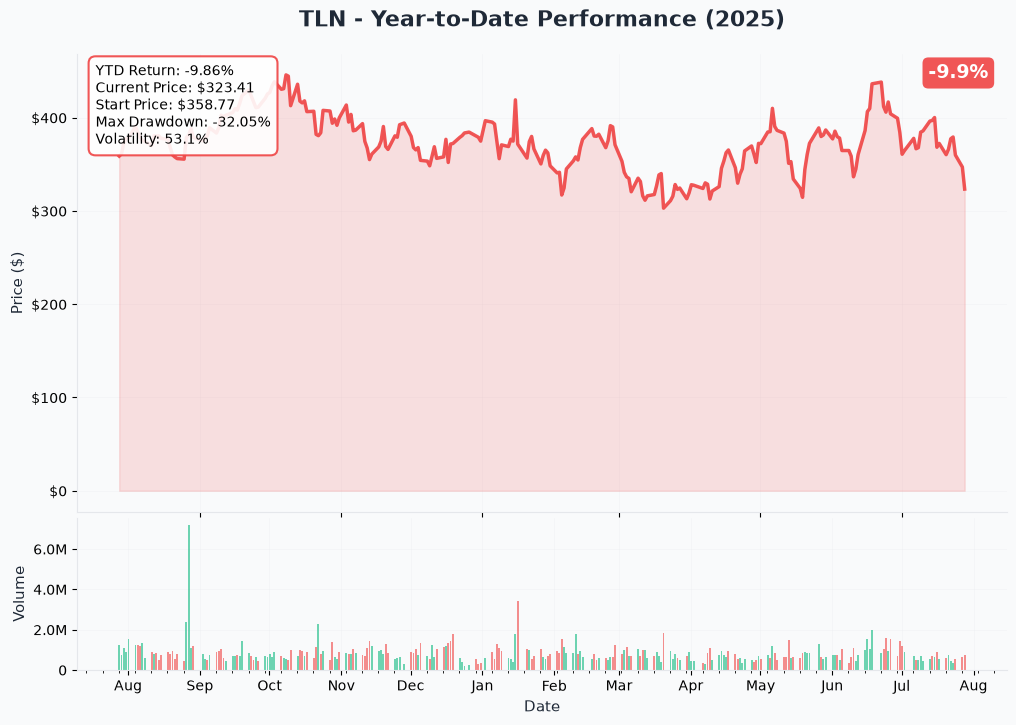
The chart tells the story in two acts: a relentless ≈3.5x climb from the $127.50 July 2024 relist to a 52-week (and all-time) high of $451.28, riding the AI-datacenter nuclear narrative — followed by a sharp ≈28% pullback to today's ≈$322.80. TLN is still up massively from its relist, but the recent trend has clearly turned lower, which is exactly the backdrop a deep-ITM put buyer would want whether betting on further downside or locking in gains on a long.
Gamma-Based Support & Resistance Analysis
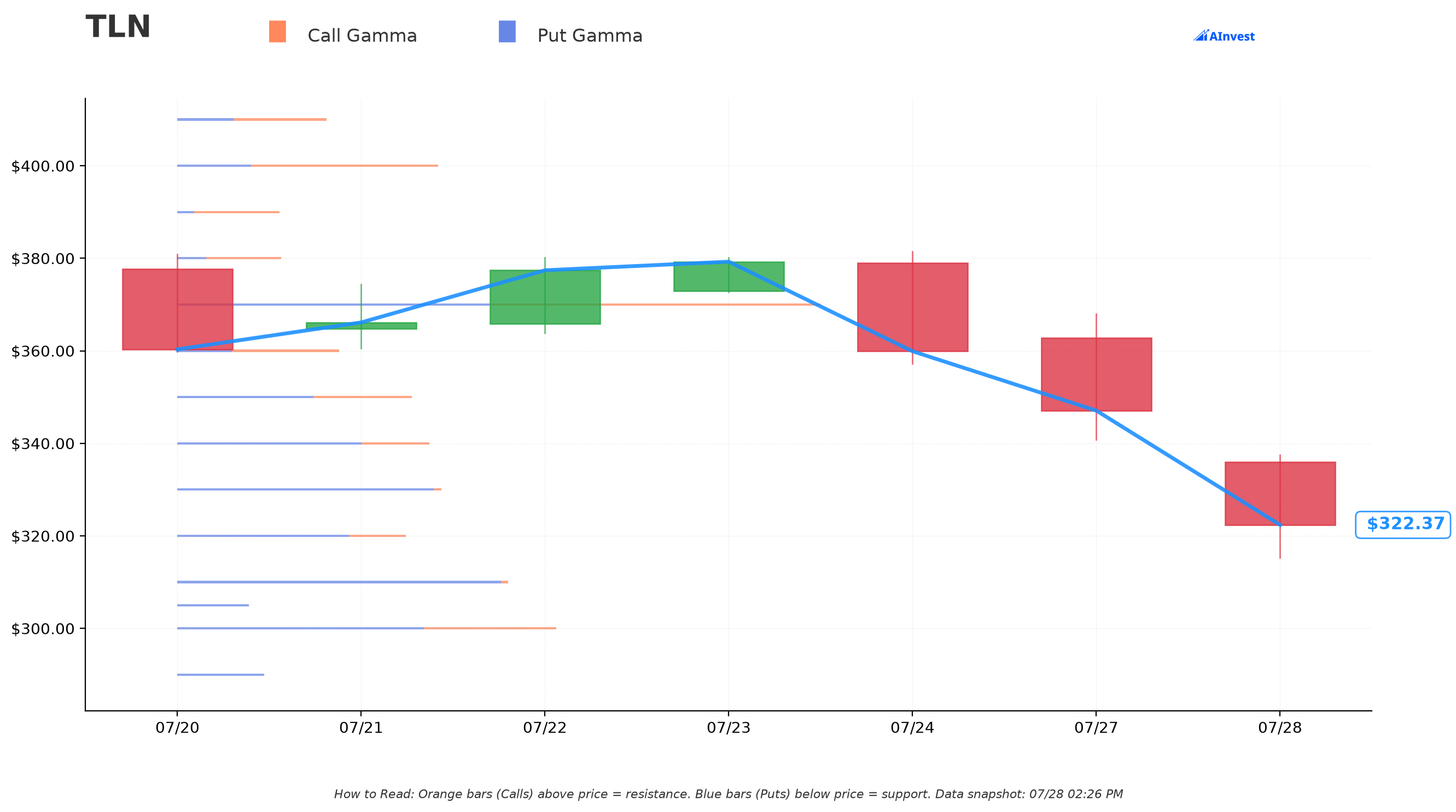
Current Price: ≈$322.5
- 🔵 $320 — immediate support, essentially right under today's spot (only ≈0.8% below), with a moderate put lean.
- 🔵 $310 support — strong (≈$0.53B total gamma, ≈3.9% below spot) and heavily put-dominated — the nearest real floor if TLN keeps sliding.
- 🔵 $300 support — the largest gamma level below spot (≈$0.61B total gamma, ≈7.0% below spot) — a major psychological and dealer-hedging level.
- 🟠 $340 / $350 / $360 — a stack of resistance (≈$0.26B–$0.41B gamma each) between roughly 5% and 12% above spot.
- 🟠 $370 — the single heaviest gamma level in the entire chain (≈$1.04B total gamma, ≈14.7% above spot) — and this is exactly where today's $10.4M put is struck. The call and put gamma here are close to balanced (net gamma only slightly positive), so this reads less like a hard directional wall and more like a magnet/pin level dealers will actively hedge around between now and December.
- 🟠 $400 / $430 — further resistance, with $430 (≈$0.44B gamma, ≈33% above spot) the most call-dominated level in the chain — the level bulls would need to reclaim to validate the Street's ≈$463–508 price targets.
What this means for traders: the $370 strike isn't just an arbitrary number — it sits directly on top of the single busiest gamma zone in the options chain, meaning dealer hedging flows around that level could add extra chop into December regardless of which way the stock ultimately goes.
Implied Move Analysis
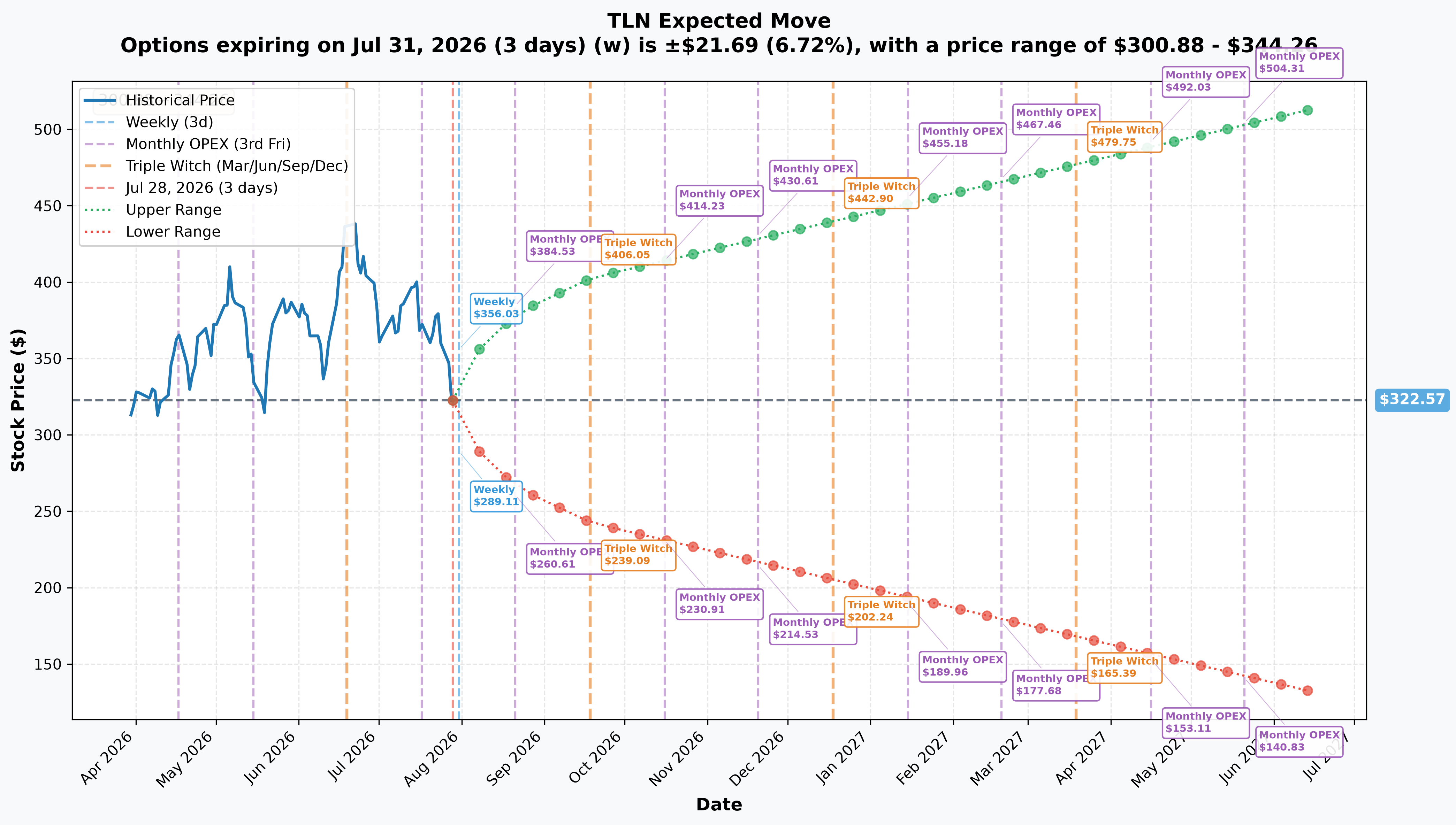
What the options market is pricing in (spot ≈$322.5):
- 📅 Weekly (July 31 — 3 days): ±6.72% (±$21.69) → range $300.88 – $344.26
- 📅 Monthly OPEX (August 21 — 24 days, spans Q2 earnings): ±17.67% (±$56.99) → range $265.58 – $379.56
- 📅 Quarterly Triple Witch (September 18 — 52 days): ±24.86% (±$80.20) → range $242.37 – $402.77
- 📅 Yearly LEAPS reference (June 17, 2027 — 324 days): ±59.39% (±$191.57) → range $131.00 – $514.14
Translation for regular folks: the options market already expects TLN could swing ≈17.7% just through the August monthly expiration — which straddles the August 5 earnings report — pushing the upper edge of that range to $379.56. Notice that's just above the $370 strike this put is written on: the market itself is pricing plausible moves that run right through this trade's strike inside a single month, which is exactly why a deep-ITM put here reads as a real, live directional (or hedging) position rather than an extreme tail bet.
🎪 Catalysts
🔥 Already Happened (Recent)
- The ≈3.5x run: relisted at $127.50 on July 10, 2024, posted a 186% total return in 2024 and ≈620% three-year post-bankruptcy return, riding to a 52-week high of $451.28 before the recent ≈28% pullback (Nasdaq).
- Q1 2026 earnings (May 5, 2026): revenue ≈$1.13B, EPS $1.33, Adjusted EBITDA ≈$473M (more than doubled year-over-year), Adjusted FCF ≈$350M (≈4x year-over-year), driven by the Freedom/Guernsey acquisitions; 2026 guidance reaffirmed at $1.75B–$2.05B Adjusted EBITDA (Motley Fool transcript).
- Cornerstone gas acquisition (January 15, 2026): $3.45B for 2.6 GW of PJM/Ohio gas plants, funded via $4B of senior notes priced April 17, 2026, expected to be >15% accretive to FCF/share through 2030 (Talen IR).
- PJM capacity auction cleared at the record $329.17/MW-day cap (+22% year-over-year) for the June 2026–May 2027 delivery year — a tailwind for Talen's uncontracted capacity revenue (RTO Insider).
- Amazon/AWS nuclear PPA expanded to up to 1,920 MW "front-of-the-meter" through 2042 (transition began April 2026), building on the 2024 sale of a 960 MW data-center campus for $650M (Talen IR).
- Analyst split near the top: Morgan Stanley raised its price target to $508 on June 24, 2026 (TipRanks/theFly), while Jefferies downgraded TLN to Hold and cut its target to $422 from $453 on July 20, 2026 — a notable caution flag right before this put print (stockanalysis ratings).
- FERC's regulatory history: FERC already rejected (2-1, November 1, 2024) the amended Susquehanna behind-the-meter interconnection agreement and denied rehearing in April 2025 — the foundational regulatory risk this entire co-location thesis carries (Utility Dive).
🚨 Coming Up (dates, distinct from the December 18 option expiry)
- August 5, 2026, after market close — Q2 2026 earnings. The single most important catalyst inside this put's window, landing ≈4.5 months before December 18. Watch 2026 EBITDA/FCF guidance updates, Cornerstone close timing, and any new hyperscaler contracting (Talen IR; GlobeNewswire).
- FERC co-location / large-load rulemaking (H2 2026): on June 18, 2026, FERC issued Show Cause orders directing PJM and other grid operators to justify or reform the tariffs governing data-center co-located load and behind-the-meter generation, with compliance proceedings running through fall 2026 — this directly governs the economics of the Susquehanna-style co-location model that underpins the entire AI-power bull case (FERC fact sheet; Utility Dive).
- Q3 2026 earnings (≈early-to-mid November 2026, not yet formally scheduled) — also lands before the December 18 expiry.
- Cornerstone acquisition close (expected 2026): completion of the $3.45B gas deal would be immediately FCF-accretive and could prompt a guidance raise (Talen IR).
- Court ruling on Talen's FERC ISA appeal: Talen is appealing FERC's rejection of the amended interconnection agreement; a decision could land in 2026 (E&E News).
- Next PJM Base Residual Auction (2027/2028): expected on PJM's compressed schedule around year-end 2026; a second consecutive clear at or near the $329.17 cap would reinforce capacity revenue (PJM 2026/2027 BRA report).
👥 How Four Different Traders Might Read This
🎲 YOLO Trader
There is nothing to follow here. The whole appeal of this print was the idea of a whale opening ≈$10.4M of leveraged downside — and open interest proved no such position was opened. What actually happened is a desk closing out and taking a loss. Copying a closing trade means putting on the exposure the other guy just paid ≈$10.4M to escape. If you want to be short TLN into August 5 earnings and the FERC fight, build that case yourself; this tape doesn't make it for you.
📈 Swing Trader
The $370 strike sits exactly on top of the heaviest gamma level in the entire chain (≈$1.04B), while spot is pinned just above the $320 and $310 support shelf. Watch the reaction into August 5 earnings: a clean break of $310/$300 on disappointing guidance confirms the bearish thesis; a hold above $340-$350 into a strong print invalidates it. The FERC co-location news flow through the fall is the second lever to watch.
💵 Premium Collector
Implied volatility here is elevated — the market is pricing a ≈17.7% swing through the August monthly expiration alone, largely on earnings and FERC-headline risk. Selling premium into that stack (especially short strikes near $370 or $310) is tempting on an income basis, but both the earnings print and any FERC ruling can gap the stock overnight — keep any short premium defined-risk and sized small.
🌱 Beginner
The key lesson here is the one this article had to learn in public: "BUY" on an options print does not mean someone is getting long. A buy can start a position (buy to open) or end one (buy to close), and those two mean opposite things. The only way to tell them apart is open interest — the count of contracts that actually exist. Here it fell 3,143 → 1,689, which is only possible if contracts were being retired, which is only possible if the buyer was closing a short. So the "bearish conviction" headline was backwards: nobody got bearish, somebody got out. Whenever you see a big options print, find the open-interest change before you decide what it means.
⚠️ Risk Factors — What This Trade Cannot Tell Us
- ✅ Open vs. close is now RESOLVED — and it was a close. Open interest fell 3,143 → 1,689 (−1,454) against a 1,388-lot print. This was a buy to close. Any reading of it as new bearish positioning is disproven.
- 🤔 The motive behind the close is genuinely ambiguous. Capitulation on a losing short put, pre-earnings risk reduction, early-assignment avoidance on a deep-ITM contract, or routine book cleanup all fit. Closing a short put can signal fresh worry about the downside or nothing at all — the tape does not distinguish them.
- 👥 Someone was on the other side, and they closed too. Retiring a contract takes both parties. A long-put holder sold out at the same moment. Neither side's view of TLN from here is visible to us.
- 📈 The AI-power bull case is very real and could squeeze this position. Consensus is still Strong Buy with an average target near ≈$463–467, Morgan Stanley's target sits at $508, the Amazon PPA and 9.8+ GW of industry-wide hyperscaler nuclear deals argue the co-location model survives, and a strong August 5 print or a favorable FERC outcome could send TLN sharply higher — hurting this put fast, especially with time decay working against it.
- 👤 We cannot see who placed this trade or why. The tape shows the mechanism (facilitated auction), the price, and the size — not the broker, the counterparty, or whether the buyer holds an offsetting long stock or long call position elsewhere.
- 📊 A single option print is one data point, not a forecast. Treat this as informative context on a genuinely two-sided, catalyst-dense name, not a prediction of where TLN trades in December.
Disclaimer: Options trading involves substantial risk of loss and is not suitable for all investors. This analysis is for educational purposes only and is not financial advice. Past performance does not guarantee future results. The trade discussed here is a single institutional options print; it does not imply the trade will be profitable or that you should copy it. Talen Energy (TLN) is a volatile, high-multiple stock facing binary earnings and regulatory catalysts — outcomes here are genuinely uncertain. Always do your own research and consider consulting a licensed financial advisor before trading.
🎯 The Bottom Line
Real talk: Someone paid ≈$10.4M for deep-in-the-money TLN puts already carrying ≈$42.55 of pure intrinsic value — and the next morning, open interest on that strike had fallen by 1,454 contracts. That single number rewrites the story. This was not conviction arriving; it was an obligation being bought back. A desk that had sold these puts, promising to buy Talen at $370 while the stock sat at $327.45, paid up to walk away from that promise and booked the loss.
What this trade tells us:
- 🔄 Open interest FELL 3,143 → 1,689 (−1,454) against a 1,388-lot print — conclusive proof of a buy to close, not a new bearish position
- 🚫 Both original readings are disproven: there is no new bearish bet and no new protective hedge — nothing was opened
- 💸 The ≈$10.4M realised a loss on a short-put obligation that was ≈$42.55 per share underwater, rather than funding fresh downside exposure
- ⚖️ Sentiment is genuinely unreadable from here: covering a short put can mean new fear of a decline, or simply a desk clearing its book before Q2 earnings and the FERC ruling
Mark your calendar:
- ✅ July 29, 2026, ≈06:30 ET — RESOLVED. Next-day open interest landed and inverted the read from a new bearish open to a close. See the ✅ RESOLVED box above.
- 📅 August 5, 2026, after close — Talen's Q2 2026 earnings report
- 📅 December 18, 2026 — this put expires
Talen's AI-power story still faces a real test through earnings and the FERC co-location fight — but this print is no longer evidence about which way it breaks. Watch how the stock behaves around the $310-$320 support shelf into August 5 instead.
About Talen Energy Corporation (TLN): an independent power producer operating ≈13.1 GW of generation including ≈2.2 GW of nuclear capacity anchored by the Susquehanna Steam Electric Station, trading at a ≈$15.5 billion market cap in the Utilities / Independent Power Producers sector as a leading AI-datacenter power play.
Published: July 28, 2026.
Last updated: July 29, 2026 — next-day OPRA open interest resolved this leg and inverted it: open interest fell 3,143 → 1,689 (−1,454) against a 1,388-lot print, proving a buy to close of an existing short put rather than the new bearish position (or hedge) originally published. The headline, quick take, flow analysis, plain-English section, trader reads, risk factors and bottom line were rewritten accordingly.