🐋 WULF ≈$16.3M Net Bull Call Spread — Desk Bets on AI/HPC Momentum Through July
📅 June 15, 2026 | 🔥 Unusual Activity Detected
⚠️ Updated 2026-06-16 — the bullish read is NOT confirmed by next-day OI. The short $33 call leg clearly opened (OI 17,654 → 94,015, Δ +76,361 — even more than the ≈70,000 sold, so others piled into $33 call-selling too), but the long $27 call leg did NOT add net open interest (OI 83,699 → 73,035, Δ −10,664 on a large existing base). A clean fresh bull call spread would show both legs opening — instead, the only new positioning that hit the book is $33 call-selling (upside-capping / overwrite), while the $27 buys churned against existing open interest. Net read: less cleanly bullish than the headline — treat this as dominated by call-selling at $33, not a confirmed directional long. See the ✅ RESOLVED box below.
🎯 The Quick Take
At 10:35:57 today, a desk structured a ≈$16.3M net-debit bull call spread on TeraWulf (WULF) — buying the ATM $27 calls and simultaneously selling the $33 calls, both expiring July 17, 2026. With WULF trading ≈$27.14, this is a defined-risk, capped-upside bet that the stock holds current levels and pushes to $33 or higher within the next 32 days — a ≈22% move from spot. The desk worked the order through a multi-leg auction (a facilitated, negotiated complex order — not a panic sweep), and they committed ≈$16.3M net to make it happen. Note: Q2 earnings land in early-to-mid August, after this July 17 expiry — so this trade is a bet on contract/capacity headlines and Bitcoin cooperation, not an earnings print.
📊 Company Overview
TeraWulf (WULF) is one of the fastest-evolving stories in the listed-infrastructure space:
- Market Cap: ≈$12.9B (mid-June 2026)
- Sector / Industry: Financials / Technology — Digital Infrastructure, Bitcoin Mining & AI/HPC Data-Center Hosting
- What they do: TeraWulf started life as a nuclear-powered Bitcoin miner at its Lake Mariner campus in New York. But the company has been in the middle of a full pivot: it now hosts AI/HPC workloads under long-term leases for hyperscaler-backed customers like Fluidstack (Google equity-backstopped), with contracted capacity exceeding 510 MW and a $12.8B+ contracted backlog. In Q1 2026, HPC lease revenue ($21M) overtook Bitcoin mining revenue ($13M) for the first time — a structural inflection.
- Google's stake: Google holds ≈14% of WULF and backstops key Fluidstack lease obligations — a seal of approval that has repeatedly triggered double-digit single-day stock jumps.
- Recent performance: Shares have surged ≈7-8x off their 52-week lows, trading near all-time highs. The stock is up enormously in 2026 on the AI/HPC pivot narrative.
💰 The Option Flow Breakdown
The Tape — June 15, 2026 @ 10:35:57: ⚡ Multi-leg Auction
| Time | Side | C/P | Strike | Exp | Volume | OI | Size | Premium | Spot | OptPx | Symbol |
|---|---|---|---|---|---|---|---|---|---|---|---|
| 10:35:57 | BUY | CALL | $27 | 2026-07-17 | 70,000 | 84,000 | 60,000 | $19M | $27.14 | $3.15 | WULF20260717C27 |
| 10:35:57 | SELL | CALL | $33 | 2026-07-17 | 70,000 | 18,000 | 60,000 | $6.7M | $27.14 | $1.11 | WULF20260717C33 |
| 10:35:57 | BUY | CALL | $27 | 2026-07-17 | 10,000 | 84,000 | 10,000 | $3.2M | $27.14 | $3.15 | WULF20260717C27 |
| 10:35:57 | SELL | CALL | $33 | 2026-07-17 | 10,000 | 18,000 | 10,000 | $1.1M | $27.14 | $1.11 | WULF20260717C33 |
| 10:35:57 | BUY | CALL | $27 | 2026-07-17 | 76,000 | 84,000 | 5,906 | $1.9M | $27.14 | $3.15 | WULF20260717C27 |
Flow summary:
- 🟢 Total $27C bought: 75,906 contracts across three prints → ≈$24.1M gross premium paid
- 🔴 Total $33C sold: 70,000 contracts across two prints → ≈$7.8M gross premium collected
- 💰 NET DEBIT: ≈$16.3M — this is the capital at risk and the headline premium
Flow type: ⚡ Multi-leg Auction — this was a facilitated, exchange-routed complex order (a worked combo) that printed simultaneously across both strikes. This is NOT a lit sweep and NOT a block cross. A desk sent a paired order to an exchange auction that found price improvement. The 27C leg printed ≈80% of the way through the bid/ask (buy-side aggressor); the 33C leg printed at ≈18% across (near the bid — the desk sold it cheap to fund the 27C buy). Together they define a textbook bull call spread.
✅ RESOLVED — Next-Day OI Says This Was Dominated by $33 Call-Selling (2026-06-16)
The next-day OPRA snapshot settled the provisional flag — and it does not confirm a clean bullish open:
| Leg | Prior OI (EOD 6/12) | Resolving OI (EOD 6/15) | Δ | Read |
|---|---|---|---|---|
| $27 call (long leg) | 83,699 | 73,035 | −10,664 | Did not open — net OI fell on a large existing base; the buys churned against / closed existing $27C interest |
| $33 call (short leg) | 17,654 | 94,015 | +76,361 | Opened big (more than the ≈70,000 sold — others piled into $33 call-selling too) |
What this means: a genuine fresh bull call spread needs both legs to open. Here only the short $33 call opened — the long $27 leg added no net open interest. So the real new positioning that hit the book is selling $33 calls (capping upside / call overwrite), not a confident long. The $27 buys most likely offset or rolled existing $27C open interest rather than establishing a fresh long.
Net read: the "bull call spread" headline overstates it. The dominant confirmed flow is $33 call-selling, which is neutral-to-mildly-bearish on the upside (someone is willing to cap WULF at $33). Treat this as upside-capping / overwrite activity, not a clean directional bet that WULF rips to $33.
🤓 What This Actually Means — Plain English
Let's unpack this step by step.
What is a bull call spread?
Instead of just buying WULF calls outright (which would be expensive on a stock with ≈28% implied move), the desk did something smarter: they bought the $27 calls and sold the $33 calls at the same time. The $33 calls they sold collected premium ($1.11/share × ≈70,000 contracts × 100 = ≈$7.8M) that went right back into their pocket, offsetting the cost of the $27 calls they bought.
The math in plain English:
| What the desk paid | What the desk collected | Net cost (capital at risk) |
|---|---|---|
| ≈$24.1M (bought $27C) | ≈$7.8M (sold $33C) | ≈$16.3M net debit |
That ≈$16.3M is the headline. NOT $24.1M gross. Gross double-counts the spread — the desk will never lose the full $24.1M because the $7.8M they collected is theirs to keep no matter what.
The three scenarios at July 17 expiry:
- 📈 Bull case — WULF above $33: Maximum profit. The spread is worth the full $6 width ($33 − $27) × 75,906 contracts × 100 = ≈$45.5M gross value. Net gain ≈ $45.5M − $16.3M = ≈$29.2M profit on the ≈$16.3M invested. That's roughly a 1.8× return in 32 days.
- 🎯 Breakeven — WULF at ≈$29.04: At breakeven, the $27C has gained back the ≈$2.04 net debit per share ($16.3M / (≈75,906 contracts × 100 shares) ≈ $2.15/share average net cost per share across all three clips). Stock needs to be ≈$29 to start turning a profit.
- 📉 Bear case — WULF below $27 at expiry: Maximum loss. Both legs expire worthless. The desk loses the full ≈$16.3M net debit — and nothing more. That's the beauty of a defined-risk spread: no matter what happens, the loss is capped.
Why a spread and not straight calls?
At ≈28% implied move for the monthly expiry, WULF options are NOT cheap. Buying 75,906 of the $27C outright would have cost ≈$24.1M. The desk reduced that by ≈32% (to ≈$16.3M net) by selling the $33C upside above the level they care about. The tradeoff: they cap their maximum gain at $33. But with Morgan Stanley's $66.50 price target pointing to ≈$66+, the near-term catalyst case is really about "does WULF reach $33 in 32 days" — and the spread efficiently expresses exactly that view.
Order type: BTO (Buy to Open) on the $27C / STO (Sell to Open) on the $33C — provisionally ⏳, pending next-day OI confirmation on the $27C leg.
📈 Technical Setup / Chart Check-Up
YTD Performance
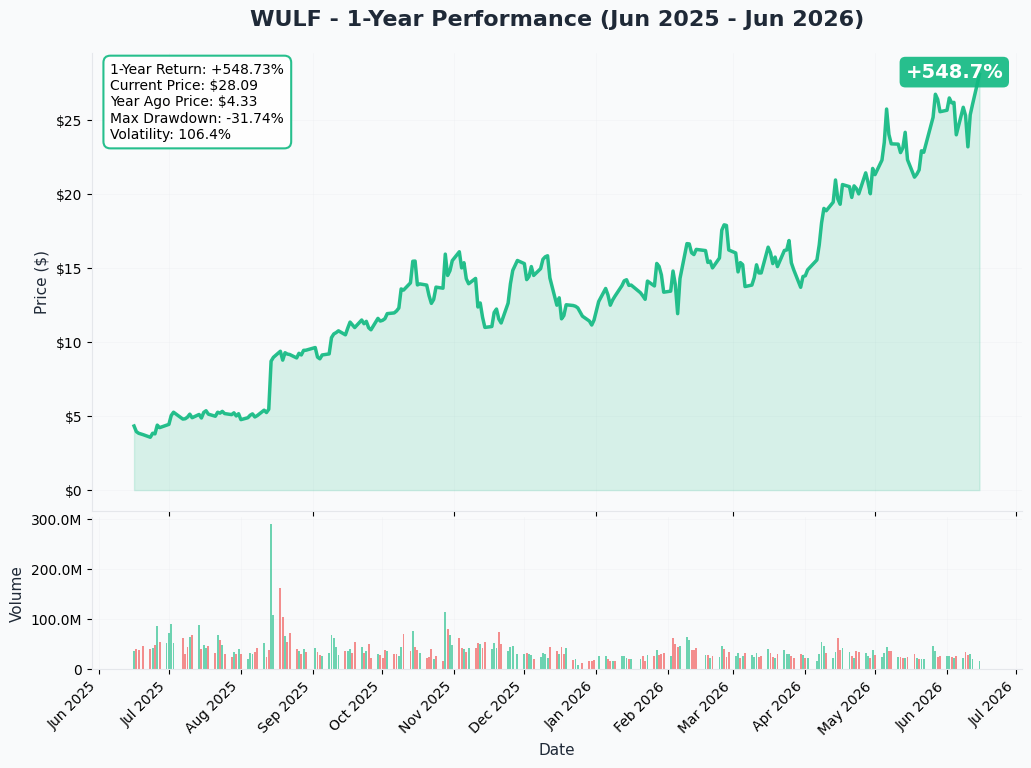
WULF has been one of the most explosive stories on the tape in 2026. Shares have surged ≈7-8x off their 52-week lows of $3.40, trading near the $27.46 52-week high as of today. The trajectory is driven almost entirely by the AI/HPC pivot narrative: Google's ≈14% stake, the $9.5B Abernathy JV with Fluidstack, and sequential capacity energizations have each driven double-digit single-day moves.
Key observations:
- 📈 Stock is near all-time highs — momentum is strong but the easy gains may be behind us near-term
- 📊 The revenue-mix flip (HPC $21M > Bitcoin mining $13M in Q1) changed the narrative from "miner" to "data-center landlord" — that flip is what retail radars started tracking
- 🎯 With the low end of analyst consensus at ≈$30.85, there's modest upside priced in at spot — but Morgan Stanley's $66.50 target suggests Street outliers see a lot more runway if the buildout executes
Gamma-Based Support & Resistance
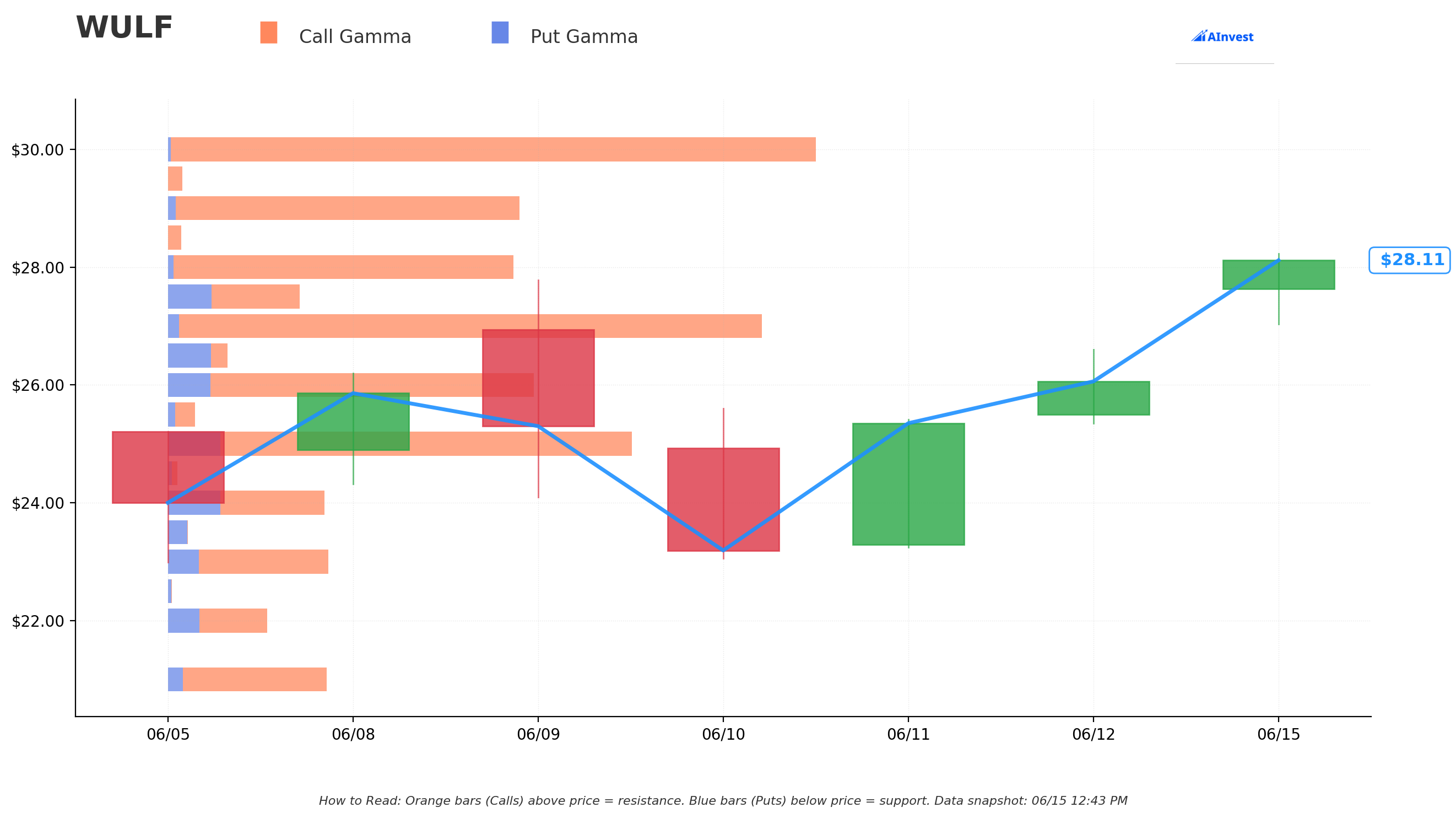
Current Price: ≈$28.13
The gamma exposure map shows an interesting structure for a stock at all-time highs:
🔵 Support Levels (Put Gamma / Call Gamma floors below price):
- $27.00 — Very Strong Support. This is the dominant gamma floor and — not coincidentally — the long strike the desk just bought. With call gamma GEX of 21.1 at $27, market makers are heavily long calls here and will tend to buy dips toward $27. The desk chose their long strike at the gamma magnet. Breaking below $27 would remove this support and accelerate a move lower.
- $25.00 — Secondary Support. GEX 16.8 — a meaningful secondary floor ≈11% below current price. If $27 fails, $25 is the next catch.
🟠 Resistance Levels (Call Gamma Walls Above Price):
- $30.00 — Very Strong Resistance. The biggest gamma wall on the map (GEX 23.4 — even bigger than the $27 support). Market makers are short gamma at $30, meaning they'll sell into rallies toward $30 and buy dips away from it. This is the first ceiling the bull thesis needs to crack. A sustained close above $30 on volume would be a significant technical event — it would remove the magnetic pull and open the door toward $31-$33.
- $29.00 — Near-term Speed Bump. GEX 12.7 — a secondary resistance just above current price. The desk needs to clear $29 first before $30 comes into play.
- $32.00 / $33.00 — Lighter Resistance. GEX drops significantly at $32 (10.1) and $33 (5.6) — notably, the $33 short strike of the spread has one of the lighter gamma walls in the chain. Once the stock clears the heavy $30 wall, the path from $30 to $33 should be relatively cleaner.
Translation for traders: WULF is pinned between $27 gamma support and $30 gamma resistance. For this spread to hit max profit, the stock needs to break the $30 wall convincingly and then push through the $31-$33 zone where gamma thins out. The good news: the $33 short strike is in a relatively light-gamma zone — which means there's less mechanical resistance there once $30 clears.
Implied Move Analysis
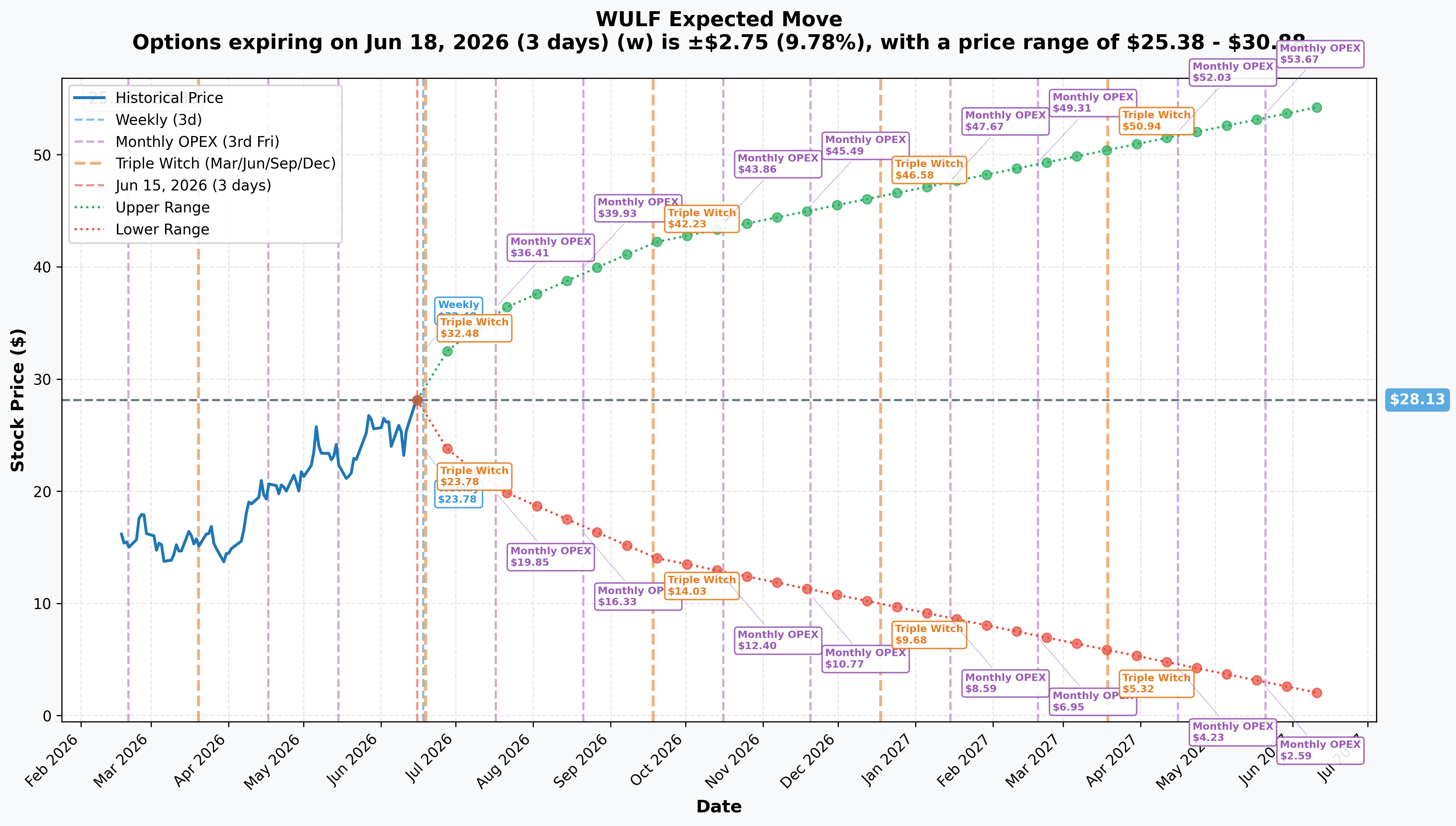
The options market is pricing substantial movement across all time frames:
- 📅 Weekly (2026-06-18, 3 days): ±$2.75 (±9.78%) → Range $25.38 – $30.88
- 📅 Monthly / This Expiry (2026-07-17, 32 days): ±$7.89 (±28.04%) → Range $20.24 – $36.02
- 📅 Quarterly (2026-09-18, 95 days): ±$14.05 (±49.94%) → Range $14.08 – $42.18
The monthly implied move is ±$7.89 — with an upper band of $36.02. The $33 short strike sits comfortably inside that upper band ($36.02). In other words, the options market itself is already pricing in enough volatility that $33 is achievable before July 17. The desk's capped upside at $33 is not an "impossible" target — it's within what the market assigns a realistic probability to.
What this means practically: the spread captures the most valuable part of the potential move ($27 → $33, a 22% rally) while staying within the implied-move cone. The desk gave up everything above $33 (which is outside the median probability) to dramatically reduce their net cost.
🎪 Catalysts
Already Happened (The Foundation)
Q1 2026 Earnings — HPC Overtakes Bitcoin Mining (Reported May 8, 2026) Total revenue $34.0M; HPC lease revenue $21.0M (≈60%) for the first time exceeded Bitcoin mining revenue $13.0M — the structural inflection the bull thesis has been waiting for. Revenue missed ≈$36.6M consensus, but the mix shift was the signal. Cash on hand ≈$3.1B for the buildout; adjusted EBITDA was still negative at −$4.1M and net loss was $(427.7)M — mostly non-cash mark-to-market on financing instruments, but a real headline risk.
Google Deepens Stake to ≈14% Google's equity position in WULF has grown from an initial 8% to ≈14%, each increment announced as part of expanding partnership agreements. The initial $3.7B Lake Mariner deal jumped the stock 22% in a single day. Google's stake is not passive — it backstops ≈$1.3B of Fluidstack's lease obligations at the Abernathy JV.
$9.5B Abernathy, TX Joint Venture (Google-Backed Fluidstack) 168 MW critical IT load, 240 MW gross, 25-year commitment, TeraWulf 51% stake. Project-level financing was successfully priced in December 2025. This is the headline generator that made WULF a household name in AI infrastructure. Commissioning targeted for late 2026 — after the July 17 expiry, but every CB energization update gets priced in early.
Morgan Stanley PT Raised to $66.50 (June 1, 2026) Morgan Stanley raised its price target from $42 to $66.50 on June 1 — the most aggressive Street target and a direct catalyst for the current move toward all-time highs. The $33 spread short strike is barely halfway to Morgan Stanley's target.
Kentucky + Maryland Acquisitions (February 2, 2026) ≈1.5 GW of additional power capacity — Hawesville (≈480 MW immediate), Chesapeake (≈210 MW, expandable to 1 GW). Power assets are the real moat in AI infrastructure.
Muskie Data Campus, Eastern Kentucky (Announced May 26, 2026) 1+ GW hyperscale HPC development site; initial 500 MW ramping from 2H 2028. This is beyond the option window but signals the long-term capacity ambition.
Upcoming Catalysts Before July 17 (The Window That Matters)
CB-3 Energization Confirmation (Lake Mariner) — Near-Term CB-3 targeted mid-May 2026; any "energized and rent-commencing" press release is a direct positive catalyst. Sequential energizations have driven material single-day moves in the past.
CB-4 Ramp (168 MW, Lake Mariner) — Q3 2026 Opening CB-4 is expected to begin energizing in Q3 2026, with the window opening in July. A pre-July-17 energization update would be a meaningful catalyst — this is one of the realistic near-term triggers the desk may be betting on.
New Contract / Hyperscaler Announcements Management targets 250–500 MW/year of new contracted capacity. Given the cadence (Aug/Oct 2025, Feb 2026, May 2026), an additional announcement before mid-July is realistic. Each major deal has historically driven a 10%+ single-day move.
⚠️ Note: Q2 Earnings Are AFTER Expiry Based on the Q1 cadence (reported May 8), Q2 2026 earnings most likely land in early-to-mid August — after the July 17 option expiry. The desk is NOT playing an earnings catalyst here. This trade lives or dies on Bitcoin price, capacity energization headlines, and potential new contract announcements before mid-July.
🎲 4-Reader Interpretation
🚀 YOLO Trader
This spread is basically already built for you — it's exactly the structure a high-conviction bull would put on. If you want to express the same directional view, you could replicate the $27/$33 bull call spread on a smaller scale: buy the Jul-17 $27C and sell the Jul-17 $33C for a net debit of ≈$2.04–$2.15/share per spread (so ≈$204–$215 per 1-lot). Max gain if WULF hits $33 by July 17: ≈$6 − net debit = ≈$3.85–$3.96/share, roughly 1.8–1.9× your money. Max loss: the net debit you paid. Risk: 32 days is not a lot of runway — needs WULF to clear the $29/$30 gamma walls fast.
📊 Swing Trader
The $29 and $30 gamma walls are your key near-term levels. Watch for WULF to clear $29 first, then attempt $30. A confirmed close above $30 on volume would signal the gamma resistance is breaking — that's your green light that the $33 target is in play before July 17. The weekly implied move upper band of $30.88 tells you the options market thinks $30 is the realistic ceiling this week — so if you want to swing this story, wait for evidence the $30 wall cracks before entering aggressively. Near-term stop: a close below $27 gamma support would invalidate the near-term bull setup.
🛡️ Premium Collector
With WULF pinned in the $27–$30 gamma corridor and implied volatility elevated at ≈28% for the monthly, selling premium around the edges could work. A cash-secured put at the $25 secondary support (≈11% OTM) in July expiry collects income while you wait for the setup to develop. The $27 gamma wall should act as a magnetic floor that makes the $25 put attractive for premium sellers. Caveat: this is a momentum name near all-time highs with Bitcoin sensitivity — it can move violently. Size accordingly and stay away from short positions on the call side while momentum is this strong.
🌱 Entry-Level / Beginner
Here is what this trade does in plain English: a desk paid ≈$16.3M net to make a 32-day bet that WULF goes from ≈$27 to ≈$33. They did it with a "bull call spread" — which means they bought low calls ($27 strike) and sold high calls ($33 strike) at the same time. The sell partially paid for the buy, reducing their risk from ≈$24M down to ≈$16.3M.
Here's the deal: they make money if WULF goes above $29 (breakeven) by July 17. They make maximum profit if WULF reaches $33 or above (≈1.8× their money). They lose up to ≈$16.3M if WULF stays below $27. They can't lose more than that — the spread caps both their gain and their loss. This is called "defined-risk" — a smart structure for a high-volatility stock where you want to bet on upside but don't want to risk everything on a stock that can move 28% in either direction.
⚠️ Risk Factors
Options trading involves substantial risk of loss and is not suitable for all investors. Specific risks for this trade and thesis:
No Earnings Catalyst in the Window This is the #1 structural constraint. Q2 earnings most likely land in early-to-mid August — after the July 17 expiry. The spread therefore relies on headlines, capacity energizations, and Bitcoin price, not a scheduled catalyst. That makes the timing less predictable and the trade more dependent on news flow.
Bitcoin Price Sensitivity Mining revenue collapsed ≈50% to $13M in Q1 2026 as hash prices fell to ≈$29/PH/s/day. Even though HPC now leads revenue, Bitcoin still drives ≈38% of the top line and a lot of sentiment. A sharp BTC drawdown between now and July 17 could stall the rally short of $33.
The $30 Gamma Wall Is a Real Obstacle The largest gamma concentration on the entire chain is at $30 (GEX 23.4) — above the current price of ≈$28.13. That wall will create mechanical selling pressure as the stock approaches $30. Clearing it requires a genuine catalyst-driven move, not just drift.
Stock Is at All-Time Highs — Much Good News May Be Priced In WULF has risen ≈7-8x from its lows. The consensus low-end analyst target of ≈$30.85 is only modestly above spot. The $33 short strike requires a ≈22% move from current levels in 32 days — achievable, but a high bar for a stock that has already run enormously.
Heavy Debt Load and Dilution Overhang TeraWulf carries ≈$2.5B convertible notes (including an $850M 1.00% issue due 2031 and a $900M 0.00% issue due 2032) plus ≈$3.2B senior secured notes. The capped-call protection on the converts has an initial cap of $18.76 — well below current spot — meaning dilution is a real risk if the stock remains elevated through conversion windows.
Q1 Net Loss Was $(427.7)M Yes, most of it was non-cash mark-to-market on financing instruments — but the headline is a tough number. In a risk-off tape, unprofitable capital-intensive AI infrastructure names can reprice fast.
⏳ Open/Close Uncertainty on the $27C Leg As flagged above, the largest $27C clip (60,000 contracts) has size ≤ prior OI (84,000). The bullish read (BTO opening) depends on next-day OI confirmation. If OI falls instead of rising, the thesis inverts: today's trade was exiting a prior long, not opening a new one.
What the Tape CANNOT Tell Us: We know the mechanism (multi-leg auction), the size, the direction on each leg, and the net cost. We do not know the desk's identity, whether this is a standalone position or part of a larger hedged portfolio, their stop levels, or whether the $27C leg is definitely an opening buy. We interpret the tape; we don't read minds.
🎯 The Bottom Line
Here's the deal: a desk just put on a ≈$16.3M net-debit bull call spread on TeraWulf — buying the ATM $27 calls, selling the $33 calls, with 32 days on the clock. They need a ≈22% rally by July 17. It's a defined-risk bet, not a blank check.
The setup makes sense given the context: WULF has Morgan Stanley pointing to $66.50, Google owns ≈14% of the company, and sequential CB energizations have been reliable near-term catalysts. The $33 short strike sits inside the monthly implied-move upper band ($36.02) — so even the options market is saying $33 is within reach.
The honest counterpart: there's no earnings print before July 17 to act as a binary catalyst, the $30 gamma wall is a real near-term ceiling, and WULF has already run 7-8x off its lows. The spread depends on deal flow and Bitcoin cooperation over the next month — both are uncertain.
What to watch:
- 📅 June 16, ≈06:30 ET: OPRA OI snapshot on WULF $27C — confirms open vs. close on the key leg
- 📅 Any day before July 17: CB-3 final energization confirmation or CB-4 ramp update from Lake Mariner — direct positive catalyst
- 📅 Any day before July 17: New hyperscaler contract or capacity announcement — historically a 10%+ move trigger
- 📅 Watch $30: That's the gamma wall the bull thesis must clear. A clean close above $30 on volume changes the near-term picture.
- 📅 Watch $27: That's the gamma support floor and the long strike of the spread. A break below $27 suggests momentum has stalled and the spread will likely expire worthless.
- 📅 July 17, 2026: WULF $27C and WULF $33C expiry — verdict day
If you're bullish on WULF: The spread structure makes a lot of sense at current implied volatility levels — it costs much less than buying calls outright while still capturing most of the upside within the probable range. The $29.04 breakeven (≈$27 + ≈$2.04 net cost) is modest; the position turns profitable with just a 7% rally from here. Size any trade to what you're comfortable losing 100% of if WULF stalls below $27.
If you're watching from the sidelines: The $27 gamma support is your entry signal to watch — if the stock dips toward $27 and holds, that's a buy-the-dip level the market will tend to defend. The weekly implied move range caps near-term upside at ≈$30.88, so expect choppy action between $27 and $30 this week before any bigger move develops.
A ≈$16.3M net bet — structured, defined-risk, pointed squarely at the capacity-and-headline story between now and July 17. The options market is pricing in enough volatility that $33 is achievable; the question is whether a near-term catalyst arrives before the clock runs out.
Disclaimer: Options trading involves substantial risk of loss and is not suitable for all investors. This analysis is for educational and informational purposes only and does not constitute financial advice. Past unusual options activity does not guarantee future returns. The WULF July 17, 2026 $27/$33 bull call spread has a maximum loss equal to the net debit paid (≈$2.04–$2.15/share per spread), and can expire worthless — resulting in 100% loss of premium. The $27C open/close classification is provisional ⏳ and will be confirmed by next-day OPRA open interest data (≈06:30 ET June 16). Always conduct your own due diligence and consider consulting a licensed financial advisor before making any trading decisions. This trade does NOT capture a Q2 earnings catalyst — that event falls after the July 17 expiry.
Last updated: June 16, 2026