🔄 WYNN $9.2M Roll — CONFIRMED: the September $90 Position Was Closed to the Contract, and Rolled 3 Months Out
✅ Updated 2026-08-06 pre-market — the one provisional leg is now proven, and the roll thesis was right. We predicted next-day September open interest of ≈100–150 (down ≈16,500) if the sale was a close. It printed 235 — down 16,392, or 99.3% of the 16,500-lot sale. The December leg confirmed too, 630 → 18,043. This is a calendar roll, proven on both sides; the provisional ⏳ STC marker on the September leg is retired. See the ✅ RESOLVED box below.
📅 2026-08-05 | 🤝 Multi-Leg Floor Trade Detected — A Calendar Roll, Not a New Bet
🎯 The Quick Take
One trading day after Wynn Resorts beat Q2 earnings and popped ≈5%, a desk sold 16,500 September $90 calls and bought 18,000 December $90 calls — same strike, same right, just three months further out — in a single negotiated multi-leg floor trade at 14:40:41 ET. The sold size matches 99.2% of everything open at that strike, and the package's net delta barely moved. This is not a fresh $31.6M bullish bet; it's an existing, long-standing bullish position paying $9.2M net to keep running through Wynn's next earnings report.
📊 Company Overview
Wynn Resorts, Limited (WYNN) operates luxury integrated casino resorts. Founded in 2002 by Steve Wynn, the company runs four megaresorts today — Wynn Macau and Wynn Palace in Macao's Cotai district, and Wynn Las Vegas / Encore on the Las Vegas Strip — plus Encore Boston Harbor in Massachusetts. It's also building Wynn Al Marjan Island, a 40%-owned joint venture in Ras Al Khaimah, UAE, targeted to open in September 2027.
- Sector / Industry: Consumer Discretionary — Casinos & Gaming (SIC classification: Hotels & Motels)
- Market cap: ≈$10.1–10.5 billion
- Employees: ≈28,500
- Spot at the time of this trade: $102.41 (stock closed the prior session at $97.60 and traded as high as ≈$109 intraday on the earnings pop before settling near $102.5)
- 52-week range: $92.52 – $134.72
💰 The Option Flow Breakdown
📊 What Just Happened — 🤝 Multi-Leg Floor Trade
Both legs printed together at 14:40:41 ET, negotiated on the exchange floor as a genuine multi-leg package — brokers arranged this trade with a known counterparty rather than sweeping the lit order book. There's no urgency implied by the mechanism itself; this was facilitated, not chased.
| Time | Symbol | Buy/Sell | Call/Put | Expiration | Premium | Strike | Volume | OI (prior) | Size | Spot | Option Price | Delta | Option Symbol |
|---|---|---|---|---|---|---|---|---|---|---|---|---|---|
| 14:40:41 | WYNN | BUY | CALL | 2026-12-18 | $31,590,000 | $90 | 18,015 | 630 | 18,000 | $102.41 | $17.55 | 0.7803 | WYNN20261218C90 |
| 14:40:41 | WYNN | SELL | CALL | 2026-09-18 | $22,357,500 | $90 | 16,503 | 16,627 | 16,500 | $102.41 | $13.55 | 0.8638 | WYNN20260918C90 |
Net: a $9,232,500 DEBIT. They paid $31.59M to open the December calls and collected $22.36M closing out the September calls.
The tell is the package delta. Buying 18,000 December $90 calls at a 0.7803 delta adds +1,404,540 shares of equivalent exposure. Selling 16,500 September $90 calls at a 0.8638 delta removes −1,425,270 shares. Net change: ≈−20,730 shares — a swing of less than 1.5% on a position worth roughly $144M in stock-equivalent terms. Whoever holds this book didn't get meaningfully more or less bullish today. They bought time.
✅ RESOLVED — the Next-Day OI Confirmation Is In, and Both Legs Are Proven
The December leg is proven. 18,000 contracts printed against just 630 prior open interest — a ≈28.6x ratio. There is no ambiguity here: this is a fresh BTO (buy to open), full stop.
The September leg is where the tape hits its limit — and here's exactly why we still lean hard toward a close. The rule we follow: size ≤ prior OI means the same-day tape alone cannot prove open vs. close, so we won't assert it as fact. But the circumstantial case here is about as strong as this kind of read gets:
- 16,500 sold against 16,627 prior OI = 99.2% of every contract open at this strike. A brand-new short seller landing on a number that close to the entire existing position, on the exact day a matching (bigger) December position opens at the identical strike, would be an extraordinary coincidence.
- Open interest at this September $90 strike has sat flat near ≈16,600 since at least May 20 — a long-standing position, not something built in the last few days that a new seller would be fading.
- The package delta barely moved (≈−20,730 shares, <1.5%) — consistent with closing one leg and opening a near-equivalent replacement, not with adding a fresh, separate short-call position on top of an unrelated long.
On the day we called this a strong inference, not proof, and marked the September leg ⏳ STC (provisional). The next-day OPRA open interest has now settled it — in favor of the close.
| Leg | Baseline OI (Aug-5 snap) | Predicted | Actual (Aug-6 snap) | Δ | Print size | Δ as % of print | Day vol | Verdict |
|---|---|---|---|---|---|---|---|---|
| Sep-18-2026 $90 C (sold 16,500) | 16,627 | ≈100–150 | 235 | −16,392 | 16,500 | ≈−99.3% | 16,503 | ✅ CLOSE (STC) — proven |
| Dec-18-2026 $90 C (bought 18,000) | 630 | ≈18,600 | 18,043 | +17,413 | 18,000 | ≈+96.7% | 18,034 | ✅ OPEN (BTO) — proven |
The September strike was effectively erased. Open interest went from 16,627 to 235 — a 98.6% reduction of the entire line, on day volume of 16,503. We predicted ≈100–150 and it landed at 235, well inside the spirit of the call. The alternative we warned about — September OI staying elevated or falling only partially, which would have meant part of the sale opened a genuine new short call — did not happen at all.
The December strike was built from nothing. 630 contracts became 18,043, adding 17,413 against an 18,000-lot buy (96.7%).
This is now a proven roll, not an inferred one. Both halves of the trade behaved exactly as a roll must: one strike extinguished, an equivalent-and-slightly-larger strike created three months further out, in the same session, at the same $90 level. The circumstantial case the article laid out — 99.2% open-interest overlap, months of stable prior OI, near-flat package delta — has been confirmed by the only evidence that could confirm it.
What remains unprovable. Open interest cannot tell us the roller's identity, their original cost basis on the September calls, or whether an offsetting stock or hedge position sits behind the package. Nor can it tell us why December was chosen over another expiry.
🤓 What This Actually Means — Plain English
This is a calendar roll — selling a call you already own to close it, then buying a similar call further out in time to open a new one. Same strike both times ($90), same right (calls), just three more months tacked on (September 18 → December 18), and a modestly bigger size (16,500 → 18,000 contracts, +9.1%).
Think of it like an interest-only loan that's coming due, where the borrower goes back to the same lender and simply extends the term. They're not making a new bet on Wynn going up — they already had that bet on, and it's working (both calls are deep in the money: spot $102.41 against a $90 strike is $12.41 of pure intrinsic value on each leg). Rolling it means:
- STC — sell to close 16,500 September $90 calls, banking $22.36M of the value that's built up in that position.
- BTO — buy to open 18,000 December $90 calls, redeploying that cash plus $9.23M more into an equivalent position that now has until December 18 to keep working, instead of expiring September 18.
Why the delta math matters more than the $31.6M headline. With deltas of 0.86 (September) and 0.78 (December), these are not lottery-ticket options — they behave almost like owning the stock outright, just with leverage and a fixed expiration. The near-flat ≈−20,730-share change in the package's delta is the clearest evidence that this wasn't a new directional decision. It was duration management: paying roughly $560 per rolled contract ($9.23M ÷ 16,500) to keep a ≈$144M stock-equivalent position alive for another quarter.
Why now matters. This crossed the day after Wynn's Q2 beat and UAE timeline reaffirmation sent the stock up ≈5%. Someone with a large, working bullish position chose the day after good news to extend it — not to take the win and walk away. That's a vote of continued confidence, not (yet) a hedge or an exit.
This was negotiated, not swept. A multi-leg floor trade means brokers arranged both legs together with a counterparty on the exchange floor — a deliberate, pre-agreed transaction, not an aggressive lit-market chase. Treat it as position management by size, not as a signal of urgent new conviction.
📈 Technical Setup / Chart Check-Up
YTD Performance Chart
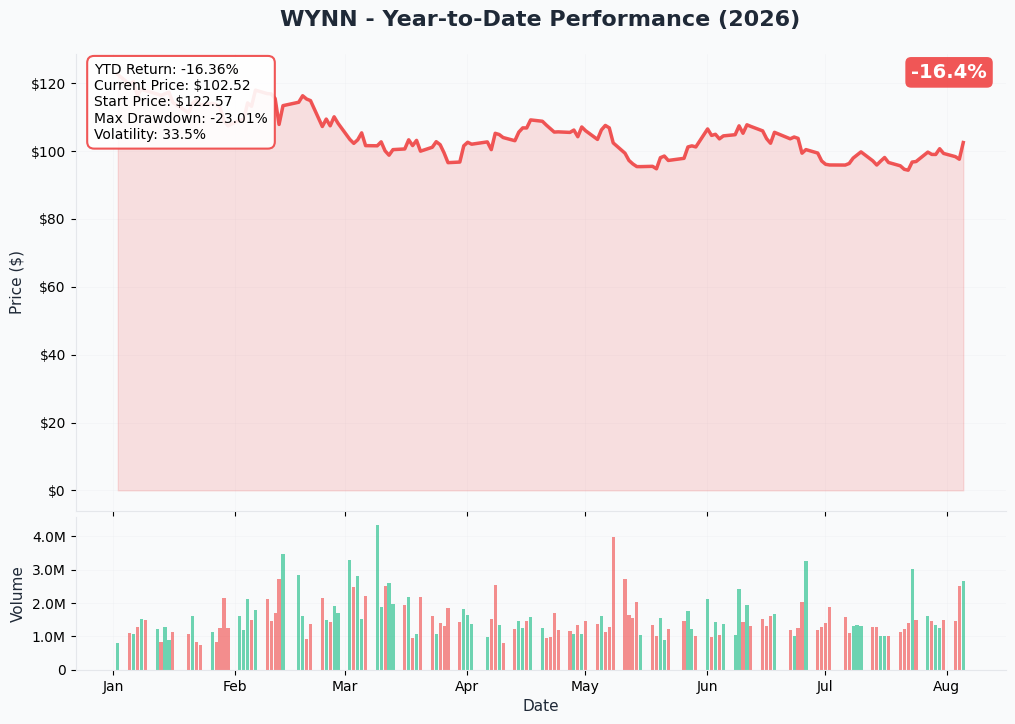
WYNN is down ≈16.4% year-to-date in 2026 — from a $122.57 start price to $102.52 — with a max intra-year drawdown of ≈23.0% and realized volatility around 33.5%. The stock spent most of the spring and summer chopping in a $95–$110 band before this week's earnings pop. Zooming out further, the 52-week range is $92.52 – $134.72, so even after Tuesday's ≈5% jump, WYNN is trading in the lower half of its trailing-year range, not near a breakout high.
🔵🟠 Gamma-Based Support & Resistance Analysis
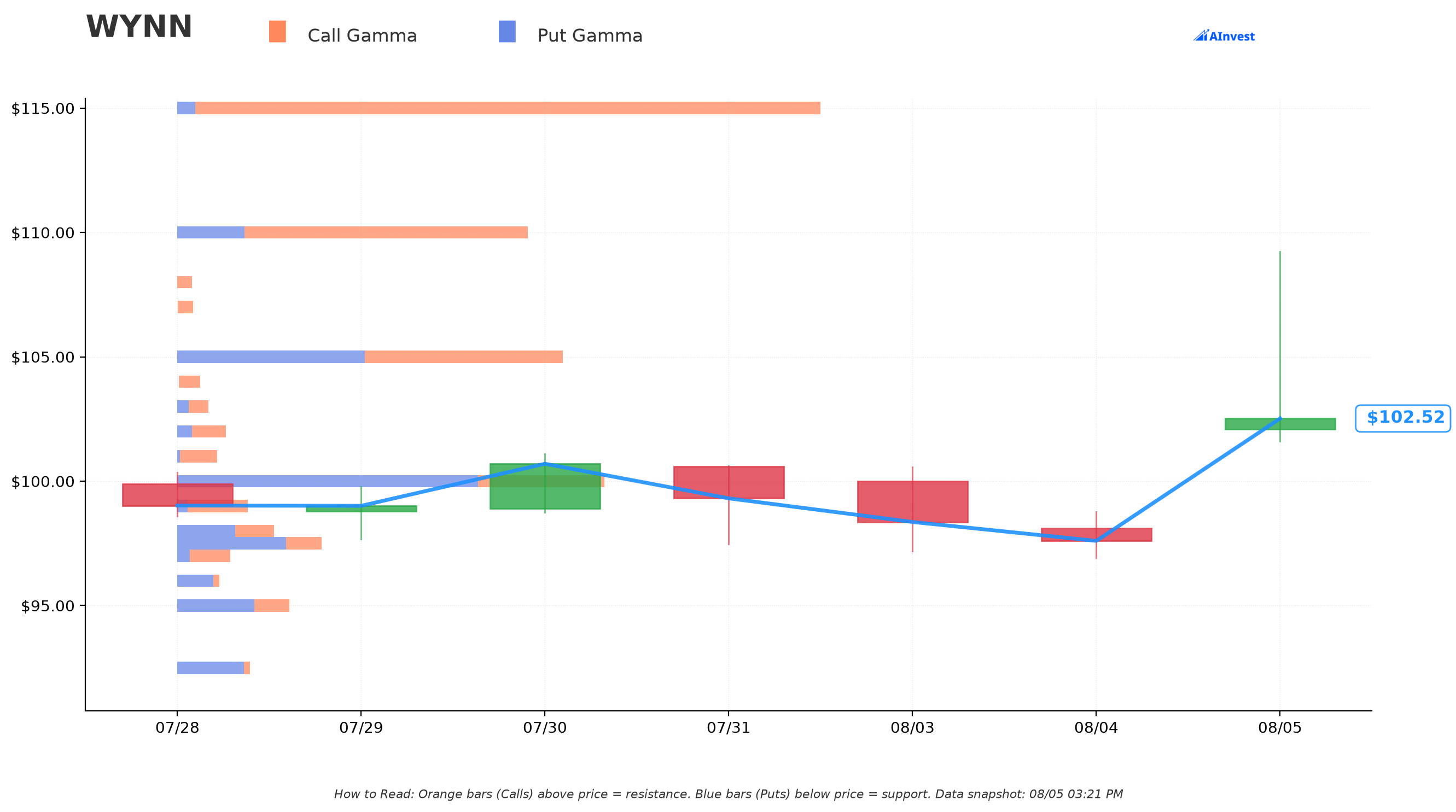
Current price: $102.52. Reading the last week and a half of dealer positioning:
🟠 Resistance (call gamma above spot):
- $105 — modest, mixed level (total gamma ≈2.71), essentially neutral chop territory just above spot
- $110 — call-tilted, total gamma ≈2.47 (net call gamma +1.52)
- $115 — call-tilted, total gamma ≈4.53 (net call gamma +4.28)
- $120 — the single biggest gamma cluster on the board, total gamma ≈7.01 (net call gamma +6.76), ≈17% above spot — this is the real ceiling on the chart
🔵 Support (put gamma below spot):
- $100 — the nearest meaningful level, total gamma ≈3.01, and it's put-dominated (net gamma −1.23), ≈2.5% below spot — dealers are more likely to lean against declines here
Worth noting: the $90 strike — exactly where today's roll happened — is itself one of the more gamma-loaded levels on the board (total gamma ≈3.49, net +2.34 call-dominant), a byproduct of large, standing positions like this one. It sits ≈12.3% below spot, deep enough that it's no longer acting as a near-term technical level — it's simply where this position lives.
What this means for traders: WYNN doesn't have a wall of resistance directly overhead the way some heavily-optioned names do. The nearest real speed bump is the call cluster at $110–$115, with $120 as the level that would require real conviction (and volume) to clear. On the downside, $100 is the first shelf dealers are likely to defend.
🎯 Implied Move Analysis
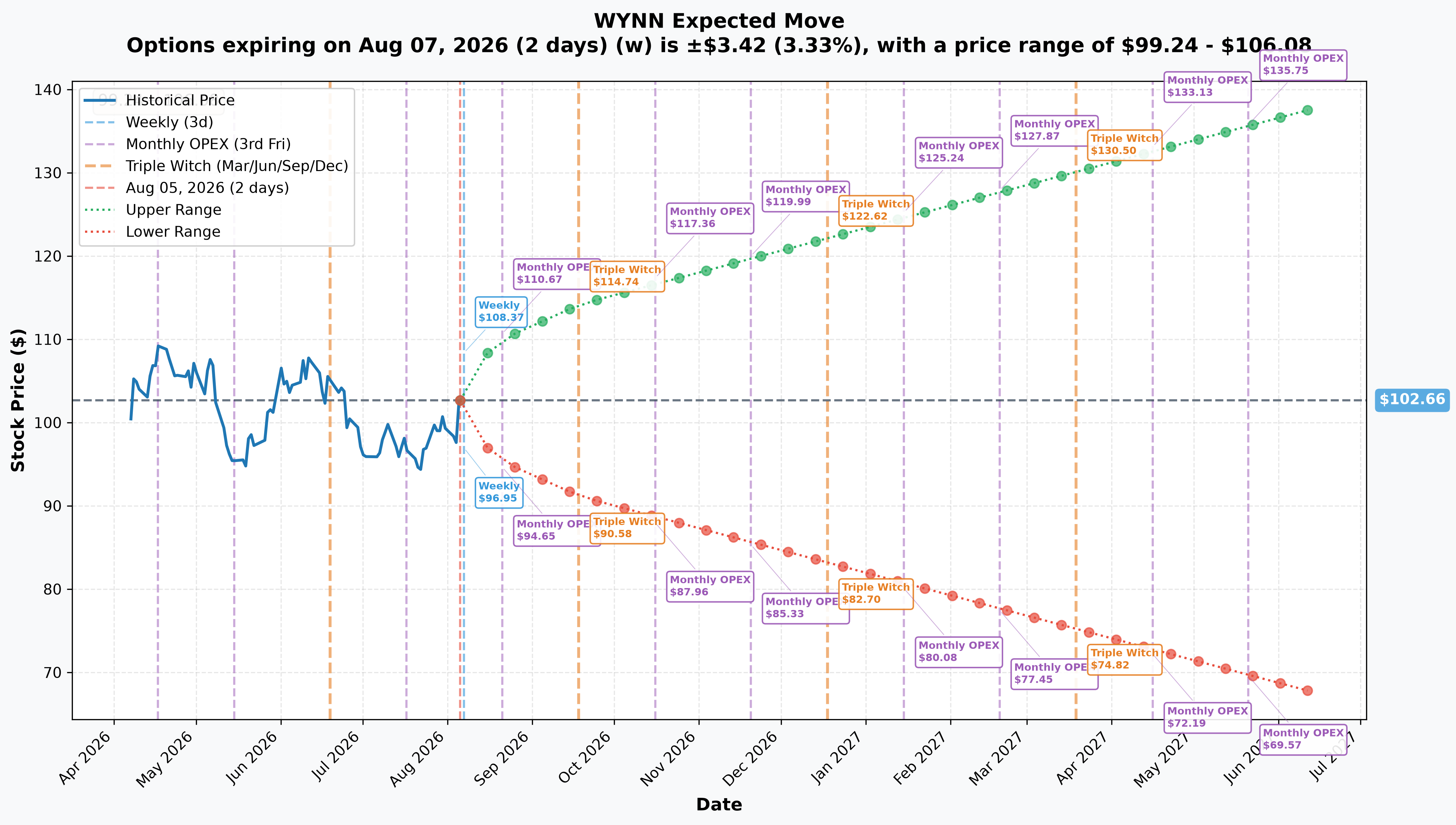
Options are pricing the following ranges from spot:
- 📅 Weekly (Aug 7, 2 days): ±3.33% (±$3.42) → Range: $99.24 – $106.08
- 📅 Monthly OPEX (Aug 21, 16 days): ±7.23% (±$7.42) → Range: $95.24 – $110.08
- 📅 Quarterly Triple Witch (Sep 18, 44 days — the CLOSED leg's expiry): ±11.25% (±$11.55) → Range: $91.11 – $114.21
- 📅 LEAPS (Jun 17, 2027, 316 days): ±34.45% (±$35.37) → Range: $67.29 – $138.03
Notice the September $90 strike being closed today sits below the entire quarterly implied-move range ($91.11–$114.21) — that contract was so deep in the money that it was barely trading on volatility at all anymore, which is exactly why it made sense to harvest it rather than hold it to expiration. The new December 18 expiry (135 days out) isn't one of the four standard windows in this dataset, but it sits between the 44-day quarterly read and the 316-day LEAPS read — meaning the new position now carries meaningfully more time premium and event risk than the one it replaced.
🎪 Catalysts
✅ Already Happened
Q2 2026 earnings — August 4, 2026 (the day before this trade). Wynn beat across the board: total operating revenues of $1.86 billion (consensus ≈$1.83B), net income $140.1 million (vs. $66.2M a year ago), diluted EPS $1.32 (vs. $0.64), and adjusted EPS $1.24 against a $0.98 consensus. Adjusted Property EBITDAR came in at $568.3 million, up $15.9M year over year. Full detail in Wynn's Q2 2026 press release.
By segment: Wynn Palace (Cotai) revenue +21.1% YoY, Wynn Macau (Peninsula) +2.1% YoY, Las Vegas roughly flat at +0.7% YoY (though Las Vegas Adjusted EBITDAR fell 8.3% to $215.2M, which the release ties to table-games hold percentage of 23.9% — within Wynn's normal 22–26% range, i.e. more likely a luck-driven swing than a demand problem), and Encore Boston Harbor −3.0% YoY. Source: same PR Newswire release.
UAE timeline reaffirmed — Wynn Al Marjan Island still targeted for September 2027. CEO Craig Billings called it "the most exciting integrated resort to be developed in over a decade." Wynn contributed $48.1 million to the joint venture in Q2 alone, bringing cumulative contributions to $1.06 billion against a $5.1 billion total project cost (Wynn owns 40%). Per Casino.org's coverage, this reaffirmation specifically addressed market concern that Middle East geopolitical tensions could delay the opening — so the "no change" itself was the news.
Capital returns: the board declared a $0.25/share dividend payable August 28, 2026, and Wynn repurchased 741,098 shares at an average $101.20 (≈$75 million) during Q2. Source: PR Newswire.
Macau industry backdrop is cooling, even as Wynn's own numbers held up. Macau gross gaming revenue fell 8.4% year-over-year in July 2026 (≈US$2.51B) and 12.1% in June, decelerating sharply from the +10.9% YoY run rate earlier in the year — year-to-date growth through July slowed to +4.4%. Per Casino.org's August 3 report, analysts attribute part of this to a post-World-Cup demand lull, with Seaport Research projecting a rebound to +4.5% (August) and +11% (September) YoY, and J.P. Morgan projecting flat (August) and +6% (September). Wynn's own Macau segments still grew in Q2 — but that print covers April–June, before the sharpest part of the July slowdown, so Q3 Macau commentary is worth watching closely.
🔮 Coming Up
≈November 5, 2026 — Q3 2026 earnings, ESTIMATED, not yet company-confirmed. Based on Wynn's historical reporting cadence (Q3 2025 was reported November 4, 2025), per Investing.com's WYNN earnings calendar. This is the structural point of today's roll: the September 18 expiry that was closed today falls well before any earnings event — it was "earnings-clean." The new December 18 expiry, by contrast, falls after the estimated Q3 report, meaning this position now owns Wynn's next earnings catalyst, which the old one did not.
Analyst sentiment is broadly bullish. Per StockAnalysis.com's ratings aggregation, the consensus is "Strong Buy" with an average 12-month price target of ≈$132.58 (≈29% above spot). Several banks reiterated Buy ratings the same day as earnings (August 5): Deutsche Bank raised its target to $139, Stifel Nicolaus to $143, Barclays to $136, and Mizuho to $132; Truist maintained $125. Earlier in July, Morgan Stanley and Goldman Sachs trimmed their targets to $128 and $120 respectively while keeping Buy ratings — a reminder the bull case isn't unanimous on magnitude even where it's unanimous on direction.
🎲 Price Targets & What the Levels Say
- Base case: WYNN consolidates in the $100–$106 zone it's occupied for most of the past week, bounded by the weekly implied-move range ($99.24–$106.08) and the nearby $100 gamma support / mild $105 resistance.
- Bull case: A push through $110 (the monthly OPEX implied-move ceiling of $110.08 lines up almost exactly with the $110 call-gamma level) opens the path toward the $120 major resistance wall — the single largest gamma cluster on the board and roughly in line with the average sell-side price target zone. Continued Macau outperformance and confirmation the UAE project stays on schedule are the fundamental legs under this case.
- Bear case: A slip below the $100 gamma support risks a retest of the quarterly implied-move floor near $91–$95, which would also put the deep-ITM $90 strike underlying today's roll much closer to the money — eroding the delta cushion that makes this position behave like stock today. A continuation of the Macau GGR deceleration into Q3, or a soft December-quarter earnings print, are the more likely triggers.
💡 Trading Ideas
🛡️ Conservative — Watch the OI Confirmation First
Don't chase this print. It's a roll — now confirmed by open interest — not fresh conviction, and the stock already moved ≈5% on the news that likely prompted it. The useful question is whether you want exposure through the ≈November 5 earnings date, which the December expiry now covers and the September one would not have.
⚖️ Balanced — Defined-Risk Spread Through the Earnings-Clean Window
If you want bullish WYNN exposure without earnings risk, a call spread expiring inside the August 21 monthly cycle (before the estimated Q3 report) mirrors the "earnings-clean" logic of the September leg that was just closed — you're betting on continued post-earnings drift, not a second binary event. The weekly/monthly implied moves ($99.24–$106.08, then $95.24–$110.08) frame reasonable strikes.
🚀 Aggressive — Own the December Earnings Window, Smaller Size
Buying December-dated calls mirrors the institutional roll's logic — capturing the ≈November 5 Q3 report inside your position — but size it far smaller than the $31.6M headline suggests. December premium carries both the ordinary macro/Macau-trend volatility and the earnings event; a soft Q3 print or a further Macau GGR slowdown could hit hard from these already-extended deltas.
🎲 Reading the Trade — Four Different Traders, Four Different Takeaways
🎰 YOLO Trader
This isn't your trade to copy directly — it's a $144M-notional institutional book being managed, not a fresh speculative shot. If you want the same directional exposure in retail size, a handful of December $90 or $95 calls gets you similar leverage without needing seven figures of capital. Just know you're buying into a stock that's still down ≈16% year-to-date, not chasing a breakout.
🌊 Swing Trader
Watch the $100 support / $110–$115 resistance band over the next few weeks. A confirmed close above $110 with volume would validate the bull case this roll is implicitly betting on; a break below $100 would be the first crack. Since this position is deep in the money, it isn't sensitive to short-term chop the way an at-the-money trade would be — it's a slower-moving signal.
💰 Premium Collector
This trade is the opposite of your playbook — it's a directional call holder extending duration, not a premium seller. If you like the bullish Macau/UAE thesis but want income instead, a cash-secured put near the $95 gamma-supported zone, or a call credit spread capped below the $120 wall, would fit your style better than mirroring this roll.
🌱 Beginner
This is a great real-world example of what a "roll" actually is: closing a winning position and reopening a similar one further out in time, rather than a single buy-and-hold trade. Notice that both legs use the same $90 strike — only the expiration date changed. That's the cleanest version of a calendar roll you'll see, and it's worth studying precisely because the mechanics are so clear.
⚠️ Honest Risk + What the Tape Cannot Prove
- The September leg's close is now a proven fact, not an inference. The August 6 OPRA snapshot showed open interest collapsing 16,627 → 235 (−16,392, ≈99.3% of the print). The provisional marker has been retired. What remains unproven is the roller's identity, cost basis, and any hedge held outside this package.
- We do not know who placed this trade, their broker, their cost basis on the original September position, or whether a stock or futures hedge exists elsewhere that OPRA can't see. Options tape data never reveals identity or motive — only price, size, timing, and mechanism.
- The estimated November 5 Q3 earnings date is not yet company-confirmed. Wynn typically confirms the exact date and time via press release only 2–3 weeks in advance. Treat "captures the next earnings report" as a strong probability, not a certainty, when reasoning about the December expiry.
- Macau's industry-wide GGR deceleration (June −12.1%, July −8.4% YoY) is a real headwind risk for the December-dated position, even though Wynn's own Q2 Macau segments outperformed. That Q2 print predates the sharpest part of the July slowdown; Q3 commentary will be the real test.
- One data point is not a signal to blindly copy. This roll reflects one desk managing an existing, already-profitable position — it happened alongside broadly bullish (but not unanimous) analyst sentiment. Your own risk tolerance and view on Macau/UAE execution should drive any decision, not this print alone.
- Options trading involves substantial risk of loss and may not be suitable for all investors. This analysis is for educational purposes only and is not financial advice. Always do your own research and consider your own risk tolerance before trading.
🎯 The Bottom Line
Real talk: this looks like a big new $31.6M bullish bet on the surface, but the tape says otherwise — it's an existing, deep-in-the-money position paying $9.2M to buy three more months of runway, placed the day after an earnings beat validated the thesis that was already working. The September $90 calls being closed were earnings-clean; the December $90 calls being opened now own Wynn's next quarterly report.
- If you're bullish WYNN through year-end: the roll's logic (own the deep-ITM calls, own the earnings date) is a reasonable template — just size appropriately and watch the $100/$110/$120 gamma levels as your guideposts.
- If you're watching, not trading: the September OI confirmation is in (16,627 → 235, roll proven). The next date that matters is the ≈November 5 Q3 report, once it's formally scheduled — it now sits inside the rolled position's life.
- If you're skeptical: the Macau GGR deceleration and the fact that Las Vegas EBITDAR actually fell this quarter (even if hold-driven) are the real fundamental risks sitting underneath this otherwise clean-looking roll.
The lesson worth carrying forward: a headline premium number tells you almost nothing on its own. It was the package delta — barely moving — that revealed this was continuity, not conviction change.
This analysis is for educational purposes only and does not constitute financial advice. Options trading involves substantial risk, including the potential loss of your entire investment, and may not be suitable for all investors.
Last updated: 2026-08-06 (pre-market) — next-day OPRA open interest proved both legs of the roll. September $90 open interest fell 16,627 → 235 (−16,392, versus a predicted ≈100–150) and December $90 rose 630 → 18,043 (+17,413). The provisional ⏳ STC marker on the September leg has been retired. Title and the resolution, trading-idea and risk sections were updated.