⚡ BE $17M Naked LEAP Call Sale — A Desk Just Got Paid to Bet the Post-Crash Bounce Stalls Below $300 Through Mid-2027
📅 July 28, 2026 | 🔥 Unusual Activity Detected
🎯 The Quick Take
Right in the middle of Bloom Energy's brutal pre-earnings selloff, a desk sold 3,919 June 17, 2027 $300 call options for ≈$17.0 million in premium collected — a strike sitting ≈88% above where BE was trading at the print. This is a naked, unhedged short call, not a bullish bet: the seller is getting paid cash today to bet BE doesn't nearly double from here and reclaim ground anywhere close to its $351.28 all-time high over the next ≈11 months. It's a short-upside-volatility, income-harvesting trade — but it comes with real, uncapped risk if the AI-power story reignites.
✅ Confirmed by the next-day open-interest snapshot: open interest at the $300 strike rose 386 → 4,384 (+3,998), ≈102% of the print size. This was genuinely a fresh opening sale — new short-call supply created, not existing contracts changing hands. Details in the ✅ RESOLVED box below.
🏢 Company Overview — What Bloom Energy Actually Does
Bloom Energy (NYSE: BE) designs and builds solid-oxide fuel cell ("Energy Server") platforms that generate on-site, grid-independent electricity from natural gas, biogas, or hydrogen — no power lines, no waiting on utility interconnection queues.
- 🏭 Sector / Industry: Industrials — Electrical Equipment (clean-energy power generation)
- 💰 Market Cap: ≈$45.0 billion
- 📊 Shares Outstanding: ≈284.4 million
- 📉 52-Week Range: $32.52 – $351.28
In 2026, Bloom re-rated hard as an AI-datacenter on-site power name — hyperscalers stuck in multi-year grid-interconnection queues started buying Bloom fuel cells to power GPU campuses immediately. That story fueled a ≈248% first-half run to an all-time high of $351.28 on June 25 — and it's also exactly the story now being stress-tested by a short-seller report, a stalled pipeline, and a brutal second-half guidance math problem (more on all three below).
💰 The Option Flow Breakdown
📊 What Just Happened
The Tape (July 28, 2026 @ 10:21:15 ET):
| Time | Buy/Sell | Call/Put | Expiration | Premium | Strike | Volume | Prior OI | Size (this trade) | Spot | Option Price | Option Symbol |
|---|---|---|---|---|---|---|---|---|---|---|---|
| 10:21:15 ET | 🔴 SELL | CALL | 2027-06-17 | $17.0M | $300 | 3,900 | 386 | 3,919 | $159.28 | $43.30 | BE20270617C300 |
Flow tag: ⚡ Facilitated single-leg auction, sold, unhedged. This printed through a facilitated exchange auction — a worked order matched through the exchange's price-improvement process, not a pre-arranged block cross with a known counterparty. It filled well down toward the bid side of the market (only ≈17% of the way across the spread), confirming this was a genuine sale, not a purchase. There is no matching block of long BE stock anywhere on the equity tape near this print — a real hedge here would need roughly 207,000 shares (3,919 contracts × 100 × the option's ≈0.528 independent delta), and nothing close to that shows up. This is a naked, unhedged short call.
- 💸 Premium collected: ≈$17.0 million — this is a CREDIT. Cash into the seller's account today, not money paid out.
- 🎯 Strike distance: $300 is ≈88% above the $159.28 spot at the print — deep out-of-the-money, and still below BE's own $351.28 all-time high from a month ago.
- ⏰ Time on the clock: ≈11 months to expiration (June 17, 2027)
- 📐 Independent delta: ≈0.528 — unusually high for a strike this far out-of-the-money, which by itself tells you how enormous BE's implied volatility is right now.
- 📊 Size vs. history: open interest at this strike was only ≈380-386 contracts before today — this single trade is roughly 10x that.
✅ RESOLVED — Fresh Opening Sale Confirmed (updated July 29, 2026)
The July 29 pre-market OPRA snapshot is in, and it landed almost exactly on our prediction.
Resolved from the OPRA open-interest snapshot for EOD July 28, 2026. This box replaces the ⏳ provisional flag published on July 28.
| Leg | Baseline OI (Jul 28 snap) | Resolving OI (Jul 29 snap) | Δ | Print Size | Verdict |
|---|---|---|---|---|---|
| Jun-17-2027 $300 CALL | 386 | 4,384 | +3,998 | 3,919 (strike's full session volume 4,051) | ✅ OPEN CONFIRMED (STO) — ≈102% of size |
What this proves: we predicted open interest would rise "from ≈386 to roughly ≈4,300 (386 + 3,919) if this was a clean fresh open." It came in at 4,384 — within 2% of the prediction, and slightly above the print size, meaning the strike's entire session volume was opening on both sides.
All three of our warning cases are ruled out. Open interest didn't rise by noticeably less than the print (so this wasn't a transfer between existing holders), and it certainly didn't stay flat or fall (so this wasn't a buy-to-close in disguise). The STO label is confirmed, not provisional. A brand-new short-call position of ≈3,919 contracts now exists at the $300 strike, where before there were only 386 contracts outstanding in total — the strike is now more than 11× larger than it was.
What that means, concretely: the ≈$17.0M credit was genuinely collected for taking on genuinely new risk. Someone has newly committed to the view that Bloom Energy does not reach $300 before June 2027 — and, as the risk section below spells out, they carry theoretically uncapped exposure if it does.
🤓 What This Actually Means — Plain English
Here's the decode: selling a call means getting paid cash today for a promise — "I'll sell you BE shares at $300 anytime before June 2027, if you want them." Since BE closed the print near $159, that promise is way out of the money today, but BE's stock has been so violent (a 248% run followed by a ≈55% crash) that the market still pays real money for that far-off possibility. That's why the seller collected $43.30 per share, ≈$4,330 per contract, ≈$17.0M total for a strike that's currently a near-double away.
This looks like STO — Sell to Open, a brand-new position, not someone closing out an old trade (see the size-vs-OI math above). And because there's no offsetting long BE stock visible anywhere on the tape, this is a naked short call, not a covered call written against shares the seller already owns.
Think about the bet this way: the seller isn't betting BE crashes further from here. They're betting BE doesn't stage a full V-shaped recovery back anywhere near its $351 high within the next 11 months. If BE grinds sideways, drifts modestly higher, or even partially recovers but stays under $300, the seller keeps the entire $17M as the option's time value bleeds away. The seller's breakeven is roughly $343 ($300 strike + $43.30 collected) — notably, that's almost exactly where the options market's own implied-move math puts BE's plausible ceiling by this same expiration (more on that below), which tells you this wasn't a throwaway strike pick; it was priced right at the edge of what the market itself considers a real tail outcome.
- 🎰 Why the premium is so rich: BE's implied volatility is enormous right now — a stock that traded $351 a month ago and $159 today prices its options like it, which is exactly why a strike 88% away still fetched $43.30.
- 💵 The win scenario: BE stays below ≈$300-343 through June 2027 (or the seller buys the position back cheaper before then). Seller keeps some or all of the $17M.
- ⚠️ The catch — this is naked, not covered: if BE's AI-datacenter story reignites and the stock melts back toward or above its old highs, this position has theoretically unlimited loss above the strike, because there's no offsetting stock to deliver against the promise. The seller would have to buy BE at whatever price the market demands to cover the short call.
- 📆 Order type: STO (Sell to Open), reasonably confident but not yet proven — size (3,919) is roughly 10x prior open interest (386), a strong but not airtight signal; confirm with tomorrow's OI print.
Bottom line in plain English: this isn't "smart money thinks Bloom Energy is doomed." It's "smart money getting paid $17M to bet that a stock which just crashed ≈55% from its all-time high doesn't fully un-crash and then some within 11 months" — an income/volatility-harvesting trade with a genuinely bearish-lean tilt, not a crash call, but one with uncapped downside if the bet is wrong.
📈 Technical Setup / Chart Check-Up
YTD Performance Chart
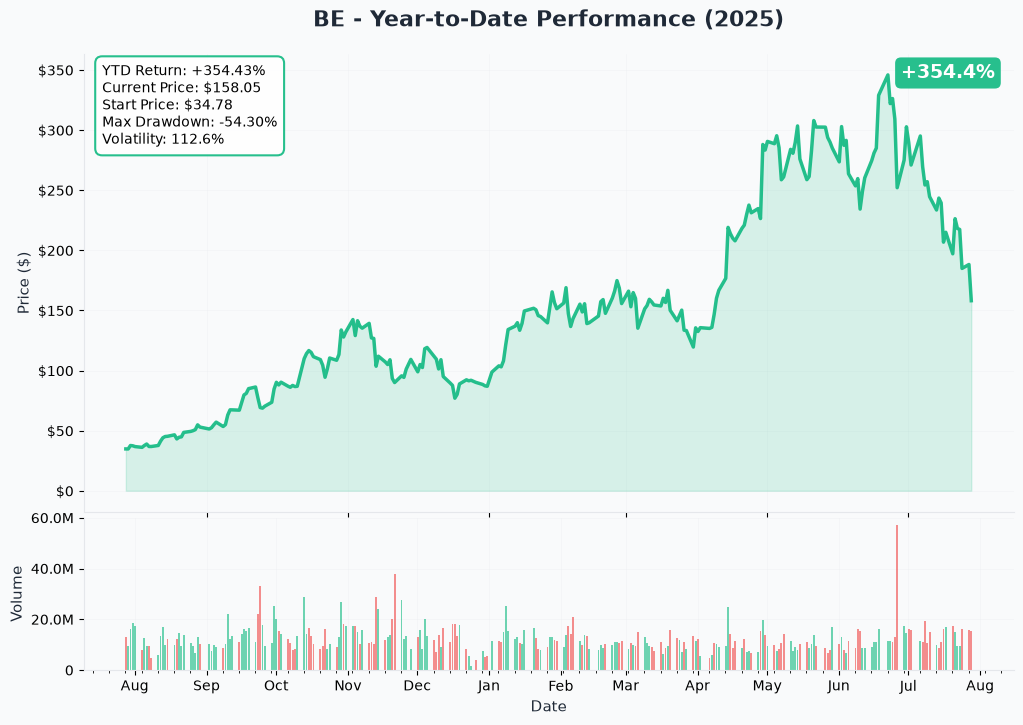
The chart tells the whole story in one picture: a parabolic run from the low-$30s to a $351.28 all-time high on June 25, then a violent ≈55% round-trip back down to the ≈$158 area by July 28 — all before the actual earnings print even landed. This is a stock that has already re-priced hard on sentiment alone; the $300 strike being sold today sits roughly in the middle of that round trip, not at some far-fetched fantasy level.
Gamma-Based Support & Resistance Analysis
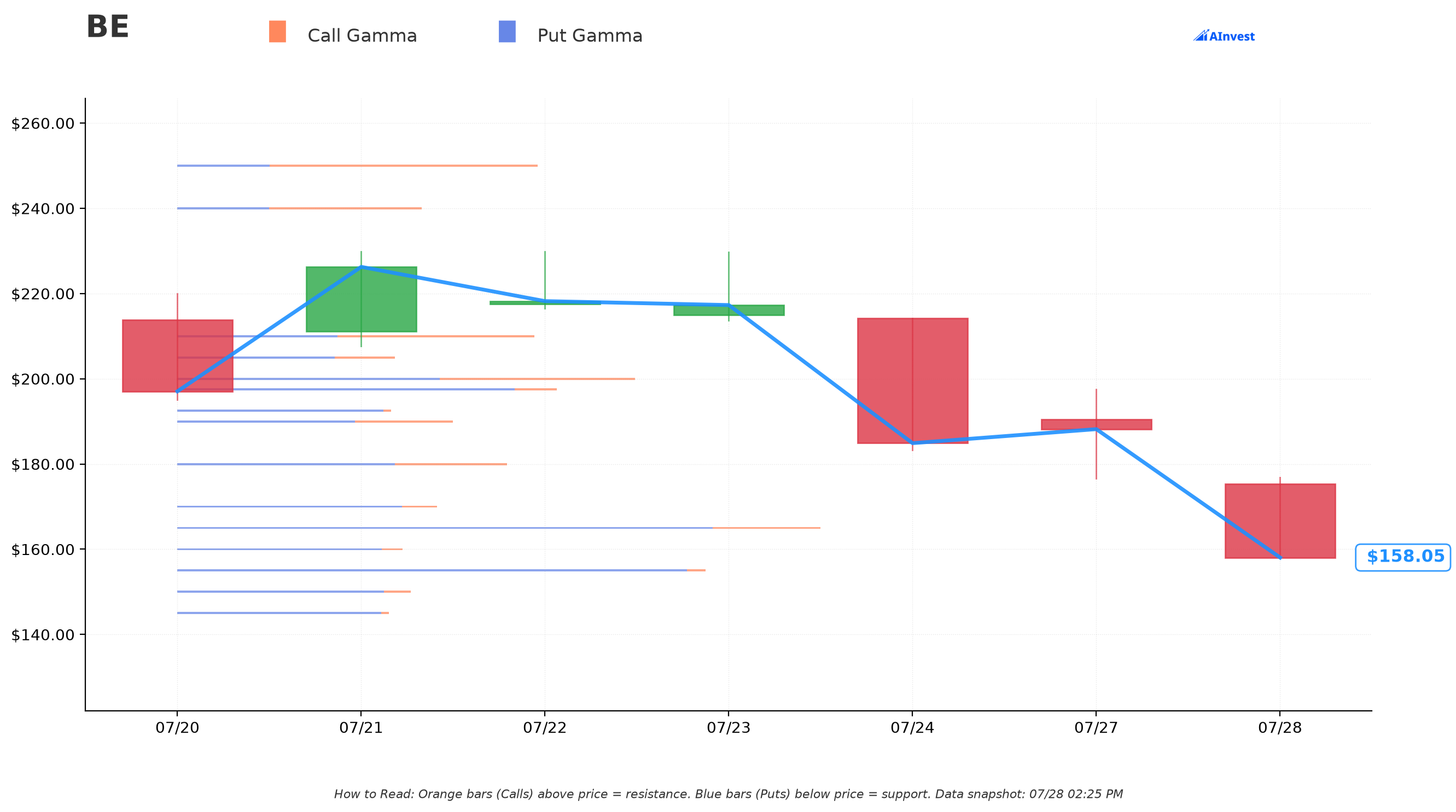
Current Price (per gamma snapshot): ≈$158.10
- 🔵 Support: $155 — the nearest notable put-gamma concentration, ≈2.0% below spot (Moderate strength)
- 🟠 Resistance: $165 — the nearest notable call-gamma concentration, ≈4.4% above spot (Moderate strength)
What this means for traders: gamma is genuinely thin on BE right now relative to how far the stock has moved — dealer hedging flows are clustered tightly around the current $155-$165 band and essentially fade to nothing out toward $300. That's a double-edged read: there's no strong dealer "wall" pinning price near-term, which is consistent with a name that can gap hard on the earnings reaction, but it also means there's no meaningful gamma resistance standing between spot and the $300 strike the seller just wrote against — the trade is relying on the fundamentals capping the move, not on dealer positioning doing it for them.
Implied Move Analysis
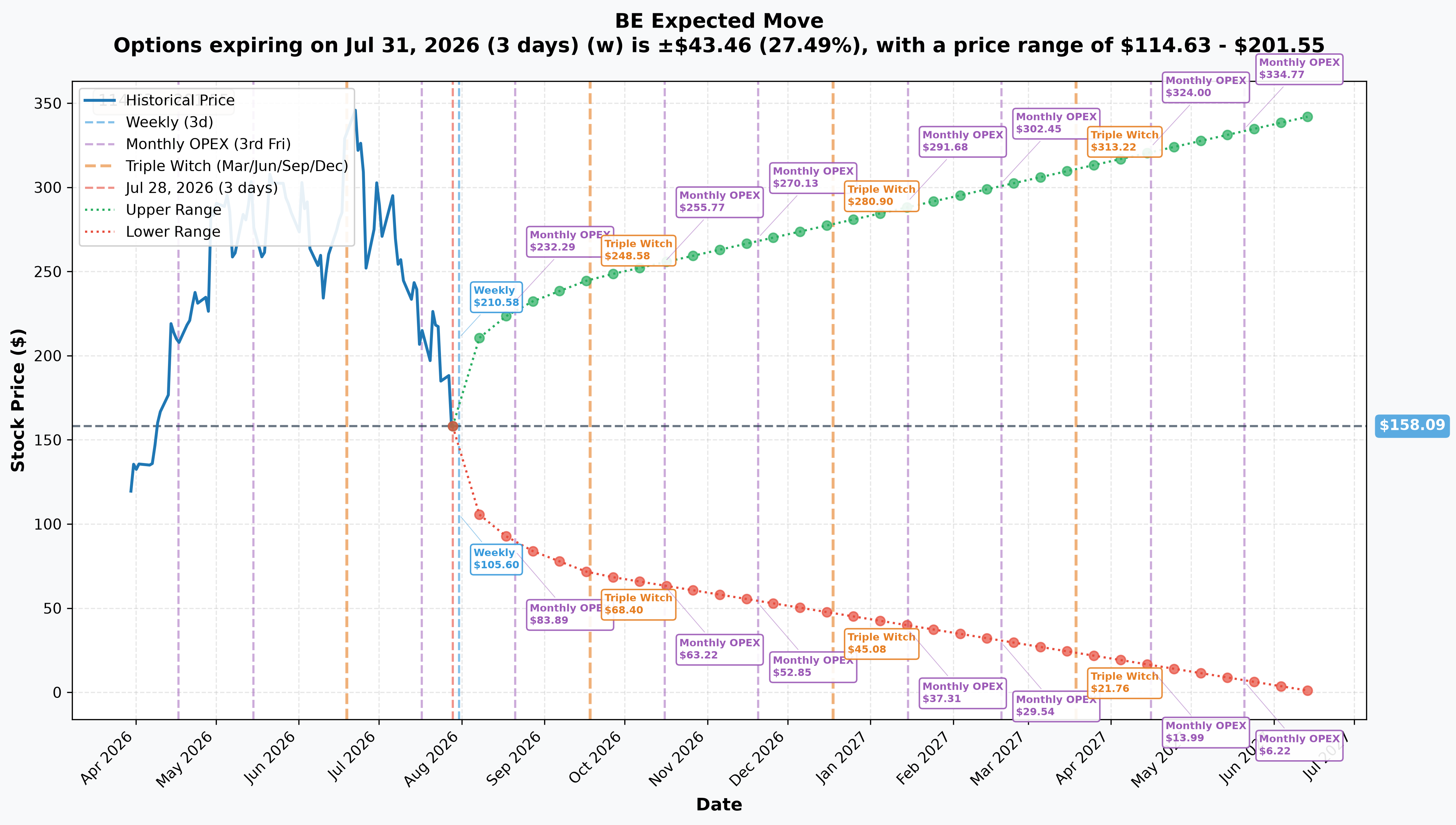
Options market pricing for upcoming expirations (from ≈$158.09 spot):
- 📅 July 31 (weekly, into the earnings reaction): ±27.49% → Range: $114.6 - $201.6
- 📅 August 21 (monthly OPEX): ±44.62% → Range: $87.5 - $228.6
- 📅 September 18 (triple witch): ±55.42% → Range: $70.5 - $245.7
- 📅 June 17, 2027 (this trade's own expiration): ±117.21% → Range: $0 - $343.4
Translation for regular folks: that ≈27% weekly swing is the market pricing genuine fireworks for the earnings reaction alone — this is exactly the fat volatility premium the $300 call seller is harvesting. But look closely at the last row: the market's own implied range for the same June 2027 expiration as this trade tops out at ≈$343 — just above the seller's ≈$343 breakeven and not far past the $300 strike itself. In other words, the desk didn't pick a strike so far out that the market considers it impossible; they picked one right around the edge of what the options market itself still prices as plausible over 11 months on a stock this volatile. That's the honest risk picture: rich premium collected, but the strike isn't as "safely OTM" as the 88% headline distance makes it sound.
🎪 Catalysts
Note: the dates below are all near-term company and market events — weeks to a few months out. They are entirely separate from the June 17, 2027 option expiration in this trade, which is roughly 11 months past every one of them.
✅ Recent (Already Happened)
Short-seller attack (July 8, 2026): Hunterbrook Media published a report attacking Bloom's financials and alleging scandium-oxide supply-chain dependence on China. Bloom categorically rejected the claims and shares initially fell ≈12% before rebounding ≈6% on the rebuttal — the thesis remains unresolved.
New Mexico rejects the Oracle "Project Jupiter" pipeline — again: New Mexico's State Land Office rejected Energy Transfer's 17-mile gas-pipeline extension meant to feed 2.5 GW of Bloom fuel cells at Oracle's data center, citing emissions and water-use concerns. This makes the August 15 in-service target highly unlikely and threatens the timing of Bloom's largest disclosed contract.
The "H2 math" problem: at the midpoint of Bloom's $3.4B-$3.8B full-year guide, the company needs to generate ≈$1.04B per quarter in the back half — ≈36% above the Q2 run-rate — and the guidance math itself is now the center of the bear case.
≈248% first-half run into a stretched multiple: Bloom soared ≈248% in H1 2026 before the June-July reversal, a crowded momentum trade now unwinding.
🔥 Today's Event
Q2 2026 earnings call — July 28, 2026, 5:00 PM ET. Bloom's own investor-relations page confirms the date. Consensus heading in was ≈$0.39-$0.41 non-GAAP EPS on ≈$767M-$827M revenue (Yahoo Finance / Zacks) — but this trade printed before the after-close release, so treat those Q2 figures as consensus estimates only, not the actual reported result. Check the printed numbers yourself at Bloom's investor-relations site or a live quote source before drawing conclusions — the number that actually matters is whether management reaffirms or cuts the $3.4B-$3.8B full-year guide.
🔮 Upcoming (Next ≈6 Months)
Q3 2026 earnings — ≈late October / early November 2026 (not yet formally dated): the first quarter that must show the ≈$1.04B run-rate to validate the H2 math.
Oracle Project Jupiter pipeline resolution: watch for an Energy Transfer refiling, re-route, or formal delay into 2027 — a near-term binary for the largest disclosed contract.
Fremont capacity ramp, 1 GW → 2 GW by end-2026: the physical gate on whether the back-half revenue math is even achievable.
Backlog conversion: Bloom's ≈$20B total backlog (≈$6B product + ≈$14B service), anchored by Oracle (2.8 GW), AEP (1 GW / $2.65B), and a $5B Brookfield AI-infrastructure vehicle, remains the standing bull catalyst — continued conversion is what the recovery case needs.
👥 How Four Different Traders Might Read This
🎲 YOLO Trader
Copying this exact trade is not realistic for most retail accounts — selling 3,919 naked LEAP calls requires either massive margin or posting collateral for exposure equivalent to ≈392,000 shares, and the loss side is uncapped if BE reignites its AI-power melt-up. A retail-shaped mirror with defined, known-in-advance risk: a small clip of short-dated OTM puts or calls around tonight's earnings reaction, sized to the ±27.49% weekly implied move ($114.6-$201.6), where the most you can lose is what you paid.
Risk level: Extreme if attempted naked | Skill level: Advanced only.
📈 Swing Trader
The trading window that actually matters here isn't June 2027 — it's the next 24-72 hours around the earnings reaction. The stock is pricing a ±27.49% weekly swing ($114.6-$201.6) into the July 31 expiration. A defined-risk way to play the reaction without picking a direction outright: a short-dated debit call or put spread sized to that implied range, rather than trying to call the exact post-earnings bounce or breakdown.
Risk level: High (binary earnings event) | Skill level: Intermediate.
💵 Premium Collector
This trade is structurally close to your playbook — selling rich, elevated-IV premium on a name whose options are pricing extreme uncertainty. The lesson isn't "go sell naked $300 LEAP calls" — it's the concept: after a 248% run and a 55% crash, BE's implied volatility is fat enough that far-OTM premium pays real money. A more controllable version of the same idea: shorter-dated covered calls against BE shares you already own (or credit spreads instead of naked shorts), collecting similarly rich premium with a defined max loss instead of the uncapped exposure this desk just took on.
Risk level: Moderate if covered/spread, extreme if naked | Skill level: Intermediate — never sell naked calls without fully understanding the uncapped-loss math.
🌱 Beginner
Selling a call means getting paid cash today for a promise: "I'll sell you BE shares at $300 anytime before June 2027." Since BE trades near $159 today, that promise is far out of the money — which normally would make it cheap, except this stock has been so wild (up 248%, then down 55%) that the market still paid ≈$4,330 per contract for it.
The critical thing to understand: selling a call you don't already own shares to cover is called "naked," and it carries theoretically unlimited risk if the stock takes off, because the seller would have to buy shares at whatever price the market demands to deliver them at $300. Also worth asking: did this trade actually settle as a new position? The next morning's official open-interest report is what proves that — and here it did: open interest went 386 → 4,384, a rise of ≈102% of the print size, which only happens when brand-new contracts are created. See the ✅ RESOLVED box above. This is advanced-trader territory; if BE interests you, start by understanding just how much this stock can move in a single month before ever considering selling options on it.
Risk level: N/A — educational only | Skill level: Beginner-friendly explanation of an advanced trade.
⚠️ Honest Limits — What The Tape Can and Can't Prove
What we know for certain (PROVEN from the tape):
- ✅ 3,919 BE June 17, 2027 $300 calls sold for $43.30 each (≈$17.0M total) at 10:21:15 ET
- ✅ Filled well down toward the bid (≈17% of the way across the spread), confirming a genuine sale, not a purchase
- ✅ No matching long-BE equity block appears anywhere near this print — as far as visible activity shows, this is unhedged
- ✅ Size (3,919) is roughly 10x prior open interest (≈386), a strong signal for a fresh open
- ✅ Independent model delta of ≈0.528 is unusually high for an 88%-OTM strike, consistent with BE's extreme implied volatility
- ✅ The stock was already down ≈16% intraday to ≈$158 before the after-close earnings release — this trade is a pre-earnings, not a post-earnings, print
What we're inferring (reasonable, but not proof):
- 🔍 That this is pure income/volatility-harvesting rather than part of a larger, invisible hedge — we cannot see the seller's other positions, brokers, or offsetting exposure executed off-exchange
- 🔍 The seller's precise motive — could be standalone premium collection, could be a partial hedge against a broader book that simply hasn't printed on this tape
- 🔍 The bearish-lean framing itself — a naked call sale expresses "probably doesn't happen," not "will crash further"; it is not equivalent to buying puts
What OPRA data flatly cannot tell us:
- ❌ Who the seller is (retail, institutional, market maker) or their broker
- ❌ Whether they hold offsetting BE shares, related positions, or hedges elsewhere that would make this less "naked" than it appears
- ❌ Their account size or whether $17M is a meaningful bet or a rounding error in their book
- ❌ Whether they intend to hold to June 2027 or actively manage/close this position long before then
- ❌ The actual Q2 2026 results — this trade printed before the after-close release; verify the reported numbers yourself before drawing conclusions from the consensus figures cited above
Disclaimer: Options trading involves substantial risk of loss and is not suitable for all investors — selling naked (uncovered) calls in particular carries theoretically unlimited risk, and this is amplified further on a stock as volatile as Bloom Energy, which has moved more than 50% in a single month in both directions this year. This analysis is for educational purposes only and is not financial advice. Past performance doesn't guarantee future results. Always do your own research and consider consulting a licensed financial advisor before trading, especially with strategies involving short options positions.
Analysis generated July 28, 2026, ahead of Bloom Energy's after-close Q2 2026 earnings release.
Last updated: July 29, 2026 — next-day OPRA open interest resolved the provisional flag and confirmed the read: open interest rose 386 → 4,384 (+3,998, ≈102% of the 3,919-lot print), proving a genuine fresh opening sale (STO) rather than a transfer or a disguised close. The quick take, provisional callout and beginner section were updated accordingly; no directional or structural claims changed.