🔄 CRWD — Not a New Overwrite: Next-Day OI Shows the $15M Hedged Call Sale Created No New Short Calls
📅 July 28, 2026 | 🔥 Unusual Activity Detected
🔄 CORRECTION — Update (July 29, 2026): the next-day OPRA open-interest snapshot inverted the open/close half of this read. Open interest on the Jun-16-2028 $195 call did not rise — it fell 2,718 → 2,468 (−250) on a day when the strike's entire volume was this single 2,600-lot cross. A fresh opening sale creates contracts; this one destroyed 250 and left the other ≈2,350 simply changing hands. So this was not a new $15M overwrite being put on — it was an existing hedged position transferring between counterparties, with a small net close on top. The headline, the STO label and the "what the desk is betting" framing have been rewritten. The delta-hedge math itself is unchanged and still verified. See the ✅ RESOLVED box.
🎯 The Quick Take
As originally published, this looked like a fresh ≈$15M delta-neutral covered-call overwrite — 2,600 CRWD Jun-16-2028 $195 calls sold for ≈$15M in CREDIT, paired in the same window with a 176,800-share long-CRWD stock block that matched the option's delta to ≈103%.
The hedge math held. The "fresh position" part did not. Open interest at the strike went 2,718 → 2,468, a decline of 250 contracts, and the 2,600-lot cross was the only trade at that strike all session. That combination is decisive: if this had opened 2,600 new short calls, open interest would have jumped toward ≈5,300. Instead it shrank. What actually happened is that an already-existing covered-call package — short calls plus the shares behind them — moved from one desk's book to another's, with ≈250 contracts retired in the process. The structure is exactly what we described; what's wrong is the idea that anyone newly committed to it on July 28.
🏢 Company Overview — What CrowdStrike Actually Is
CrowdStrike Holdings, Inc. (Nasdaq: CRWD) is a cloud-native cybersecurity vendor built around the single-agent Falcon platform — endpoint protection (EDR/XDR), cloud security, identity protection, next-gen SIEM/log management, threat intelligence, and AI-driven security operations, all sold as a modular, subscription/ARR-based platform.
- 💰 Market Cap: ≈$184 billion
- 🏭 Sector / Industry: Technology — Application/Infrastructure Software (Cybersecurity SaaS)
- ✂️ Note the split: CRWD executed a 4-for-1 stock split effective July 2, 2026 (Motley Fool, SEC 8-K). Every price and strike in this article — including the sold $195 call — is on a post-split basis. Some data feeds show a distorted "-56% YTD" figure; that's a split artifact, not a real decline. Split-adjusted, CRWD is still up ≈40% year-to-date.
💰 The Option Flow Breakdown
📊 What Just Happened
| Time | Buy/Sell | Call/Put | Expiration | Premium | Strike | Volume | OI (prior) | Size | Spot | Option Price | Option Symbol |
|---|---|---|---|---|---|---|---|---|---|---|---|
| 10:34:25 ET | 🔴 SELL | CALL | 2028-06-16 | ≈$15.18M | $195 | 2,600 | 2,718 | 2,600 | $176.83 | $58.40 | CRWD20280616C195 |
Flow tag: 🤝 Block cross, delta-hedged. This printed as a negotiated block with a known counterparty on the other side — not an aggressive lit sweep, so there's no urgency to read into the print itself. The option's own independent pricing model puts its delta at ≈0.66.
Paired with it, on the equity tape, in the same stretch of trading: a 176,800-share long-CRWD stock block at $175.50 — a known-counterparty block, not open-market buying pressure.
✅ RESOLVED — Next-Day OI Proves a Transfer, Not a Fresh Opening Sale (updated July 29, 2026)
The July 29 pre-market OPRA snapshot is in, and it went against the opening-sale read.
Resolved from the OPRA open-interest snapshot for EOD July 28, 2026. This box replaces the ⏳ provisional flag published on July 28.
| Leg | Baseline OI (Jul 28 snap) | Resolving OI (Jul 29 snap) | Δ | Print Size | Verdict |
|---|---|---|---|---|---|
| Jun-16-2028 $195 CALL | 2,718 | 2,468 | −250 | 2,600 (and the strike's entire session volume was this one cross) | 🔄 TRANSFER — STO not confirmed (≈−10% of size) |
What this proves: we published the test as "if OI rises → a genuine opening sale (STO); if OI falls → the seller was actually closing." Open interest fell by 250. The STO label does not survive as a description of what happened to the market's net position.
This particular strike gives an unusually clean read, and it's worth pausing on why. The 2,600-lot cross was the only trade at this strike all day — no other prints to muddy the attribution. So the entire open-interest change of −250 is attributable to this one package, and the arithmetic leaves exactly one interpretation: of the 2,600 contracts, ≈2,350 simply changed owners and ≈250 were retired outright. Nothing new was created.
What that changes, concretely:
- No new short-call supply exists at $195. The claim that a desk newly sold ≈$15M of CrowdStrike's upside through mid-2028 is disproven — that upside was already sold, to somebody, before July 28.
- The ≈$15M credit is real but is a transfer price, not new income. One party received it; another paid it to take on an obligation that already existed.
- The package moved intact. The 176,800-share stock block travelling alongside the calls is the tell that what changed hands was the whole covered-call structure, calls and cover together, rather than a bare option position.
- The structure description below still stands. Long stock against short calls, ≈103% delta match, capped above $195 — all of that remains accurate about the position. It simply has a different owner now, and is ≈250 contracts smaller.
⚠️ Still inferred, not proven: OPRA shows the net contract count, not which side opened and which closed on the ≈2,350 that transferred. Both "old seller closed, new seller opened" and "old buyer closed, new buyer opened" produce the same flat net. Identity, motive, and which desk ended up holding the risk are all invisible on the tape.
🤓 What This Actually Means — Plain English
Here's the decode, piece by piece.
Selling a call means getting paid cash today for a promise: "I'll sell you CRWD shares at $195 anytime before June 16, 2028, if you want them." CRWD is at $176.83 today, so that promise is currently out of the money by ≈10% — the $58.40 collected is a mix of a large chunk of time value and volatility premium on a 2.5-year window, priced on a high-multiple, high-IV name.
Now the part that changes the whole story: this is not a naked short call. We pulled both tapes — the option print and the paired equity block — and checked the math independently rather than trusting a label:
- Expected hedge if delta-neutral: 2,600 contracts × 100 shares × 0.66 delta = ≈171,600 shares
- What actually printed on the equity tape, same window: 176,800 shares at $175.50
- 176,800 actual vs. ≈171,600 expected = a ≈103% match — a tight, tape-verified confirmation of a genuine delta hedge
Translation: the desk sold $15M of call premium and simultaneously holds (or bought) ≈176,800 shares of CRWD to offset the calls' delta. What's left is a textbook covered-call / overwrite — long stock, short calls against it — run at institutional scale. This is the same mechanic a retail investor uses selling a covered call against shares they already own, just far larger and with a delta match precise enough to prove it's genuinely hedged, not guessed at.
- 🎯 What whoever holds this position is betting: that CRWD's rich, long-dated implied volatility comes in higher than realized volatility will actually be over the next 2.5 years — a volatility/carry view, not a directional call. The position is roughly delta-neutral. Note the change of subject: because open interest fell, we now know this view was already on the books, and July 28 was the day it changed hands rather than the day it was formed.
- 💵 The win scenario for the holder: CRWD chops, drifts, or grinds higher but stays under $195 through June 2028. The premium decays in the short-call holder's favor, and the long shares capture any upside up to the strike.
- ⚠️ The tradeoff — capped, not unlimited, but real: because this is covered (long stock behind it), the loss isn't uncapped the way a naked short call would be. But a sustained rally through $195 caps the combined position's gain right at the strike — the holder gives up everything above $195, even if CRWD keeps running for the next 2.5 years.
- 📆 Order type: the STO label is DISPROVEN as a net matter ✅. Size (2,600) was below prior OI (2,718), which is why we flagged it provisional — and the July 29 snapshot showed open interest falling 250. No new short calls were opened. What the tape cannot resolve is which counterparty was closing and which was opening within the ≈2,350 that transferred.
Bottom line in plain English: this isn't "smart money thinks CrowdStrike is about to break down" — and, after the open-interest check, it isn't "smart money just got paid ≈$15M to sell CrowdStrike's upside" either. It's an existing income/carry position — short 2.5-year calls with stock held against them — changing hands at a ≈$15M price, and shrinking slightly as it went. The economics of the structure are unchanged; what's different is that nobody formed a new view on CrowdStrike that day.
📈 Technical Setup / Chart Check-Up
YTD Performance Chart
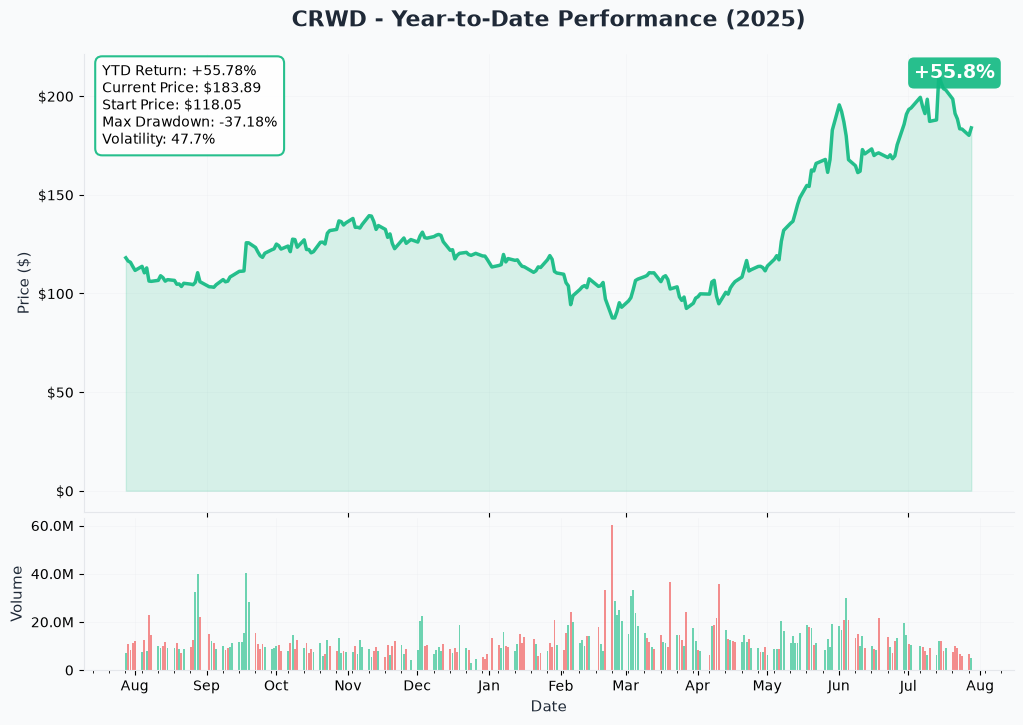
CRWD ran into and through its July 2 4-for-1 split to a split-adjusted high near $210 on July 6, then slid nine straight sessions, ≈15%, to today's ≈$177–184 area — a profit-taking / valuation reset off a stretched entry, not a fundamental break. Split-adjusted, the stock is still up ≈40% for the year and remains well above its longer-term trend.
Gamma-Based Support & Resistance Analysis
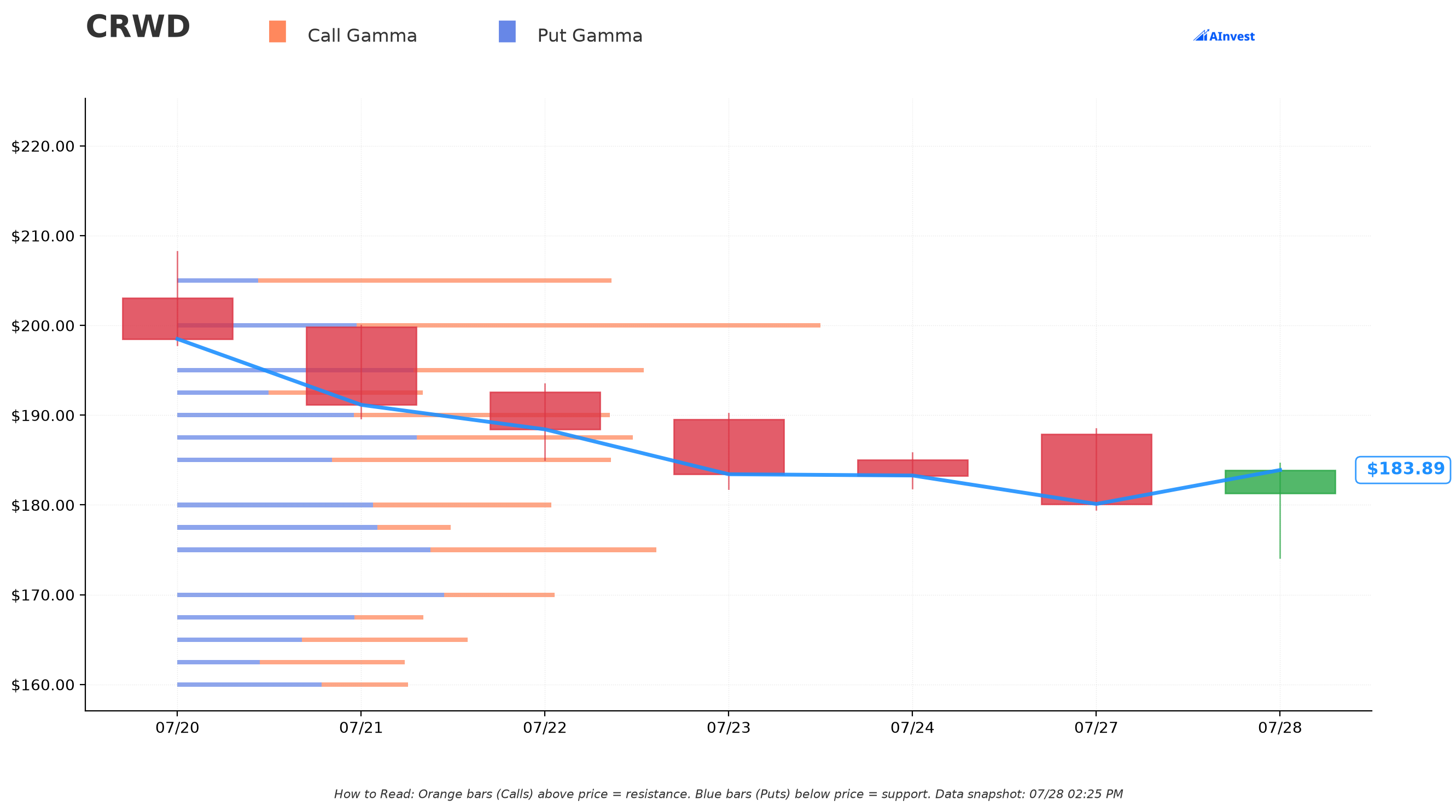
Current Price: ≈$184
- 🔵 Support wall: $175 (Moderate) — ≈4.8% below spot, the nearest meaningful floor
- 🟠 Resistance wall: $185 (Moderate) — just above spot, ≈0.6% away
- 🟠 Resistance wall: $187.50 (Moderate) — ≈2% away
- 🟠 Resistance wall: $195 (Moderate) — ≈6% away, and exactly where the sold call strike sits
What this means for traders: the desk didn't pick $195 randomly — it's parked right on top of a real dealer-hedging wall in the chain. A grind between the $175 support and the $185–195 resistance band is exactly the kind of chop this overwrite is built to harvest.
Implied Move Analysis
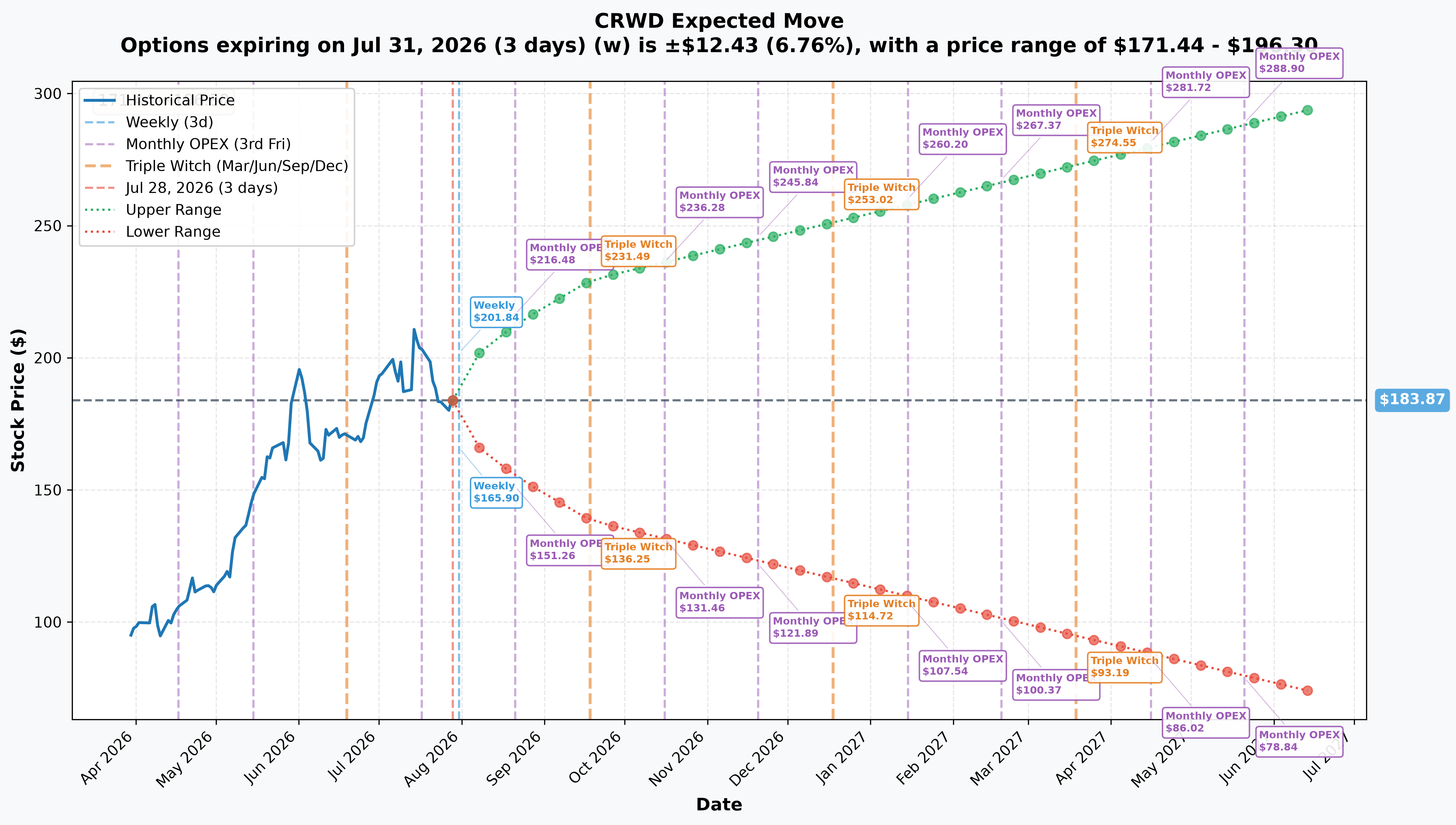
Options market pricing from ≈$183.87 spot:
- 📅 July 31 (weekly, 3 days out): ±6.76% → Range: $171.44 – $196.30
- 📅 August 21 (monthly OPEX, 24 days out): ±15.79% → Range: $154.83 – $212.91
- 📅 September 18 (Triple Witch, 52 days out): ±24.86% → Range: $138.16 – $229.58
- 📅 June 2027 (yearly LEAPS reference, 324 days out): ±60.24% → Range: $73.10 – $294.64
Translation: the $195 strike sits comfortably inside the market's own Aug-21 one-standard-deviation range ($154.8–$212.9) — a disciplined, non-extreme strike for an overwrite seller, roughly ≈10% OTM rather than a strike that requires a wild move to reach.
🎪 Catalysts
The 2028 expiration on this trade is entirely separate from CrowdStrike's near-term earnings calendar — every dated catalyst below resolves years before the calls expire.
Already Happened (last ≈3 months)
- 4-for-1 stock split, effective July 2, 2026 — announced June 3, record date June 25, additional shares distributed July 1 (Motley Fool, SEC 8-K).
- Fiscal Q1 2027 earnings (reported June 3, 2026): revenue $1.39B, +26% YoY; record ending ARR of $5.51B; net new ARR +32% YoY; non-GAAP subscription gross margin expanded to 81%; record free cash flow $468M (CrowdStrike IR).
- Nine straight down sessions (mid-to-late July), CRWD off ≈15% from its split-adjusted high — a valuation reset after the split-driven run, not a fundamental deterioration (Trefis).
- Falcon Flex (flexible licensing / land-and-expand engine): >1,000 customers, Flex ARR up >120%, driving durable expansion (CrowdStrike Falcon Flex).
- Named a Leader in the 2026 IDC MarketScape for Worldwide SIEM, validating CrowdStrike's Next-Gen SIEM push against legacy incumbents (CrowdStrike IR).
- Charlotte AI now ships generally-available agents across triage, response, threat hunting and investigation — positioned as the reasoning engine of the "agentic SOC" on top of Next-Gen SIEM (CrowdStrike Next-Gen SIEM).
- Analyst target hikes in July: UBS to $235 (Benzinga), Morgan Stanley Overweight to $227 (GuruFocus), Argus Buy to $230 (GuruFocus).
Upcoming (next ≈4 months)
- September 2, 2026 (after close, confirmed) — fiscal Q2 2027 earnings, covering the quarter ended July 31, 2026. Company guidance: revenue $1.436B–$1.442B (≈23% YoY growth) (TipRanks, CrowdStrike IR). Watch net-new ARR re-acceleration, Falcon Flex cadence, and Charlotte AI monetization color.
- Fal.Con user conference (annual, typically September) and ongoing product GA announcements.
Why this matters for the overwrite: the Sept 2 print sits ≈1.75 years inside the life of this Jun-2028 call. The desk is exposed to that earnings report — and every other catalyst between now and 2028 — only through the option's vega and gamma as time passes, not as a dated, all-or-nothing bet the way a short-dated call spread would be.
👥 How Four Different Traders Might Read This
🎲 YOLO Trader
Copying this exact trade at retail scale is unrealistic — 2,600 covered calls requires owning ≈260,000 shares of CRWD (tens of millions of dollars). If you want the directional flavor of "I don't think CRWD rips through $195 by the time it matters to me," the retail-shaped mirror is a small clip of short-dated OTM call debit spreads or put spreads sized around the Sept 2 earnings date, where your max loss is fixed and known upfront — not a capital-intensive, multi-year overwrite.
Risk level: High if you try to mirror this directly (capital-intensive) | Skill level: Advanced.
📈 Swing Trader
This 2028 overwrite isn't a swing-trade signal — it says almost nothing about where CRWD goes into September 2 earnings. The tradable window for a swing idea is the run-up to the Sept 2 print, where the stock's nine-day slide has already reset some of the valuation froth. A defined-risk way to play that catalyst: a short-dated debit or calendar spread sized to the market's own weekly implied range (±6.76%, $171–$196), rather than reading directional conviction into a multi-year hedged block.
Risk level: Moderate-to-high (event-driven) | Skill level: Intermediate.
💵 Premium Collector
This structure is literally your playbook, run at institutional size — but note what the open-interest check revealed about it. Someone holds ≈176,800 shares of CRWD with calls ≈10% out of the money sold against them, capping the upside for 2.5 years. What July 28 recorded was that package changing owners at a ≈$15M price, not being created. The retail-safe version of the structure is unchanged and still worth studying: if you already own CRWD shares, selling an OTM LEAP or monthly call against them harvests the same rich, high-IV premium with a fully defined, known-in-advance opportunity cost (the stock called away at the strike) — never an uncapped loss, because the shares back the position. The $195 strike sitting right on a gamma resistance wall, and comfortably inside the Aug-21 implied-move range, is genuinely disciplined strike selection. Just don't read the print as a fresh institutional vote for selling CrowdStrike vol at these levels — the vote was cast earlier, by someone who has now handed it off.
Risk level: Moderate (opportunity-cost capped, not loss-uncapped, when fully covered) | Skill level: Intermediate.
🌱 Beginner
Selling a call means getting paid cash today for a promise: "I'll sell you CRWD shares at $195 anytime before June 16, 2028." Because whoever is short these calls also holds roughly 176,800 real shares of CRWD (matching the option's delta almost exactly), this is called a covered call — very different from a naked call sale, which carries theoretically unlimited risk. Covered means the worst case is capped: if CRWD rallies hard past $195, the holder simply sells their shares at $195 instead of participating in further upside — a real cost, but not a runaway loss.
Now the second lesson, which is the one this article had to learn in public. A "SELL" on an options print doesn't tell you whether someone is starting a position or ending one — sell-to-open and sell-to-close look identical on the tape. The only thing that distinguishes them is open interest, the count of contracts that actually exist. Here, 2,600 contracts traded and open interest went down by 250, which is only possible if contracts were being retired and re-assigned rather than created. So no new covered call was written on July 28; an existing one moved. Whenever you see a big options headline, look for the open-interest change before deciding what it means.
Risk level: Moderate (capped upside, not unlimited loss) | Skill level: Beginner-friendly concept, institutional-scale execution.
⚠️ Honest Risk & Limits — What the Tape Can and Can't Prove
What we know for certain (PROVEN from the tape):
- ✅ 2,600 CRWD Jun-16-2028 $195 calls sold for ≈$58.40 average, ≈$15M total credit, via a negotiated block cross with a known counterparty
- ✅ A 176,800-share long-CRWD stock block printed at $175.50 in the same window
- ✅ Independent model delta of ≈0.66 on the option, and 176,800 actual vs. ≈171,600 expected hedge shares = a ≈103% match — strong, tape-verified confirmation of a genuine delta hedge
Now also PROVEN (next-day open interest, July 29):
- ✅ Open interest fell 2,718 → 2,468 (−250) against the 2,600-lot print, which was the strike's entire session volume. No new short calls were created — ≈2,350 contracts transferred and ≈250 were retired. The STO label is disproven as a description of the market's net position.
What we're inferring (reasonable, but not proof):
- 🔍 That the ≈2,350 transferred contracts moved as an intact covered-call package (calls plus the shares behind them) rather than two coincidental trades — the ≈103% delta match and same-window printing support this, but OPRA does not label packages
- 🔍 That the motive is income/carry-harvesting on rich long-dated implied volatility, rather than a partial hedge against a larger, invisible book (other options, a broader equity overlay program) — the tape cannot see either party's full portfolio
What the tape flatly cannot tell us:
- ❌ Who either counterparty is (retail, institution, market maker) or their broker
- ❌ Which side was opening and which was closing within the ≈2,350 contracts that transferred — a flat net is consistent with either arrangement
- ❌ Whether the 176,800-share stock position was already held, freshly purchased, or part of a larger equity book
- ❌ Whether $15M is a meaningful position size or a small slice of a much larger portfolio
- ❌ Whether the seller plans to roll the calls up/out if CRWD approaches $195, or simply let assignment happen years from now
The key risk to this structure: a sustained re-rating higher — stronger-than-guided Q2 results on Sept 2, continued Falcon Flex/Charlotte AI momentum, or a broader security-software multiple expansion — could carry CRWD decisively through $195 well before June 2028, capping the combined position's gain right at the strike even though the long shares cushion (but do not fully offset) missing further upside. This is a direction-neutral, low-signal trade by design — it tells us far less about "where CrowdStrike is headed" than a naked directional bet would, and should not be read as a call on the stock's current nine-day pullback.
Options trading involves substantial risk of loss and is not suitable for all investors. This analysis is for educational purposes only and is not financial advice. The delta-hedge match (≈103%) is based on the option's independently modeled delta compared against the paired equity block — it strongly supports a genuine hedge but cannot prove the seller's full intent or portfolio. Always confirm next-day open interest before drawing conclusions about a trade's open/close status, and consider consulting a licensed financial advisor before trading options.
Mark your calendar:
- ✅ July 29, 2026, ≈06:30 ET — RESOLVED. Next-day OPRA open interest landed: OI fell 250, proving a transfer rather than an opening sale. See the ✅ RESOLVED box above.
- 📅 September 2, 2026 (after close) — fiscal Q2 2027 earnings, guided to $1.436B–$1.442B revenue
- 📅 June 16, 2028 — this position's expiration
Last updated: July 29, 2026 — next-day OPRA open interest resolved this leg and inverted the open/close read: open interest fell 2,718 → 2,468 (−250) against a 2,600-lot print that was the strike's entire session volume, proving a position transfer rather than the fresh opening sale (STO) originally published. The delta-hedge verification is unchanged. The headline, quick take, plain-English section, trader reads and risk section were rewritten accordingly.