🛡️ GOOGL $5M Diagonal Call Spread — Whale Sells May ITM Calls to Finance August OTM Bet After Q1 Beat
📅 May 4, 2026 | 🔥 Unusual Activity Detected
🎯 The Quick Take
Someone just executed a $5M net-credit diagonal call spread on Alphabet (NASDAQ: GOOGL) — simultaneously selling $16M worth of in-the-money May 15 calls at the $345 strike while buying $11M of out-of-the-money August 21 calls at the $390 strike. Both legs hit the tape at exactly 12:24:33, confirming this is a single structured strategy, not two independent bets. Net upfront credit collected: $5M.
This is not a simple directional bet. This is a sophisticated institutional strategy — a diagonal call spread that collects income today while maintaining a long-biased position through August. Translation for the rest of us: a well-funded trader is effectively betting that GOOGL stays at or below $345 through May 15 (pocketing the full $16M credit), while simultaneously maintaining optionality on a rally to $390+ by late August. If GOOGL cooperates and the near-term leg expires worthless, the $390 August call becomes a nearly free lottery ticket on a Gemini 4.0 or Google I/O catalyst. The timing — five days after Alphabet's monster Q1 2026 beat with Cloud +63% and backlog near doubling to $462B — is not a coincidence.
📊 Company Overview
Alphabet Inc. (NASDAQ: GOOGL) is the parent of Google and one of the world's most valuable companies at ~$4.67 trillion market cap as of May 4, 2026:
- 🌐 Business Segments: Google Services (~84% of revenue — Search, YouTube, Android, Play, Maps, Subscriptions), Google Cloud (~18% of revenue and accelerating), and Other Bets (Waymo, Verily, Wing)
- 💰 Market Cap: ~$4.67 trillion as of May 4, 2026, making it one of the three largest companies globally by market cap
- 🤖 AI Angle: Gemini 3.1 Pro leads BenchLM's provisional leaderboard (92 vs. 91 for GPT-5.5); enterprise LLM market share jumped from 7% to 21% (2023–2026); Gemini 4.0 reveal expected at Google I/O May 19–20
- ☁️ Cloud: GCP is the fastest-growing hyperscaler at +63% YoY with a $462B backlog — nearly double QoQ — the largest in company history
- 🚗 Waymo: Now in 10 US cities, raised $16B at a $126B valuation, targeting 1M weekly trips by end-2026
- 📊 Current Price: ~$383.51 as of May 4, 2026; currently sitting squarely in the GEX resistance zone between $382.50 and $385.00
💰 The Option Flow Breakdown
📊 The Tape — May 4, 2026
| Time | Symbol | Buy/Sell | Type | Expiration | Strike | Volume | Premium | Order Type | Z-Score | Signal |
|---|---|---|---|---|---|---|---|---|---|---|
| 12:24:33 | GOOGL | SELL | CALL $345 | 2026-05-15 | $345 | 4,300 | $16M CREDIT | STO | 6.87 | EXTREMELY UNUSUAL |
| 12:24:33 | GOOGL | BUY | CALL $390 | 2026-08-21 | $390 | 4,500 | $11M DEBIT | BTO | 33.48 | EXTREMELY UNUSUAL |
Spot at time of trade: ~$383.51 | Near-leg (STO) per-contract price: ~$38.50 | Far-leg (BTO) per-contract price: ~$27.20
Net Position: $16M credit collected − $11M debit paid = $5M net credit
🤓 What This Actually Means
This is a diagonal call spread — a two-legged options structure where a shorter-dated, lower-strike call is sold against a longer-dated, higher-strike call. Let's break each leg:
Leg 1: STO $345 Call — May 15, 2026 OPEX (CREDIT LEG)
- 💸 Premium collected: $16M (~$38.50/share × 100 × 4,300 contracts)
- 📍 Strike vs. Spot: $345 strike vs. ~$383.51 spot — this call is $38.51 in-the-money (ITM). The trader sold a deeply ITM call, collecting nearly all of its value as premium
- ⏰ Expiration: May 15, 2026 — Monthly OPEX, just 11 days away
- 📊 Volume vs. OI: 4,300 contracts with a Vol/OI ratio of 0.494 — moderate activity relative to existing open interest, suggesting this strike has existing positioning
- 🔥 Z-score: 6.87 (EXTREMELY UNUSUAL) — Nearly 7 standard deviations above average GOOGL call activity at this strike and tenor
- What it means: By selling the $345 ITM call, the trader effectively commits to potentially selling 430,000 shares of GOOGL at $345 if assigned. They collected $38.50/share upfront for that commitment. With GOOGL at $383.51 and only 11 days to expiry, this leg is overwhelmingly likely to be exercised — UNLESS something causes GOOGL to fall below $345 by May 15.
Leg 2: BTO $390 Call — August 21, 2026 (DEBIT LEG)
- 💸 Premium paid: $11M (~$27.20/share × 100 × 4,500 contracts)
- 📍 Strike vs. Spot: $390 strike vs. ~$383.51 spot — this call is $6.49 out-of-the-money (OTM), only 1.7% above the current price
- ⏰ Expiration: August 21, 2026 — 109 days out, capturing Google I/O, Q2 earnings, and summer AI momentum
- 📊 Volume vs. OI: 4,500 contracts with a Vol/OI ratio of 3.0 — HIGH ACTIVITY, 3x the existing open interest pool. This is almost certainly a fresh position
- 🔥 Z-score: 33.48 (EXTREMELY UNUSUAL) — Over 33 standard deviations above average activity. This is among the most statistically unusual prints in GOOGL options history. Trades this anomalous happen a handful of times per year
- What it means: The trader bought a near-at-the-money call with 109 days of runway and maximum catalyst exposure (I/O, DOJ ruling, Q2 earnings). They paid $27.20/share for the right to buy GOOGL at $390 — and they largely financed it with the $38.50/share credit from the near-term leg
The Net Structure:
- 📥 Net credit received upfront: $5M ($16M collected − $11M paid)
- 🎯 Max profit if near-leg expires worthless: Keep the full $16M credit, own the $390 August call essentially for free minus the $11M cost basis already paid — effectively the call costs $11M but only $5M net came out of pocket
- 📈 Long-biased via the August call: If GOOGL rallies past $390, the $390 call profits dollar-for-dollar above the strike — the trader has upside exposure into earnings and Google I/O
- ⚠️ Near-term assignment risk: With the $345 call deep ITM, the trader faces assignment (being forced to sell 430,000 shares at $345) if GOOGL stays above $345 through May 15 OPEX — but their $390 August call acts as an offset if they own shares or can deliver them
📈 Technical Setup / Chart Check-Up
YTD Performance
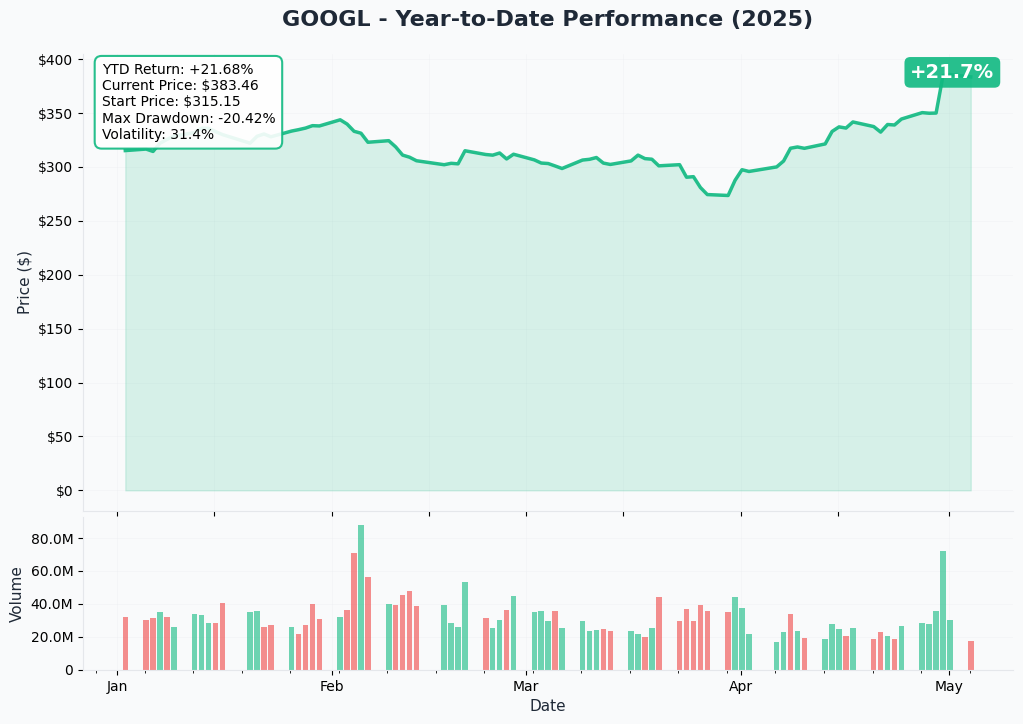
GOOGL has had one of the most dramatic intra-year reversals in mega-cap history during 2026: it plunged to a low of $271.57 on March 30 amid macro uncertainty and trade-policy fears, then staged a +34% rally in April alone — its best month since 2004 — surging past the $345 and $380 levels in rapid succession on the back of an earnings blowout reported April 29.
Key observations:
- 🚀 V-shaped recovery: The March 30 low of $271.57 to the current ~$383.51 represents a +41% recovery in roughly 35 days — one of the fastest recoveries in GOOGL's history for a stock of this size
- 📈 Key levels reclaimed: GOOGL has now cleared $345, $360, $370, $380, and is approaching $385 — each of which was a prior resistance level. The velocity of this reclaim is remarkable
- 📊 Q1 earnings gap: The April 29 post-earnings gap (stock jumped ~10% after-hours) has been sustained and extended, a bullish sign — earnings gaps that hold for 3–5 sessions typically confirm a new trading range
- ⚠️ Near all-time high territory: At $383.51, GOOGL is approaching the consensus analyst 12-month price target of ~$386.82 — meaning if targets haven't yet been revised post-Q1, the stock is already approaching the "old" bullish consensus
- 🎢 Volatility profile: The magnitude of moves (March 30 low to May 4: +41%) shows this is a high-beta name within mega-cap tech during AI-driven sentiment cycles; options market is pricing in continued volatility
Gamma-Based Support & Resistance Analysis
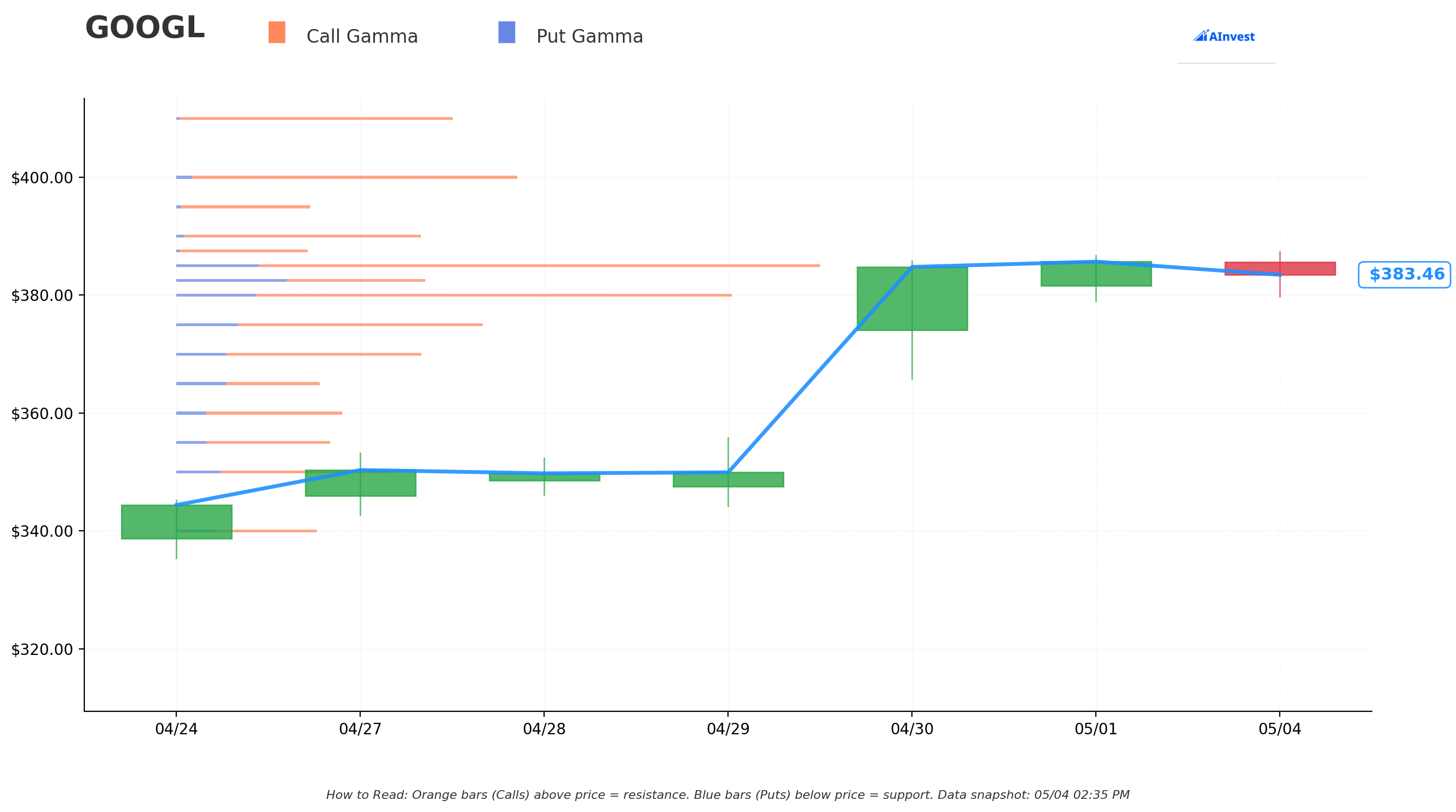
Current Price: $383.51
The gamma exposure (GEX) map reveals where market makers are most heavily positioned, where price action tends to get sticky, and which levels offer the most structural conviction:
🔵 Support Levels (Below Current Price):
- $382.50 — Immediate gamma floor with 18.25B total GEX (net $2.38B). The stock is currently right at this level. Market makers with long gamma here will mechanically buy the underlying on dips, creating a natural short-term bid
- $380.00 — Strong secondary support at 39.40B total GEX — the single largest support concentration in the data. Net GEX of $27.88B (strongly call-dominated) means dealers are significantly long gamma here and will defend this level aggressively with mechanical buying
- $375.00 — Meaningful floor with 21.36B total GEX. A test of $375 would represent only a 2.2% pullback from current levels — very achievable in a single session if sentiment shifts
- $370.00 — Deep support at 17.13B total GEX; 3.5% below current price. This is the zone where institutional dip buyers tend to be most active
- $360.00 — Extended support at 11.52B total GEX, 6.1% below current price. A GOOGL at $360 would start to call the post-earnings rally into question
- $350.00 — Structural floor at 14.73B total GEX. Note this is also very close to the $345 near-term STO strike on this diagonal spread — if GOOGL fell to $350, the short May call would be moving toward worthlessness, which would be a gift for the diagonal trader
🟠 Resistance Levels (Above Current Price):
- $385.00 — IMMEDIATE and STRONGEST resistance at 41.35B total GEX (net $30.72B). This is a significant gamma wall — market makers are massively long call gamma at $385. They mechanically hedge by selling underlying into rallies toward this level. GOOGL is currently trading just below this wall at $383.51
- $390.00 — Secondary resistance at 16.84B total GEX. Note this is also the BTO strike for the August call leg of this diagonal spread — a sustained move through $390 is where the August calls begin building real intrinsic value
- $400.00 — Meaningful resistance at 23.44B total GEX, 4.3% above current price
- $410.00 — Extended resistance at 19.03B total GEX, 6.9% above current price
Net GEX Bias: Bullish — Total call GEX of 312.2B towers over total put GEX of 83.1B. Market maker positioning is overwhelmingly long-biased, providing a structural tailwind. However, the $385 gamma wall at 41.35B total GEX is a real ceiling that the bull case must overcome.
What this means for the diagonal spread:
The diagonal trader's near-term short call at $345 is so deep ITM ($38.51 below the strike) that it's essentially insulated from the GEX dynamics — the gamma and delta on that leg are already near maximum. The action is in the August $390 call, which sits just above the $385 resistance wall. A sustained break of $385 would accelerate the $390 call's value as market makers adjust their hedges. Conversely, if GOOGL stalls at $385 and consolidates, the short $345 leg approaches expiry and the trader pockets the credit.
Implied Move Analysis
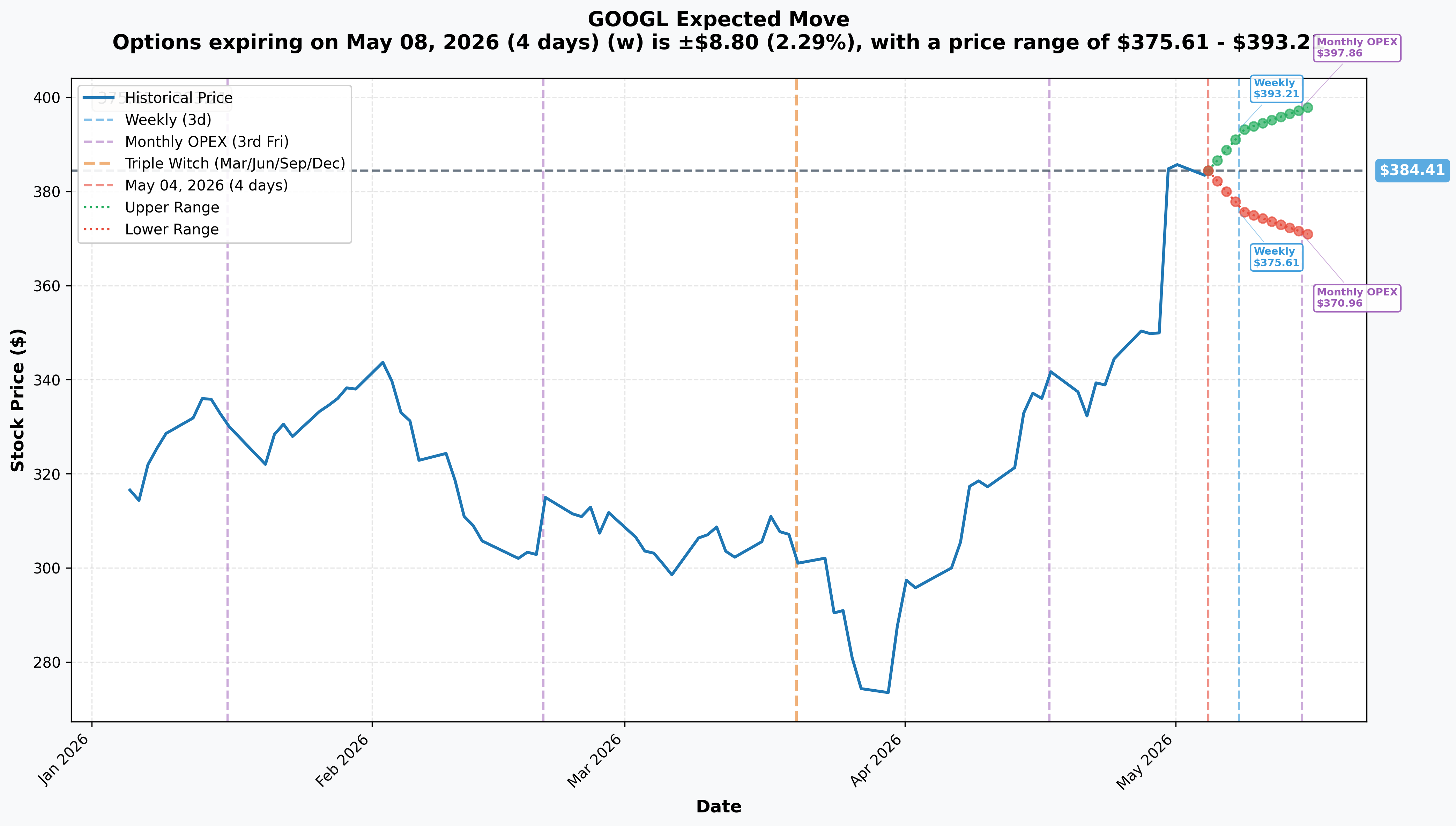
Options market pricing for upcoming expirations (from $384.41 reference):
| Expiry | Type | Days Out | Implied Move | Upper Range | Lower Range |
|---|---|---|---|---|---|
| May 8, 2026 | Weekly | 4 days | ±2.29% / ±$8.80 | $393.21 | $375.61 |
| May 15, 2026 | Monthly OPEX (Near Leg!) | 11 days | ±3.50% / ±$13.45 | $397.86 | $370.96 |
Key observations from the implied move data:
-
📊 May 15 OPEX range: $370.96 to $397.86 — The near-leg of this diagonal (short $345 call) has already seen its fate largely determined by this data. With the lower end of the May 15 range at $370.96 and the $345 strike a full $25.96 below that lower range, the options market is pricing essentially ZERO probability that GOOGL falls to $345 by May 15. The $345 short call is almost certainly expiring in-the-money and will be assigned unless the trader actively manages or rolls it
-
🎯 What the trader needs for the near-leg: For the short $345 call to expire worthless, GOOGL would need to fall to $345 — a 10% decline in 11 days from current levels. The implied move only prices a 3.5% ($13.45) move in either direction. A 10% decline is roughly a 3-sigma event by this measure — extremely unlikely absent a catastrophic catalyst. The trader almost certainly knows this. Their plan may not be for the near-leg to expire worthless — see the strategy breakdown below
-
📈 August 21 context: The August 21 BTO leg sits 109 days out. The implied move data doesn't extend to that date in this snapshot, but given the $390 strike is only 1.7% OTM from current spot of $383.51, the August $390 call has meaningful delta and will benefit directly from a sustained rally above $385
🎪 Catalysts
🔥 Recent Catalysts (Already Happened — Setting the Table)
Q1 2026 Earnings Blowout — April 29, 2026
Alphabet delivered one of the strongest quarters in its history, triggering the +34% April rally that propelled GOOGL from $271 to $380+:
- 📊 Revenue: $109.9B (+22% YoY) vs. $107.2B consensus — highest growth rate since 2022
- 💰 EPS: $5.11 (+81% YoY) vs. $2.63 consensus per Yahoo Finance — net income of $62.6B
- ☁️ Google Cloud: $20.0B (+63% YoY), operating income tripled, operating margin expanded from 17.8% to 32.9%
- 📦 Cloud RPO (backlog): nearly doubled QoQ to $462B — per BigGo Finance, signaling multi-year demand visibility that the market had seriously underestimated
- 🔍 Search revenue: $60.4B (+19% YoY) — AI-integrated Search ("AI Overviews") is not cannibalizing ad revenue at the pace bears feared
- 📺 YouTube ads: $9.88B (+10.7% YoY) — slight miss vs. $9.99B consensus, the one soft spot
- 💳 Subscriptions/Platforms: $12.4B (+19%), driven by 350M+ paid subscriptions across YouTube Premium, Music, and Google One AI plans
Capex Raised to $180–190B for 2026
CFO Anat Ashkenazi raised the full-year 2026 capex envelope from $175–185B to $180–190B, with Q1 alone at $35.7B. She also telegraphed that 2027 capex will "significantly increase" beyond 2026 — a statement that split the market between bulls (Cloud ROI is arriving) and bears (free cash flow at risk).
Gemini 3.1 Pro — February 19, 2026
Gemini 3.1 Pro launched with a 2M-token context window, 77.1% on ARC-AGI-2 (more than double Gemini 3 Pro), and pricing roughly 2.5x cheaper than GPT-5.5 on output tokens. It now leads the BenchLM provisional leaderboard 92–91 over GPT-5.5. This model win directly drove the enterprise LLM share jump from 7% to 21% and is feeding the $462B Cloud backlog.
Waymo's $16B Raise and 10-City Expansion
Waymo raised $16B at a $126B valuation and now operates in 10 US cities — adding incremental option value to GOOGL's Other Bets segment that most DCF models still value near zero.
🚀 Upcoming Catalysts (The Reasons for the August Leg)
Google I/O — May 19–20, 2026 (15 DAYS AWAY)
Google I/O 2026 at the Shoreline Amphitheatre in Mountain View is the single most important near-term catalyst for GOOGL — and it falls squarely within the August 21 option window. Key expected announcements per Android Gadget Hacks and Abhishek Gautam's preview:
- 🤖 Gemini 4.0 flagship model reveal — the successor to Gemini 3.1 Pro; if it extends the AI benchmark lead, expect a re-rating of GOOGL's AI multiple
- 📱 Android 17 with deeper native Gemini integration across all Google services
- ⚙️ Agentic coding tools and developer frameworks for Vertex AI — directly feeding the Cloud backlog thesis
- 🔗 Deeper Gemini integration across Search, Workspace, and Pixel — the distribution moat is the whole thesis
I/O has historically driven 2–5% same-week moves in GOOGL. With Gemini 4.0 positioned as the headliner, the magnitude of any surprise — positive or negative — could be at the high end of that range.
DOJ Ad-Tech Remedy Ruling — Imminent (May–June 2026)
Judge Brinkema's March 31 self-imposed AdX deadline has passed; legal analysts expect the ruling within weeks. The DOJ seeks structural divestiture of AdX and DFP. Per Linos News analysis, a forced divestiture would remove ~$25–30B in annual Google Network revenue — but at much lower margins than Cloud or Search, so the profit impact may be smaller than the revenue loss implies. This is the primary binary downside risk for GOOGL in the May–June window and falls directly within both the near-leg (May 15) and far-leg (August 21) expiration windows.
Q2 2026 Earnings — ~July 23, 2026
The Q2 print falls perfectly within the August 21 option window. Wall Street Horizon places it around July 23. Key metrics the options market will be watching:
- ☁️ Cloud growth rate: does it sustain near 63% or decelerate? Street consensus is mid-to-high 50s%
- 📊 Cloud operating margin: Street expects ~29.8% in Q2, +900 bps YoY per TIKR
- 🔍 Search ad revenue resilience vs. AI-native search disruption
- 💸 Capex pacing toward the $180–190B envelope — is the spend generating visible backlog conversion?
A Q2 beat of the Cloud growth narrative would be a direct catalyst for the August $390 call, giving the position maximum optionality coverage: I/O in May, earnings in July, and anything in between.
Gemini 4.0 Staggered Rollout — June–August 2026
Following an I/O reveal, Gemini 4.0 typically rolls out through Vertex AI and the Gemini app over the subsequent 60–90 days. Enterprise adoption acceleration would feed directly into incremental Cloud backlog — the key driver of the $462B RPO story.
Waymo Milestone — 1M Weekly Trips by End-2026
Co-CEO Tekedra Mawakana committed to 1M weekly trips by year-end 2026. Multiple new city launches — Dallas, Houston, Las Vegas, San Diego, Detroit — are confirmed for the May–October window. Waymo approaching commercial scale changes how investors model Alphabet's Other Bets optionality.
🧠 Diagonal Spread Mechanics: How This Trade Actually Works
Understanding the diagonal spread requires thinking through three distinct scenarios:
Scenario A: GOOGL Holds Above $345 Through May 15 (Most Likely — ~85% Probability)
With GOOGL at $383.51 and the May 15 implied move range flooring at $370.96, the short $345 call expires deep ITM. The trader faces two sub-scenarios:
Sub-scenario A1: Trader is assigned on the short $345 call
- They must sell 430,000 shares at $345 per share — but remember they collected $38.50/share for the privilege, so their effective sale price is $345 + $38.50 = $383.50/share — essentially exactly where GOOGL is trading today
- This "synthetic forward sale" at $383.50 is not a loss — it's a controlled exit at current prices while retaining the August $390 call
- The August call then becomes their re-entry vehicle: if GOOGL rallies past $390, they participate in the upside via the 4,500-contract call position
Sub-scenario A2: Trader rolls the near-term leg before assignment
- A sophisticated diagonal manager often rolls the short near-term call forward — buying back the May 15 $345 call and simultaneously selling a June or July call, typically at the same strike or slightly higher
- This extends the income collection and maintains the diagonal structure, allowing more time for the long August $390 call to appreciate
- Each roll generates additional premium income, progressively reducing the net cost basis of the August call
Scenario B: GOOGL Crashes Below $345 by May 15 (Unlikely — ~15% Probability)
- The short $345 call expires worthless — the trader keeps the full $16M credit from that leg
- They now own the August $390 call with a net cost basis of only $11M − $16M = negative $5M (i.e., they are already in profit on the combined position, with the August call owned for free and then some)
- This would be the home-run scenario: they collected the full near-term credit AND own a 4,500-contract August call at no net cost
- This scenario requires a ~10% decline in GOOGL in 11 days — roughly a 3-standard-deviation move given current implied volatility
Scenario C: Breakeven and Profit on the Full Diagonal
Key levels for the August $390 call leg (expires August 21, 2026):
- Breakeven on August leg alone: $390 + $27.20 = $417.20/share
- But accounting for the $5M net credit already pocketed, the combined position breaks even on the August leg at a meaningfully lower effective strike
- If GOOGL is at $417 on August 21 and 4,500 contracts are fully in the money, intrinsic value = $27/share × 100 × 4,500 = $12.15M just in intrinsic value
- Maximum theoretical profit on the August call is uncapped above $390 strike
The elegant math: The diagonal trader effectively bought the August $390 call for a net of $5M after collecting the near-term credit, rather than the full $11M market price. That 54% discount on the long-dated call is the entire point of the structure.
🎲 Price Targets & Probabilities Through August 21, 2026
Using GEX levels, implied move data, and the catalyst calendar, here are the scenarios through August 21, 2026 expiration:
📈 Bull Case (35% probability)
Target: $400–$430 | August $390 Call P&L: Profitable
How we get there:
- 🤖 Google I/O May 19–20 delivers a blow-out Gemini 4.0 reveal — benchmark scores significantly above GPT-5.5 equivalents, driving a wave of enterprise API contract announcements and Vertex AI adoption
- ☁️ Q2 2026 Cloud growth sustains above 55% — any re-acceleration toward 60%+ triggers analyst model upgrades and a re-rating of the Cloud segment multiple, which still trades at a discount to Azure's implied multiple
- ⚖️ DOJ ad-tech ruling comes in with behavioral remedies (not structural divestiture) — removing the $25–30B revenue risk overhang and sparking a relief rally
- 🚗 Waymo milestone announcements — new city launches, ridership data, or autonomous tech partnerships — add incremental upside to Other Bets optionality
- 📊 GOOGL clears the $385 gamma wall convincingly, triggering momentum buyers through $390, $400, and toward the $410 resistance zone
August $390 call P&L in the bull case:
- GOOGL at $400 on Aug 21: intrinsic value $10/share × 4,500 contracts × 100 = $4.5M intrinsic (vs. $11M paid) — still at a partial loss but recovering
- GOOGL at $417 on Aug 21: ~$27/share intrinsic — full recovery of the $11M debit
- GOOGL at $430 on Aug 21: ~$40/share intrinsic → $18M intrinsic, +$7M profit on the leg (after accounting for $5M net credit already pocketed, combined position nets +$12M)
- GOOGL at $450 on Aug 21: ~$60/share intrinsic → $27M intrinsic, a massive win on the combined book
🎯 Base Case (45% probability)
Target: $370–$400 range | August $390 Call P&L: Near breakeven to partial loss
Most likely scenario:
- ✅ I/O delivers solid but not blow-out announcements — Gemini 4.0 is impressive, Android 17 launches well, but no dramatic benchmark leapfrog or surprise enterprise contract announcements
- 📊 Q2 Cloud growth comes in around 55–58% — decelerating from 63% but remaining exceptional; market is mildly disappointed after lofty expectations
- ⚖️ DOJ ad-tech ruling is mixed — partial behavioral remedies with uncertainty about structural outcomes, keeping a modest overhang
- 💸 Capex concerns re-emerge in Q2 — with $180–190B full-year commitment, Pivotal Research's projection of FCF collapsing ~90% to $8.2B becomes a more prominent narrative heading into Q3
- 📈 GOOGL trades in the $375–$400 range through the summer, unable to decisively break above the $385 gamma wall and toward $400
August $390 call P&L in the base case:
- At $385 on August 21: call expires OTM ($5 below strike), intrinsic = $0 → full $11M debit lost on the leg (but net position is still a gain of $5M from the credit already collected)
- At $390 on August 21: at-the-money, nominal intrinsic → near full $11M debit lost on the leg (but combined position down only $5M net, a manageable drawdown)
- At $395 on August 21: $5/share intrinsic, $2.25M recovered → net $8.75M loss on the long leg (combined position at -$3.75M, after the +$5M credit offset)
The key insight for the base case: Even if GOOGL just consolidates in the $375–$400 range and the August $390 call loses most of its time value, the $5M net credit already collected means the combined position is not a disaster. The trader earns income today while maintaining a call option on the upside scenario.
📉 Bear Case (20% probability)
Target: $320–$350 range | Combined Position: Profitable on the near-term, uncertain on August
What could go wrong:
- ⚖️ DOJ structural divestiture ruling forces AdX/DFP spinoff — removes $25–30B in annual Google Network revenue, triggers algorithmic selling and analyst estimate cuts; stock gives back significant post-earnings gains
- 😰 I/O disappoints — Gemini 4.0 fails to clearly beat rival models, agentic tools underwhelm enterprise buyers, developer reception is muted
- 💸 Capex bear thesis gains traction — if the market decides $180–190B capex + a "significantly higher" 2027 number means FCF collapses with insufficient Cloud ROI, multiple compression kicks in
- 📺 YouTube ad revenue continues softening — Q1's $9.88B vs. $9.99B miss was isolated; if Q2 comes in below $10B again in a growing market, brand advertisers are signaling concern
- 🌍 Macro deterioration from tariff escalation — repeat of the March 30 shock scenario; GOOGL was at $271.57 just 35 days ago. Another macro shock could retrace to $340–$360
In the bear case, the diagonal structure actually works in the trader's favor on the near-term leg:
- If GOOGL falls toward $345 by May 15, the short $345 call loses value rapidly → the trader can buy it back cheaply or let it expire worthless
- The $16M credit means the trader profits if GOOGL falls significantly by May 15
- The August $390 call becomes the only remaining risk, having already pocketed the near-term credit
GEX support levels in the bear case:
- $382.50 (18.25B total GEX) — First mechanical bounce zone
- $380.00 (39.40B total GEX) — Strongest support; dealers mechanically buy here
- $375.00 (21.36B total GEX) — Secondary defense
- $370.00 (17.13B total GEX) — Meaningful floor; 3.5% below current price
- $350.00 (14.73B total GEX) — Deep support; approaching the near-term short call strike
💡 Trading Ideas
🛡️ Conservative: Sell the I/O Volatility Premium Via a Calendar Spread
Play: Sell the May 23 (or May 30) GOOGL $385 call and buy the June 20 $385 call — a horizontal calendar spread that collects inflated I/O event premium from the near-term leg while maintaining exposure via the longer-dated leg.
Why this works:
- ⏰ Google I/O runs May 19–20, just 15 days away. The options market is almost certainly inflating near-term implied volatility (IV) to reflect the binary announcement risk from Gemini 4.0, Android 17, and enterprise product reveals. A post-I/O IV crush is highly predictable once the event resolves
- 📊 Selling the post-I/O weekly or bi-weekly expiry captures the elevated IV premium while the calendar long leg retains value as a hedge. After I/O resolves and IV collapses, the short leg's value deflates faster than the long leg — generating a profit from the volatility differential (theta/vega difference between the two legs)
- 🎯 The $385 strike is directly at the GEX resistance wall — the most crowded area of the gamma surface. Strikes at heavy OI concentration tend to act as "gravity" near expiry, especially on large event dates like OPEX
- 📈 If GOOGL pins at or near $385 post-I/O (a plausible outcome given the gamma wall), the calendar spread at $385 maximizes the time-decay income as the short leg expires worthless or near-worthless
- 💰 Estimated structure cost: calendar spreads at this strike/timeframe typically cost $3–5/share net debit for the spread. Maximum profit occurs if GOOGL closes at exactly $385 on the short leg's expiry — capturing the full premium differential
Sizing and management:
- Enter 5–20 spreads (500–2,000 shares of exposure) depending on account size
- Close the spread when the short leg has decayed 50–70% of its value — do not wait for expiry on the short leg to avoid gamma risk in the final days
- Stop loss: if GOOGL moves aggressively above $395 or below $370, the calendar begins losing value on both wings — exit and reassess
Risk level: Low to Moderate | Skill level: Intermediate | Best entry window: May 12–16 (just before I/O, when near-term IV is maximally inflated)
Expected outcome: Collect $2–4/share in net credit from the IV crush post-I/O. On 10 spreads, that is $2,000–$4,000 in realized gains from the volatility premium without meaningful directional exposure.
⚖️ Balanced: Wait for the DOJ Ruling Drop and Trade the Resolution
Play: Do not enter ahead of the DOJ ad-tech remedy ruling. Watch for the ruling to hit (expected within weeks), then enter a defined-risk position aligned to the ruling's outcome — either a bull call spread if behavioral remedies (relief rally) or a put spread if structural divestiture (sell-off).
Why this works:
- ⚖️ The DOJ ad-tech remedy ruling is a known, imminent binary that will resolve within weeks. The market is NOT pricing this risk fully — GOOGL is at $383 and has rallied 41% from the March lows, but the regulatory sword of Damocles is still hanging. Waiting for resolution removes the binary surprise entirely
- 📊 If behavioral remedies: GOOGL likely gaps 3–5% higher as the $25–30B AdX/DFP revenue risk is removed from the overhang. Enter a June 20 or July 17 bull call spread — buy the $390 call, sell the $410 call — immediately after the ruling, while IV has already compressed post-event and pricing is cleaner
- 📉 If structural divestiture: GOOGL likely sells off 5–10% back toward $345–$360. Enter a May 15 or June 20 put spread to capture the downside — buy the $370 put, sell the $355 put — for a defined-risk bearish position on the ruling overhang
- 🎯 Either way, you are trading with information (the ruling is known) rather than guessing the outcome in advance. The advantage of the reactive approach is that post-event IV crush makes options cheaper, and you have confirmation of the directional catalyst
Bull call spread structure (if behavioral ruling):
- Buy the July 17, 2026 $390 call / Sell the July 17, 2026 $415 call
- Estimated net debit: $6–9/share for a $25-wide spread
- Max profit: $16–19/share if GOOGL closes above $415 on July 17
- Breakeven: approximately $396–$399 — a modest 3–4% rally from the post-ruling price
- The July 17 expiry captures Q2 earnings (~July 23) is slightly outside the window — consider the August 21 spread to capture the full Q2 earnings catalyst
Put spread structure (if structural divestiture ruling):
- Buy the June 20, 2026 $370 put / Sell the June 20, 2026 $350 put
- Estimated net debit: $4–6/share for a $20-wide spread
- Max profit: $14–16/share if GOOGL falls below $350 by June 20
- Breakeven: approximately $364–$366
Risk level: Moderate | Skill level: Intermediate | Timing: Wait for the ruling, do not anticipate
🚀 Aggressive: Replicate the Whale — Scaled-Down Diagonal Call Spread
Play: Mirror the institutional diagonal structure at retail scale — sell 2–5 contracts of the May 15 $345 call (or roll to June $365 call if the May has already moved) and simultaneously buy 2–5 contracts of the August 21 $390 call, targeting a net credit or neutral cost structure.
Why this could work:
- 🐋 The Z-score on the August $390 call is 33.48 — over 33 standard deviations above normal activity. This is statistically among the most anomalous GOOGL options prints in recent history. When institutions make a 33-sigma move in a liquid mega-cap name, it is worth taking seriously
- 💰 The diagonal structure is inherently capital-efficient: by selling the near-term ITM call, you dramatically reduce the net cost of the long-dated position. The near-term premium partially or fully funds the long-dated optionality — this is a time-value arbitrage
- ☁️ The August 21 expiry captures three distinct catalysts: Google I/O (May 19–20), DOJ ruling (May–June), and Q2 earnings (~July 23). This is dense catalyst coverage for a single options window
- 📍 At only 1.7% OTM ($390 vs. $383.51 spot), the August call is near-at-the-money — it has high delta and will respond meaningfully to any move higher in GOOGL, without requiring a dramatic 20%+ move just to reach the strike
- 🛡️ The net credit structure ($5M net collected at institutional scale) means the trader is already "in profit" on the combined position unless GOOGL crashes AND the August call also expires worthless — two adverse things must happen simultaneously to lose money
Practical retail execution (example with 3 contracts per leg):
| Leg | Action | Strike | Expiry | Est. Price | Premium |
|---|---|---|---|---|---|
| Near | STO 3 contracts | $345 CALL | May 15, 2026 | ~$38.50/sh | +$11,550 collected |
| Far | BTO 3 contracts | $390 CALL | Aug 21, 2026 | ~$27.20/sh | -$8,160 paid |
| Net | +$3,390 credit |
How to manage this trade:
- ⏰ Before May 15 OPEX: Monitor the short $345 call daily. If GOOGL stays above $345 (almost certain given current $383.51 price), prepare for one of two actions:
- Accept assignment: Allow the short call to be exercised, effectively selling GOOGL at $345 + $38.50 premium collected = $383.50 effective sale price (essentially current market). You are now flat on shares with the August $390 call remaining
- Roll forward: Buy back the May 15 $345 call (cost will be close to all intrinsic value — about $38–39/share) and sell a June 19 or July 17 call at the same strike or slightly higher. This extends the income calendar while maintaining the diagonal
- 📈 After near-term leg resolves: The August $390 call is your remaining position. With a $383.51 spot and $390 strike, GOOGL needs to rally only 1.7% for the call to go in-the-money. This is a very manageable threshold
- 🎯 Target exit on August call: If GOOGL reaches $405–$415 before August 21 (in a post-I/O or post-Q2 rally), consider closing the $390 call for a $15–25/share gain — capturing the bulk of the intrinsic value without waiting for expiry theta decay
Why this could blow up (READ THIS CAREFULLY):
- ❗ Assignment risk on the short call is nearly certain given current prices. If you are not prepared to deliver 300 shares of GOOGL (for 3 contracts) at $345/share, do NOT sell this call without proper margin or share ownership. Being short a naked call on a $383 stock with assignment imminent is a margin event for unprepared accounts
- 💸 Short ITM call carries pin risk: In the last days before May 15 expiry, if GOOGL happens to be very close to $345, the assignment outcome becomes uncertain and the position has maximum gamma exposure
- 🎢 Diagonal management requires active monitoring. Unlike a simple long call, this structure needs decisions made at or before the near-term expiration. Set calendar reminders for May 13–14 (two days before OPEX) to make the roll-or-assign decision
- ⚠️ If GOOGL gaps down dramatically: A black-swan move (DOJ structural ruling causing a 10–15% drop) benefits the short near-term call (it expires worthless), but the August $390 call also loses significant value as the stock moves further from the strike. The net credit buffers some of this loss but does not eliminate it
Estimated P&L scenarios (3-contract example, combined position):
- GOOGL at $370 on Aug 21: August call OTM, expires worthless → net position = +$3,390 collected credit (total win from the near-term leg if near-leg also expired worthless; loss adjusted if assigned on near-leg)
- GOOGL at $390 on Aug 21: at-the-money, minimal intrinsic → August call near zero → net slightly positive from the credit offset
- GOOGL at $410 on Aug 21: $20/share intrinsic × 3 × 100 = $6,000 intrinsic + $3,390 credit = $9,390 combined gain
- GOOGL at $430 on Aug 21: $40/share intrinsic × 3 × 100 = $12,000 intrinsic + $3,390 credit = $15,390 combined gain
Risk level: HIGH — requires margin awareness and active management | Skill level: Advanced | Maximum account allocation: 3–5% of total portfolio per diagonal
CRITICAL WARNING: Do not sell a naked ITM call without (a) owning the underlying shares to deliver, or (b) sufficient margin to cover assignment. The $345 call is $38.51 ITM as of trade date. Assignment is the default outcome, not the exception. Plan for it explicitly.
⚠️ Risk Factors
Do not overlook these landmines:
-
⚖️ DOJ ad-tech remedy ruling — imminent binary: Judge Brinkema's ruling on AdX/DFP could land any week. Structural divestiture would force the removal of ~$25–30B in annual Google Network revenue and create multi-year operational disruption. This is the most significant near-term downside catalyst and falls squarely within both option legs' windows. GOOGL is trading as if behavioral remedies are the base case — if structural divestiture hits, the stock could retrace to the $340–$360 zone rapidly
-
💸 Capex/FCF compression bear thesis: The $180–190B 2026 capex plus a "significantly higher" 2027 number has Pivotal Research modeling FCF collapsing ~90% to $8.2B. At a ~$4.67T market cap, a FCF yield near zero is an uncomfortable place for a stock already near all-time highs. If the market rotates from "growth at any cost" back to "show me the cash," GOOGL's multiple is vulnerable
-
📺 YouTube ad softness: The Q1 $9.88B vs. $9.99B miss was the only blemish in an otherwise perfect quarter. If Q2 brand advertising weakens further — particularly if TikTok/Instagram Reels continue taking brand budget share — YouTube's deceleration narrative could resurface at exactly the wrong moment (pre-earnings positioning in July)
-
🌍 Macro/tariff tail risk: GOOGL was at $271.57 just 35 days ago. The macro environment that produced that March 30 low has not been permanently resolved — tariff escalation or geopolitical shock could trigger a similar episode. At $383, there is significantly more downside territory between current price and the March low than most investors currently acknowledge
-
📊 Search disruption structural risk: Alphabet's own 10-K added new AI risk language — "there is no assurance that we will adapt effectively and competitively." AI-native search competitors (ChatGPT and others) are still a slow-burn threat; Morgan Stanley estimates mandatory choice screens could cost $15–25B annually on DOJ Search appeal
-
📈 Consensus price target risk: The average analyst 12-month price target is ~$386.82 — essentially where the stock trades today. Even after 29 analysts revised estimates upward post-Q1, the stock has already risen to meet those targets. Sustained momentum above $390 requires not just target revisions but a genuine multiple expansion — a high bar given the capex overhang
-
🔄 Near-term assignment mechanics for the diagonal trader: If managing the diagonal yourself, the short $345 call is almost certain to be in-the-money at May 15 OPEX. Failing to proactively roll or plan for assignment before expiry is a common retail mistake — early assignment (before expiry) is possible at any time on American-style equity options when the short call is deep ITM
🎯 The Bottom Line
Real talk: This is one of the most sophisticated institutional options prints on GOOGL in recent memory. The 12:24:33 simultaneous execution of both legs — confirmed by Z-scores of 6.87 and 33.48 respectively — is textbook structured institutional flow, not retail noise. Someone with serious capital (the $16M credit leg alone is not accessible to most traders) decided that five days after Alphabet's best earnings quarter in years, the right play is to engineer income today while maintaining long call exposure through the full catalyst gauntlet of I/O, the DOJ ruling, and Q2 earnings.
What this trade tells us:
- 🛡️ Net credit = income priority, not pure bullishness. The $5M net credit collected means this trade profits if GOOGL consolidates or declines slightly through May 15 — not just if it rallies. The trader is saying: "GOOGL is probably going sideways or slightly up short-term; let me collect premium. But I want to own calls through the summer's big catalysts just in case."
- 🐋 The $390 August call Z-score of 33.48 is extraordinary. Only a handful of trades this statistically anomalous occur in any liquid mega-cap name per year. The institution had a specific reason to want $390 August exposure — not $380, not $400, not July. That specificity implies a view on both the strike and the catalyst calendar
- ☁️ The $462B Cloud backlog is the anchor. With nearly $462B in committed Cloud revenue, Google's Cloud growth of 63% is not noise — it is structural. The August call is a bet that the backlog conversion story remains intact through Q2 and that I/O gives the enterprise AI narrative another leg. The backlog is real, the operating leverage is arriving (margin from 17.8% to 32.9%), and the $390 call is positioned to capture that story
- 🎯 The diagonal structure is designed for exactly this setup: a stock that has already had a massive move (March low $271 to current $383 = +41%), is approaching consensus targets, but has a dense future catalyst calendar that could extend the rally. Collect income near the current elevated price; finance long-dated optionality cheaply; win in multiple scenarios
If you own GOOGL stock:
- ✅ The institutional diagonal is validation that even after the +41% recovery, sophisticated money sees enough upside to maintain long exposure through August — the fundamental thesis is not over-consensus yet
- 📊 Watch the $385 GEX resistance wall as your first test. A sustained close above $385 on volume signals the next leg toward $390–$400
- ⏰ Mark May 19–20 Google I/O as the first major inflection point. A clean Gemini 4.0 reveal with benchmark-beating results likely clears $390 in the same week
- ⚖️ Watch for the DOJ ad-tech ruling headline — if behavioral remedies are announced, expect a sharp gap higher. Consider reducing stock exposure into the gap as the overhang clears and take profits
- 🛡️ Set a mental stop at $370 GEX support — below that level (3.5% from current), the post-earnings narrative is cracking
If you're on the sidelines:
- ⏰ Wait for the DOJ ad-tech ruling before initiating meaningful exposure. It is the most imminent known unknown and could move GOOGL ±5–10% in a single day. Waiting costs you upside opportunity but removes the binary surprise
- 📈 Post-DOJ-ruling entry into a June or July bull call spread ($385/$410) offers better risk/reward than chasing at current prices — you know the regulatory outcome and can trade with it, not against it
- 🎯 If GOOGL consolidates in the $375–$385 range ahead of I/O (extremely plausible given the $385 gamma wall), any dip toward $375–$380 GEX support is an excellent entry point for a defined-risk bull position ahead of the event catalyst
If you're skeptical:
- 👀 The $385 GEX wall (41.35B total GEX, strongest resistance in the dataset) is your primary tell. If GOOGL cannot breach $385 with volume heading into I/O, momentum is stalling at exactly the price implied by the institutional diagonal's structure
- 📉 A break below $380 GEX support (39.40B total GEX — strongest support) on elevated volume would signal something is wrong with the post-earnings narrative. Below $380, the next meaningful cushion is $375, then $370
- 🎯 Defined-risk June put spreads ($370/$350) — entered after the DOJ ruling resolves and only if it is structural divestiture — offer clean downside exposure with capped risk
Mark your calendar — Key dates:
- 📅 Any day now (May–June 2026) — DOJ ad-tech remedy ruling — structural vs. behavioral remedies; this is the biggest binary for GOOGL between now and August
- 📅 May 15, 2026 — Near-leg expiration (short $345 call); diagonal manager must decide: assign or roll
- 📅 May 19–20, 2026 — Google I/O 2026 — Gemini 4.0, Android 17, agentic developer tools; 2–5% event move priced in
- 📅 ~July 23, 2026 — Q2 2026 earnings — Cloud growth momentum check, capex pacing, YouTube recovery; critical data point for the August $390 call
- 📅 August 21, 2026 — Far-leg expiration (long $390 call); this is the final settlement date for the entire diagonal structure
Final verdict:
Alphabet just delivered its strongest quarter in years — Cloud +63%, backlog $462B, EPS +81% YoY — and an institutional trader responded by immediately engineering a structure that collects $5M in income while maintaining 4,500-contract exposure to a summer rally. The diagonal call spread is the sophisticated institutional answer to the post-earnings dilemma: the stock has already moved dramatically, near-term risk is elevated (DOJ ruling, I/O), but the multi-month catalyst calendar (I/O, DOJ resolution, Q2 earnings, Gemini 4.0 rollout, Waymo milestone) is too good to be entirely flat. Sell the near-term overpriced premium. Finance the longer-dated optionality. Net credit. Let the structure work.
For retail traders: the structure is elegant, but the mechanics are not beginner-friendly. The assignment risk on the short call alone requires careful planning. The smarter approach is to watch the DOJ ruling and I/O from the sidelines, then enter a clean bull call spread with full information rather than navigating a diagonal's management complexity. The whale's trade confirms the thesis — GOOGL's Cloud and AI story is real. How you express that thesis depends on your experience level and risk tolerance.
Stay patient. Let the DOJ ruling and I/O print. Then allocate with conviction.
Disclaimer: Options trading involves substantial risk of loss and is not suitable for all investors. This analysis is for educational and informational purposes only and does not constitute financial advice. Past option flow activity does not guarantee future results. The STO classification on the $345 call reflects a new short (credit) position opened by selling to open — the trader collected premium and bears assignment risk. The BTO classification on the $390 call reflects a new long position opened by buying to open. The diagonal spread structure involves multiple moving parts including potential assignment, roll decisions, and active management — it is not a passive, hold-to-expiry position. Z-scores of 6.87 and 33.48 reflect unusual activity relative to recent GOOGL options history; they do not imply profitability. The $390 call has a meaningful probability of expiring worthless if GOOGL fails to sustain its post-earnings momentum through August 21. Always conduct your own research and consider consulting a licensed financial advisor before making any investment decisions.
About Alphabet Inc.: Alphabet Inc. is the parent holding company of Google, headquartered in Mountain View, California. The company operates through Google Services (Search, YouTube, Android, Chrome, Maps, subscriptions), Google Cloud (GCP, Workspace, Vertex AI/Gemini platform), and Other Bets (Waymo, Verily, Wing). With Search powering ~90% of global queries, YouTube the dominant global video platform, and Gemini 3.1 Pro leading the BenchLM AI benchmark leaderboard, Alphabet sits at the convergence of advertising dominance, AI infrastructure leadership, and autonomous vehicle commercialization. Market cap: ~$4.67 trillion as of May 4, 2026.