🔷 INTC $24M Deep-ITM Call Block — Today's Biggest Ticket Is a Delta-Hedged Financing Trade, Not a Bullish Bet
📅 July 28, 2026 | 🔥 Unusual Activity Detected
🎯 The Quick Take
✅ Update (July 29, 2026): next-day open interest confirmed this as a genuine opening trade — OI at the $70 strike rose 73,263 → 83,059 (+9,796), slightly more than the 9,200-lot print itself, so the whole strike's session volume was opening. The provisional ⏳ flag is resolved. This does not make it bullish — what opened is the delta-hedged financing structure described below, not a directional bet. See the ✅ RESOLVED box.
The single largest options trade on the tape today was a ≈$24 million purchase of 9,200 Intel Nov-20-2026 $70 CALL contracts — a strike sitting ≈$17 below spot, meaning the call is deep in-the-money before you even add time value. On a day INTC is down ≈5.9% in a broad chip selloff, "someone just bought $24M of deep-ITM calls" reads like a huge bullish bet that Intel bounces. It isn't one. The same moment this call printed, a 744,800-share short-stock block hit the equity tape — and the math shows that stock leg almost exactly cancels the option's directional exposure. This is a delta-hedged financing / synthetic structure, not a directional wager on where INTC goes next. The $24M headline measures capital changing hands between two counterparties who'd already agreed on terms — it does not measure conviction that Intel is about to rally.
🏢 Company Overview
Intel Corporation (NASDAQ: INTC) designs and manufactures microprocessors, chipsets, and system-on-chips for the PC (client), data-center/AI, edge, and networking markets — and, uniquely among large-cap chip designers, it also runs its own leading-edge wafer fab business, Intel Foundry (IFS). Under CEO Lip-Bu Tan, Intel is executing a turnaround built on its 18A / 14A process nodes and an attempt to become a credible third-party foundry rival to TSMC and Samsung.
- Sector / Industry: Information Technology — Semiconductors
- Market Cap: ≈$435 billion
- Current Price: ≈$86 (down ≈5.9% today amid a broad chip-stock selloff hitting Micron, SanDisk, and Intel together)
- 52-Week Range: $18.97 – $142.35; all-time-high close of $140.94 on June 22, 2026
Intel has undergone one of the largest large-cap re-ratings in recent memory — roughly a 4x move off its ≈$20 August 2025 lows, driven by an unprecedented U.S. government 10% equity stake, a $5B Nvidia investment, a $2B SoftBank investment, first 18A silicon (Panther Lake), and seven straight quarters of beating guidance. More on all of that below.
💰 The Option Flow Breakdown
📊 What Just Happened
| Time | Symbol | Buy/Sell | Type | Expiration | Strike | Volume | Size | OI (prior → new) | Premium | Spot | Option Price |
|---|---|---|---|---|---|---|---|---|---|---|---|
| Jul 28, 2026 | INTC | BUY | CALL | 2026-11-20 | $70 | 9,200 | 9,200 | 8,354 → 73,263 | ≈$24M | $86.87 | $25.65 |
Option Symbol: INTC20261120C70
🤝 BLOCK CROSS — DELTA-HEDGED. This printed at the ask as a negotiated, off-book block cross with a known counterparty on the other side — not an aggressive, urgent sweep of the lit order book. There's no meaningful "aggressor" read for a cross like this, and — as the delta-hedge math below shows — the real story is in the structure, not in any headline urgency. The $70 strike sits ≈$17 below Intel's $86.87 spot, so this contract carries roughly $17 of built-in intrinsic value (≈66% of the $25.65 price paid) before you even get to time value.
✅ RESOLVED — Open Confirmed, and the Build Kept Going (updated July 29, 2026)
The July 29 pre-market OPRA snapshot is in, and it confirmed opening activity outright.
Resolved from the OPRA open-interest snapshot for EOD July 28, 2026. This box replaces the ⏳ provisional flag published on July 28.
| Leg | Baseline OI (Jul 28 snap) | Resolving OI (Jul 29 snap) | Δ | Print Size | Verdict |
|---|---|---|---|---|---|
| Nov-20-2026 $70 CALL | 73,263 | 83,059 | +9,796 | 9,200 (strike's full session volume 9,882) | ✅ OPEN CONFIRMED (BTO) — ≈106% of size |
What this proves: we set the test as "if tomorrow's OI at the $70 strike holds near 73,263 (or keeps climbing), that confirms genuine new opening activity. If it falls back sharply, part of today's build was unwinding." It did not merely hold — it kept climbing, by 9,796 contracts.
That figure is slightly larger than our 9,200-contract print, and the strike's entire session volume was 9,882. In other words, essentially everything that traded at this strike on July 28 was opening on both sides, with no meaningful offsetting closes anywhere in the strike. The unwinding scenario is ruled out.
What that means, concretely:
- This print opened new contracts. The BTO label is confirmed rather than inferred.
- The bigger accumulation is real and continuing. Open interest at the $70 strike has now gone 8,354 → 73,263 → 83,059 across three snapshots — a build of roughly 75,000 contracts in this single line, of which our $24M print is one slice.
- None of this makes it bullish, and that remains the central point of this article. The position that opened is the hedged structure described below — long deep-ITM calls against ≈744,800 short shares. Confirming that it opened confirms that a financing/synthetic structure was newly established, not that anyone took a directional view on Intel. A large, growing open interest in a delta-hedged strike is a statement about financing demand, not about where the stock goes.
🤓 What This Actually Means — Plain English
Here's the part that matters most, and it's why this trade is a head-fake rather than a bullish signal: this isn't a naked call buy.
We pulled both sides of the tape — the option print AND the nearby equity block — and computed the delta math independently, rather than trusting any screenshot or label:
- The option's own pricing model puts its delta at ≈0.762 — meaning each of these deep-ITM calls behaves like roughly 76 shares of long stock exposure (out of 100).
- Expected stock hedge if this package were built delta-neutral: 9,200 contracts × 100 shares × 0.762 delta = ≈701,040 shares of stock a desk would need to sell short to cancel that long-delta exposure.
- What actually printed on the equity tape at essentially the same moment: a 744,800-share short-stock block at $87.07.
- ≈701,040 expected vs. 744,800 actual = a ≈106% match. That's about as tight a confirmation as real market data gets — this stock block was almost certainly sold specifically to offset the new deep-ITM call position (and slightly overshoots into a small net-short tilt, which is common in these packages).
Translation: the desk bought deep in-the-money calls (which behave like they're long ≈76% of the underlying) and simultaneously sold enough stock short to cancel that long-delta exposure out. What's left is close to delta-neutral — a package that doesn't profit if INTC rallies and doesn't lose if INTC falls, at least not from the directional move alone. In options-math terms, a long deep-ITM call plus short stock is close to a synthetic long put plus a financing leg (put-call parity at work: C − S ≈ P − PV(K)) — a structure much more consistent with financing, borrow, or a hedged package built with a known counterparty than with a bet that Intel is about to bounce.
Why would a desk build this on Intel specifically, right now? A deep-ITM call is a capital-efficient way to hold synthetic long exposure while freeing up the actual shares to lend or borrow against — and Intel's lendable float is unusually tight at the moment, with roughly 10% sitting in a government-owned block plus sizable Nvidia and SoftBank strategic stakes. Pairing the call against short stock lets a desk monetize that borrow dynamic, carry a cheap synthetic-put-style downside hedge through the ≈October 22 earnings print (see Catalysts below), or run a long-volatility position into a high-event-density window — all without taking a real view on direction.
Why the headline number is misleading: $24 million sounds like a big directional bet, and it's real capital — but it's capital that changed hands between two parties who had already agreed on the terms of a delta-neutral structure. It is not $24 million of unhedged bullish conviction on a $435B company. Reading this print as "someone thinks Intel is about to rip higher" mistakes a mechanically hedged financing trade for a directional bet — the single biggest interpretive trap in today's flow.
📈 Technical Setup / Chart Check-Up
YTD Performance
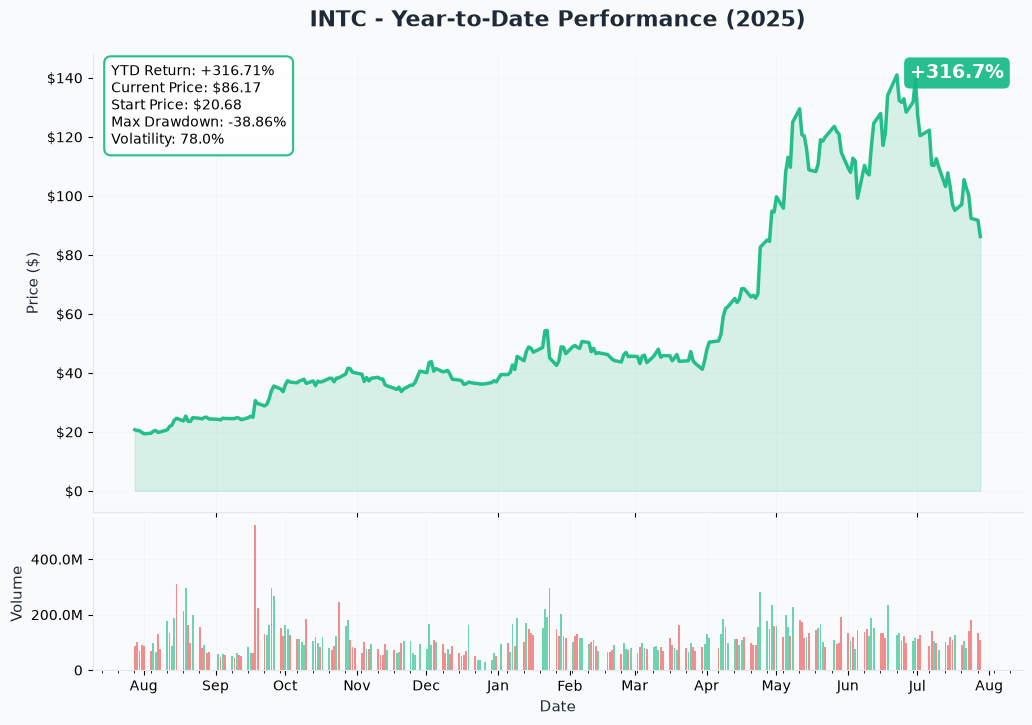
Intel has been one of the market's most dramatic turnaround stories — roughly a 4x run off the ≈$20 August 2025 lows to a $140.94 all-time-high close on June 22, 2026, before pulling back about 39% into today's ≈$86 print. Today's ≈−5.9% move is part of a sector-wide chip selloff dragging Micron and SanDisk down alongside Intel, not an Intel-specific event.
Gamma-Based Support & Resistance Analysis
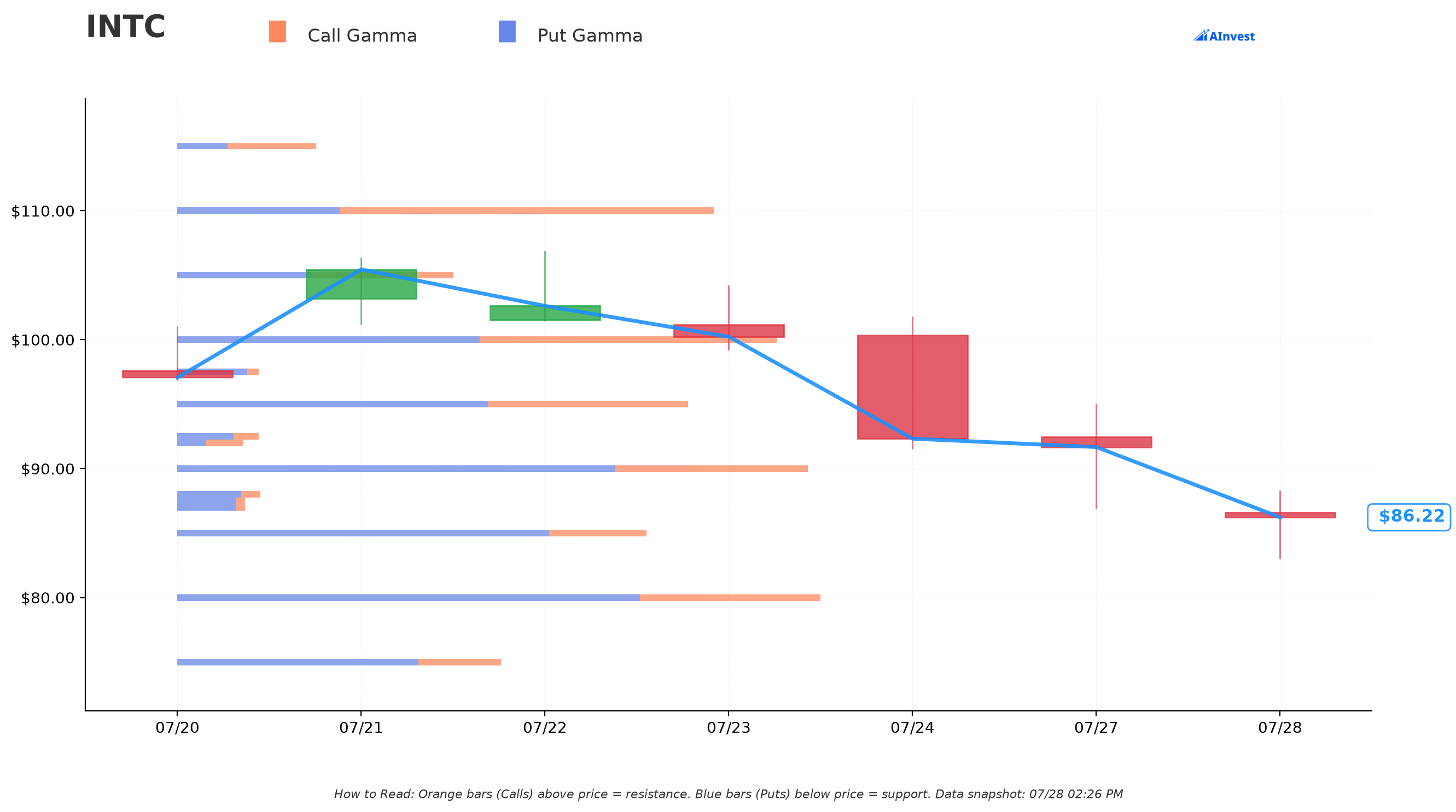
Current Price: ≈$86.87
🔵 Support Level (Put Gamma Below Price):
- $80 — the nearest meaningful gamma-support wall, roughly 8% below spot
🟠 Resistance Levels (Call Gamma Above Price):
- $90 — the first overhead gamma wall, just ≈4% above spot
- $100 — a heavier resistance shelf, ≈15% above spot, and the level dealer hedging flows would concentrate around on a bigger rally
What this means for the traded strike: the $70 strike used in today's trade sits below the $80 support wall entirely — outside the active gamma shelf where dealer hedging is concentrated around the current $80–$100 range. That gap is itself a tell: this strike wasn't picked to play the $80/$90/$100 tug-of-war. It was picked for its deep-ITM delta profile (≈0.76), exactly the kind of strike a desk chooses when the goal is a precisely-sized delta-hedge ratio, not a view on where INTC trades over the next few months.
Implied Move Analysis
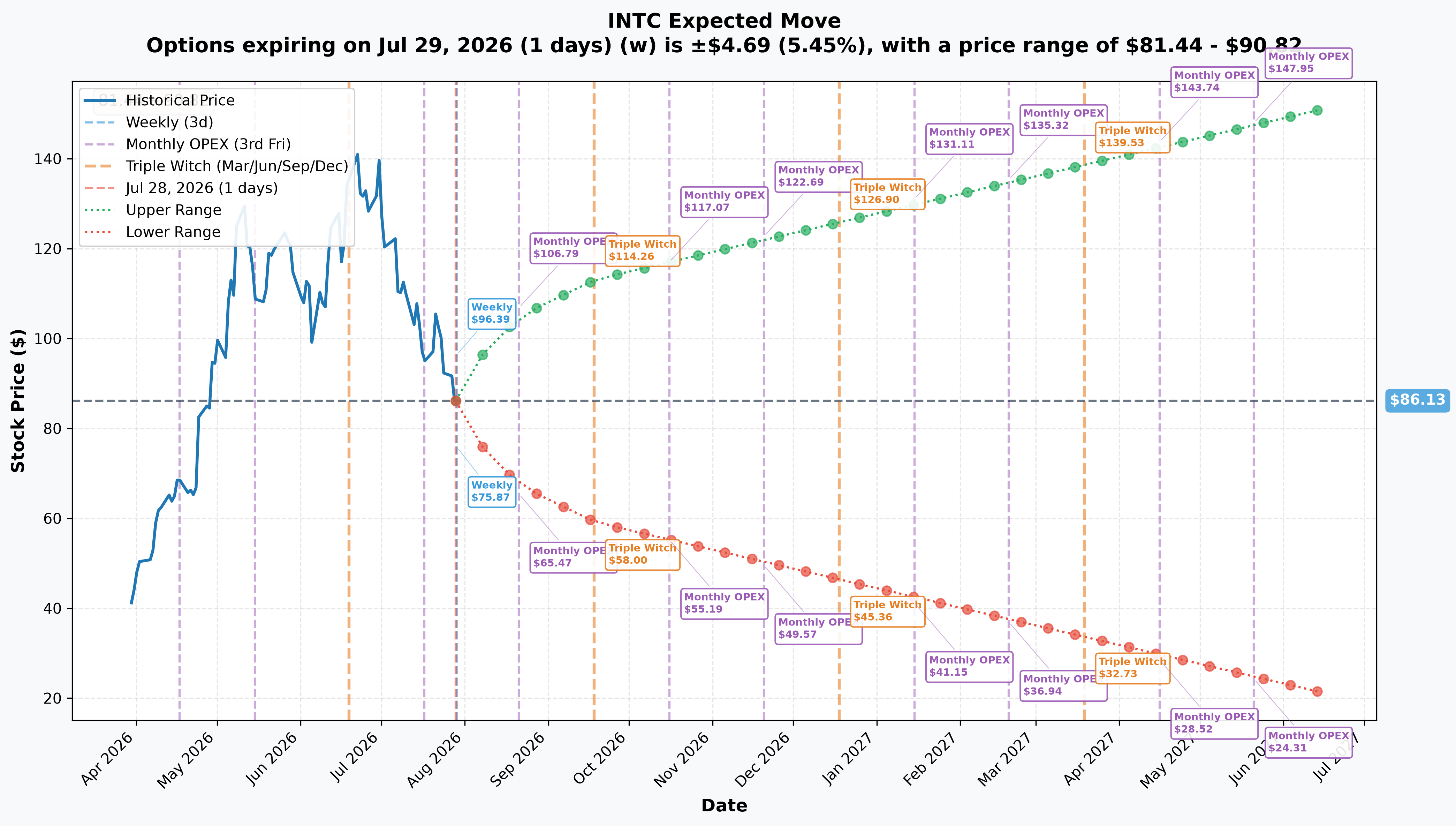
Options pricing across INTC's key expiration (spot ≈$86.87):
- 📅 Monthly OPEX (Aug 21): ±21.98% → Range: $67.20 – $105.10
The $70 strike sits just below the lower edge of that one-standard-deviation range — near the market's own "one-sigma-down" boundary for the August expiry. That elevated implied vol is part of why a deep-ITM financing package carries real premium here ($25.65/contract, ≈$24M total): even a delta-neutral structure is expensive to build and carry when implied vol is this rich, which is consistent with a sophisticated desk doing this deliberately rather than an accident of pricing.
🎪 Catalysts
Why Intel Re-Rated 4x — The Drivers (Already Happened)
- U.S. Government 10% Equity Stake (Aug 22, 2025). The Trump administration converted $8.9B of CHIPS Act funding into 433.3 million shares at $20.47/share, giving Washington roughly a 9.9% stake — Intel Newsroom. By April 2026 the stake had appreciated ≈300% to ≈$36B, per Bloomberg via Yahoo Finance.
- Nvidia's $5B Investment + Joint Products (Sept 18, 2025). Nvidia bought $5B of INTC common at $23.28/share and agreed to co-develop "Intel x86 RTX SoCs." Intel had its best day in nearly 38 years (+22–23%) on the news — NVIDIA Newsroom; CNBC.
- SoftBank's $2B Investment alongside the government and Nvidia deals — Manufacturing Dive.
- 18A First Silicon. Panther Lake, the first 18A client CPU, taped out and shipped, giving investors concrete proof Intel's most advanced node works — Intel Newsroom — Panther Lake.
- Seven Straight Guidance Beats, most recently Q2 2026 revenue of $16.13B (+25% YoY), Intel's fastest revenue growth since 2011 — CNBC.
🗓️ Upcoming — Keep the Dates Straight
- Q3 2026 earnings ≈ October 22, 2026 (after close; forecast from Intel's historical reporting cadence, not yet officially confirmed — see Nasdaq earnings calendar and TipRanks)
- This trade's option expiration = November 20, 2026
- The earnings event lands ≈29 days before the Nov-20 expiry — so any position held to expiration carries through one full earnings print, the single largest known volatility event inside this option's life.
Other things to watch into that window: 14A external anchor-customer commitments, expected in 2H 2026, which CFO David Zinsner has flagged as coming from two prospective customers — the single most important remaining foundry catalyst — per Tom's Hardware. Analyst targets are wide and split: KeyBanc raised to $155 (the Street high) while Morgan Stanley sits at just $75 — consensus is "Hold" at ≈$115.27, per public.com. That genuine two-sided dispersion is part of why a direction-neutral financing structure makes sense on Intel right now rather than an outright bullish or bearish bet.
👥 How Four Different Traders Might Read This
🎲 YOLO Trader
It's tempting to see "$24M deep-ITM call buy" on a down day and think a whale is buying the dip — resist that urge. This desk bought the calls and sold 744,800 shares short to cancel the direction out almost completely (≈106% match). There's no free directional signal to piggyback on here, and the biggest ticket of the day carries zero conviction read either way.
📈 Swing Trader
The tradable gamma levels are $80 support below and $90/$100 resistance above, with spot at ≈$86.87 — none of which this trade actually touches. The $70 strike sits below the active gamma shelf entirely, chosen for its delta ratio, not as a level call. Don't treat this print as a level to trade around; the swing-relevant zone is still the $80–$100 range.
💵 Premium Collector
A fully delta-hedged $24M structure into a rich-implied-vol window (±21.98% to Aug 21) is more consistent with financing or carry management than with someone pricing a directional move. It doesn't tell you INTC will stay calm into the ≈October 22 earnings print — that event is still a live vol catalyst — but this specific trade isn't the "smart money is loading up bullish" signal the headline number suggests.
🌱 Beginner
The lesson here is the most important one in options flow: a giant deep-ITM call buy paired with a giant short-stock block is not a directional bet — it's a hedge. The 744,800-share short offsets the calls' delta almost exactly (≈106% match), so this position is built to be roughly flat to INTC's day-to-day direction, not to profit from a bounce. Before reading any big options headline as bullish or bearish, always ask whether a stock trade printed alongside it — here, one did, and it completely changes what the trade means. Also note: the strike's open interest jumped by ≈65,000 contracts today, and our 9,200-contract print is smaller than that new total OI — so we genuinely can't say from today's tape alone whether this specific print opened or closed anything. That's a real, honest limit, not something to guess past.
⚠️ Risk Factors & What the Tape Cannot Prove
Proven (from both tapes, independently verified): the trade printed as a single-leg block cross at the ask — 9,200 contracts of the Nov-20-2026 $70 call at $25.65 (≈$24M); the option's own model delta (≈0.762) and the paired 744,800-share short-stock block, printed at essentially the same moment, match to ≈106%. That match is strong, independently-computed evidence of a genuine, deliberate delta hedge — this is arithmetic that checks out against real market data on both the option and equity tapes, not an inference from a screenshot.
Now also PROVEN (next-day open interest, July 29): open interest at the $70 strike rose 73,263 → 83,059 (+9,796) against our 9,200-contract print, on total strike volume of 9,882. Essentially all of the day's activity in this line was opening, so this print created new contracts — the BTO label is confirmed, and the possibility that it partly unwound something inside the larger build is ruled out.
Inferred, not proven:
- Motive. The delta-neutral structure is proven; the purpose behind it is not. "Financing/borrow package," "synthetic downside hedge into earnings," and "long-volatility position" are the most natural reads given the deep-ITM strike, the tight-float dynamics around Intel's government/Nvidia/SoftBank ownership, and the known-counterparty cross mechanism — but we cannot see which desk initiated the trade, either counterparty's identity, whether this is part of a larger multi-leg or multi-day structure, or whether other off-tape hedges (futures, swaps, other tickers) are part of the same book.
- Directional view beyond today. Delta-neutral at the moment of the trade doesn't mean the position stays delta-neutral — the option's delta will drift as INTC moves and as time passes (gamma, theta), and we can't see whether either side plans to actively rebalance the hedge going forward.
Options trading involves substantial risk of loss and is not suitable for all investors. This analysis is for educational purposes only and is not financial advice. The ≈106% delta-hedge match is based on the option's independently modeled delta compared against the paired equity block size on the real tape — it strongly supports a genuine, deliberate hedge but cannot prove the counterparties' full intent, other positions, or off-tape hedges. Always confirm next-day open interest before drawing conclusions about a trade's open/close status, and consider consulting a licensed financial advisor before trading options.
Mark your calendar:
- ✅ July 29, 2026, ≈06:30 ET — RESOLVED. Next-day OPRA open interest at the $70 strike rose to 83,059 (+9,796), confirming this print opened new contracts and that the larger build is continuing. See the ✅ RESOLVED box above.
- 📅 ≈October 22, 2026 — Intel's Q3 2026 earnings (unconfirmed estimate), the largest volatility event inside this option's life
- 📅 November 20, 2026 — this trade's expiration
Options trading involves substantial risk and may not be suitable for all investors. Nothing in this article is financial advice.
Last updated: July 29, 2026 — next-day OPRA open interest resolved the provisional flag and confirmed the read: open interest rose 73,263 → 83,059 (+9,796, ≈106% of the 9,200-lot print), proving this print opened new contracts and that the strike's ≈75,000-contract build is still growing. The delta-hedged, non-directional framing is unchanged.