🔄 NVDA — Not New Bullish Money After All: Next-Day OI Shows the $17M LEAP Print Created Zero New Contracts
📅 July 28, 2026 | 🔥 Unusual Activity Detected
🔄 CORRECTION — Update (July 29, 2026): the next-day OPRA open-interest snapshot inverted this read. Open interest on the Dec-17-2027 $210 call did not rise — it fell, 23,720 → 23,329 (−391), against a 4,606-lot print. Open interest only rises when a trade creates new contracts, so a print this size landing on a shrinking strike proves this was not a fresh bullish open. It was overwhelmingly a transfer — existing contracts changing hands — with a small net retirement on top. No new long-call exposure was created. The headline, the "clearest bullish bet on the tape" framing, and the delta math below have all been rewritten. See the ✅ RESOLVED box.
🎯 The Quick Take
As originally published, this looked like a clean ≈$17 million unhedged bullish LEAP call buy — 4,606 NVDA December 17, 2027 $210 calls, filled via a facilitated exchange auction with no offsetting stock trade on the tape, one trading day after NVDA fell ≈5% on a Wall Street Journal report about a possible $250B OpenAI financing guarantee.
The next-morning open-interest snapshot says it created no new bullish exposure at all. Open interest on the strike went 23,720 → 23,329, a decline of 391 contracts, on a day when 6,500 contracts traded there. A fresh open would have pushed open interest up by roughly the print size. Instead the strike shrank. What actually happened is that ≈4,600 already-existing contracts changed owners — someone who was long sold to someone else who bought — and a few hundred were retired outright. The dollars are real and someone did pay ≈$17.1M, but the market's aggregate bullish position in this strike is smaller today than it was yesterday, not ≈4,600 contracts larger.
📊 Company Overview
NVIDIA (NVDA) designs the GPUs, CPUs (Grace), networking gear (NVLink, Spectrum-X, InfiniBand/Quantum), and full-stack CUDA software that power the overwhelming majority of the world's AI training and inference. Data Center revenue now makes up the vast majority of the business — NVIDIA sells complete rack-scale "AI factory" systems to hyperscalers, neoclouds, sovereign states, and enterprises.
- Sector: Information Technology — Semiconductors (AI accelerators, data-center GPUs, networking)
- Market Cap: ≈$5.0 trillion — the largest company in the world by market cap, and an estimated 80-92% share of the merchant AI-accelerator market
- Where the stock is right now: ≈$193.33, having just fallen ≈5.0% on July 27 (from $196.51) and now sitting ≈18% below its May 14, 2026 all-time closing high of $235.47. NVDA has since ticked back up toward ≈$197 intraday as of this writing.
💰 The Option Flow Breakdown
📊 What Just Happened
The Tape (July 28, 2026 @ 09:55:14 ET):
| Time | Buy/Sell | Call/Put | Expiration | Premium | Strike | Volume | Prior OI | Size | Spot | Option Price | Option Symbol |
|---|---|---|---|---|---|---|---|---|---|---|---|
| 09:55:14 | BUY | CALL | 2027-12-17 | $17.1M | $210 | 4,606 | ≈23,720 | 4,606 | $193.33 | $37.15 | NVDA20271217C210 |
Flow tag: 🔄 POSITION TRANSFER (facilitated auction, unhedged, OI-confirmed). This print went through a facilitated exchange auction — a broker working the order for price improvement — and filled right around the midpoint of the bid-ask (not aggressively lifted, not aggressively hit). Our independent option-pricing model puts the delta on this contract at ≈0.579. We checked the equity tape around the print for a paired stock block the way a dealer would delta-hedge a facilitated trade, and the nearby prints only add up to ≈61,500 shares — far short of the ≈266,700 shares (4,606 × 100 × 0.579) a real hedge would require, so those equity prints are ambient NVDA trading rather than a dedicated hedge. What the next-day open-interest snapshot then established is that this bought-not-sold position was not a new one: the strike's open interest fell 391 contracts on the session, so the contracts the buyer received came out of an existing holder's hands rather than being newly created.
✅ RESOLVED — Next-Day OI Proves a Transfer, Not a Fresh Open (updated July 29, 2026)
The July 29 pre-market OPRA snapshot is in, and it went the wrong way for the bullish read.
Resolved from the OPRA open-interest snapshot for EOD July 28, 2026. This box replaces the ⏳ provisional flag published on July 28.
| Leg | Baseline OI (Jul 28 snap) | Resolving OI (Jul 29 snap) | Δ | Print Size | Verdict |
|---|---|---|---|---|---|
| Dec-17-2027 $210 CALL | 23,720 | 23,329 | −391 | 4,606 (strike's full session volume 6,500) | 🔄 TRANSFER — open NOT confirmed (≈−8% of size) |
What this proves: we published two explicit tests. The bullish one was "OI rises toward ≈28,326 → strong confirmation of a fresh open." The bearish one was "OI rises by less than 4,606, stays flat, or falls → some or all of this was existing holders trading among themselves, or even a partial close — a materially less bullish story." The second test is what happened, in its most negative form: open interest fell.
Open interest is the count of contracts that actually exist. It rises only when a buyer opening a position meets a seller opening one, and falls only when contracts are retired. A 4,606-lot print that leaves the strike 391 contracts smaller therefore cannot have opened ≈4,600 new calls. The overwhelming majority of this print was one party handing an existing long-call position to another, with a few hundred contracts extinguished in the process.
What that changes, concretely:
- The ≈$17.1M is real; the "new bullish money" is not. Someone genuinely paid it. But it bought a position that already existed rather than adding one to the market.
- The ≈266,700-share-equivalent delta was not added to the market. It moved from one book to another. Aggregate long exposure at this strike is now marginally lower than before the print.
- The seller matters as much as the buyer. For every bullish story you could tell about the buyer stepping in after a ≈5% drop, there is an equal and opposite one about a holder who chose that same moment to hand the position over. The tape gives us no basis to call either one the "smart" side.
What it does not change: the mechanism (facilitated auction), the price, the ≈$37.15 paid, the ≈0.579 delta, and the absence of a delta hedge are all unchanged and were verified on the tape. What inverted is solely the open-vs-transfer question — and it inverted the article's central claim.
🤓 What This Actually Means — Plain English
Let's decode this one piece at a time:
- 💵 What they paid: $37.15 per contract × 4,606 contracts × 100 shares = ≈$17.1M in total premium — and that premium is also the maximum possible loss for whoever now holds the calls. Compare that to buying ≈$89M of NVDA stock outright to get similar dollar exposure; the option holder has leverage with the downside capped at the premium.
- 🔄 What a "transfer" means here, and why it matters most: the buyer now owns the right — not the obligation — to buy NVDA at $210/share any time between now and December 17, 2027. But because open interest fell, those rights were not newly minted; they were bought from an existing holder who chose to get out. In a fresh open, one investor adds bullish exposure to the market. In a transfer, one investor adds it while another sheds exactly as much — the market's net position is unchanged, and here it actually shrank by 391 contracts.
- 🚫 Not a hedge. No dedicated stock block sized to offset this call's delta showed up on the tape. That rules out a market-maker financing structure — but ruling out a hedge is not the same as proving new directional conviction, which is precisely what the open-interest decline denies.
- 🪙 Why a 2027 LEAP, and why ≈9% OTM? This isn't a bet on next week, or even on the August 26 earnings print. A December 2027 expiry buys ≈17 months of runway — enough to ride through several quarterly reports, product launches, and headline scares like this week's OpenAI-financing story, without getting knocked out by one bad week. Buying it ≈9% out-of-the-money (strike $210 vs spot $193.33) instead of at-the-money is how you buy more leveraged convexity for the same dollars — you're accepting that NVDA has to actually clear $210 (plus the ≈$37.15 premium, so ≈$247.15 to be fully profitable at expiry) to pay off in full, in exchange for paying less up front.
- 📉 Why now, of all weeks? NVDA just had its worst single day in a while, dropping ≈5% on July 27 after a Wall Street Journal report that the company may guarantee up to $250 billion of OpenAI's data-center financing, reviving "circular financing" and AI-bubble worries. A buyer stepping into a 2027 LEAP call one day after that selloff is implicitly treating the drop as an entry point into a multi-year thesis, not a reason to stay away — though it's worth being honest that we can't see whether this desk views the OpenAI-financing story as a real long-term risk or as noise.
- ⚖️ Bottom line in plain English: a leveraged, defined-risk, ≈9%-out-of-the-money position with ≈17 months of runway changed hands the day after NVIDIA's biggest single-day AI-bubble-fear scare in months. One desk wanted it enough to pay ≈$17.1M; another wanted out of it badly enough to sell at the same moment. Treat that as a two-sided disagreement about the AI-compute cycle, not as a one-sided vote of confidence in it.
📈 Technical Setup / Chart Check-Up
YTD Performance Chart
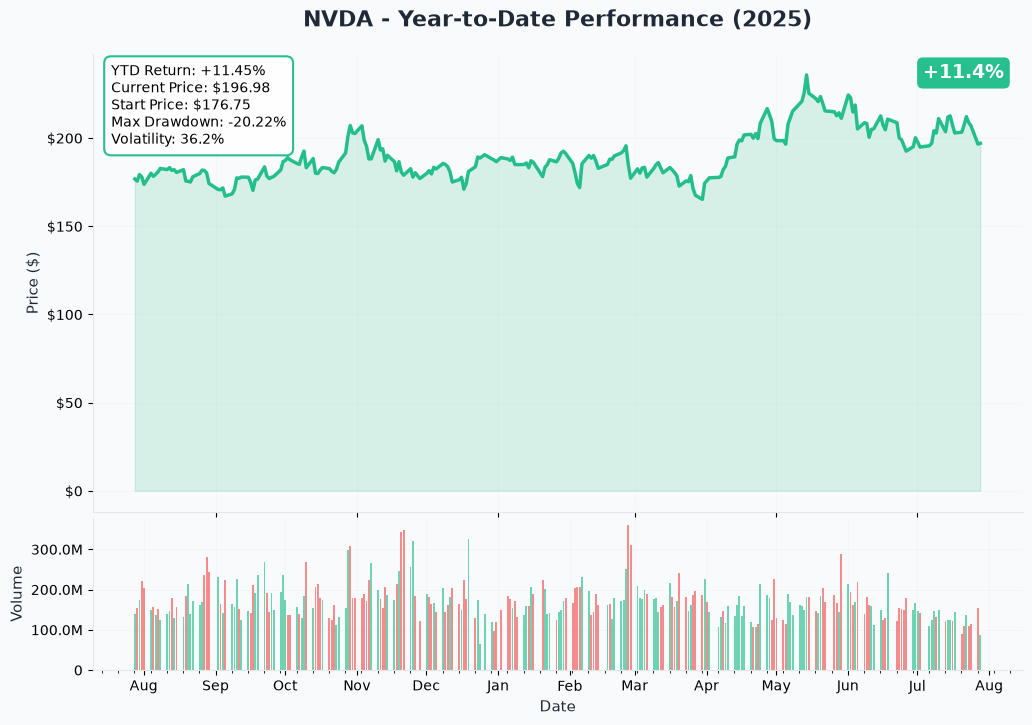
NVDA's 2026 chart shows a stock that ran to an all-time closing high of $235.47 on May 14, 2026, then cooled off before the July 27 AI-financing-fear drop knocked it ≈5% lower in a single session, down to ≈$193-$197 as of this writing — ≈18% off the peak. That's the exact tension this LEAP call is leaning into: is this a healthy multi-year pause, or the start of a real valuation reset?
Gamma-Based Support & Resistance Analysis
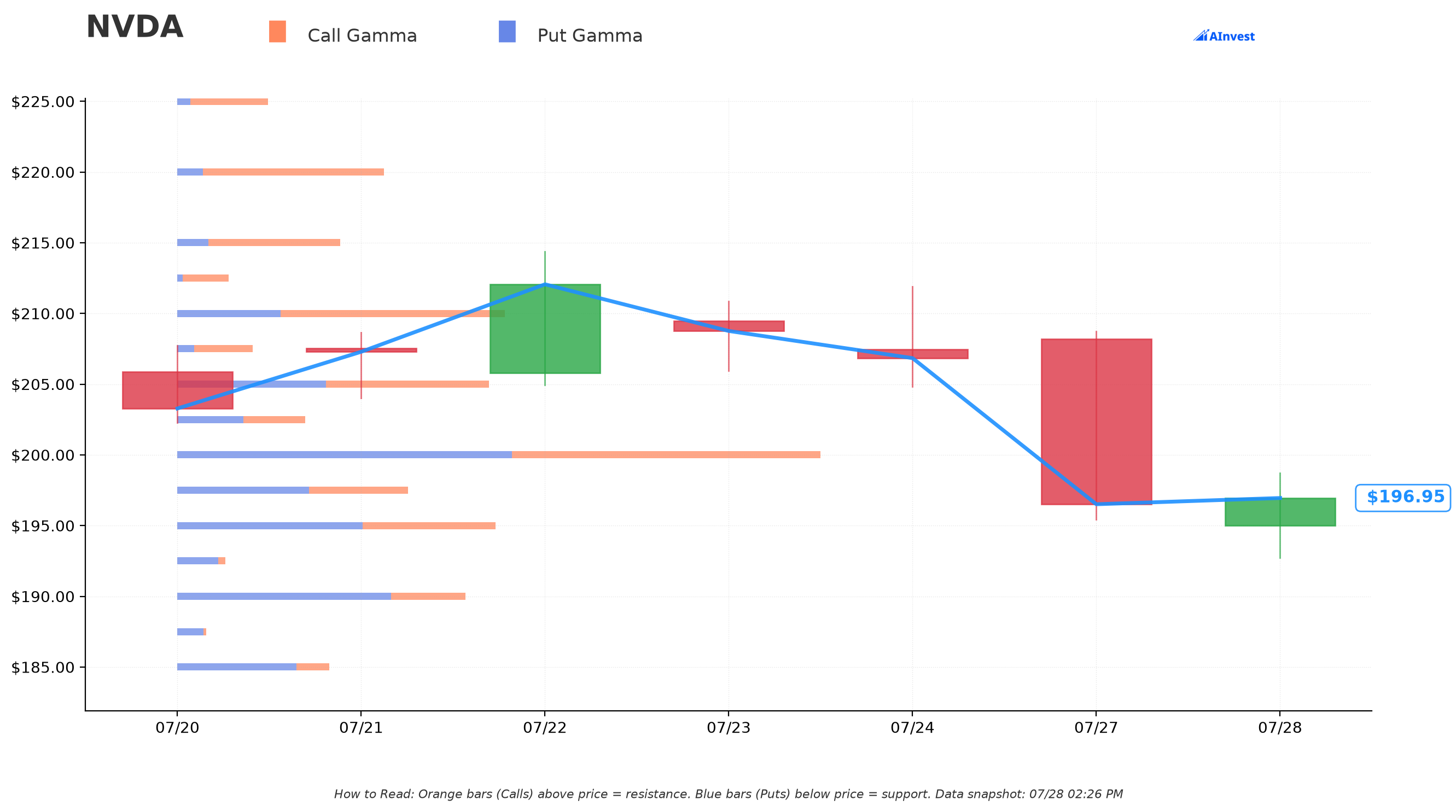
Current price (at chart generation): ≈$196.99
- 🟠 $200 — the dominant Resistance Wall (very strong, only ≈1.5% above spot) — this is the level dealer-hedging flow is most likely to lean against on any near-term bounce, and it's also the round-number psychological line NVDA just fell back below.
- 🟠 $210 — a second, notably strong Resistance Wall (≈6.6% above spot) — and it happens to be the exact strike this LEAP call bought. The buyer isn't just picking a round number; they're targeting the strike where the options market itself has built its next big wall of resistance.
- 🔵 $195 — the nearest Support Wall (very strong, essentially right at spot) — the market's dealer-hedging structure is currently pinning price close to here.
- 🔵 $190 / $185 — deeper Support Walls further down — the levels that would need to give way for a genuinely disorderly slide.
What this means for traders: the near-term gamma cage is tight — $195 support, $200 then $210 resistance — a normal chop zone for the next few weeks. None of that structure has any real bearing on where NVDA needs to be by December 2027; it's a map of the next few weeks, not the next year and a half.
Implied Move Analysis
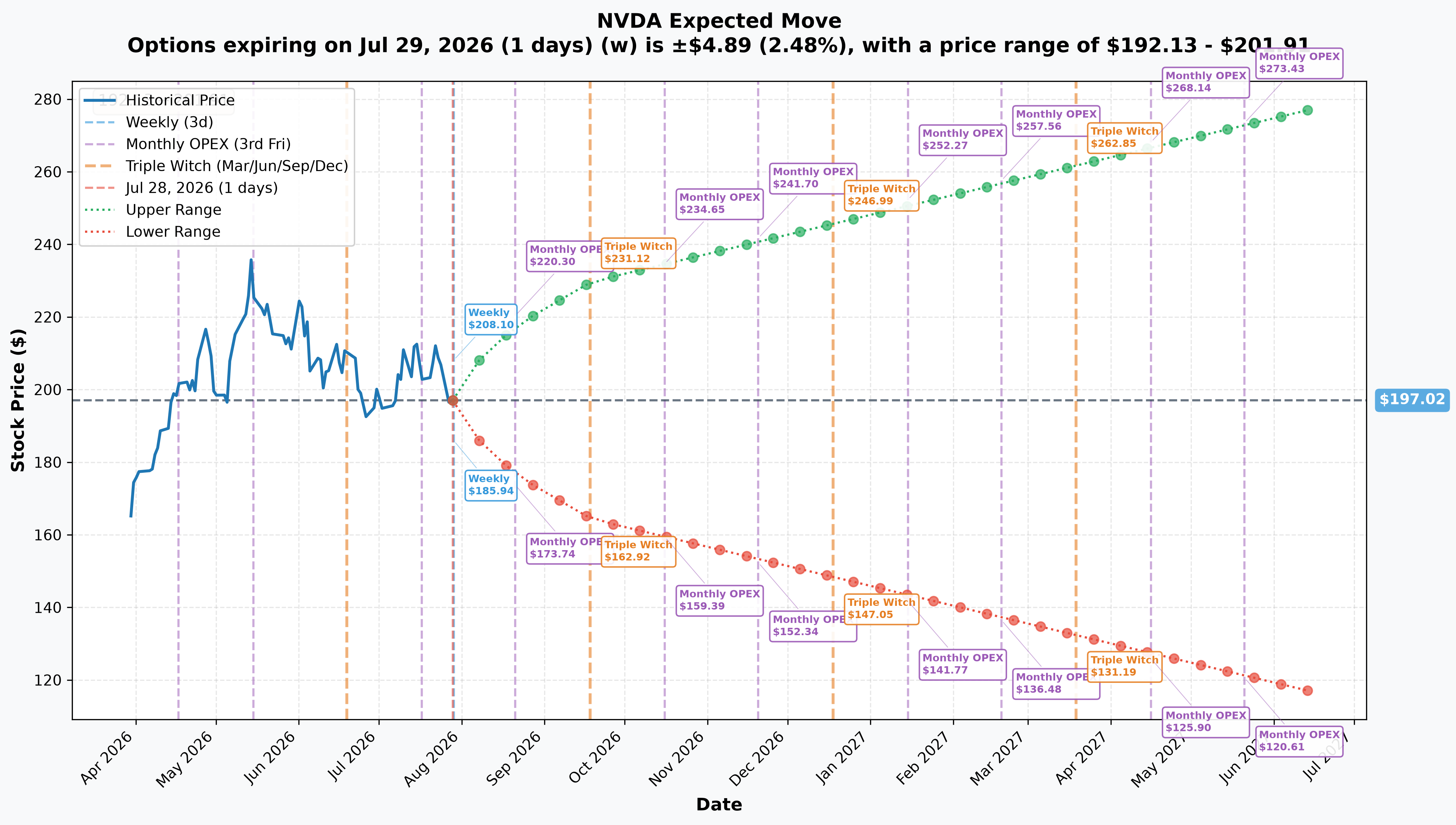
What the options market is pricing in (as of July 28, 2026, spot ≈$197.02):
- 📅 Monthly OPEX (August 21 — 24 days, captures Q2 FY2027 earnings on August 26): ±10.51% (±$20.71) → range $176.31 – $217.73
- 📅 Quarterly Triple Witch (September 18 — 52 days): ±16.59% (±$32.69) → range $164.33 – $229.71
Translation for regular folks: the $210 strike this LEAP bought sits right near the top edge of the market's own monthly one-sigma range ($217.73) and directly on top of the $210 gamma wall noted above. In other words, the buyer isn't betting on some wild outlier move — $210 is squarely inside what the options market itself considers a "normal" range of outcomes over the next month, and well inside the quarterly range. The buyer has ≈17 months, not 24 days, to get there — which is exactly why this trade uses a LEAP instead of a near-dated call.
🎪 Catalysts
Note: the LEAP expires December 17, 2027 — every date below happens well before that. The two dates below serve very different purposes: August 26 is the near-term catalyst that will move the stock this quarter; December 17, 2027 is simply when this contract stops trading.
🔥 Recent (Already Happened)
NVIDIA posted a record Q1 FY2027 on May 20, 2026: total revenue of $81.6B, up 85% YoY, beating consensus, with Data Center revenue of $75.2B, up 92% YoY — a record $13.5B sequential jump — and data-center networking revenue of $14.8B, up 199% YoY [Yahoo Finance] [Futurum]. Management guided Q2 FY2027 revenue to ≈$91.0B [TechTimes] and raised the dividend 25x alongside a new buyback [QZ].
At the U.S.-Saudi Investment Forum, HUMAIN (Saudi PIF) expanded its NVIDIA partnership, adding xAI, Global AI, and AWS, and plans to deploy "several hundred thousand" NVIDIA GPUs over five years, anchored by an initial 18,000-GPU GB300 supercomputer — a structurally new, price-insensitive buyer class underpinning the multi-year bull case.
Then on July 27, 2026, the Wall Street Journal reported NVIDIA is in talks to guarantee up to $250B of financing for OpenAI's Ohio data-center buildout, with separate talks around up to $350B in chip purchases. Investors questioned whether NVIDIA is bankrolling its own demand ("circular financing"), sending the stock down ≈5% and dragging the broader chip complex lower with it — this is the exact fear this LEAP call is being bought against.
🚨 The Big One — Coming Up
Q2 FY2027 earnings — Wednesday, August 26, 2026, after market close [Catacal]. Watch: actual revenue vs. the ≈$91B guide, Blackwell-Ultra/GB300 supply, Data Center gross margin, any updated China commentary, and whether management addresses the OpenAI-financing questions directly.
📆 Developing Over the Life of This Trade
- Vera Rubin (R100) launch, H2 2026 into 2027 — announced at GTC 2026: 336B transistors, HBM4, claimed ≈5x Blackwell inference performance at ≈10x lower cost-per-token; sampling Q4 2026, volume production Q1 2027 [tech-insider]. This is arguably the single biggest product catalyst inside the LEAP's window.
- Rubin Ultra (R300), 2027 — currently in tape-out, sustaining NVIDIA's annual product cadence [ai-infrastructure.net].
- Hyperscaler capex: the four biggest cloud players plan ≈$725B of 2026 capex (+77% YoY), with combined capex projected to top $1 trillion in 2027 [valueaddvc] — the demand backdrop this LEAP is betting keeps showing up as NVIDIA revenue.
- Three more quarterly earnings land inside this LEAP's life before it even reaches its final months (Q3 FY2027 ≈late-November 2026, Q4 FY2027 ≈late-February 2027, then all of FY2028).
👥 How Four Different Traders Might Read This
🎲 YOLO Trader
On July 28 this looked like about as clean a directional signal as options flow gets. The open-interest print took that away. A $17M call buy that leaves the strike smaller is not a green light — there was a motivated seller on the other side of it, at the same price, on the same day. If you still like the multi-year idea, like it on its own merits: the $210 strike sits right on the $210 gamma resistance wall and near the top of the market's own monthly one-sigma range, and it needs the thesis to actually play out, not just a one-week bounce. Don't buy it because you think you're following a whale — on this print, the whale was on both sides.
📈 Swing Trader
The near-term gamma map is tight: $195 support, then $200 and $210 resistance stacked above. The next real catalyst is August 26 earnings, which will move NVDA more than dealer-hedging mechanics over the coming weeks. A decisive reclaim of $200 on a strong print would be the first real technical sign the market is starting to lean the buyer's way again.
💵 Premium Collector
A 17-month, ≈9%-OTM call with a ≈0.579 delta isn't cheap lottery premium — it's real, near-coin-flip directional exposure being sold to the buyer at $37.15. If you're inclined to fade richness here with a covered call or credit spread against existing NVDA shares, know you're doing it against a name that just reported a record $81.6B quarter and sits on 80-92% AI-accelerator share, not a stale or overbought setup.
🌱 Beginner
This trade is the single best lesson we can offer about reading options flow. Volume and open interest are not the same thing. Volume counts how many contracts traded; open interest counts how many exist. On July 28, 6,500 contracts traded at this strike — and open interest fell by 391. That combination has only one explanation: contracts were changing owners, not being created. A "$17 million bullish call buy" headline is true about the money and false about the exposure. The second lesson: size versus prior open interest is a warning light, not a verdict — 4,606 traded against ≈23,720 outstanding told us we could not know yet, and we said so. The next-morning snapshot is what actually answered it, and it answered against the bullish read. Always wait for it.
⚠️ Risk Factors — What This Trade Cannot Tell Us
- This was a transfer, and that is now proven, not speculated. Open interest fell 23,720 → 23,329 (−391) against a 4,606-lot print. No new bullish exposure entered the market. Any read of this print as institutional conviction has to contend with the fact that an equally institutional counterparty sold it.
- What we still cannot see is who was on each side, or why. A holder might have sold to take profit, to cut risk, to fund something else, or because their fund mandate changed. The buyer might be initiating a view or covering a short call. OPRA shows neither identity nor motive — only that the contracts moved and the strike shrank.
- The AI-bubble / circular-financing debate is real and unresolved. The July 27 OpenAI-financing report is a legitimate question about demand durability, not manufactured noise — if AI developers can't monetize compute fast enough, NVIDIA and its financing partners absorb real risk.
- Valuation is still rich even after the pullback. At ≈$5.0T market cap, NVDA prices in years of continued flawless execution; the ≈18%-off-highs discount doesn't make the stock cheap in absolute terms.
- We cannot see who placed this trade or why. The tape shows the mechanism (a facilitated auction), the price, and the size — it does not show the broker, the counterparty's identity, their cost basis, or whether they hold offsetting positions elsewhere (stock, other options, other venues) that would change their real risk profile.
- LEAP-specific: at ≈9% OTM, the $210 calls need a sustained move above ≈$210 (and ≈$247.15 to be fully profitable including premium) by December 17, 2027. A prolonged sideways-to-down grind — like this week's — erodes the position's value even if the long-term thesis stays intact.
- A single option print does not predict the stock. This is one $17M bet among many NVDA option trades today. Treat it as one data point alongside the gamma structure, the implied move, and the fundamental catalyst calendar — not a standalone signal to copy.
Disclaimer: Options trading involves substantial risk of loss and is not suitable for all investors. This analysis is for educational purposes only and is not financial advice. Past performance does not guarantee future results. The trade discussed here is a single institutional options print; it does not imply the trade will be profitable or that you should copy it. AI-infrastructure-linked equities like NVDA can move sharply and unpredictably on both company-specific and macro news outside any single company's control. Always do your own research and consider consulting a licensed financial advisor before trading, especially with long-dated, leveraged, out-of-the-money options.
🎯 The Bottom Line
Real talk: Someone paid $17.1 million, at roughly the midpoint of the bid-ask via a facilitated auction, for the right to buy NVDA at $210/share any time before December 17, 2027 — a strike ≈9% above spot at the moment of the print, one trading day after NVDA's worst single session in months. And the next morning, open interest on that strike came back 391 contracts lower. The money changed hands; the market's bullish position did not grow. This was an existing LEAP moving from a seller who wanted out to a buyer who wanted in, not new conviction arriving.
What this trade tells us:
- 🔄 Open interest FELL 23,720 → 23,329 (−391) on a 4,606-lot print — proof that this was a transfer, not the fresh bullish open it appeared to be
- ⚖️ Every buyer implies a seller, and this one is the point: on the day after a ≈5% AI-bubble scare, one institution wanted this LEAP and another wanted rid of it, at the same price
- 🎯 The contract itself is unchanged — leveraged, defined-risk, ≈9% OTM convexity with ≈17 months of runway — it simply has a different owner now
- 📅 The real tests for the thesis are still ahead: Q2 FY2027 earnings, three more quarterly prints, and the Vera Rubin ramp
Mark your calendar:
- ✅ July 29, 2026, ≈06:30 ET — RESOLVED. Next-day open interest landed and inverted the read from a fresh open to a transfer. See the ✅ RESOLVED box above.
- 📅 August 26, 2026 (after close) — Q2 FY2027 earnings, the nearest real catalyst
- 📅 December 17, 2027 — this call expires
The lasting lesson here is bigger than one print: a large premium number tells you how much money moved, not whether anyone took on new risk. Only open interest answers that — and on this trade it said no.
Last updated: July 29, 2026 — next-day OPRA open interest resolved this leg and inverted it: open interest fell 23,720 → 23,329 (−391) against a 4,606-lot print, proving a position transfer rather than the fresh bullish open originally published. The headline, quick take, flow tag, plain-English section, trader reads, risk factors and bottom line were rewritten accordingly.
About NVIDIA (NVDA): NVIDIA designs the GPUs, CPUs, and networking hardware powering the AI-compute buildout, with a market cap of ≈$5.0 trillion in the Information Technology / Semiconductors sector, holding an estimated 80-92% share of the merchant AI-accelerator market.