🛡️ QQQ ≈$19M Nasdaq-100 Downside Put — Precision Timed for the FOMC + Mega-Cap Earnings Gauntlet
📅 June 29, 2026 | 🔥 Unusual Activity Detected
✅ Update (2026-06-30): Next-day OPRA OI confirms the $695 put OPENED — OI rose 521 → 18,251 (Δ +17,730, ≈98% of the 18,000-lot print, even larger than the predicted ≈16,199). The open is confirmed; see the resolved box below.
🎯 The Quick Take
Someone just facilitated a clean ≈$19M put position on QQQ — 15,678 contracts of the July 31 $695 put, priced at $11.92 per contract, executed through a price-improvement auction at 15:06:17 ET. This is NOT a panic sweep. The timing is the story: the put expires July 31, the day after the FOMC decision (July 28-29) and the first mega-cap earnings wave — MSFT and META on July 29, then AMZN and AAPL on July 30. It captures the most catalyst-dense 48-hour window of the summer in a single position, and then it's gone before NVIDIA reports on August 26. Hedge first, ask questions later — that's what ≈$19M of near-term put protection looks like.
📊 ETF Overview
Invesco QQQ Trust (QQQ) tracks the Nasdaq-100 — the 100 largest non-financial companies on the Nasdaq exchange. It is the world's primary vehicle for expressing a view on US mega-cap tech and the AI-capex trade.
- Current Price: ≈$723.24 (up ≈2.37% on the day), per stockanalysis.com
- AUM: ≈$480.5 billion
- 52-Week Range: $544.66 – $748.65
- Nasdaq-100 P/E: ≈35.3 as of June 2026, per GuruFocus
- Top-5 concentration: ≈30% of the fund in five names (NVIDIA ≈7.6%, Apple ≈6.8%, Microsoft, Broadcom, Amazon), all highly correlated and AI-capex driven, per Yahoo Finance
Real talk: QQQ is a concentrated bet on the AI trade. The four hyperscalers alone — Microsoft, Amazon, Alphabet, Meta — represent nearly a quarter of the index, per 24/7 Wall St.. One major earnings miss or a hawkish Fed shock and the whole ETF moves. That concentration is exactly why a large QQQ put is the most capital-efficient way to hedge a Nasdaq-100 book heading into a dense catalyst window.
💰 The Option Flow Breakdown
📊 What Just Happened
At 15:06:17 ET, a single block of 15,678 QQQ July 31 $695 puts was executed through a price-improvement auction at CBOE. The put was bought — the initiating side was the buyer, confirmed at 71% through the bid-ask spread. This is NOT a lit-book sweep where someone urgently slams the ask. It is a facilitated single-leg auction: a broker routed the order through a price-improvement mechanism where the buyer received execution at a price better than the displayed quote. There is no stock block, no paired equity leg — this is a clean, standalone long put.
Full Trade Table:
| Time | Buy/Sell | Call/Put | Expiration | Premium | Strike | Volume | OI | Size | Spot | Option Price | Option Symbol |
|---|---|---|---|---|---|---|---|---|---|---|---|
| 15:06:17 | BUY | PUT | 2026-07-31 | ≈$19M | $695 | 18,000 | 521 | 15,678 | $722.79 | $11.92 | QQQ20260731P695 |
Mechanism tag: 🤝 single-leg auction — facilitated price-improvement execution, NOT a lit sweep, NO paired stock leg
✅ OI RESOLVED (2026-06-30) — OPEN CONFIRMED
Next-day OPRA OI is in: the $695 put OPENED cleanly — open interest rose from 521 to 18,251, a gain of +17,730 (≈98% of the 18,000-lot print). This is a confirmed BTO (Buy to Open), and the actual OI rise was even larger than the predicted ≈16,199.
| Leg | EOD 06-26 (baseline) | EOD 06-29 (resolving) | Δ | Print size | Verdict |
|---|---|---|---|---|---|
| Jul-31 $695 PUT | 521 | 18,251 | +17,730 | 18,000 | OPEN — full size ✅ |
🤓 What This Actually Means — Plain English
Let me decode this for everyone — because a ≈$19M QQQ put at face value sounds like a crash call. It's more nuanced than that.
Step 1: What is a single-leg auction, and why does it matter?
When a large institution needs to execute a big options block, it often routes through a broker who arranges a price-improvement auction — a short window (typically ≈100ms) where market participants compete to offer a better fill price. The buyer still drives the order, and 71% across the bid-ask spread confirms the put was the bought side (above mid-price). But this is NOT a trader frantically sweeping the open book. It is a deliberate, pre-arranged block executed at a negotiated price. There is also no matched stock block — unlike the June 26 QQQ crosses (where every option leg was individually paired by a same-second stock block that canceled the delta), today's put stands completely alone. It is pure downside exposure with no attached hedge.
Step 2: The two honest readings of a standalone ≈$19M QQQ put
For a standalone near-term put this size, the honest interpretation is one of two things:
-
🛡️ Portfolio insurance: A large Nasdaq-100 long book buying one-month downside protection into a dense macro window. For a desk managing, say, $500M–$1B of QQQ-correlated exposure, spending $19M on put protection is 2–4% of the book — standard institutional hedging. They own the upside through stock; the put is the seatbelt.
-
📉 Tactical bearish hedge: A shorter-term directional view that the FOMC + mega-cap earnings will disappoint, pushing QQQ through ≈3.9% to the put's strike. No underlying long, pure conviction on the downside.
We cannot see the buyer's stock book. If they are long Nasdaq-100 exposure, this is pure portfolio insurance. If they own nothing, it is a directional bet. The tape cannot tell us which. Given the facilitated (not panicked) mechanism and the precise expiry date selection, the insurance interpretation is more consistent with the facts — but we cannot prove it. Frame it as downside protection / hedge first, speculative bet second.
Step 3: Why July 31 specifically — the timing is the entire thesis
The expiration is the most important feature of this trade. July 31 falls the day after the most compressed macro-event cluster of the summer:
-
July 28-29: FOMC — The Federal Reserve rate decision under hawkish Chair Kevin Warsh. The June 17 meeting already shocked markets: nine of 18 FOMC officials now project a 2026 rate hike and the easing bias has been stripped. July is a no-dot-plot meeting, but Warsh's tone on September — live hike risk or hold — will set the summer narrative for a Nasdaq-100 trading at ≈35× earnings.
-
July 29 (after close): MSFT + META earnings — Two of QQQ's largest weights report in the same evening. Azure AI revenue growth and capex guidance from Microsoft; AI-driven ad revenue and Reality Labs from Meta. A combined miss could swing QQQ 2–3% overnight.
-
July 30 (after close): AMZN + AAPL earnings — Amazon AWS growth and Bedrock AI commentary; Apple iPhone/Services and China demand. Both in the same evening, the day before the put expires.
The put expires on July 31 — the morning after all four of those reports have printed and the FOMC is in the rearview. That morning, the market will be pricing in four mega-cap earnings reactions simultaneously. This is precisely when the put's value is settled.
And critically: NVIDIA (August 26) is NOT covered by this put. The single heaviest QQQ weight — and the single biggest single-day index risk event of the summer — reports 26 days after this put expires. The buyer chose the FOMC + first-earnings-wave window and left NVDA out of scope. That's not an accident.
Step 4: Key economics at a glance
- Strike: $695 (≈3.9% OTM from ≈$723 spot)
- Option cost: $11.92 per contract
- Total premium paid: ≈$19M
- Breakeven at expiry: $695 − $11.92 = $683.08 (≈5.5% below current spot)
- Max loss: ≈$19M — entire premium, if QQQ stays above $695 on July 31
- Max gain: QQQ could theoretically fall well below $683, each additional dollar below breakeven is profit × 1,567,800 shares equivalent
- The put is in-the-money if QQQ falls ≈3.9% or more by July 31
This is the cost of a one-month insurance policy on ≈$1.1B of QQQ exposure (if the buyer is delta-neutral at the strike). That's a standard institutional hedging cost for a dense macro window.
📈 Technical Setup / Chart Check-Up
YTD Performance Chart
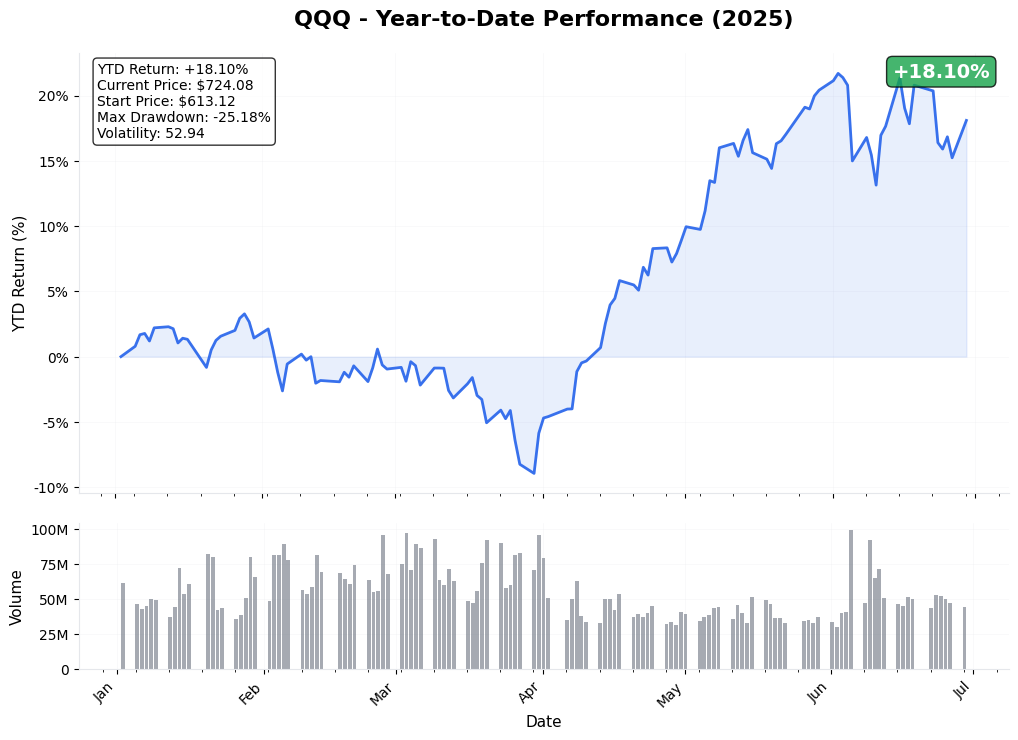
QQQ has had a dramatic 2026. Per Tickeron, QQQ is up ≈15% year-to-date, but the path there included a violent round trip: a collapse to the mid-$540s in late March in a tariff-driven selloff, followed by a more than 33% recovery in roughly ten weeks to a record high just above NDX 30,660 in early June. A brief pullback, a consolidation, and QQQ now trades near $723 — just ≈3.5% below the all-time high of $748.65. The chart is a V-shaped recovery with a resilient grind to the top.
The nearness to all-time highs is why a hedge makes sense from an institutional risk-management perspective. The upside from here is limited by gamma walls and valuation; the downside from a macro catalyst shock could be sharp.
Gamma-Based Support & Resistance Analysis
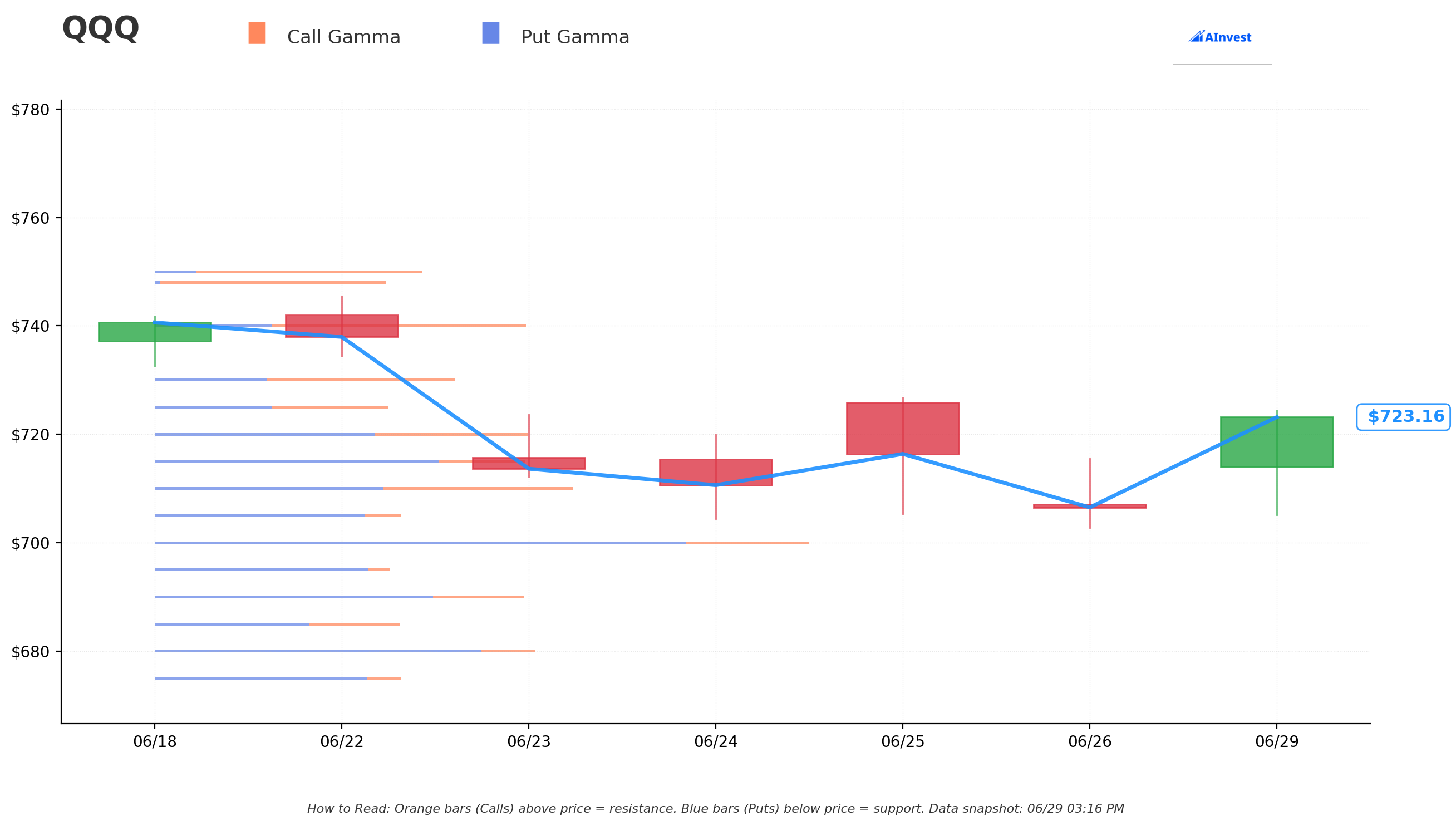
The gamma exposure map reveals where dealer hedging flows create structural price floors and resistance ceilings. The $695 put strike is notably positioned just below the most significant gamma wall in the entire QQQ structure.
🔵 Support Levels (Put Gamma Below Price) — key floors:
| Level | Total GEX | Distance from Spot | Strength | Why It Matters |
|---|---|---|---|---|
| $720 | 33.6 | 0.4% below | Very Strong | Immediate floor just under current price |
| $715 | 33.4 | 1.1% below | Very Strong | Dense put gamma; dealer buying zone |
| $710 | 37.7 | 1.8% below | Very Strong | Meaningful nearby floor |
| $700 | 59.0 | 3.2% below | Very Strong | THE gamma wall — highest total GEX in the entire structure; the mechanical line-in-the-sand |
| $695 | 21.1 | 3.9% below | Moderate | The put strike — positioned exactly $5 below the $700 gamma wall |
| $690 | 33.3 | 4.6% below | Very Strong | Strong secondary floor |
| $680 | 34.3 | 6.0% below | Very Strong | Deep structural support |
The $700 strike carries 59.0 in total GEX — the single largest gamma wall across the entire QQQ chain. That level is where dealer hedging flows will mechanically push back hardest. The $695 put strike is positioned exactly $5 below that wall. The read: if $700 cracks, the put becomes relevant. Until then, the gamma wall at $700 acts as a mechanical buffer between current price and the put's in-the-money territory.
👀 Notice the precision: The put buyer didn't strike at $700 (the gamma wall itself) or at $710 (the next floor up). They struck at $695 — just below the biggest mechanical support in the structure. If you're buying downside protection on a level you expect to hold, you put your strike just below it. That's exactly what this print shows.
🟠 Resistance Levels (Call Gamma Above Price) — ceilings:
| Level | Total GEX | Distance from Spot | Strength | Why It Matters |
|---|---|---|---|---|
| $725 | 21.1 | 0.2% above | Moderate | Immediate ceiling — just above current price |
| $730 | 27.1 | 0.9% above | Very Strong | First meaningful call gamma wall |
| $740 | 33.4 | 2.3% above | Very Strong | Major resistance ceiling |
| $748 | 20.8 | 3.4% above | Moderate | Near the $748.65 all-time high |
| $750 | 24.1 | 3.7% above | Very Strong | Extended resistance |
QQQ is currently in a tight zone: $720 support just below, $725/$730 resistance just above. A daily close above $730 with volume likely accelerates toward $740–$748. A break below $720, especially accelerated by a catalyst, risks a flush toward $710, then $700.
Implied Move Analysis
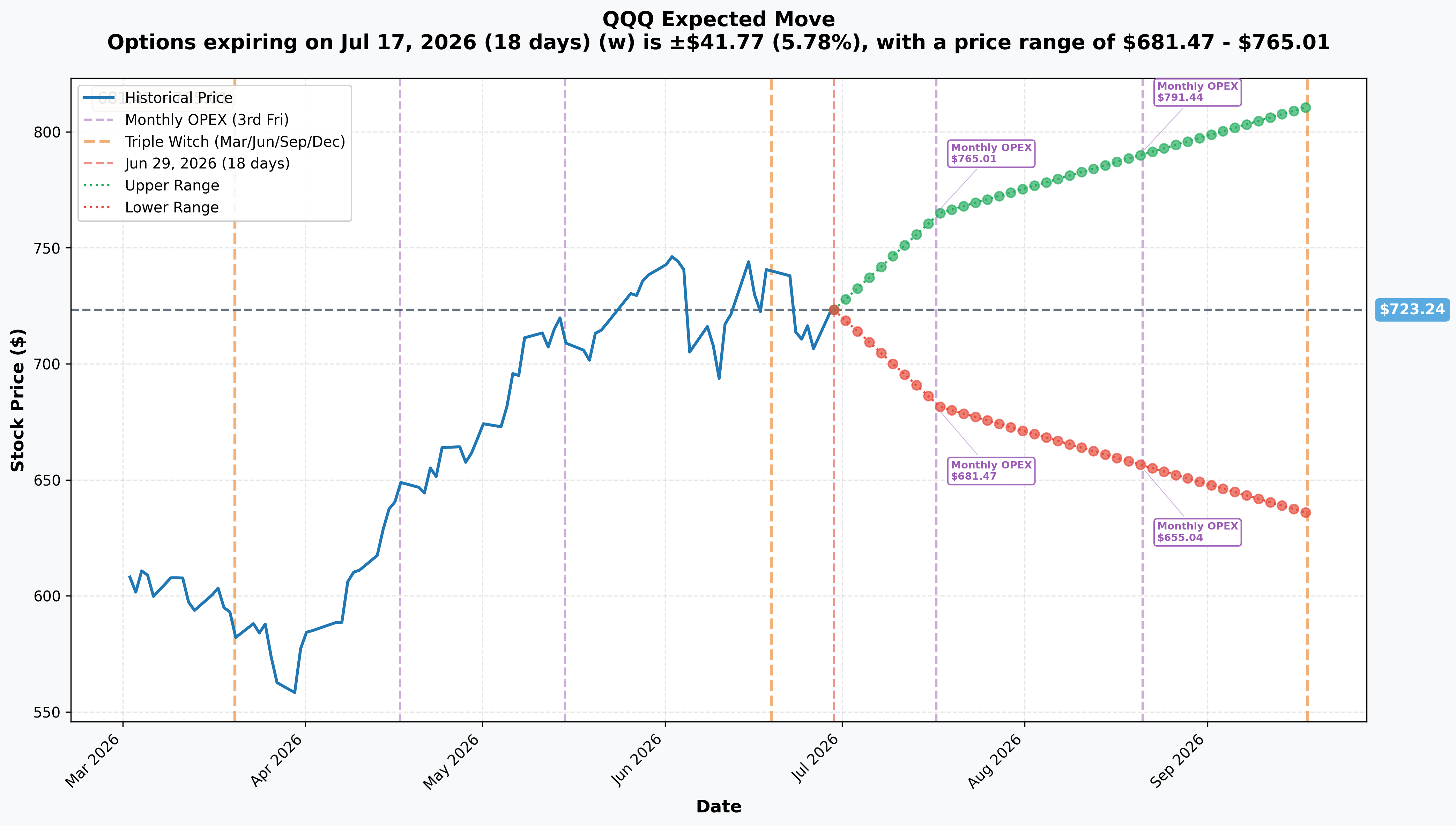
The options market is pricing significant uncertainty over the next two OPEX cycles:
| Timeframe | Expiry | Days | Implied Move | Upper Range | Lower Range |
|---|---|---|---|---|---|
| Monthly OPEX | July 17, 2026 | 18 days | ±$41.77 (±5.78%) | $765.01 | $681.47 |
| Triple Witch | September 18, 2026 | 81 days | ±$88.02 (±12.17%) | $811.26 | $635.22 |
Translation for regular folks:
By the July 17 OPEX (18 days away), options price QQQ in a $681.47–$765.01 range — a ≈$83 spread on a $723 ETF. The $695 put strike sits inside the lower end of that implied range ($681.47 is the lower bound for July 17 OPEX; the put strike of $695 falls between spot and the lower boundary). The market is not calling this scenario wildly improbable — it's pricing it as a real possibility inside the one-month window.
This put expires July 31 — between the two OPEX dates above. The event density in that window (FOMC + 4 mega-cap earnings) is exactly what drives those elevated implied-move numbers. By September, the range widens to $635–$811 — a ±12% swing that absorbs NVDA, September FOMC, and CPI. The July put is positioned for the first major catalyst wave, not the full summer arc.
🎪 Catalysts
🔥 Recent Catalysts (Already Happened)
The Warsh Hawkish Pivot — June 17, 2026 (the regime-change event)
The most important recent macro catalyst for QQQ. At the June 16-17 FOMC, new Chair Kevin Warsh held rates at 3.50%–3.75% but delivered a hawkish shock: nine of 18 FOMC officials now project a 2026 rate hike, and the 2026 PCE inflation projection was raised to 3.6%. The easing bias was stripped from the statement. Per Falco Insights, the VIX climbed ≈12% and the 2-year Treasury yield jumped ≈15bps on the day. For QQQ trading at a Nasdaq-100 trailing P/E near 35.3, higher rates directly compress the high-multiple growth names that dominate the index. This is the backdrop that makes a FOMC-covering put rational.
Resilient Labor Market — May 2026 Jobs
The US added 172K jobs in May, well above the ≈85K forecast — removing the Fed's urgency to cut and reinforcing the hawkish dots.
The AI-Capex Supercycle (the structural bull narrative)
The four hyperscalers are scaling 2026 AI capex toward ≈$700 billion, a 60–70% increase over 2025. This spending is the structural engine under QQQ's concentration. But per VaaSBlock's Q2 preview, markets are shifting from rewarding capex narratives to demanding AI monetization proof (ROIC, FCF) — raising the stakes for the upcoming earnings gauntlet.
June 26 QQQ Hedging — the Index-Hedging Theme Continues
Three days ago, QQQ saw ≈$124M of delta-hedged QCC block crosses — a 2-year protective-put structure (≈$36M) paired with long stock on all three legs, plus a delta-hedged call-selling complex across two near-term expiries. Every leg was individually delta-neutralized by a same-second stock block. Today's trade is structurally simpler — a clean standalone near-term put with no stock leg — but thematically continuous: institutional desks are actively buying QQQ downside protection heading into this event window. The 2-year put from June 26 survives all of the upcoming catalysts; today's July 31 put is a targeted one-month overlay on the most immediate risk window.
📅 Upcoming Catalysts — The Live Wires This Put Is Positioned Around
July 2, 2026 — June Jobs Report The next US employment situation release, per the BLS schedule. A hot number reinforces the hawkish backdrop; a sharp miss revives cut hopes and could be the most plausible near-term dovish catalyst for QQQ.
July 14, 2026 — June CPI First major inflation print before the FOMC meeting, per the BLS CPI calendar. With the Fed's 2026 PCE projection already raised to 3.6%, a hot print directly validates the hawkish dots and pressures QQQ in the weeks before the July meeting. This arrives two weeks before the put's expiry window begins.
July 22, 2026 — Alphabet (GOOGL/GOOG) Q2 Earnings (after close) First of the mega-cap reports. Google Cloud growth and Gemini revenue will set the AI-monetization tone for the main earnings week. Strong Google Cloud = positive setup for the broader AI complex; weakness = warning shot.
July 28-29, 2026 — FOMC Rate Decision (INSIDE THIS PUT) The Federal Reserve July meeting. Per current FedWatch data, markets price ≈70% probability of a hold at 3.50%–3.75%. But this is a Warsh FOMC — the tone on September's meeting (live hike or hold) will determine QQQ's trajectory through August. This is the #1 macro catalyst inside the July 31 expiry window.
July 29, 2026 — MSFT + META Earnings (after close) — INSIDE THIS PUT Two of QQQ's top weights in the same evening, per the Magnificent 7 earnings calendar. Azure AI revenue growth and capex guidance from Microsoft; AI-driven ad revenue and capex from Meta. A combined miss on AI monetization from both could swing QQQ 2–3% overnight — right into July 30 open.
July 30, 2026 — AMZN + AAPL Earnings (after close) — INSIDE THIS PUT Amazon (≈4.9% QQQ weight) reporting AWS growth and Bedrock AI ROI; Apple (≈6.8% weight) reporting iPhone/Services and China demand, per the Magnificent 7 earnings calendar. Both in the same evening, the day before the put expires.
July 31, 2026 — This Put Expires The morning of July 31 opens with the FOMC absorbed, four of QQQ's five largest holdings having reported, and the market pricing in the cumulative result. This is when the put's value is determined — a precise 32-day window covering everything that matters most between now and August.
August 12, 2026 — July CPI (≈mid-August) The next inflation read after the FOMC, per the BLS CPI schedule. Outside this put's scope, but sets the September FOMC narrative.
August 26, 2026 — NVIDIA Q2 Earnings (after close) — OUTSIDE THIS PUT QQQ's single largest weight (≈7.6%). Per TipRanks consensus, NVDA guided ≈$91B ±2% revenue. The single biggest single-day QQQ catalyst of the summer — and it fires 26 days after this put expires. The buyer explicitly excluded NVDA from this position's scope.
September 15-16, 2026 — FOMC (live hike risk) Includes the dot plot. Per Fortune's BofA forecast, nine of 18 officials already project a 2026 hike, and this is the most likely window for an actual rate increase. A confirmed hike into a 35× P/E index could be a major de-rating event — outside this put's window, but the reason the 2-year put from June 26 exists.
🎲 Price Targets & Scenario Analysis
Using gamma levels from the GEX map, the July implied move, and the catalyst calendar:
📈 Bull Case — FOMC Benign, Earnings Beat (25% probability)
QQQ Target: $740–$765
FOMC delivers a calm hold with no September escalation signaled, MSFT/META/AMZN/AAPL all beat and provide strong AI monetization commentary, and QQQ breaks above the $730 gamma resistance band (27.1 total GEX). The $740 call gamma wall (33.4 GEX) is the next test; above that, $748 (the all-time high) becomes the target.
In this scenario: the ≈$19M put expires worthless on July 31. The premium paid is the cost of insurance that was not needed. If the buyer holds QQQ exposure, they still made money on the underlying book — the $19M is the peace-of-mind premium for surviving this event window.
The July 17 implied move upper range of $765 gives the bull case its ceiling.
🎯 Base Case — Mixed Results, Fed on Hold, Range-Bound (50% probability)
QQQ Target: $700–$730
The most likely scenario: FOMC holds but tone is carefully hedged, one mega-cap miss offsets one beat, and QQQ grinds sideways in the $700–$730 gamma band. The $700 gamma wall (59.0 total GEX) holds as mechanical support. The put loses the bulk of its value through time decay as QQQ stays above $695. The put buyer's underlying QQQ exposure holds value.
Watch the $700 support level closely. With 59.0 total GEX, this is the strongest mechanical floor in the structure. If QQQ holds $700 through the event window, the put expires deeply out-of-the-money. If $700 breaks, things accelerate.
📉 Bear Case — Hawkish FOMC + Earnings Disappointment (25% probability)
QQQ Target: $670–$695
Warsh signals September as a live hike at the July meeting, one or two mega-cap names guide conservatively on AI ROI (capex up, monetization soft), and QQQ breaks through the $700 gamma wall. Once $700 gives way, the $695 put strike becomes the focal point.
At expiry on July 31:
- 📊 QQQ at $683 (breakeven): put worth ≈$12, position ≈flat
- 📈 QQQ at $675: put worth ≈$20, gross gain ≈$8/contract → ≈$12.5M gain on ≈$19M invested
- 🚀 QQQ at $660 (near the July implied lower range of $681): put worth ≈$35, gross gain ≈$23/contract → ≈$36M gain on ≈$19M invested
The gamma support chain ($700, $695, $690, $685, $680) creates multiple mechanical bounce levels on the way down. A genuine catalyst shock — not just a soft print, but a hawkish FOMC combined with a major earnings miss — is needed to push through all of them.
💡 Trading Ideas for Different Risk Appetites
🚀 YOLO Trader: Ride the Same Expiry, Smaller Scale
If you believe the FOMC + earnings window will disappoint, buy a smaller position in July 31 puts — but choose carefully. The $700 put (directly at the gamma wall) is higher probability of touching in-the-money if the wall cracks; the $695 put (today's print) requires the same movement. Both are 32-day positions with fast time decay.
What you are targeting: the $700 gamma wall breaking. If it cracks hard, the $700 put could double or triple rapidly. But time is your enemy — every day QQQ holds above $700, these puts lose value. Only risk what you can fully afford to lose. Do not size this as a core position.
⚖️ Swing Trader: Trade the $720/$730 Range Into FOMC
QQQ sits in a narrow band: $720 support (33.6 GEX, 0.4% below) and $725/$730 resistance (21.1 and 27.1 GEX, 0.2–0.9% above). This is a tradeable mechanical range with a hard catalyst trigger on July 28-29 (FOMC).
The play: stay nimble, trade the range into FOMC, and watch for the break. Long QQQ above $720 with a mental stop below the $715 gamma cluster; reduce or flip on a FOMC hawkish surprise. A clean hold + strong early earnings (Alphabet July 22) likely pushes QQQ through $730 toward $740. A hawkish tone or early earnings miss accelerates the test of $710–$700.
The $700 gamma wall is your stop-and-reassess level. If that holds, the range trade continues. If it breaks, the downside scenario opens.
🛡️ Premium Collector: Sell Elevated Post-Event Vol
With a ≈$19M put arriving into an elevated-volatility window, implied vol in QQQ options is elevated going into the FOMC + earnings. Once the event risk resolves (July 30 close, post-AAPL/AMZN), vol typically collapses — that's the premium collector's opportunity.
Consider selling a put spread after July 30 earnings resolve — for example, the September $680 put / $660 put spread, collecting premium on the elevated post-event IV. The $680 level has 34.3 total GEX in the gamma structure and sits inside the September implied lower range ($635.22). Defined risk below $660 keeps the max loss contained.
Risk: If QQQ gaps below $680 on a FOMC + double-earnings-miss scenario (the bear case), both legs lose. Use a spread, never naked puts.
🎓 Entry Level: The Most Important Lesson from This Trade
If you are just learning to read options flow, here's the single biggest takeaway from today's print:
Not every big options "BUY" is a bullish bet. Someone paying ≈$19M for a PUT profits if QQQ falls. And even this put could be portfolio insurance from a desk that owns hundreds of millions of QQQ — they're not hoping for a crash, they're protecting against one.
When you see a big options print, always ask three questions:
- Is this a call or a put — and in which direction does it profit?
- What is the expiration — and what catalysts fall inside that window?
- Is this a facilitated/negotiated block or a lit-book sweep — and does it have a stock leg that cancels the directional exposure?
For this trade: it is a PUT (profits if QQQ falls) → expires July 31 (captures FOMC + 4 mega-cap earnings) → single-leg auction with no stock block (pure standalone downside exposure). The timing, the strike, and the mechanism together tell a clear story: precisely targeted downside protection for a specific macro window. That is the kind of analysis that separates reading flow from chasing headlines.
⚠️ Risk Factors & Honest Limits
What the tape PROVES: ✅ A facilitated single-leg price-improvement auction (NOT a lit sweep) bought 15,678 QQQ July 31 $695 puts at $11.92 per contract, totaling ≈$19M in premium, at 15:06:17 ET on June 29, 2026 on CBOE. The initiating side was the buyer (71% across the bid-ask spread). ✅ Block size (15,678) vastly exceeds prior OI (521), confirming this is a fresh opening position (BTO). At least 15,157 contracts are proven new opens. ✅ No paired stock block detected. This is a clean standalone put — NOT a delta-hedged QCC package like the June 26 crosses. ✅ The July 31 expiry precisely covers the FOMC (July 28-29) and four major mega-cap earnings reports (July 29-30), and expires before NVDA's August 26 report.
What the tape CANNOT tell us: ❌ Whether the buyer holds a large underlying QQQ long position (making this portfolio insurance) or has no equity exposure (making this a directional bearish bet). Both are consistent with the print. We cannot see the buyer's book. ❌ The counterparty identity, broker, or fund name. ❌ Whether the buyer intends to hold to July 31 expiry or will exit early if their target is reached. ❌ The full portfolio delta of the buyer — if they are long billions of Nasdaq-100 exposure, ≈$19M of put protection represents 1–2% of their book. If they own nothing, it is a $19M directional speculation.
Key risks for your own positioning:
- 🔥 Theta decay is fast on a 32-day put. If QQQ holds above $695 through July 31, the entire ≈$19M premium is lost. Near-term puts decay quickly — especially when the catalyst does not deliver.
- 📊 The $700 gamma wall (59.0 total GEX) provides mechanical support. Breaking through that level requires a genuine catalyst shock, not just a mild disappointment. The FOMC + earnings cluster absolutely could deliver that shock — or it might not.
- 🚀 Upside risk is real. If FOMC is calm and earnings beat strong, QQQ could run back toward $748. Puts decay rapidly in a rising market.
- 💸 Do not sell naked puts into this window. Implied vol is elevated for a reason. Use spreads if you are a premium seller — define your risk below $660 or wherever your pain tolerance sits.
- 📅 NVDA (August 26) is outside this put's scope. The single heaviest QQQ name and largest single-day catalyst this summer fires after expiry. If you want to hedge NVDA specifically, you need a separate instrument.
- 🎢 Concentration amplifies moves. With ≈30% of QQQ in five correlated names, a single mega-cap miss can drag the whole ETF 2–3%. A double-miss (MSFT + AAPL, for example) in the same week as a hawkish FOMC has historically generated outsized moves. The put is sized for exactly that tail.
🎯 The Bottom Line
Here's the deal: A well-capitalized desk just facilitated a clean ≈$19M standalone put on QQQ, timed with surgical precision to cover the July 28-31 macro gauntlet — the Federal Reserve decision AND four of QQQ's top-five holdings reporting earnings in a 48-hour window. The put expires on July 31, exactly right after all of those events resolve. NVDA, the single largest QQQ weight and biggest summer AI catalyst, is deliberately left out of scope.
This is not a crash call. This is portfolio insurance with an expiry date calibrated to the calendar.
What this tells us:
- 🛡️ The index-hedging theme that began June 26 (≈$124M of delta-hedged crosses including a 2-year protective put) continues — now as a cleaner, near-term standalone position covering a precise event window
- 📅 July 28-31 is the single most catalyst-dense period of the summer for QQQ: FOMC + four top-five mega-cap earnings in 48 hours
- 🤔 Whether this is portfolio insurance or a directional bet, someone with ≈$19M in conviction thinks the risk-reward of buying QQQ downside protection through this window is worth the premium
- ⚠️ The put expires before NVDA (Aug 26) — the buyer is specifically hedging the FOMC + first-earnings-wave risk, not the full summer
Watch for:
- 📅 July 14 — June CPI. A hot print validates the hawkish regime and adds pre-FOMC pressure to QQQ
- 📅 July 22 — Alphabet earnings. Sets the AI monetization tone for the main week
- 📅 July 28-29 — FOMC decision. ≈70% odds of a hold, but Warsh's tone on September is what matters. This is the #1 macro trigger inside the put window
- 📅 July 29 (after close) — MSFT + META. Two of QQQ's largest weights in one evening. The highest single-session event risk inside this put's life
- 📅 July 30 (after close) — AMZN + AAPL. The second wave. If both disappoint, QQQ could test $700 on the July 31 open — right at the put's key inflection zone
- 📅 July 31 — Expiry morning. The cumulative verdict on FOMC + all four reports prints in the market open. This is when the put settles.
- 📅 August 26 — NVDA. Outside this put's scope, but the biggest QQQ event of the summer. If you want to hedge NVDA, you need a different position.
If you are long QQQ:
- ✅ The FOMC (July 28-29) and the July 29-30 earnings gauntlet are your evaluation moments
- 🎯 The $700 gamma wall (59.0 total GEX) is your key floor. Above it, dealer dynamics support; below it, things accelerate toward $695 and $690
- 🛡️ Consider small put protection at your own scale through the July window — not a directional bet, but a seatbelt on a densely-catalyzed 32-day window
If you are watching from the sidelines:
- ⏰ Hold off on large new QQQ positions until FOMC tone is clear (July 29)
- 📈 Clean FOMC hold + two earnings beats = likely run toward $730–$748. That's the bullish confirmation
- 📉 Hawkish FOMC escalation + one or two big earnings misses = $710/$700 tests incoming. Below $700, reassess — that is the gamma wall that institutional players including today's put buyer are watching
✅ Open/Close Update — RESOLVED (2026-06-30): OI rose 521 → 18,251 (Δ +17,730), confirming the open. The morning OI check is complete.
Disclaimer: Options trading involves substantial risk of loss and is not suitable for all investors. This analysis is for educational purposes only and is not financial advice. The mechanism identification (single-leg facilitated auction, no stock leg) is based on analysis of the OPRA tape condition code, bid-ask dynamics, and absence of a matched equity block — we cannot confirm the buyer's full portfolio context, whether they hold an underlying long position (insurance) or have no equity exposure (directional bet), the counterparty identity, or precise intent. The open/close determination (BTO, confirmed by size 15,678 >> prior OI 521) will be verified by next-day OPRA OI on June 30. The put position may lose its entire ≈$19M premium if QQQ remains above $695 through July 31, 2026. Near-term options carry significant time decay (theta). All gamma levels, implied move ranges, and probability scenarios are estimates, not guarantees. Past performance does not guarantee future results. Always conduct your own research and consider consulting a licensed financial advisor before trading options.
About Invesco QQQ Trust: QQQ tracks the Nasdaq-100 Index, offering exposure to 100 of the largest non-financial companies on the Nasdaq, heavily concentrated in AI and mega-cap technology, with ≈$480.5B in AUM as of June 2026. One of the most liquid ETFs in the world and the primary vehicle for institutional Nasdaq-100 hedging.
Last updated: 2026-06-30 — next-day OPRA OI resolved the open/close flag (see ✅ RESOLVED box).