🛡️ YPF $1.8M Long-Dated Tail-Risk Hedge — 2028 OTM Put on Argentina Political, Legal & FX Risk
📅 June 11, 2026 | 🔥 Unusual Activity Detected
✅ Updated 2026-06-12: Next-day OPRA OI confirms the open — open interest rose 2 → 2,002 (Δ +2,000, exactly the size). The long-dated Argentina tail hedge is confirmed on the books.
🎯 The Quick Take
At 12:01:32 today, a desk crossed a $1.8M block of long-dated put options on YPF Sociedad Anónima (YPF) — Argentina's state-controlled integrated oil and gas giant — buying 2,000 contracts of the January 2028 $50 puts as a negotiated block with a known counterparty. The $50 strike sits ≈13% below spot ($57.40), and the expiry is 2.5 years away. This isn't an urgent directional bet; it's a patient, capital-efficient tail-risk hedge deliberately timed to span the entire remaining U.S. legal calendar on the ≈$16.1B YPF nationalization lawsuit, the Argentine peso/FX stress cycle, and the execution risk on a $25B Vaca Muerta export build-out. Someone is buying multi-year downside insurance — and with YPF trading above Wall Street consensus targets, there is very little valuation cushion if any of these tail risks flare.
📊 Company Overview
YPF Sociedad Anónima (YPF) is Argentina's dominant integrated oil and gas company:
- Market Cap: ≈$22B
- Sector / Industry: Energy — Integrated Oil & Gas
- What they do: YPF explores, produces, refines, and distributes oil and natural gas across Argentina, operating as the country's de facto national energy champion. The company is 51% owned by the Argentine federal government following a controversial 2012 re-nationalization. Its flagship growth engine is the Vaca Muerta shale play in Patagonia, now the world's second-largest shale-oil basin by output, where YPF has grown shale-oil production to ≈205,000 barrels per day — 76% of its total oil output and up 39% year over year.
- ADR note: YPF trades on the NYSE as an American Depositary Receipt, which means U.S. investors are holding exposure to an Argentine-peso-denominated, state-majority-controlled entity. That layered structure — sovereign shareholder, peso revenue, dollar-denominated debt, and an active U.S. federal litigation docket — is precisely what makes long-dated options on YPF interesting as a tail-hedge vehicle.
- YTD performance: +55.8% YTD, last ≈$56.54. The stock has been one of the best-performing energy ADRs in 2026, riding the Vaca Muerta export story and Milei's reform credibility. That run-up is also what puts the spot price above analyst fair value — and above the put's strike only by ≈13%, giving the hedge meaningful convexity if any tail risk materializes.
💰 The Option Flow Breakdown
The Tape — June 11, 2026 @ 12:01:32: 🤝 Block Cross
| Time | Buy/Sell | Call/Put | Expiration | Premium | Strike | Volume | OI | Size | Spot | Option Price | Option Symbol |
|---|---|---|---|---|---|---|---|---|---|---|---|
| 12:01:32 | BUY | PUT | 2028-01-21 | $1.8M | $50 | 2,000 | 2 | 2,000 | $57.40 | $9.20 | YPF20280121P50 |
Flow type: 🤝 BLOCK CROSS — the entire tape on this print is a single-leg negotiated block cross. A broker matched a buyer and a seller off the open order book — there is a known counterparty on the other side. This is not a lit-book sweep, not urgent buying pressure, not a panic bid. A desk crossed this block deliberately, at a price both parties agreed on. The word to use is "crossed" or "negotiated," not "slammed" or "aggressive."
Order type: BTO — Buy to Open. A fresh long put position.
✅ RESOLVED — Next-Day OI Confirms the Open (2026-06-12)
| Snapshot | Open Interest |
|---|---|
| Pre-print baseline (EOD 2026-06-10) | 2 |
| Resolving (EOD 2026-06-11) | 2,002 |
| Δ | +2,000 (= the 2,000 traded) |
Open interest ROSE by exactly 2,000, the full trade size, off a near-zero prior base — an unambiguous fresh open. The 2.5-year $50 put on Argentina political/legal/FX tail risk is confirmed on the books.
🤓 What This Actually Means — Plain English
Let's break this down simply.
What is a long put? Buying a put option gives you the right — but not the obligation — to sell shares at the strike price ($50) anytime before expiration (January 21, 2028). You profit when the stock falls below the strike. The desk paid $9.20 per share (=$920 per contract × 2,000 contracts = $1.84M total) for that right. If YPF stays above $50 for 2.5 years, the entire $1.8M expires worthless. But if YPF falls below $50 — or even just gets close — the puts build real value fast.
Why is this out-of-the-money? The $50 strike is ≈13% below today's spot of $57.40. The stock needs to fall 13% just for this option to reach the strike at expiration. For the buyer to profit, YPF needs to fall even further — the rough breakeven at expiration is approximately $40.80 ($50 strike minus $9.20 premium paid). That's ≈29% below today's spot. This is not a momentum trade. It is pure downside insurance against a scenario the buyer thinks is plausible but not inevitable.
Why 2.5 years? Here's where it gets interesting. The January 2028 expiry is not random — it is specifically designed to span every remaining branch point in the YPF legal saga. The U.S. Second Circuit reversed the ≈$16.1B nationalization judgment on March 27, 2026 — a massive win for Argentina — but as Burford Capital (the litigation funder) stated on March 30, 2026, the case is suspended, not dead. The path includes: a possible en-banc rehearing, a U.S. Supreme Court petition deadline of ≈September 28, 2026, possible cert and oral argument in 2027, and investment-treaty arbitration with no hard deadline at all. The 2028 LEAP put carries exposure across all of those branch points simultaneously — no shorter-dated option can do that.
The 4 tail risks this hedge is priced for:
- Litigation reversal: If the en-banc court or SCOTUS reinstates the ≈$16.1B judgment (or the 51%-stake-turnover order), YPF's ADR could face an existential repricing.
- Peso/FX devaluation: Argentina's peso is pinned near the top of its new January 2026 currency band, with a >$19–25B external debt wall due in 2026. A band break or forced devaluation would hit the ADR directly.
- Oil-price normalization: Brent is currently elevated on a Strait of Hormuz geopolitical premium. The EIA projects Brent falling to ≈$88/bbl by Q4 2026; J.P. Morgan sees it averaging ≈$60/bbl in 2026 in a bearish scenario. YPF's upstream economics and ADR valuation are directly linked to oil prices.
- Execution risk on the $25B plan: The Vaca Muerta export story — the $25B investment plan unveiled in May 2026, the VMOS pipeline ramp, and the Argentina LNG FID targeted for H2 2026 with Eni and XRG — is highly concentrated in execution. Any of these slipping is a catalyst for a re-rating.
Think of it this way: YPF is operationally firing on all cylinders right now — record Q1 EBITDA, shale-oil production surging, balance sheet deleveraging. But the ADR is priced for a lot of good things to stay good across a very complex multi-year risk landscape. The put buyer isn't necessarily predicting a crash. They're buying ≈2.5 years of cheap insurance at $9.20/share for a $22B company sitting on top of four distinct tail risks — and doing it at a negotiated block cross so they don't move the market on the way in.
The order type is BTO — Buy to Open. This is a fresh position, not a hedge rollover or a closing trade.
📈 Technical Setup / Chart Check-Up
YTD Performance
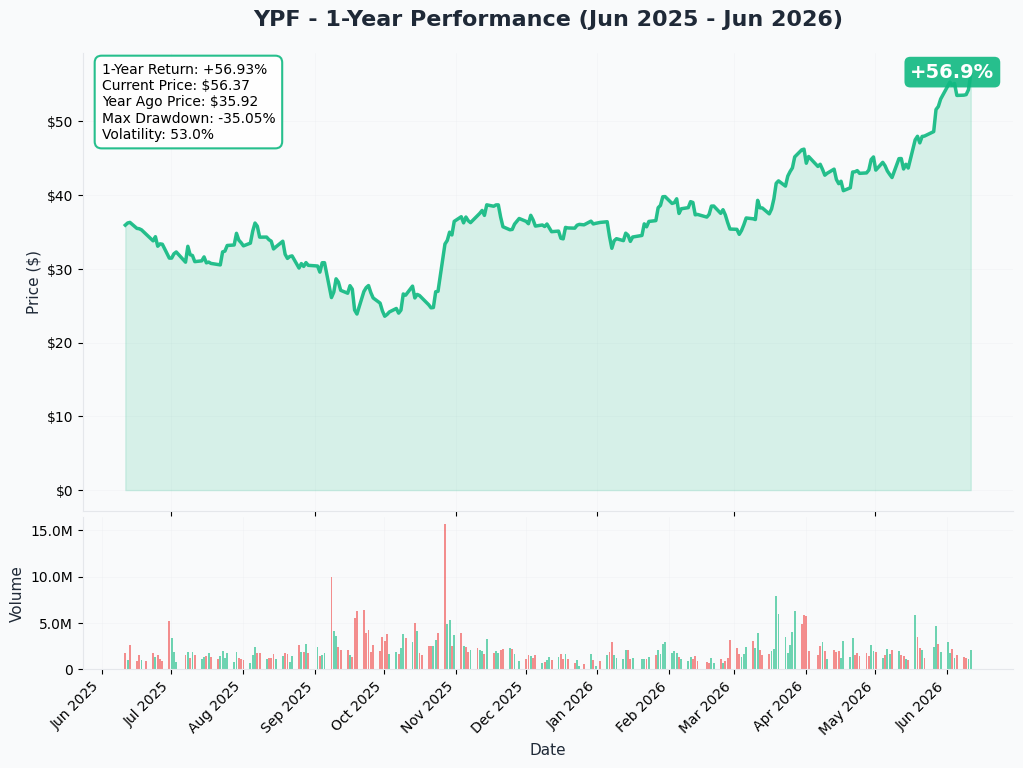
YPF has been one of the standout energy ADRs in 2026, up ≈55.8% YTD to approximately $56.54. The chart tells the story of the Vaca Muerta trade in full swing — the rally has been driven by record shale-oil production, improving lifting costs, balance-sheet deleveraging, and the favorable March 2026 appellate reversal that removed the most acute near-term litigation threat. Notably, the stock also benefited from the Strait of Hormuz geopolitical premium lifting oil prices.
The critical context for the put trade: YPF spot ($57.40) now trades above the 3-month analyst consensus target (≈$52.67) and well above the latest UBS price target ($48, raised May 27, 2026 from $45 — still ≈16% below spot). A stock outrunning analyst fair value is exactly the kind of setup where a long-dated OTM put makes structural sense as cheap portfolio insurance.
Gamma-Based Support & Resistance
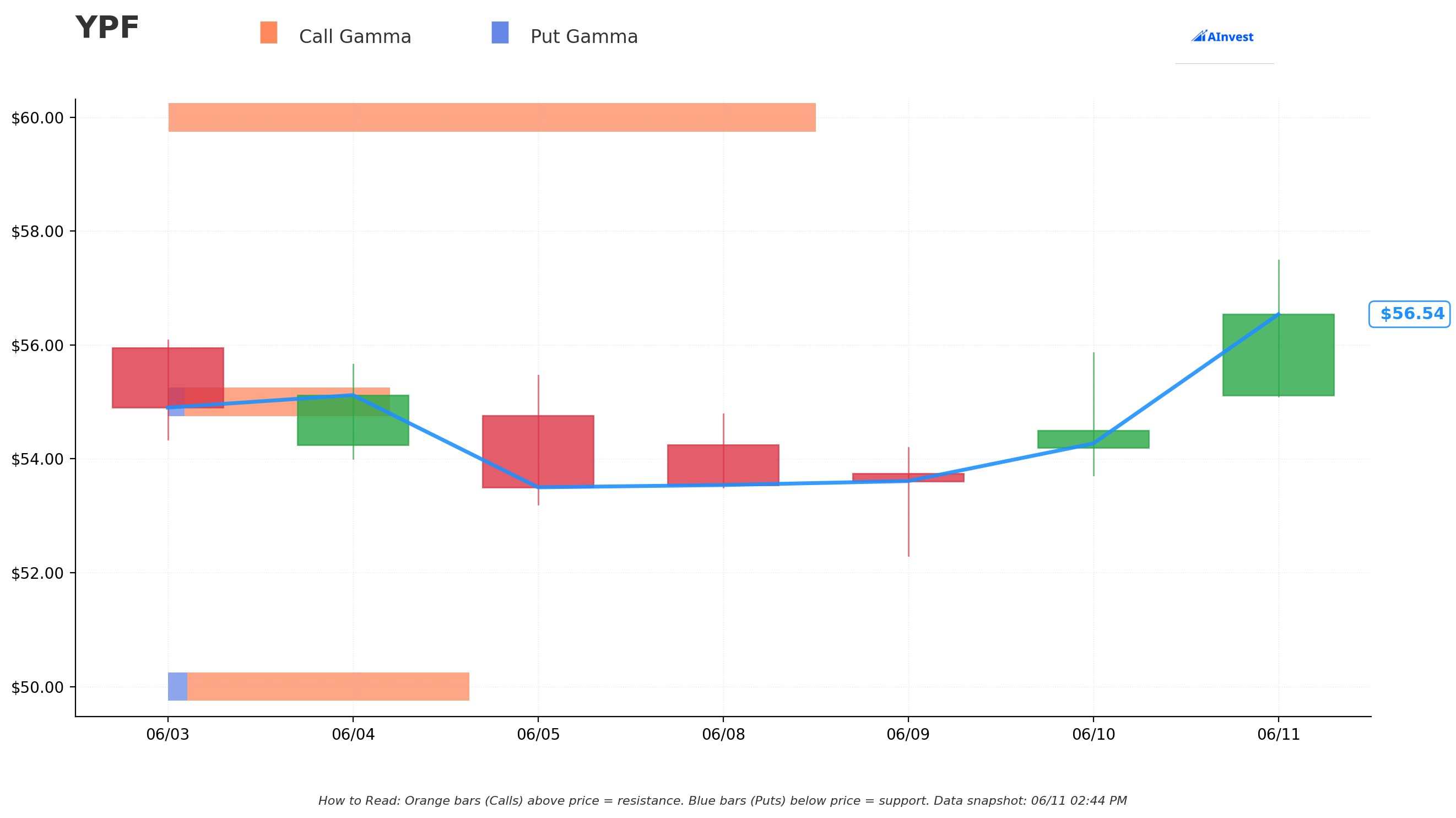
YPF is a thinly-optioned name on U.S. exchanges — the options market here is a fraction of the depth you'd see in a large-cap tech stock or even a major domestic energy name. The gamma exposure data reflects that reality.
🟠 Resistance Level (Call Gamma Above Price):
- $60.00 — One notable resistance level. The options activity concentrated near current price shows a modest call gamma cluster around $60, acting as a near-term ceiling. Market makers hedging short call exposure may create mild selling pressure as the stock approaches $60, but the overall gamma wall here is not dominant.
🔵 Support Levels (Put Gamma Below Price):
- No significant gamma support detected below current price. This is important to state honestly: the thin options market on YPF means there are no large put-gamma clusters below $57 creating a mechanical floor the way you'd see in an S&P 500 name. If the stock breaks down, the options market is not going to catch it on the way down. This actually reinforces the logic of the long-dated put hedge — the downside is structurally uncushioned.
Translation for traders: Don't read too much into the gamma levels here. YPF is a macro and catalyst-driven story, not a gamma-pinned name. The important price levels come from the implied-move analysis and the catalyst landscape below.
Implied Move Analysis
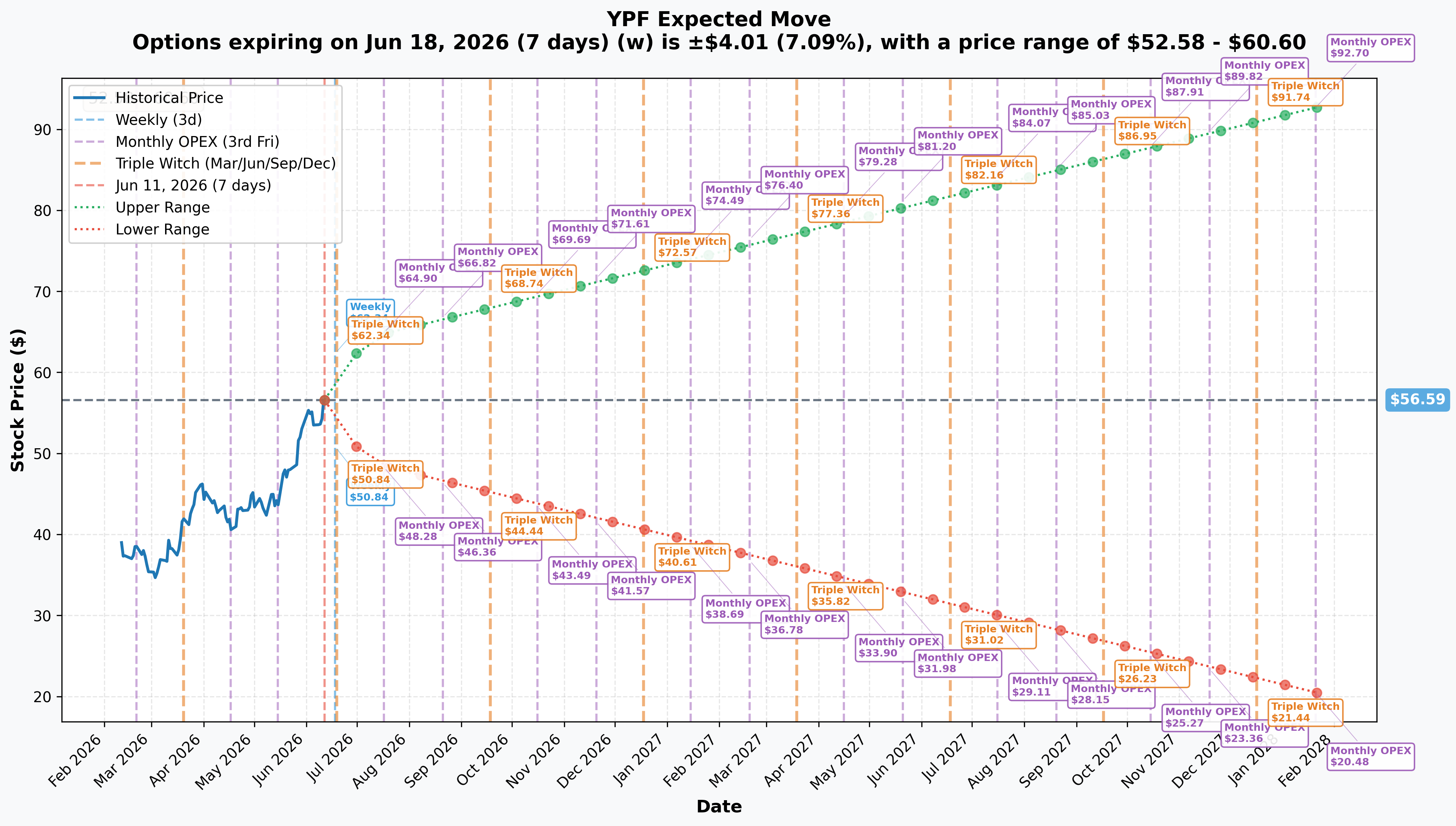
The options market is pricing substantial uncertainty into YPF across time horizons — appropriate for an Argentine ADR with live litigation, FX risk, and a commodity price dependency:
- 📅 Weekly (exp 2026-06-18, 7 days): ≈±7% → Range $52.58 – $60.60
- 📅 Monthly OPEX (exp 2026-07-17, ≈36 days): ≈±14.5% → Range $48.38 – $64.80
- 📅 LEAP (exp 2028-01-21, ≈589 days): ≈±63.8% → Range $20.48 – $92.70
A few things stand out here. The $50 strike sits just below the monthly implied-move lower band ($48.38), which means the options market itself says a monthly move to $50 is within but toward the outer edge of its own near-term probability range. Over the 2.5-year LEAP cone (±63.8%), the $50 strike sits comfortably within the market's own estimate of where YPF could reasonably trade — meaning this is not an extreme lottery-ticket bet. The market's own implied distribution assigns non-trivial probability to a $50 print over the next 2.5 years.
The wide LEAP cone ($20.48 – $92.70) is itself a statement about Argentine macro risk: the options market is explicitly pricing in scenarios ranging from a near-collapse to a near-doubling of the ADR over the next 2.5 years. That kind of terminal-state uncertainty is precisely the environment where long-dated OTM puts have positive expected value as a hedge.
Key takeaway: The $50 put is not a lottery ticket by the market's own math. It's a deliberate, within-the-implied-cone hedge timed for a risk landscape that won't resolve for at least 12–18 months.
🎪 Catalysts
Already Happened (Context for the Hedge)
Q1 2026 Earnings — Record Results (Reported May 2026)
- Revenue $4.95B (+9% QoQ, +7% YoY); adjusted EBITDA $1.6B (+28% YoY, 32% margin) — a record quarter operationally.
- EPS $1.03, beating the $0.83 consensus by $0.20; shale-oil production hit 205,000 bpd (+39% YoY), now 76% of total oil output.
- Lifting costs dropped 42% to $8.8/BOE; FCF jumped to $871M; net leverage fell to 1.57x.
- The operational story is genuinely strong — which is what makes the spot price above analyst consensus, and the gap-to-downside that much more interesting for the put.
The ≈$16.1B Litigation Reversal — March 27, 2026
- The U.S. Second Circuit Court of Appeals voided the ≈$16.1B judgment against Argentina in a 2-1 vote, ruling that District Judge Loretta Preska had misinterpreted Argentine law. The 51%-stake-turnover order was vacated.
- The Washington Post covered the scope of the decision; Sullivan & Cromwell's memo provides the legal detail.
- But it is not over. Burford Capital (the litigation funder) stated clearly that Petersen and Eton Park are expected to seek en-banc rehearing, consider a U.S. Supreme Court petition, and likely pursue investment-treaty arbitration — a parallel track with no hard deadline. Burford's further statement doubled down on the litigation path.
Strategic Developments — Major Capital Commitments
- YPF unveiled a $25B Vaca Muerta investment plan in May 2026 to accelerate shale exports — a major upside catalyst and a major concentration of execution risk simultaneously.
- Eni and XRG signed a JDA with YPF in February 2026 targeting a 12-mtpa floating LNG facility, targeting FID in H2 2026. S&P Global confirmed the deal structure.
- Shell and Chevron finalized their equity positions in the VMOS pipeline — a 437-km, up-to-550 kbpd crude export line targeting 180,000 b/d start in 2026 and full ramp by July 2027. The S&P Global infrastructure roundup details the scale.
Analyst Activity
- UBS, May 27, 2026: Hold, price target $48 (raised from $45) — still ≈16% below spot at $57.40.
- 3-month consensus target ≈$52.67 — below spot (MarketBeat). The Street is not bullish at current levels.
Capital Returns
- YPF launched an AR$38.5B share buyback program and pre-purchased short-term notes ahead of a July 2026 maturity — balance-sheet management and shareholder return signals.
Upcoming Catalysts (The Runway for the Hedge)
Q2 2026 Earnings — ≈August 6–7, 2026 📅 Revenue consensus ≈$6.19B per MarketBeat earnings estimates and Benzinga earnings data. Key metrics to watch: shale-oil bpd vs. the 215k full-year guide, lifting cost trajectory, CapEx pacing on the $25B plan, and any update on the VMOS ramp. With spot above analyst targets, any softness in execution could be the first re-rating trigger.
SCOTUS Petition Deadline — ≈September 28, 2026 ⚖️ Burford Capital has explicitly flagged the ≈September 28, 2026 deadline for a U.S. Supreme Court petition, with a possible certiorari decision by ≈December 4, 2026. If SCOTUS grants cert and takes the case, oral argument and a decision could come by mid-2027 — well inside the January 2028 LEAP window. This is the single highest-stakes binary event in the entire option's lifetime.
Argentina LNG FID — Targeted H2 2026 📅 Eni, YPF, and XRG are working toward a Final Investment Decision on the 12-mtpa Argentina LNG project in the second half of 2026. A positive FID is a medium-term bullish catalyst for the ADR; a collapse or delay of FID is a bearish surprise that could re-rate the stock sharply lower given how central LNG monetization is to the long-term equity story.
Oil Price Normalization — Q3–Q4 2026 📉 Near-term Brent is elevated on the Strait of Hormuz geopolitical premium. The EIA projects Brent falling to ≈$88/bbl by Q4 2026 as Hormuz flows resume in Q3. J.P. Morgan's bear case targets ≈$60/bbl for 2026. That's a ≈$45 per barrel potential range. At the bearish end of that spectrum, YPF's upstream economics look meaningfully different from what the current ADR price implies.
July 2026 — Short-Term Note Maturity 📅 YPF has been pre-purchasing short-term notes ahead of a July 2026 maturity — a near-term balance-sheet checkpoint. Argentina's >$19–25B external debt wall for 2026 is the sovereign backdrop this maturity sits against.
Peso/FX Band Stress — Ongoing 💱 The peso is hovering near the top of Argentina's new January 2026 currency band, and devaluation bets persist despite Milei's reserve deployment. A band breach or forced devaluation would transmit directly into the YPF ADR. Credendo's framework is explicit: the midterm win eases near-term liquidity but long-term challenges remain.
🎲 Price Targets & Probabilities
The thin gamma landscape on YPF means technical levels matter less here than catalyst outcomes. Using the implied-move cones and the catalyst schedule:
📈 Bull Case — $65–$75 range over 2.5 years VMOS pipeline ramps on schedule, Argentina LNG FID is signed and construction begins, SCOTUS declines cert (killing the litigation), the peso remains within the band, and oil stays in the $90–$105 range as Hormuz disruption continues longer than expected. YPF re-rates toward its export-growth intrinsic value. The 2028 put expires worthless — the hedge buyer spent $1.8M for protection they didn't need. Inside the implied-move upper cone.
🎯 Base Case — $45–$60 range over 2.5 years One or two of the tail risks partially materialize: oil normalizes toward $88–$95 (compressing upstream margins), VMOS ramp experiences modest slippage, and the peso requires minor adjustment. The stock trades sideways-to-down from current levels. The $50 put gains value but the breakeven (≈$40.80 at expiration) requires further downside. Inside the implied-move median cone.
📉 Bear Case — $20–$45 range over 2.5 years Any combination of: SCOTUS reinstates the ≈$16B judgment or the 51%-stake-turnover order; the peso breaks the currency band and a sharp devaluation hits the ADR directly; oil falls toward the JPM $60 scenario; or Argentina's $25B+ 2026 debt wall triggers a sovereign credit event. The $50 put moves deep in-the-money and the $1.8M hedge becomes worth multiples of its cost. Inside the implied-move lower cone.
💡 4-Reader Interpretation
🚀 YOLO Trader
Real talk: this isn't your trade structure. A 2.5-year OTM put at $9.20 with a ≈29% move required to breakeven at expiration is a patient institutional hedge, not a quick-hit momentum play. If you want to express a bearish view on YPF with shorter-dated options — say August 2026 puts near the $50–$52 strike ahead of the Q2 earnings and SCOTUS petition window — that's a tighter, more leveraged structure. Just know you're in a thinly-traded name with wide bid/ask spreads. Size small, define your risk, and don't overpay. The desk that crossed today had the luxury of negotiating a block price — retail traders won't have that.
📊 Swing Trader
The most actionable near-term level is the weekly implied-move floor of ≈$52.58 and the monthly implied-move floor of ≈$48.38. Those are your key downside checkpoints heading into Q2 earnings (≈August 6–7). If YPF trades through $52.58 on a catalyst event, the monthly lower band ($48.38) becomes the next target — and the January 2028 $50 puts would be at-the-money. A directional swing short (via stock or shorter-dated puts) with a stop above the $60 resistance level offers a defined risk structure. The SCOTUS petition deadline (≈September 28) and the LNG FID (H2 2026) are your two major catalyst windows to watch.
🛡️ Premium Collector
This is not a premium-collection environment in thin names like YPF. The wide bid/ask spreads on a lightly-traded ADR options market mean you'll give away most of your edge in the spread. If you want income exposure to the stock, consider selling cash-secured puts in the $48–$50 range in the July or August expiry — you'd be collecting premium while getting assigned (if it happens) at a price below current consensus targets. But be clear-eyed: you're selling into Argentine political tail risk, not a simple covered-put situation. The July note maturity and Q2 earnings are binary events that could move the stock sharply before your put expires.
🌱 Entry-Level / Beginner
Here's what happened in plain English: someone paid $1.8M for the right to sell YPF shares at $50 per share — even though the stock is currently trading at $57.40 — anytime over the next 2.5 years. Why would anyone do that? Because they own (or are worried about) a large position in YPF, and they want insurance against a big drop. Think of it like buying flood insurance on a house in a floodplain: the neighborhood looks fine today, but you know there are risks — a big legal case, a currency problem, oil prices dropping — that could flood it in the next few years. The put option is that flood insurance. If YPF stays above $50 for 2.5 years, the $1.8M is just the cost of the policy they didn't need. If the stock falls sharply, the put becomes very valuable. This is called a tail-risk hedge — buying protection against low-probability but high-impact scenarios. It's one of the most sophisticated things you can do with options, and it's a long way from speculation.
⚠️ Risk Factors
Options trading involves substantial risk. Here are the specific risks for this trade and thesis:
The Litigation Reversal May Stick The March 27, 2026 appellate ruling is a real, significant legal victory for Argentina. En-banc grants are rare; SCOTUS cert grants for commercial cases are rare. Sullivan & Cromwell's memo analyzes the legal basis — the 2nd Circuit found the district court misread Argentine law, which is a substantive ruling, not a procedural technicality. The litigation path that the put is hedging may simply close without a revival. In that scenario, the $1.8M is insurance that was never needed.
YPF's Operational Execution Is Genuinely Strong Record Q1 EBITDA, 39% shale-oil production growth, 42% lifting-cost reduction, and $871M FCF are real operational achievements. The Vaca Muerta shale basin is a world-class asset. If the $25B investment plan executes and VMOS + LNG deliver on their ramp timelines, the stock has a path well above current levels. The put buyer could have sold this hedge for zero gain.
Oil-Price Bears May Be Wrong The EIA's own base case for Q4 2026 is ≈$88/bbl, not $60. The EIA's June 2026 STEO is not a bearish forecast — it's a normalization forecast. If the Hormuz disruption proves more persistent than expected, or if OPEC discipline holds, Brent could stay elevated. At $100+ oil, YPF's upstream economics look very different, and the $50 put loses most of its value before expiration.
Currency Band Resilience Milei's landslide October 2025 midterm win gave the government political capital to defend the peso band. Inflation at a 7-year low (31.8% in November 2025) suggests the macro adjustment is partly working. The devaluation scenario is plausible but not inevitable.
What the OPRA Tape CANNOT Tell Us We know the mechanism (single-leg negotiated block cross), the size (2,000 contracts), the price ($9.20), and the direction (BUY). We do not know the buyer's identity, whether this is a standalone hedge or part of a larger institutional position (e.g., long YPF stock hedged with this put), the precise entry logic, or the buyer's stop-out scenario. We interpret the tape; we cannot read minds. This could be a portfolio manager with a large YPF long position buying downside protection, or a dedicated Argentine-risk macro fund. The structure is clear; the motive is inferred.
🎯 The Bottom Line
Here's the deal: a desk just crossed a $1.8M negotiated block of long-dated downside insurance on YPF — 2,000 January 2028 $50 puts — at a moment when the stock is +55.8% YTD, trading above Wall Street's consensus fair value, and sitting on top of four distinct multi-year tail risks. They didn't sweep the market, didn't send an urgent signal. They crossed a block, quietly, at 12:01 in the afternoon, with a known counterparty on the other side.
The trade is textbook: pay ≈$9.20/share today to own 2.5 years of $50-strike protection on an Argentine state-controlled energy company whose biggest legal threat is suspended not dead, whose currency is under latent devaluation pressure, whose oil-price premium is fading toward a normalization target, and whose $25B export plan is unbuilt. The January 2028 expiry was chosen deliberately to span every remaining branch point in the U.S. legal calendar — en-banc, cert, a possible 2027 SCOTUS ruling, and the early innings of investment-treaty arbitration.
The honest counterpart: YPF is operationally excellent right now. The record EBITDA, the 39% shale-oil growth, the falling lifting costs — none of that is fake. And the biggest litigation threat was reversed in March 2026, not just paused. This put could expire worthless if execution continues, the litigation stays dead, the peso holds, and oil stays elevated. That's the base case for YPF bulls, and it's not an unreasonable one.
What to watch:
- 📅 July 2026: Short-term note maturity — YPF balance-sheet checkpoint
- 📅 ≈August 6–7, 2026: Q2 2026 earnings — shale bpd, lifting costs, CapEx pacing
- 📅 ≈September 28, 2026: SCOTUS petition deadline — the highest-stakes legal binary in the option's window
- 📅 H2 2026: Argentina LNG FID with Eni/XRG — bullish confirmation or bearish delay
- 📅 ≈December 4, 2026: Possible SCOTUS cert decision (grant = re-open litigation; deny = case likely closes)
- 📅 Mid-2027: Possible SCOTUS oral argument and decision if cert granted
- 📅 Tomorrow ≈06:30 ET: OPRA OI snapshot — expected OI rise ≈2,000 from the prior 2 (confirming the fresh open; largely a formality given size ≫ prior OI)
- 📅 January 21, 2028: YPF Jan-2028 $50P expiration
If you own YPF stock: The ±14.5% monthly implied move and thin gamma support below current price mean you're carrying real downside risk with no mechanical cushion. The put block today is a signal that at least one sophisticated counterparty sees enough tail risk to pay $1.8M for 2.5 years of coverage. Whether you want to do the same at ≈$9.20/share is a function of your own risk tolerance and holding size.
If you're watching from the sidelines: The implied-move lower bands ($52.58 weekly, $48.38 monthly) are your key reference levels. A break of $52 on a catalyst event would bring the $50 put into-the-money territory and signal the hedge is already paying off. The SCOTUS petition window (≈September 28, 2026) and the LNG FID (H2 2026) are the two binary catalysts to have on your calendar.
If you're curious about the structure: This is a master class in using long-dated OTM puts as tail-risk insurance. The desk paid ≈15.9% of spot for 2.5 years of $50-strike protection on a stock carrying genuinely complex multi-year risks. That is cheap, patient, and structurally elegant — even if it expires worthless.
A $1.8M negotiated block of LEAP puts on Argentina's national oil company, timed to span the entire remaining legal calendar on a ≈$16B lawsuit. Whoever crossed this trade is playing a very long game. 👀
Disclaimer: Options trading involves substantial risk of loss and is not suitable for all investors. This analysis is for educational and informational purposes only and does not constitute financial advice or a solicitation to buy or sell any security. The YPF January 2028 $50 put trade analyzed here requires approximately 29% downside from current levels to reach breakeven at expiration and can expire entirely worthless — resulting in 100% loss of the $1.8M premium. Argentine ADRs carry additional sovereign, currency, and regulatory risk layers not present in U.S.-domiciled equities. Open/close classification is based on size (2,000) vs. prior OI (2) — a near-certain fresh open — and will be confirmed by next-day OPRA open interest data (≈06:30 ET). Always conduct your own due diligence and consider consulting a licensed financial advisor before making any trading decisions.
Last updated: June 12, 2026