🔄 MRK ≈$5.1M Call Repositioning — Next-Day OI Flips the Read: the Sep $100C Leg CLOSED, Not a Fresh Bullish Diagonal
📅 June 12, 2026 | 🔥 Unusual Activity Detected
🔄 Updated 2026-06-15 — the read inverted. Next-day OPRA OI flips the original "cautiously bullish diagonal open." The long Sep-18 $100C leg resolved as a CLOSE — open interest fell 19,700 → 15,650 (Δ −4,050), so the desk was reducing existing Sep $100C exposure, not opening a fresh long. The short Dec-18 $105C leg opened as expected (STO — OI rose 664 → 7,891, Δ +7,227). Net: the desk took off near-term call exposure and sold December upside — a de-risking / overwrite repositioning, neutral-to-mildly-bearish, NOT a new bullish bet. Title and tone corrected below.
🎯 The Quick Take
At 11:28:34 on June 12, a desk worked a multi-leg options structure on the trading floor on Merck (MRK) — a BUY of September $100 calls paired with a SELL of December $105 calls, a pure options structure with no stock leg. The net debit was ≈$5.1M. On the day it looked like a cautiously bullish diagonal open. But next-day OPRA OI flipped that read: the Sep $100C BUY leg resolved as a CLOSE (OI fell ≈4,050), so the desk was reducing existing September call exposure — not opening a fresh long — while the Dec $105C SELL leg opened a new short (STO confirmed). The honest interpretation is therefore a repositioning / de-risking move: take off near-term call exposure, sell December upside. That is neutral-to-mildly-bearish in net delta, not a new bullish bet. Read on for the tape and the corrected interpretation.
📊 Company Overview
Merck & Co. (MRK) is one of the world's largest pharmaceutical companies:
- Market Cap: ≈$300B+
- Sector / Industry: Healthcare — Large-Cap Pharmaceuticals
- What they do: Merck's crown jewel is Keytruda (pembrolizumab), the world's best-selling cancer immunotherapy at ≈$8B/quarter (≈half of all company revenue). Beyond oncology, Merck runs a growing cardiopulmonary franchise (Winrevair for PAH at $525M in Q1 2026), a profitable Animal Health division, and vaccines including Gardasil. The company's entire strategic debate right now centers on how fast it can convert patients to subcutaneous Keytruda (branded Keytruda Qlex), which carries patents potentially extending exclusivity to ≈2042 — pushing out the feared 2028 Keytruda IV patent cliff.
- Dividend: $0.85/quarter = $3.40 annualized, ≈2.8% yield at ≈$120 (Washington Crossing Advisors)
- Analyst consensus: ≈39 analysts, median PT $130, average ≈$128–$131 — ≈10% implied upside vs. ≈$119–$120 spot
💰 The Option Flow Breakdown
The Tape — June 12, 2026 @ 11:28:34: multi-leg options floor spread
| Time | Buy/Sell | Call/Put | Strike | Expiration | Premium | Volume | OI | Size | Spot | Option Price | Option Symbol |
|---|---|---|---|---|---|---|---|---|---|---|---|
| 11:28:34 | BUY | CALL | $100 | 2026-09-18 | ≈$8.1M | 7,400 | 20,000 | 3,722 | $120.42 | $21.75 | MRK20260918C100 |
| 11:28:34 | SELL | CALL | $105 | 2026-12-18 | ≈$7.4M | 5,900 | 664 | 3,722 | $120.42 | $19.90 | MRK20261218C105 |
| 11:28:34 | BUY | CALL | $100 | 2026-09-18 | ≈$1.1M ×4 clips | 7,400 | 20,000 | 501 ×4 | $120.42 | $21.75 | MRK20260918C100 |
Net option premium: ≈$8.1M paid − ≈$7.4M collected = ≈$5.1M net debit
Flow type: multi-leg options floor structure — a BUY of deep-ITM Sep $100C paired with a SELL of Dec $105C, worked on the trading floor as a pure options structure. The MRK tape carries zero stock+option codes; this is entirely within the options market. On the day it presented as a diagonal; next-day OI (below) shows the long leg was a close, reframing it as a repositioning.
🔄 RESOLVED — Next-Day OI Flips the Read: Sep Leg CLOSED, Dec Short OPENED (2026-06-15)
| Leg | Pre-print baseline (EOD 2026-06-11) | Resolving (EOD 2026-06-12) | Δ | Verdict |
|---|---|---|---|---|
| Sep-18 $100C (BUY) | 19,700 | 15,650 | −4,050 | CLOSE — not a fresh long open |
| Dec-18 $105C (SELL) | 664 | 7,891 | +7,227 | OPEN — STO confirmed |
This is an inversion of the original read. On the day, the BUY Sep $100C leg looked like it could be a new cautiously-bullish long (size ≈5,726 vs prior OI 20,000 — provisional, size below OI). Next-day OPRA OI settled it: open interest FELL by ≈4,050, which is the signature of net closing activity on that strike. The desk was reducing existing September $100 call exposure, not initiating a fresh bullish long.
The short Dec $105C leg resolved exactly as flagged — OI rose 664 → 7,891 (Δ +7,227, well above the 3,722 traded), STO confirmed — a genuinely new short call in December.
What the inversion means: combine a close of near-term Sep $100C exposure with a new Dec $105C short, and the net move is a de-risking / overwrite repositioning — taking off long-dated-ITM call exposure while selling December upside. In net-delta terms that is neutral-to-mildly-bearish, the opposite of the "new bullish diagonal" the size-vs-OI ambiguity allowed on the day. (Note: OPRA gives us the net OI direction, not the desk's prior position sign — we can prove the Sep leg net-closed, but cannot prove from the tape alone whether the desk was unwinding a long or covering a short. Either way, it is not a fresh bullish open.)
🤓 What This Actually Means — Plain English
Let's unpack what a diagonal call spread is and why someone would use it here.
What is a diagonal call spread?
A diagonal call spread combines two call options with different strikes AND different expirations:
- Long leg (BUY): Deep-ITM September $100 calls (MRK at $120, so these calls are already $20 in-the-money). These calls have a high delta — they move almost dollar-for-dollar with the stock. Buying them gives you stock-like upside exposure for the next ≈3 months, with defined maximum loss (you can only lose the premium paid, not a stock-equivalent drawdown).
- Short leg (SELL): December $105 calls at a higher strike and further-out expiration. By selling these, the desk collects ≈$7.4M in premium, which offsets most of the cost of the long leg. The trade-off: if MRK trades above $105 in December, you are obligated to deliver calls there — so your effective upside is capped above $105 by the December expiration.
Net debit = capital changing hands: The desk paid ≈$8.1M on the Sep $100C side and collected ≈$7.4M on the Dec $105C side, a ≈$5.1M net debit. On the day this looked like the cost of opening a diagonal — but with the Sep leg now confirmed as a close, the ≈$5.1M is better read as the net cash of a repositioning, not the maximum loss on a fresh bullish bet.
Why this is NOT the bullish diagonal it first appeared (the inversion):
The next-day OI is decisive. The Sep $100C open interest fell (Δ −4,050) — the hallmark of closing activity — while the Dec $105C open interest rose (Δ +7,227) — a genuine new short. So instead of adding near-term long-delta exposure, the desk removed it, and layered on a December upside-cap short. Net delta moved lower, not higher. That is a de-risking / overwrite repositioning — neutral-to-mildly-bearish — the opposite of "grinding higher."
Why the day-of read was provisional:
The Sep $100C BUY size (≈5,726 contracts) was smaller than the existing open interest of 20,000, so size alone could not prove open vs. close — exactly the ambiguity the ⏳ flag warned about. The next-day OI fall resolved it as a close. The lesson here is the standing one: a big BUY headline does not mean bullish conviction — only the next-day OI resolves open vs. close, and here it inverted the thesis.
The plain-language summary: A desk net-closed September $100 call exposure and opened a new December $105 short call, for ≈$5.1M net. Rather than a fresh cautiously-bullish diagonal, this is a desk reducing near-term call exposure and selling December upside — a considered, structured repositioning, not a new directional bull bet, and certainly not a panic buy or urgent sweep.
📈 Technical Setup / Chart Check-Up
YTD Performance
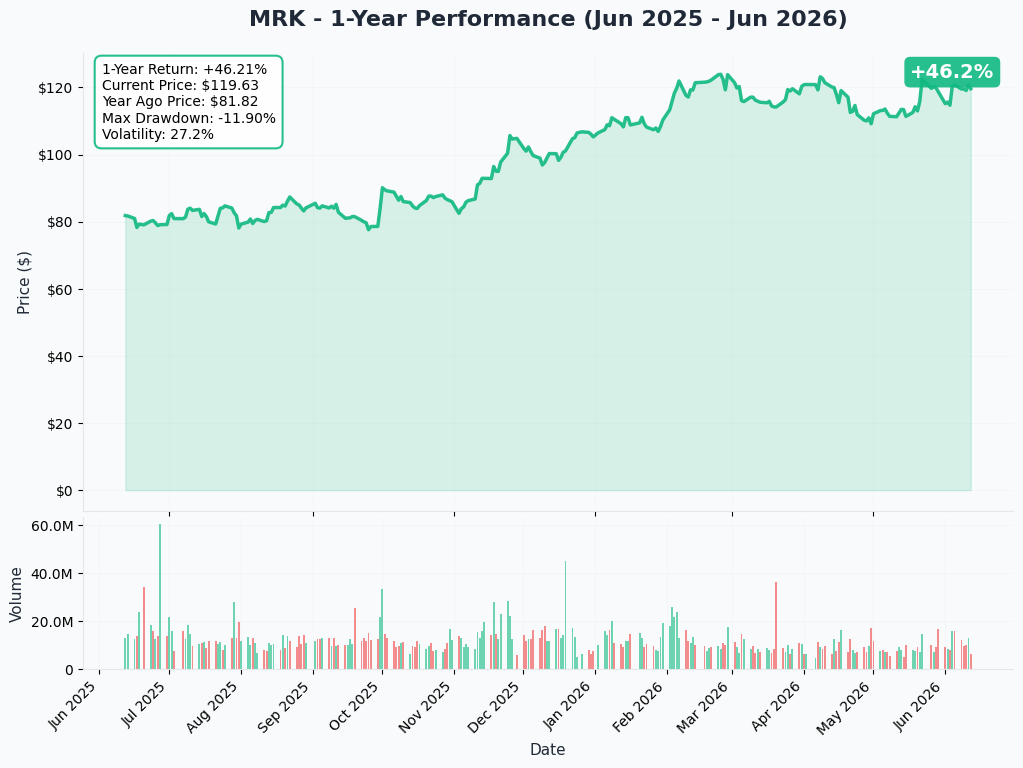
MRK has been a mixed performer in 2026, trading ≈$120 as of today — roughly range-bound after the Cidara-charge-induced volatility in late Q1. The stock digested a noisy Q1 GAAP loss (driven by the $9.2B Cidara acquisition charge) while the underlying business actually beat revenue estimates at $16.29B. The chart reflects a stock caught between a strong operational business and a looming structural cliff narrative:
- 📊 Revenue beat: $16.29B Q1, +5% YoY — operationally solid
- 📉 Gardasil overhang: −19% to $1.07B in Q1 as China demand remains structurally soft
- 🎯 Analyst average PT ≈$128–$131 implies ≈10% upside from current levels; the diagonal's short leg at $105 in December sits well below the analyst consensus — consistent with a desk that is constructive but not expecting a rip to the full PT range in the near term
Gamma-Based Support & Resistance
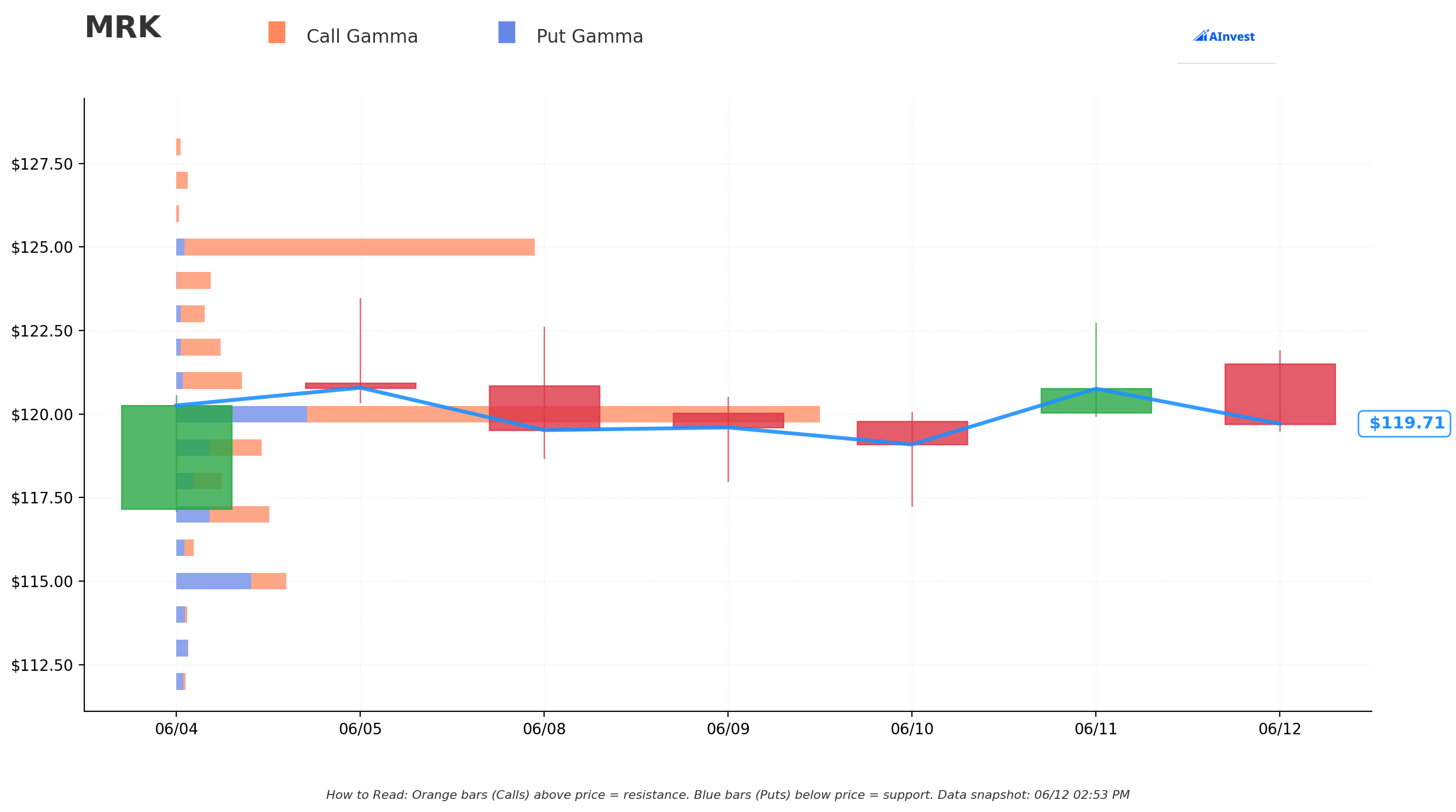
Current Price: ≈$119.70–$120.42
The gamma exposure map at current spot reveals a clear structure:
🔵 Support Levels (Put Gamma Below Price):
- $115.00 — Key Gamma Support. The gamma chart shows meaningful put open interest anchoring at $115. Market makers will tend to buy dips toward this level, making it a sticky floor. A break below $115 would remove this support and open faster downside.
🟠 Resistance Levels (Call Gamma Above Price):
- $120.00 — Near-Term Resistance. MRK is trading right at this level. Call gamma here creates mechanical headwinds as market makers hedge by selling stock on rallies through $120.
- $125.00 — Next Resistance. If $120 is cleared cleanly, $125 is the next gamma ceiling. Heavy call interest here would slow any rally.
Translation: MRK is pinned in a ≈$115–$125 corridor right now, pressing up against the $120 gamma level. For any bullish thesis to gain traction, the stock needs a sustained close above $120. The $115 level is the floor to watch on the downside — a clean break below that could accelerate a move toward $110–$112. Notably, the diagonal's short Dec $105C is below the current gamma floor, reinforcing the view that the desk is protecting against downside while capping only the far-upside.
Implied Move Analysis
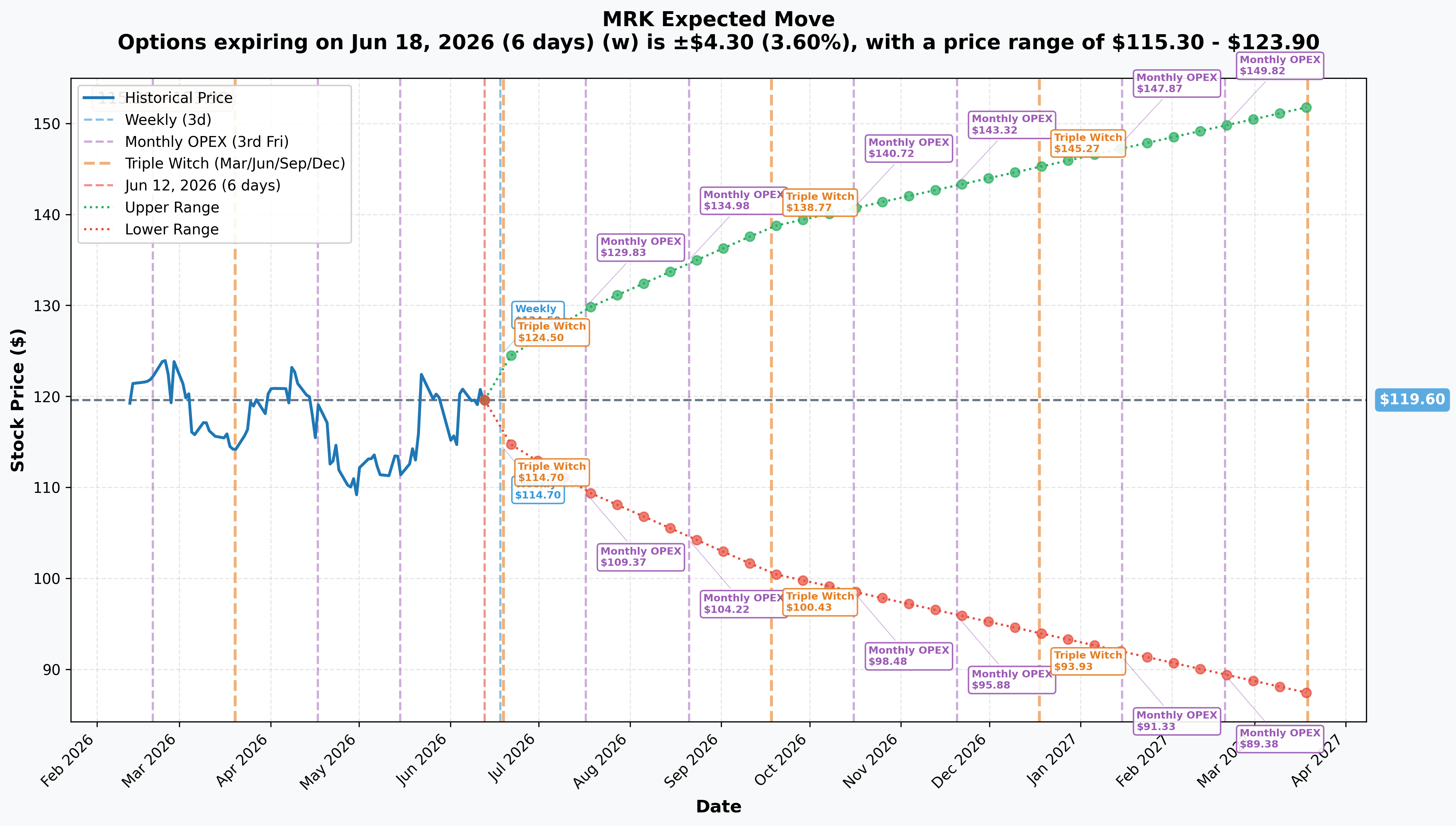
The options market is pricing steady uncertainty across all time horizons:
- 📅 Monthly (exp 2026-07-17): ±$10.12 (±8.44%) → Range $109.51 – $129.69
- This window captures the June 19 Welireg+Keytruda PDUFA and approaches Q2 earnings (expected late July)
- 📅 Quarterly (exp 2026-09-18): ±$19.20 (±15.97%) → Range $100.50 – $138.70
- This window captures the Aug 17 Keytruda+Padcev MIBC decision and Q2 earnings — the expiration of the long BUY call leg
The Sep-18 $100 strike sits right at the lower edge of the quarterly implied move range ($100.50). The long Sep $100C is therefore a position that profits as long as MRK stays anywhere within the broad implied-move range — it only fully loses if MRK breaks through the lower tail of the quarterly distribution. That is consistent with a cautiously bullish, defined-risk structure: exposed to the upside of the implied move range, fully hedged against catastrophic downside beyond the premium paid.
🎪 Catalysts
Already Happened (Recent Backdrop)
Q1 2026 Earnings — April 30, 2026:
- Revenue $16.29B, +5% YoY, beating the ≈$15.82B consensus — solid top line.
- GAAP net loss of −$4.24B driven entirely by a $9.2B Cidara R&D acquisition charge — a one-time item, not reflective of the business.
- Keytruda (incl. Qlex) at $8.0B, +12% YoY — still growing strongly despite the 2028 cliff narrative.
- Winrevair $525M, +12% sequential — the cardiopulmonary franchise is scaling.
- Gardasil −19% to $1.07B — China demand remains the persistent soft spot.
- FY2026 adjusted EPS guidance raised to $5.04–$5.16.
Subcutaneous Keytruda (Keytruda Qlex) — FDA Approved, Rolling Out: FDA-approved across ≈38 cancer types; available in the U.S. from September 2025. Merck targets converting 30–40% of Keytruda use to SC in 18–24 months — a conversion that carries patents potentially pushing exclusivity toward 2042, defusing much of the 2028 cliff math.
Cidara Acquisition Closed January 7, 2026: $9.2B acquisition of Cidara Therapeutics adds MK-1406 (CD388), a long-acting antiviral for influenza prophylaxis — part of Merck's strategy to backfill the Keytruda cliff with bolt-on deals.
Upcoming Catalysts (The Runway — All Within the Sep / Dec Option Window)
📅 June 19, 2026 — Welireg + Keytruda, Adjuvant RCC PDUFA 🔴 Binary Merck faces a regulatory decision on the Welireg+Keytruda combination in adjuvant renal cell carcinoma — one week away. Approval would expand the Keytruda label; a Complete Response Letter (CRL) would be a negative signal. This event sits inside the September $100C window.
📅 Late July 2026 — Q2 2026 Earnings 📊 Q2 2025 was reported July 29; Q2 2026 is expected in the same window. Watch: Keytruda Qlex SC conversion rate (the single most important data point), Winrevair trajectory, Gardasil/China commentary, and FY guidance updates. This event also sits inside the September window.
📅 August 17, 2026 — Keytruda + Padcev, MIBC Decision 🔴 Binary FDA decision on Keytruda combined with Padcev for muscle-invasive bladder cancer — a meaningful new indication if approved. This event sits inside the September $100C window, within days of the September 18 expiration.
📅 October 10, 2026 — ifinatamab deruxtecan (I-DXd) PDUFA 🔴 Binary FDA decision on I-DXd for 2L+ extensive-stage small-cell lung cancer, partnered with Daiichi Sankyo; FDA granted priority review in April 2026. This event sits inside the December $105C window — notably between Sep-18 and Dec-18 expirations.
Expected (Flexible Timing) — Enlicitide (Oral PCSK9) Filing: Three positive Phase 3 readouts on LDL-C reduction; potential first oral PCSK9 with an FDA Commissioner's National Priority Voucher to expedite review. A regulatory filing or decision here would be a new multi-year growth pillar.
🎲 4-Reader Interpretation
🚀 YOLO Trader
The Sep $100C calls look attractive on paper — deep ITM, ≈$21.75 each, high delta (probably ≈0.85+). But read the setup carefully: next-day OI confirmed the Sep $100C BUY leg was a CLOSE (OI fell ≈4,050), not a fresh long, and the desk opened a Dec $105C short alongside it. So this flow is a desk taking exposure off, not piling in — chasing it by buying the Sep $100C would be fading the desk, not following it. The June 19 PDUFA next week is a defined binary event — if you want to express a trade around that catalyst, do it on its own merits with a targeted near-dated call or call spread, not by piggybacking on what turned out to be a repositioning.
📊 Swing Trader
The $120 gamma resistance is your near-term line in the sand. MRK needs a sustained close above $120 to shift into the $122–$125 range, and the June 19 PDUFA is one week away as the first test. Note the flow signal, though: the desk closed its Sep $100C exposure and sold Dec $105C upside — a constructive-but-capped, even cautious, posture rather than a fresh bullish push. If Welireg+Keytruda gets approved in RCC adjuvant, that could be the push through the $120 wall regardless of this single desk's repositioning. A defined-risk way to play it: a call spread (e.g., Jul-17 $120/$125 or $120/$127), which profits from a moderate move up without paying for the full implied-move premium. The $115 gamma support is your stop-reference — a close below there weakens the setup materially.
🛡️ Premium Collector
MRK at ≈$120 with a ≈2.8% dividend (Washington Crossing Advisors) and a $115 gamma floor is a reasonable covered-call or cash-secured-put setup for income traders. The $115 cash-secured put in the July cycle lets you collect premium while the gamma floor does some natural defending. Alternatively, selling the $125 covered call (if you own shares) captures premium while the gamma ceiling helps keep the stock rangebound through it. Watch out for the June 19 PDUFA and late-July earnings — both will spike implied volatility, so consider being short premium going into those events, not through them.
🌱 Entry-Level / Beginner
Here is what actually happened — and why the framing matters.
Today's trade involved a desk working two call options at once — a BUY of September $100 calls and a SELL of December $105 calls, all purely in the options market (no stock involved). On the day it looked like opening a "diagonal." The next-morning open-interest check changed that picture.
Here is what the two legs turned out to be:
-
The BUY leg (Sep $100 calls): These calls are deep "in the money" — MRK is trading at $120 and the strike is $100, so each contract already has $20 of real value. On the day, a BUY of deep-ITM calls looks bullish. But open interest on this strike fell the next morning (it would have risen if this were a fresh new long). A falling OI on a strike means contracts were being closed, not opened — so the desk was taking exposure off, not adding it.
-
The SELL leg (Dec $105 calls): Here open interest rose sharply — a genuinely new short position. The desk sold December $105 calls, collecting ≈$7.4M and capping any upside above $105 by December.
Net result: ≈$5.1M net cash, with the desk removing September call exposure and adding a December upside-cap short. That is a de-risking / repositioning move — its net delta is lower, not higher — not a fresh bullish bet.
This is the textbook reason the next-day OI check matters: a big BUY headline is not the same as bullish conviction. Only the next-morning open interest resolves whether a trade opened or closed — and here it flipped the read from "cautiously bullish" to "reducing exposure."
The bottom line for a beginner: this is a structured repositioning by a desk that was trimming its Merck call exposure and selling December upside — not a panic buy, not an urgent sweep, and not a new bullish bet.
⚠️ Risk Factors
Options trading involves substantial risk of loss and is not suitable for all investors. Specific considerations for this trade and thesis:
The 2028 Keytruda Cliff — The Whole Story Without the SC Qlex conversion, modeled revenue could drop ≈80% on the Keytruda franchise — from ≈$30B annually to ≈$6B. The entire bull case rests on how fast that SC conversion happens. Merck has been struggling with this narrative since the $29.5B Keytruda patent cliff was first quantified. It's the overarching risk that keeps this stock from re-rating toward the high end of the PT range.
Gardasil / China — A Multi-Quarter Drag Gardasil is down −19% YoY and Merck has even halted some China shipments as demand collapsed. Merck described the sudden step-down as confusing even to themselves. There is no near-term resolution in sight.
Three Binary PDUFA Events in the Window The June 19, August 17, and October 10 regulatory decisions are all binary — approval or CRL. Any CRL creates immediate downside; all three together represent clustered binary risk that could move MRK meaningfully in either direction. A bad outcome on the June 19 PDUFA next week, for example, could push MRK below the $115 gamma support level and pressure the diagonal's long leg.
M&A / Balance Sheet Risk The $9.2B Cidara deal added a massive one-time charge and ongoing integration risk on an unapproved antiviral. Management has signaled more dealmaking ahead to backfill the Keytruda cliff, which could mean more one-time charges and balance-sheet pressure.
Policy / Macro Overhangs IRA Medicare price negotiation remains a headline risk for large pharma. Drug-pricing politics, tariff/FX effects, and sector rotation all represent ongoing macro headwinds that cannot be fully priced.
What the OPRA Tape CANNOT Tell Us: We know the mechanism (a multi-leg options structure worked on the trading floor), the size and strikes, the net debit (≈$5.1M), and — now that next-day OI is in — that the Sep $100C leg net-closed while the Dec $105C leg opened. We do NOT know: whether the closed Sep leg was the desk unwinding a long or covering a short (OPRA gives the net OI direction, not the desk's prior position sign); the identity of the counterparty; or whether this repositioning is standalone or part of a larger hedged book. We read the tape honestly — we cannot read motivation or the full portfolio context.
🎯 The Bottom Line
Here is the deal: today's MRK print is a pure multi-leg options structure worked on the trading floor — a BUY of deep-ITM Sep $100C against a SELL of Dec $105C, ≈$5.1M net. There is no stock leg. On the day it presented as a cautiously bullish diagonal, but next-day OI flipped the read: the Sep $100C leg net-closed (OI −4,050) and the Dec $105C leg opened (STO, OI +7,227). The honest characterization is a de-risking / overwrite repositioning — the desk removed near-term call exposure and sold December upside — net-delta-lower, neutral-to-mildly-bearish, NOT a fresh bullish bet.
The resolved framework (next-day OI is in):
- BUY Sep $100C → CLOSE confirmed. OI fell ≈4,050 — the desk reduced existing September $100 call exposure rather than opening a fresh long.
- SELL Dec $105C → STO confirmed. OI rose 664 → 7,891 (Δ +7,227, well above the 3,722 traded) — a genuinely new short call that caps upside above $105 by December.
- Net effect → a desk taking off near-term call exposure and selling December upside. The "new bullish diagonal" read the day-of size-vs-OI ambiguity allowed did not survive the OI check.
What to watch:
- 📅 June 19, 2026: Welireg+Keytruda adjuvant RCC PDUFA — first binary event, one week away; a key near-term volatility catalyst for the Sep $100C long
- 📅 Late July 2026: Q2 earnings — SC Qlex conversion rate is the single most important number to watch
- 📅 August 17, 2026: Keytruda+Padcev MIBC decision — second binary event, inside the Sep-18 expiration window
- 📅 October 10, 2026: I-DXd PDUFA — inside the Dec-18 expiration window
- ✅ 2026-06-15 OI check (done): the provisional BUY leg read flipped to CLOSE — Sep $100C OI fell 19,700 → 15,650 (Δ −4,050). The Dec $105C short opened (STO, OI 664 → 7,891). Net = desk reduced Sep exposure and sold December upside.
- 📊 $120 gamma resistance and $115 gamma support are the two levels to watch for near-term directional bias
Real talk: This is a considered, structured floor repositioning — not a speculative sweep or a panic buy, and — per the next-day OI — not a fresh bullish bet either. The desk net-closed its September $100 call exposure and opened a December $105 short call, a de-risking / overwrite move. Watch the June 19 PDUFA as the first near-term catalyst, but read this particular flow as a desk trimming Merck call exposure, not piling in.
Disclaimer: Options trading involves substantial risk of loss and is not suitable for all investors. This analysis is for educational and informational purposes only and does not constitute financial advice. The MRK structure involves a deep-ITM BUY call leg that next-day OI resolved as a CLOSE (Sep $100C OI fell −4,050) and a SELL call leg that opened (Dec $105C STO confirmed). The net ≈$5.1M is the net cash of a pure options repositioning; the MRK tape carries zero stock+option codes. The original "cautiously bullish diagonal" framing was corrected on 2026-06-15 once next-day OPRA OI inverted the long-leg read. Past unusual options activity does not guarantee future results. The June 19, August 17, and October 10, 2026 regulatory decisions are binary events that could move MRK materially in either direction. Always conduct your own due diligence and consider consulting a licensed financial advisor before making any trading decisions.
Last updated: 2026-06-15 — next-day OPRA OI INVERTED the read: Sep $100C BUY leg resolved as a CLOSE (OI −4,050), Dec $105C SELL opened (STO). Title and tone corrected from "cautiously bullish diagonal" to a de-risking / overwrite repositioning. (Originally published June 12, 2026.)