🐋 MSFT $20M Covered Call Dump - Big Money Selling Premium on a $400 Broken Giant! 💰
📅 March 18, 2026 | 🔥 Unusual Activity Detected
🎯 The Quick Take
Someone just sold $20 MILLION worth of MSFT call options in one single print this morning - 7,000 contracts of the March 2027 $460 strike calls, collected at $28.51 apiece. At $395 stock price, the $460 strike is 16.4% out of the money and 366 days away. This is textbook premium selling: an institution sitting on a massive MSFT stock position is writing covered calls a year out to collect income while they wait for the stock to recover from its 26% drawdown from all-time highs. With FOMC happening today and Q3 FY2026 earnings in April, they're getting paid to be patient. The question is whether patience is rewarded or the $460 strike is ever seen again.
📊 Company Overview
Microsoft Corp (MSFT) is the enterprise software, cloud infrastructure, and AI platform titan:
- Market Cap: $2.97 Trillion (world's 4th most valuable company)
- Industry: Prepackaged Software
- Current Price: $395.28 (spot at trade time)
- Primary Business: Azure cloud computing, Microsoft 365/Copilot enterprise productivity, Windows, gaming (Xbox/Activision), and AI services (OpenAI partnership, Anthropic investment)
💰 The Option Flow Breakdown
The Tape (March 18, 2026 @ 11:44:52):
| Time | Symbol | Side | Buy/Sell | C/P | Expiration | Premium | Strike | Volume | OI | Size | Spot | Option Price | Option Symbol |
|---|---|---|---|---|---|---|---|---|---|---|---|---|---|
| 11:44:52 | MSFT | MID | SELL | CALL | 2027-03-19 | $20M | $460 | 7,000 | 3,800 | 7,000 | $395.28 | $28.51 | MSFT20270319C460 |
🤓 What This Actually Means
This trade is classified as STO - Sell to Open (initiating a new short call position). Here's the full picture:
- 💸 The math: 7,000 contracts × $28.51 × 100 shares = $19.957M in premium collected (~$20M). Day one, they pocket $20M in cash
- 📊 Volume vs OI: Volume of 7,000 against existing open interest of 3,800 is the smoking gun this is a fresh position - they're adding more than the entire existing OI in a single block. That's a brand new, large short call position
- 🎯 $460 strike = 16.4% OTM: MSFT needs to rally from $395 to $460 - a $65 (16.4%) move - before these calls go in the money. That's a significant buffer
- ⏰ March 19, 2027 expiry = LEAP (366 days): A full year of time premium. The market is pricing in considerable uncertainty over the next 12 months, which inflates the $28.51 premium
- 🏦 Most probable interpretation: A large institution holding millions of MSFT shares is writing covered calls. They're essentially saying "if MSFT rallies 16%+ to $460 by March 2027, we'll happily sell our shares there." In the meantime, they collect $20M and reduce their effective cost basis
What's really happening here: Buckle up for a quick options lesson! When you own 700,000 shares of MSFT (that's what 7,000 contracts of covered calls represents) and the stock is down 26% from its $539 ATH, you have two choices: sell the stock and lock in losses, or sell calls above current price to generate income while you wait. This institution chose option two. At $28.51 per share in premium collected, they're earning about 7.2% annualized yield on the stock price. That's real money. The risk? If MSFT explodes to $500+, they get "called away" at $460 and miss the gains above that level. For an institution sitting on a stock that's already down 26%, this is classic "get paid to wait" portfolio management.
Unusual Score: 🔥 VERY HIGH - 7,000 contracts printing in a single block at mid is roughly 15-20x the average single-trade block size for MSFT options in the past 30 days. MSFT is a liquid mega-cap so large trades happen, but 7,000 contracts in a single print is the kind of size you see maybe a few times a month across the entire MSFT options complex. Volume exceeding existing OI in one shot is the big tell - this is definitively one institution opening a new strategic position, not a market-maker hedge or retail noise.
📈 Technical Setup / Chart Check-Up
YTD Performance Chart
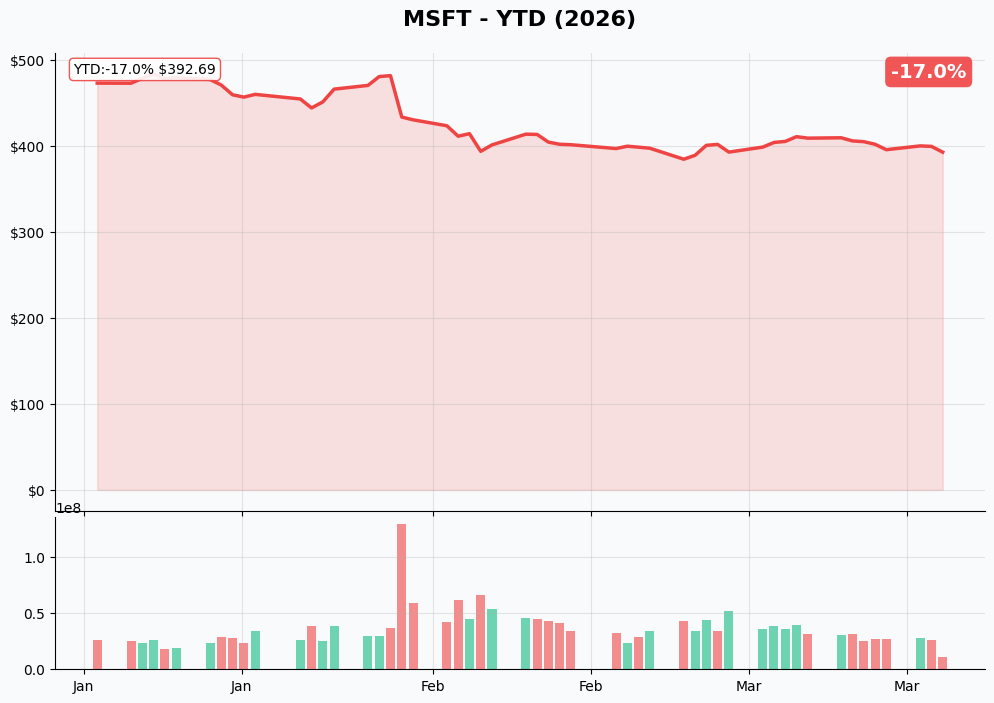
MSFT has been grinding lower since hitting its all-time high of $539.83 in October 2025. The stock is now at ~$395 - that's a 26% drawdown from the peak, a brutal correction for a $3 trillion company. The sell-off has been driven primarily by investor anxiety over record $37.5B quarterly capex and persistent Azure capacity constraints limiting near-term revenue upside despite massive demand.
Key observations:
- 📉 26% correction from ATH: From $539 to $395 is significant damage for a mega-cap with $625B backlog
- 🎢 Elevated but improving volatility: Stock down 26% but Azure growth still 39% - the selloff is multiple compression, not fundamentals deterioration
- 📊 52-week range context: $344.79 - $555.45 - we're in the lower-middle portion of the yearly range
- 👀 Analyst upgrades not moving it: Average price target ~$600, stock still at $395 - the market simply doesn't believe the bull case yet
- ⚠️ Overhead supply massive: Everyone who bought between $450-$540 is underwater, creating significant supply on any bounce attempt
Gamma-Based Support & Resistance Analysis
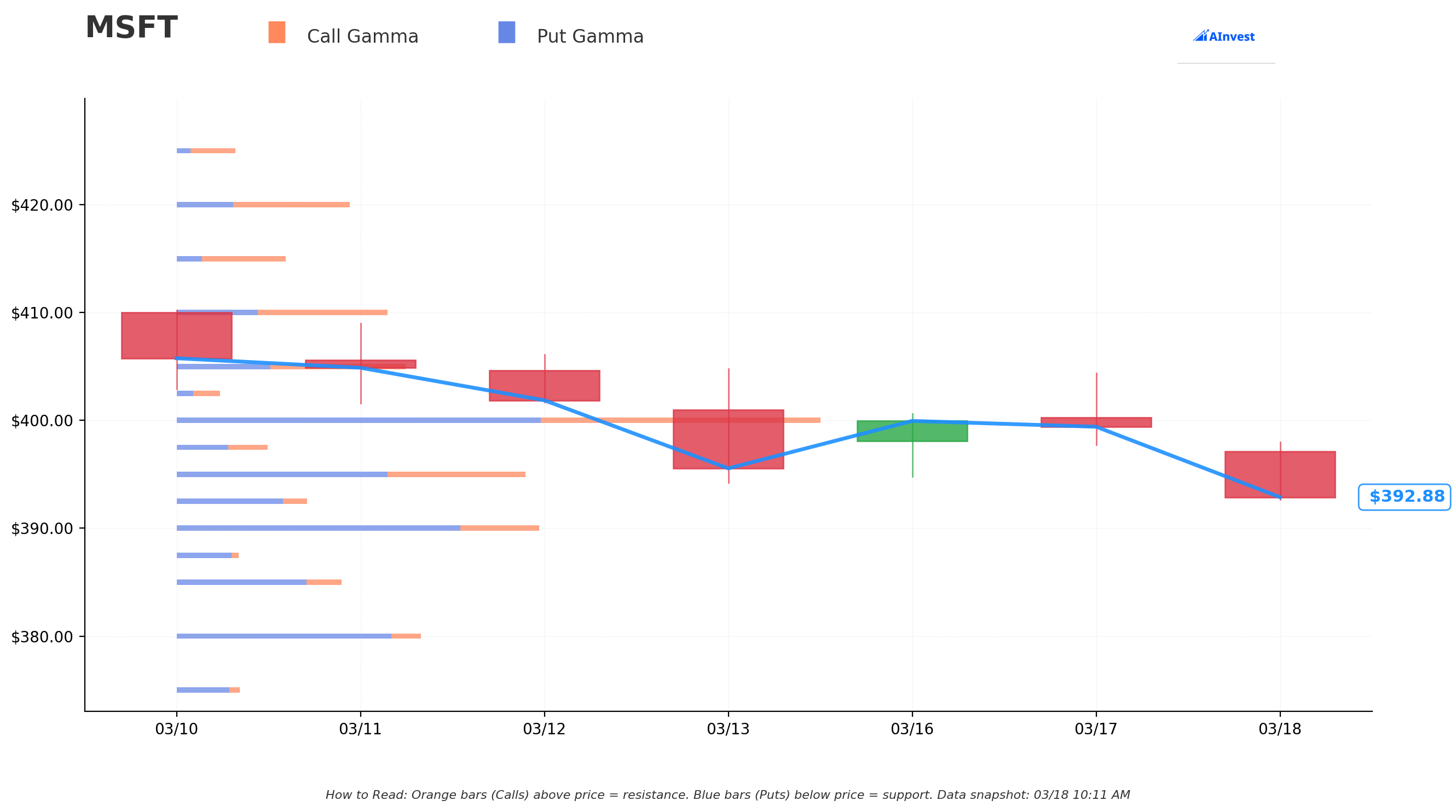
Current Price: ~$392-395
MSFT's gamma map is dense with important levels clustered right around current price:
🔵 Support Levels (Put Gamma Below Price):
- $392.50 - Immediate support at 16.7B total gamma (13.5B put / 3.1B call) - stock is trading RIGHT ON TOP of this level. Net GEX of -10.4B means dealers are long delta here from put hedges, which creates natural buying on any dip to this level
- $390 - Strong secondary support at 46.4B total gamma (36.3B put / 10.1B call) - this is the BIGGEST nearby support level. Net GEX of -26.2B is massive. Dealers with huge long delta exposures at $390 will mechanically buy this stock if it touches there. This is the line
- $385 - Next floor at 21.1B total gamma (16.6B put / 4.5B call) - net GEX -12.1B, still heavily put-dominated
- $380 - Deeper support at 31.3B total gamma (27.5B put / 3.8B call) - net GEX of -23.7B. If $390 fails, this is the next bounce zone
🟠 Resistance Levels (Call Gamma Above Price):
- $395 - IMMEDIATE ceiling at 44.7B total gamma (27.0B put / 17.7B call) - only 0.6% above current price. Net GEX of -9.3B (still put-dominated) but this is the strongest total gamma level overhead and will create dealer selling pressure on any bounce
- $400 - Major resistance at 82.6B total gamma (46.8B put / 35.8B call) - this is the SINGLE LARGEST gamma level on the board at 82.6B. The round number $400 has magnetic and mechanical significance. Getting through $400 will take sustained buying pressure
- $405 - Secondary resistance at 29.5B gamma (net bullish 5.1B) - once above $400, dealers start getting short delta from calls, which flips the dynamic to natural selling slowing but call buying can accelerate
- $410 - Next resistance zone at 27.1B gamma (net bullish 6.2B)
- $420 - Bigger target at 22.2B gamma (net bullish 7.7B) - above $420 the gamma structure becomes meaningfully net bullish
- $450 - Critical LEAP-level resistance at 16.7B gamma (net bullish 6.6B) - meaningfully below the $460 strike these calls were sold at
Overall GEX Bias: Bearish (313.5B put gamma vs 311.5B call gamma - nearly balanced but slightly bearish). This is notable: MSFT has roughly EQUAL call and put gamma across the board. The near-term bearish bias reflects current positioning, but the stock isn't as structurally oversold as it might appear.
Translation for regular folks: MSFT is pinned between $392.50 support (where dealers start buying) and $395-$400 resistance (where dealers start selling). The $400 level is a WALL - 82.6B gamma is enormous. The institution selling the $460 calls is doing so knowing that $460 requires a 16% rally AND breaking through multiple major gamma resistance levels at $395, $400, $405, $410, $420, and $450. That's why they're comfortable selling those calls - the market structure makes $460 a difficult target in the near term.
Implied Move Analysis
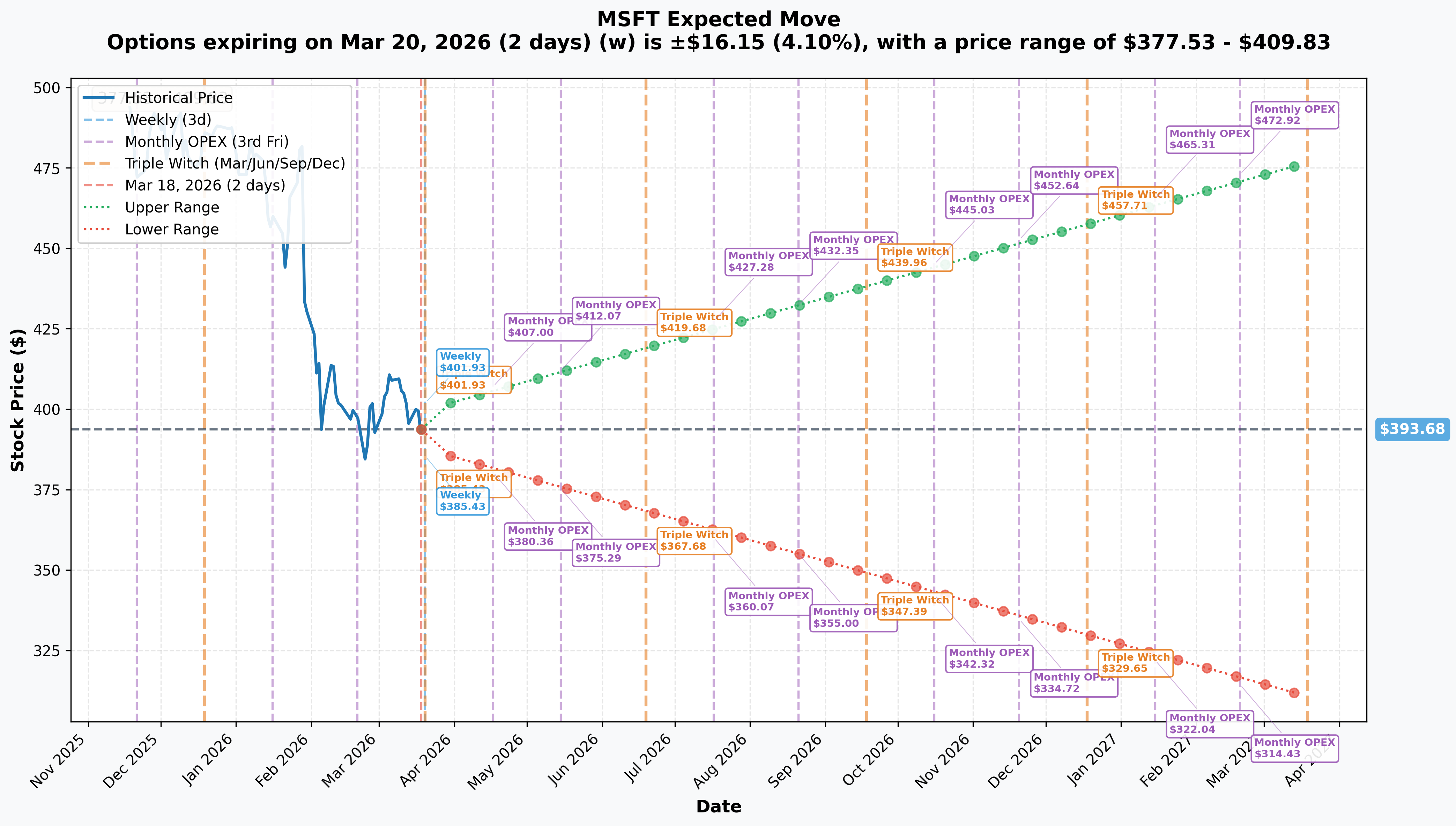
Options market pricing for upcoming expirations (as of March 18, 2026):
- 📅 Weekly (March 20 - 2 DAYS): ±$16.15 (±4.1%) → Range: $377.53 - $409.83
- 📅 Monthly OPEX (March 20 - same): ±$6.18 (±1.57%) → Range: $387.50 - $399.86
- 📅 Quarterly Triple Witch (March 20 - same): ±$6.14 (±1.56%) → Range: $387.54 - $399.82
- 📅 LEAP (March 19, 2027 - 366 DAYS - THIS TRADE!): ±$83.04 (±21.09%) → Range: $310.63 - $476.72
The critical data point for this trade: The 1-year implied move is ±$83.04 (±21.09%). The UPPER range of the 1-year implied move is $476.72. The $460 strike these calls were sold at sits INSIDE the upper implied move range - which means the market actually gives this a non-trivial probability of being breached over 12 months. This is not a "no chance" strike. The seller is collecting $28.51 knowing that the market prices the $460 strike as reachable.
The upside breakeven for the seller at expiry is $460 + $28.51 = $488.51. Below $488.51 at March 19, 2027 expiry, this trade is profitable for the call seller. The 1-year implied move upper bound is $476.72, which is below the seller's breakeven of $488.51. On a statistical basis, the options seller has the better side of this trade.
FOMC timing context: The weekly range of ±$16.15 (±4.1%) is notably wider than the quarterly range of ±$6.14. This anomaly reflects TODAY'S FOMC risk - the weekly options are pricing in the potential for a large Fed-driven move this week. The Fed is expected to hold rates, but the dot plot and Powell commentary could move markets significantly.
🎪 Catalysts
🔥 Active Catalysts (Happening NOW)
FOMC Decision - March 18, 2026 (TODAY) 📊
The Fed is expected to hold rates at 3.50%-3.75% with the key focus on the quarterly dot plot and Powell's commentary. For MSFT specifically:
- High capex = high sensitivity to discount rate changes. At $37.5B/quarter in capex, every 25bps in rate change meaningfully impacts the NPV of Microsoft's long-duration AI infrastructure investments
- Azure's $625B commercial backlog sounds great until you discount it at elevated rates - that's where the valuation pain comes from
- A dovish surprise (fewer hikes expected, earlier cuts) could trigger a sharp MSFT relief rally toward $410-420
Copilot Cowork General Availability - Late March 2026 🤝
Microsoft launched Copilot Cowork on March 9 - an enterprise AI agent built on Anthropic's Claude, integrated into Microsoft 365. General availability is expected in late March 2026. This matters because:
- New Microsoft 365 E7 licensing tier attached - potential ARPU uplift on 300M+ commercial seats
- Signals Microsoft is diversifying beyond OpenAI while keeping both relationships
- Early adoption metrics will telegraph whether enterprises will pay for the next tier of AI productivity tools
📅 Upcoming Catalysts (Next 12 Months - The LEAP Trade Window)
Q3 FY2026 Earnings (~April 28-29, 2026) 📊
This is the next confirmed major catalyst. Investors will be watching:
- Azure growth acceleration: Did 39% hold, or is there deceleration? Any sequential improvement would be huge for the stock
- Copilot seat growth and monetization: 15M paid seats growing 160% YoY - the monetization machine is turning on, but 35.8% workplace conversion rate vs 83.1% for ChatGPT shows huge headroom (and risk)
- Capex cadence: Did Q3 capex slow from $37.5B, or is the spending accelerating? Any reduction in capex guidance would be a major stock catalyst
- Azure capacity updates: CEO Nadella said power constraints (not GPUs) are the bottleneck. Any announcement of new power agreements, data center completions, or capacity additions would unlock trapped Azure demand
Azure Capacity Expansion Throughout 2026 🏗️
Microsoft plans to increase AI capacity by 80%+ in FY2026 and nearly double its data center footprint over two years. The dark irony: Azure literally has GPUs sitting idle in warehouses because there isn't enough power to run them. Once power comes online, trapped Azure demand converts to revenue. This is the single biggest catalyst for the stock getting back toward $460+.
Build 2026 Developer Conference (~May) 🛠️
Microsoft typically hosts its annual developer conference in May. New Azure AI services, Copilot platform capabilities, and developer tooling announcements have historically moved the stock. This sits squarely within the 366-day window before the $460 calls expire.
OpenAI Partnership Developments 🤖
OpenAI reaffirmed the exclusive Azure API relationship on February 27 and committed to $250B in incremental Azure purchases. The commercial backlog is 45% tied to OpenAI. Any major OpenAI product launch (GPT-5, Sora expansion, reasoning model advances) that drives GPU compute demand flows directly into Azure revenue.
AI Revenue Milestones - $25B Target for FY2026 💰
AI business annualized revenue exceeded $13B as of Q2 FY2025. Analysts project $25B in FY2026 and $40-50B by FY2027. Hitting the $25B milestone with strong FY2026 results would be a meaningful sentiment shift and could catalyze a move toward $420-450.
✅ Past Catalysts (Already Happened)
- Q2 FY2026 Earnings (January 28): Revenue $81.3B (+17% YoY), Azure +39%, Cloud crossed $50B. BUT record $37.5B capex spooked investors and stock dropped post-earnings
- Anthropic Investment (~November 2025): Microsoft invested ~$15B in Anthropic alongside Nvidia, building AI multi-provider strategy
- Commercial Backlog Hits $625B: A 110% surge in RPO signals extraordinary enterprise AI demand, though the market isn't rewarding this yet due to capacity constraint concerns
- Copilot reaches 15M paid seats: 160% YoY growth - monetization engine is clearly starting to fire
🎲 Price Targets & Probabilities
Using gamma levels, implied move data, and the catalyst roadmap over the next 12 months (the LEAP trade window):
📈 Bull Case (30% probability) - The $460 Strike Gets Threatened
Target: $450-$480 by March 2027
How we get there:
- 💪 Q3 earnings (April 28-29) show Azure reacceleration to 40%+ and capex moderation - stock gaps to $430-440
- 🏗️ Azure capacity constraints ease by H2 2026 as new data centers come online - trapped demand converts, revenue guidance raised
- 🤖 OpenAI GPT-5 or major new model drives compute demand surge, Azure utilization spikes
- 🚀 Copilot conversion rate improves from 35.8% toward 50%+ - monetization ramp accelerates
- 💰 AI revenue hits $25B FY2026 target early, analysts raise FY2027 estimates toward $50B
- 📊 Build 2026 developer announcements showcase transformative new Azure AI capabilities
- 📈 Technical breakout above $400 (82.6B gamma wall) with volume triggers a ramp through $420, $450, then challenges the $460 strike
For the call seller: If MSFT approaches $460, they face assignment risk but still profited on the stock position (held from lower basis). The $28.51 premium collected buys significant buffer.
🎯 Base Case (45% probability) - Premium Collector's Dream
Target: $380-$440 range (SLOW RECOVERY)
Most likely scenario:
- ✅ FOMC holds rates, neutral commentary - market exhales, MSFT grinds slowly higher
- 📊 Q3 earnings in-line - Azure 37-39%, capex stable at $35-38B, Copilot growing but conversion rates stay low
- 🔄 Stock slowly climbs toward $410-420 through summer as capacity constraints ease incrementally
- 💤 No dramatic acceleration in AI monetization but steady progress - stock re-rates to 25-28x earnings
- 📅 Copilot Cowork GA in late March gets decent enterprise uptake but no transformative numbers
- 🎯 By March 2027 expiry, stock trades somewhere in the $400-450 range
For the call seller: The $460 calls expire worthless or with minimal value. They keep the full $20M premium. Scenario where they "win" most cleanly. The stock recovery gives them equity appreciation too - double win.
Why 45% probability: MSFT has massive fundamental tailwinds ($625B backlog, Azure leadership, 90% Fortune 500 Copilot adoption) but near-term constraints limit upside velocity. This gradual recovery path is the most realistic given the overhang.
📉 Bear Case (25% probability) - No Recovery, Premium Partially Offsets Losses
Target: $320-$370
What could go wrong:
- 😰 FOMC surprise - hawkish dot plot showing fewer 2026 rate cuts drives discount rate fears back
- ⚠️ Q3 earnings disappoint - Azure decelerates below 35%, capex stays at $37.5B or increases, Copilot conversion rates stall
- 🏗️ Azure capacity constraints don't ease as expected - power grid delays push data center timelines into 2027
- 💸 Broader tech selloff as recession fears return - enterprise IT spending cuts reduce Microsoft 365/Azure demand
- 🤖 OpenAI's for-profit transition creates partnership uncertainty - if OpenAI raises from other cloud providers at scale, Azure revenue share at risk
- 🎮 Gaming/Activision losses widen - still generating $440M operating losses despite $2B revenue
- 📊 Breakdown below $390 gamma support ($46.4B put gamma) and $380 ($31.3B put gamma) triggers technical selling cascade
Critical support levels:
- 🛡️ $392.50: Immediate support with 16.7B gamma - holding this is critical for near-term stability
- 🛡️ $390: Major floor at 46.4B gamma (strongest nearby put support) - this is THE line
- 🛡️ $385: Secondary support at 21.1B gamma
- 🛡️ $380: Deeper support at 31.3B gamma - if this breaks, $360 then $344 (52-week low) come into play
For the call seller in the bear case: The $20M premium collected partially offsets stock losses. The $28.51 collected = $28.51 in reduced cost basis per share. On 700,000 shares, that's $20M in protection against the drawdown. They don't profit, but they're better off than if they'd just held naked stock.
💡 Trading Ideas
🛡️ Conservative: "Copy the Covered Call Strategy"
Play: If you already own MSFT shares (or buy 100 shares first), sell the same type of trade this institution just did - but sized for your account
Structure: Own 100-500 MSFT shares, Sell $420 calls - December 2026 expiration (closer in, lower risk than the March 2027 LEAP)
Why this works:
- 💰 The $420 December strike is closer in and likely fetches $20-25 in premium (5-6% yield on the stock price)
- 📊 $420 sits above the $400 gamma wall and the $410 resistance - you're selling above meaningful technical resistance
- 🛡️ Premium collected reduces your cost basis and provides a cushion if the stock dips further
- 🎯 If the stock recovers to $420 by December, you're called away at a profit AND kept the premium - a win-win
- ⏰ 9 months to expiry gives MSFT time to work through its capex overhang narrative
Risk:
- ❗ If MSFT rips to $500+ on AI revenue surprises, you miss gains above $420. Only do this if you're happy selling at $420
- ❗ You still have full downside risk on the stock itself
Risk level: Low for existing holders (income strategy) | Skill level: Intermediate
⚖️ Balanced: "Bull Call Spread into Q3 Earnings"
Play: Bet on a recovery toward the $400-$410 gamma resistance zone into April earnings
Structure: Buy $395 calls, Sell $410 calls - April 17 expiration (captures Q3 earnings on April 28-29)
Why this works:
- 🎯 Defined risk spread - you know your max loss upfront
- 📊 The $395-$400-$410 zone is where the gamma structure lives. A move toward $400-$410 is achievable even in the base case scenario
- ⏰ April 17 expiry is just BEFORE earnings on April 28-29 - you're positioning for pre-earnings drift higher, not the binary earnings event itself
- 💰 With 31-32 analysts at Strong Buy consensus with average PT ~$600, institutional rebalancing into MSFT ahead of earnings is a tailwind
- 🏗️ Any positive Azure capacity news between now and April moves the stock
Estimated P&L:
- 💰 Estimated net debit: ~$5-7 per spread (post-FOMC IV settling)
- 📈 Max profit: ~$8-10 if MSFT above $410 at April 17 expiry
- 📉 Max loss: ~$5-7 (the debit - fully defined)
- 🎯 Breakeven: ~$400-402
Entry timing:
- ⏰ Enter AFTER FOMC resolution today or Thursday morning once markets stabilize
- 🎯 Best entry if stock pulls back toward $390 gamma support (better prices, defined risk the same)
Risk level: Moderate (defined risk, bullish directional) | Skill level: Intermediate
🚀 Aggressive: "Sell Put Spread for Income" (Premium Selling Play)
Play: Rather than buying the stock outright, sell put spreads to generate income from the elevated IV environment, betting MSFT holds the $390 gamma support level
Structure: Sell $390 puts, Buy $380 puts - April 17 expiration
Why this works:
- 💰 The $390 level has 46.4B gamma (MASSIVE) - this is the strongest support on the board. Selling puts at this level means you're selling where the structural bid is strongest
- 📊 Net GEX at $390 is -26.2B, meaning dealers are heavily long delta there and will buy aggressively. You're siding with the market structure
- 🎲 Defined risk spread with max loss capped at the $10 wide strike spread minus premium collected
- 🏦 FOMC hold expected today means acute macro risk may clear by end of day - IV could compress after the decision, making premiums expensive RIGHT NOW (sell high IV)
- 📉 Even in a moderate selloff, $390 likely holds due to gamma dynamics
Estimated P&L (approximate):
- 💰 Estimated net credit collected: ~$3-4 per spread
- 📈 Max profit: $3-4 if MSFT stays above $390 at April 17 expiry (keep all premium)
- 📉 Max loss: ~$6-7 if MSFT breaks below $380 (defined and limited)
- 🎯 Breakeven: ~$386-387
CRITICAL WARNING:
- ❗ If FOMC is hawkish surprise and MSFT breaks below $390, losses can mount quickly. The $380 long put is your parachute
- ❗ Don't sell more spreads than you can handle if all go against you at once
- ❗ This is NOT a "set it and forget it" trade - monitor FOMC today closely
Risk level: Moderate-High (selling premium with defined risk) | Skill level: Intermediate-Advanced
⚠️ Risk Factors
Here's what keeps bulls up at night:
-
💸 Record $37.5B quarterly capex with power constraints: Microsoft has AI GPUs sitting in warehouses because it doesn't have enough power to run them. This creates the worst combination - massive capital deployed with delayed revenue recognition. Until new data centers come online with full power, Azure's capacity ceiling caps revenue growth regardless of demand
-
📉 26% drawdown from ATH with no clear catalyst to reverse it: From $539 to $395 is serious technical damage. Every investor who bought above $430 is underwater and represents supply on any bounce. The stock needs a fundamental rerating catalyst - likely Q3 earnings (April 28-29) showing Azure reacceleration and capex stabilization - before sustainable recovery can happen
-
🤖 Copilot conversion rate of 35.8% vs ChatGPT's 83.1%: 90% of Fortune 500 companies are "using" Copilot but only 35.8% are converting to paid, scaled deployments. This is the enterprise AI ROI problem in a single statistic. Until Microsoft can show enterprises are getting enough value from Copilot to justify scaling from pilots to enterprise-wide deployments, the monetization thesis remains unproven
-
⚡ Azure capacity constraints extend through end of FY2026: CEO Nadella said this explicitly. Even with $37.5B/quarter in capex and 80% planned AI capacity growth, power constraints mean new capacity can't be unlocked as fast as capital is deployed. This limits Azure revenue upside for multiple quarters even as demand vastly exceeds supply
-
🎮 Gaming still bleeding: Activision generating $440M in operating losses despite $2B in revenue. The $68.7B acquisition is not yet generating the expected synergies. Gaming segment revenue declined 3% in Q2. Hardware weakness persists. This drag won't disappear quickly
-
🔗 OpenAI dependency risk: Despite the Anthropic investment and Copilot Cowork launch, OpenAI still represents 45% of the $625B commercial backlog. OpenAI's for-profit transition and fundraising rounds from other cloud providers introduce long-term partnership uncertainty. If OpenAI scales its compute elsewhere, Microsoft's backlog shrinks
-
📊 Net GEX bearish, $400 = massive wall: The 82.6B gamma level at $400 is the single largest concentration on the board. This creates mechanical overhead resistance that is very difficult to break without sustained institutional buying. Don't underestimate how hard $400 is to crack when options market-makers are continuously delta-hedging against it
-
🌍 FOMC today is the wildcard: A hawkish Fed surprise (more hawkish dot plot, Powell signals inflation resurgence from energy) could push all mega-cap growth stocks sharply lower. MSFT at $395 with a hawkish FOMC could test the $390 gamma floor before the day is done. This risk is real and happening right now as you read this
🎯 The Bottom Line
Here's the deal: An institution just collected $20 million in cold hard cash to sell 7,000 calls 16.4% above current price with a year to expiry. This is one of the cleanest premium-selling trades you'll see - a large MSFT stock holder deciding that $28.51/share in income (7.2% annualized yield) beats hoping for a $65 rally in 12 months.
What this trade tells us:
- 🎯 The seller expects MSFT to stay below $460 through March 2027 - they think the recovery is real but slow
- 💰 At $395 spot, they need a 16.4% rally just to break even on the short calls - that's significant distance to travel in a stock with $400 gamma ceiling and 26% in prior losses to recover
- ⚖️ The 1-year implied move upper bound is $476 - the seller structured INSIDE the statistical range but above the most likely scenario. They're collecting premium while acknowledging $460 is theoretically reachable
- 📊 Volume exceeding open interest (7,000 vs 3,800 existing OI) confirms this is entirely new positioning - this institution just decided TODAY to write this trade. The FOMC catalyst timing is not coincidental
If you own MSFT:
- ✅ Consider the covered call strategy - sell monthly or quarterly calls at $420-$450 to collect income while you wait for the fundamentals to reassert themselves
- 📊 The $390 gamma floor ($46.4B) is your near-term stress test. If that holds, stock is stable. If it breaks with volume, take some risk off until Q3 earnings provide clarity
- 📅 April 28-29 - Q3 FY2026 earnings - is the moment of truth on Azure reacceleration and capex moderation
If you're watching from the sidelines:
- ⏰ Let FOMC resolve TODAY and Triple Witch pass Friday before adding new positions
- 🎯 The $390 gamma support (46.4B put gamma) is a potential excellent entry zone if MSFT touches it post-FOMC
- 📈 Analyst consensus of ~$600 price target implies 50%+ upside from current levels - the long-term bull case is extremely strong with $625B backlog
- 🚀 Q3 earnings in April: Azure reacceleration story + capex moderation guidance = catalyst for run toward $420-450
If you're bearish:
- 📊 The $400 gamma wall is your friend - selling call spreads above $400 (like the institution just did above $460) is a reasonable premium income strategy
- 🎯 First put targets on breakdown: $392.50 → $390 → $385 → $380. The $390 level with 46.4B gamma is a fortress, but break there and you cascade quickly
- 📉 Post-FOMC put spreads ($390/$380) offer defined-risk downside plays if the Fed surprises hawkish
Mark your calendar - Key dates:
- 📅 March 18 (TODAY) - FOMC rate decision and Powell press conference (market-moving event)
- 📅 March 20 - Triple Witch quarterly OPEX (high volume, high volatility day)
- 📅 Late March 2026 - Copilot Cowork general availability rollout
- 📅 ~April 28-29, 2026 - Q3 FY2026 earnings (THE catalyst for direction)
- 📅 ~May 2026 - Build 2026 developer conference
- 📅 March 19, 2027 - LEAP expiration date for this $20M short call trade
Final verdict: Microsoft's fundamentals remain extraordinary - $625B commercial backlog, Azure growing 39%, 15M Copilot seats up 160% YoY, and now a Copilot Cowork product powered by Anthropic expanding the enterprise AI agent opportunity. But the market is in "show me" mode after the $37.5B quarterly capex shock. The institution that just sold $20M in covered calls isn't betting MSFT fails - they're betting the recovery is measured, not meteoric. Get paid $20M to wait. That's not a bad plan.
Disclaimer: Options trading involves substantial risk of loss and is not suitable for all investors. This analysis is for educational purposes only and does not constitute financial advice. Covered call writing involves specific risks including opportunity cost if the underlying stock rallies substantially above the short strike, and full downside exposure on the underlying stock position. The $20M trade discussed represents one institution's risk management strategy, which may require a large underlying stock position to execute and is not directly replicable by most retail traders. LEAP options have specific dynamics around time decay and volatility exposure that differ from shorter-dated contracts. Always conduct your own due diligence and consider consulting a licensed financial advisor before trading.
About Microsoft Corporation: Microsoft develops, licenses, and supports software, services, devices, and solutions worldwide with a market cap of $2.97 trillion in the Prepackaged Software industry. Its core businesses include the Azure cloud platform, Microsoft 365 productivity suite, Windows operating system, gaming through Xbox and Activision Blizzard, and the transformative Copilot AI platform built in partnership with OpenAI and Anthropic.