🔍 PLTR Unusual Options Activity Report -- 2026-03-09
$28 Million Calendar Spread Signals Sophisticated Institutional Bet on Palantir Volatility
📌 Company Overview
Palantir Technologies Inc. (NASDAQ: PLTR)
| Detail | Value |
|---|---|
| Sector | Services -- Prepackaged Software |
| Market Cap | $375.9 Billion |
| Current Price | ~$153.11 |
| 52-Week Range | $66.12 -- $207.52 |
| Forward P/E | ~116x |
Palantir is the AI and data analytics powerhouse that has become the backbone of both U.S. government intelligence operations and a rapidly expanding commercial enterprise AI platform. The company's Artificial Intelligence Platform (AIP) and its signature "Bootcamp" go-to-market strategy have driven Q4 2025 revenue up 70% year-over-year to $1.41 billion, with U.S. commercial revenue surging 137%. They recently issued FY 2026 guidance of $7.18--$7.20 billion -- crushing consensus estimates by nearly $1 billion.
With a $10 billion U.S. Army enterprise agreement, NATO Maven deployment, UK MoD contracts, and a deepening role alongside DOGE in modernizing federal technology infrastructure, Palantir sits at the intersection of every major government and enterprise AI spending trend.
🚨 The Unusual Options Activity
Here is what lit up the tape today. Two massive, coordinated trades that together constitute a $28 million calendar call spread -- one of the most sophisticated institutional strategies you will see in a single-name equity.
Trade Table
| Time (ET) | Symbol | Buy/Sell | Call/Put | Expiration | Strike | Volume | Premium | Order Type | Strategy | Z-Score |
|---|---|---|---|---|---|---|---|---|---|---|
| 12:02:08 | PLTR | BUY | CALL | 2026-04-17 | $150 | 13,000 | $17M | BTO | Long Call | 13.58 |
| 12:02:08 | PLTR | SELL | CALL | 2026-03-20 | $150 | 14,000 | $11M | STO | Short Call | 6.19 |
Total Premium: $28M across 2 trades Unusualness Rating: 🔴 EXTREMELY UNUSUAL (Z-Scores of 13.58 and 6.19)
Let those Z-Scores sink in. A Z-Score of 13.58 means this trade is over 13 standard deviations above the average -- that is not just unusual, that is statistically extraordinary. Both legs executed at the exact same timestamp (12:02:08 ET), confirming this was a single, coordinated institutional order.
🧩 Strategy Breakdown: Calendar Call Spread
This is a calendar call spread (also called a horizontal spread or time spread):
- Sell the March 20 $150 Call (near-term, 11 days to expiration) -- collecting $11M
- Buy the April 17 $150 Call (longer-term, 39 days to expiration) -- paying $17M
- Net Debit Paid: $6M ($17M - $11M)
- Same Strike ($150), Different Expirations = Calendar Spread
Why This Trade Makes Sense
With PLTR trading at ~$153.11, both legs are slightly in-the-money. Here is the institutional logic:
-
Time Decay Arbitrage: The short March 20 leg decays faster than the long April 17 leg. Every day that passes with PLTR staying near $150, the spread widens in the trader's favor. The short leg has only 11 days of theta to give; the long leg has 39 days of cushion.
-
Volatility Play: Calendar spreads are long vega -- they profit when implied volatility increases on the back month relative to the front month. This trader is positioning for either (a) a vol compression into March OPEX followed by a vol expansion into April, or (b) simply harvesting the steeper theta decay in the front month.
-
Pinning at $150: The ideal scenario is PLTR pins near $150 at March 20 expiration. The short call expires near worthless (or is easily managed), and the trader is left holding the April $150 call for just the $6M net debit -- an April call that could be worth substantially more if PLTR rallies heading into Q1 earnings.
-
Earnings Positioning: Q1 2026 earnings are expected early May 2026. The April 17 expiration captures the volatility ramp leading up to that event. After the short leg expires, this trader could hold the April call into the earnings vol bid-up and sell it at an inflated premium.
Max Profit / Max Loss
- Max Profit: Achieved if PLTR closes exactly at $150 on March 20 expiration, maximizing the front-month decay while preserving maximum value in the April leg
- Max Loss: Limited to the $6M net debit paid (if PLTR moves dramatically in either direction, both legs move together and the spread collapses)
- Breakeven: Complex and dependent on IV levels, but roughly bounded by the implied move range around $150
📊 View Apr 17 $150 Call chart | View Mar 20 $150 Call chart
📈 Technical Analysis
YTD Price Action
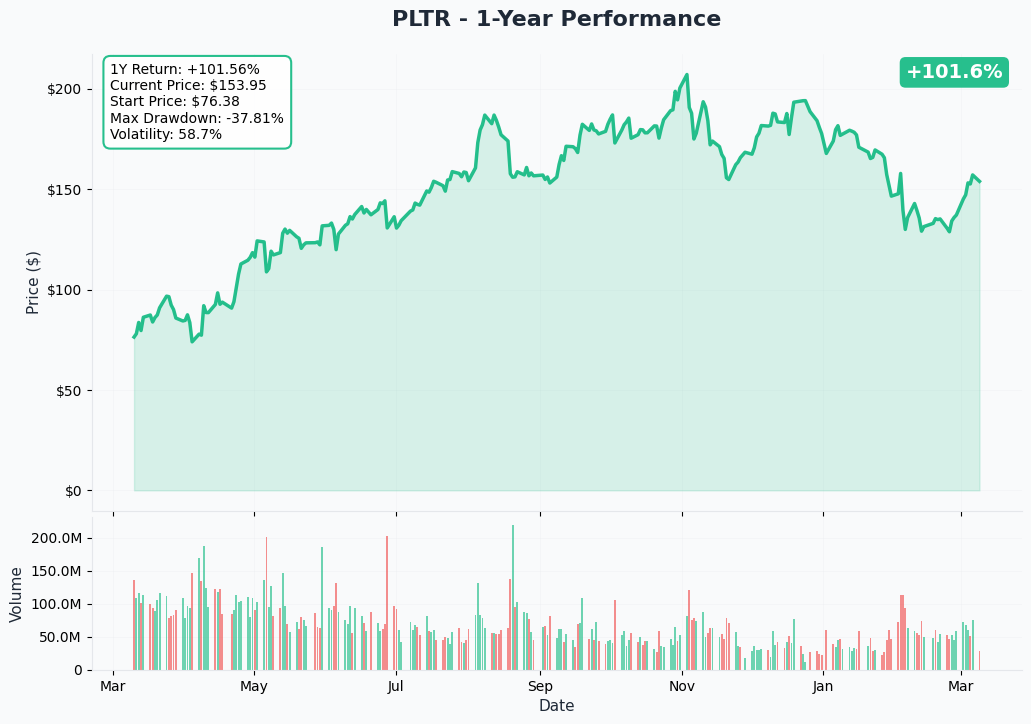
PLTR has had a turbulent 2026 so far. After closing 2025 near $178, the stock has pulled back roughly 12% year-to-date. The decline from the all-time high of $207.52 in November 2025 has been even steeper -- approximately 24%. Key drivers of the pullback include:
- A 10.5% single-day plunge on January 27 on DOGE-driven Pentagon budget cut fears
- Michael Burry's bearish head-and-shoulders chart post on February 10, targeting $46
- Persistent insider selling ($137 million in February 2026 alone)
- Broader tech sector rotation out of high-multiple AI names
Despite the pullback, PLTR has found support in the $150 area -- notably the exact strike selected for today's calendar spread.
Gamma Exposure & Key Levels
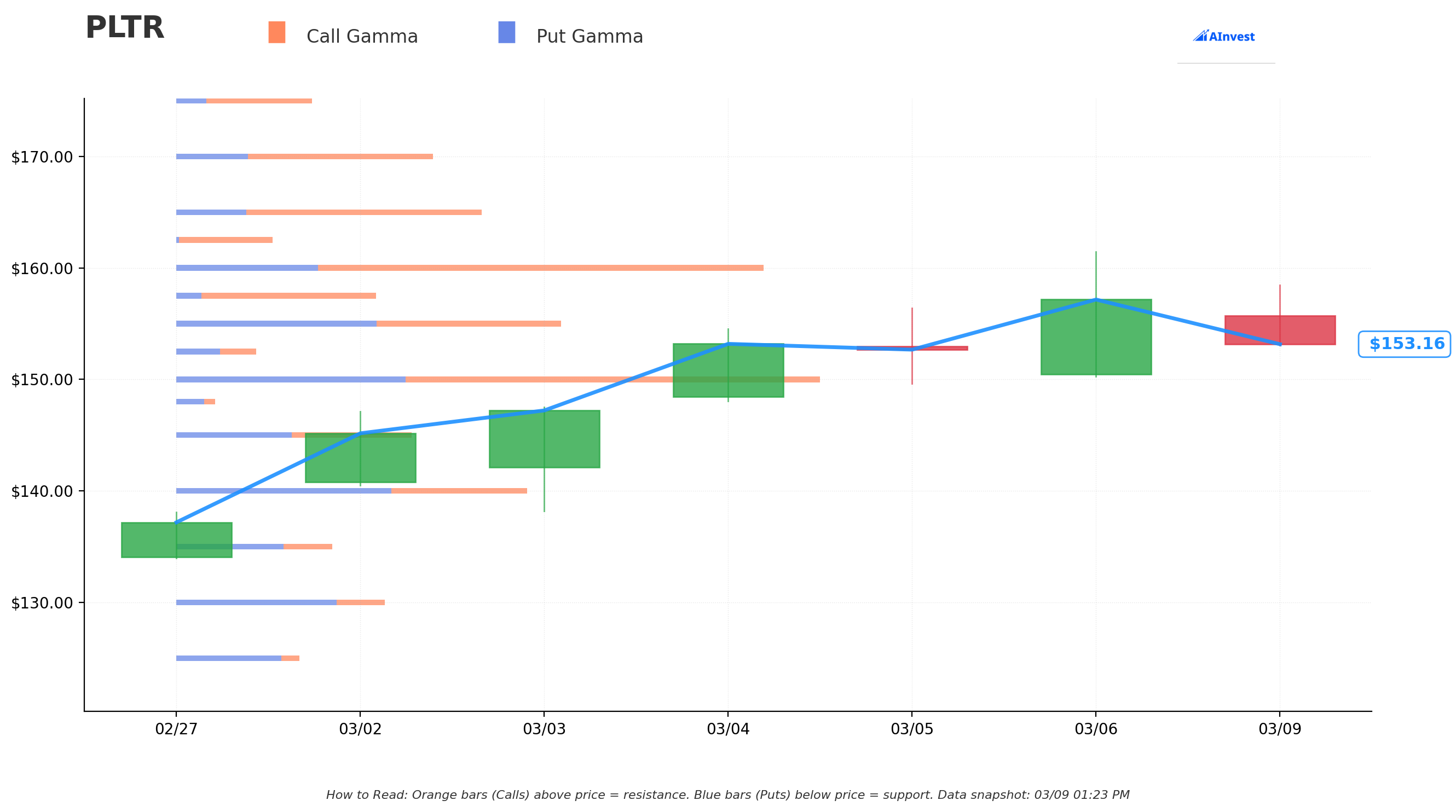
The gamma profile tells a compelling story that supports the calendar spread thesis:
| Level | Type | GEX Value |
|---|---|---|
| $150 | 🟢 Major Support | 40.2B GEX |
| $145 | 🟢 Support | 14.7B GEX |
| $140 | 🟢 Support | 21.9B GEX |
| $155 | 🔴 Resistance | Strongest ceiling |
Net GEX Bias: Bullish
The $150 level stands out with 40.2 billion in gamma exposure -- by far the densest level on the board. This creates a powerful "gamma magnet" effect: as market makers hedge their positions around this level, they tend to suppress volatility and pull the stock price toward $150. This is exactly the dynamic that makes a calendar spread at the $150 strike so attractive. Dealer hedging flows naturally support the pin scenario that maximizes calendar spread profitability.
The $155 resistance overhead means any rally likely stalls in the near term, while the stacked support at $150/$145/$140 creates a floor. This range-bound setup is textbook calendar spread territory.
Implied Move Analysis
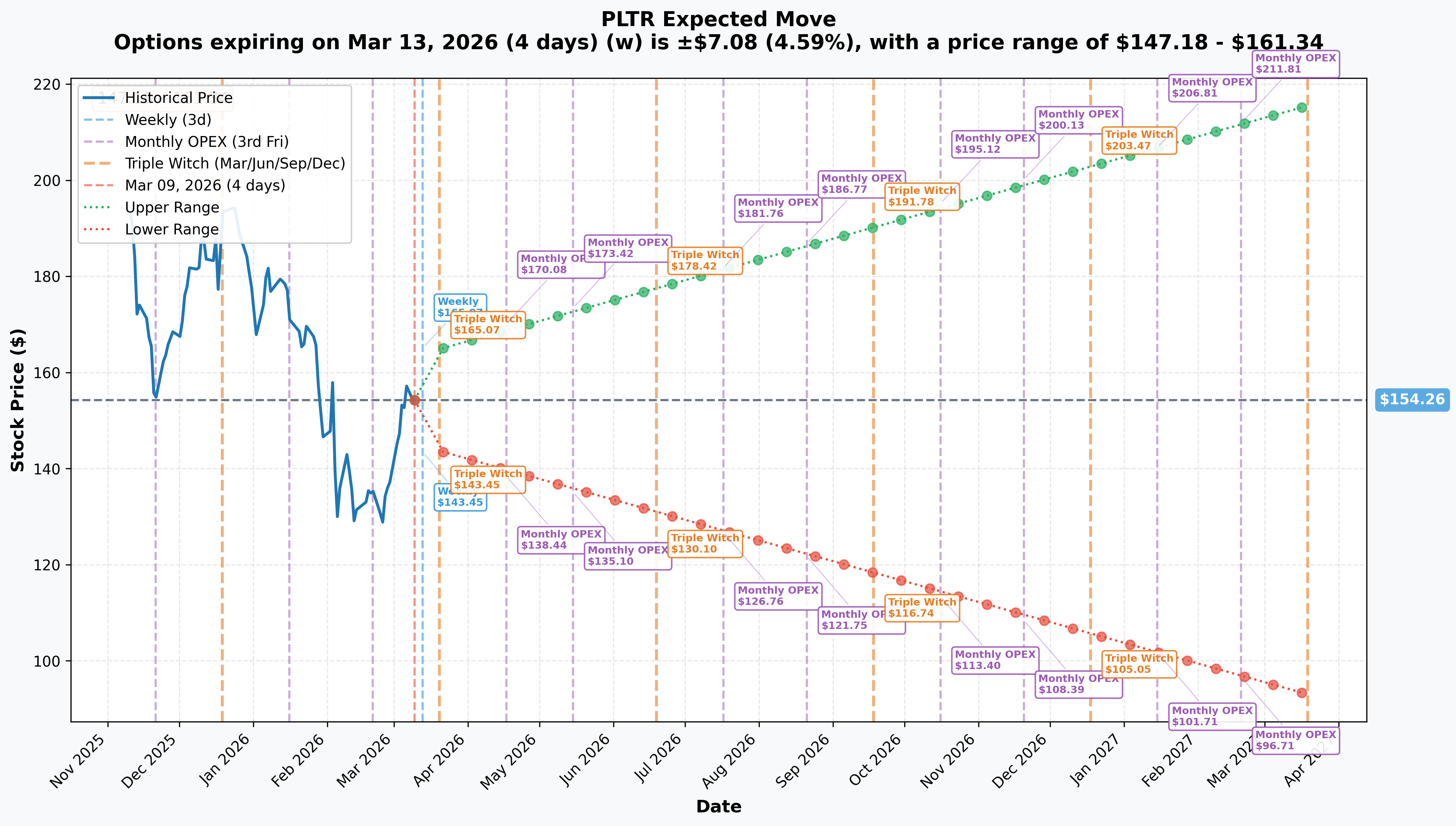
| Timeframe | Implied Move | Dollar Range | Price Range |
|---|---|---|---|
| Weekly (Mar 13) | ±4.59% | ±$7.08 | $147.18 -- $161.34 |
| Monthly OPEX (Mar 20) | ±6.92% | ±$10.67 | $143.59 -- $164.93 |
The March 20 implied move of ±6.92% is notable because it encompasses the $150 strike. The lower bound of $143.59 sits below the calendar spread's optimal zone, but the probability distribution is centered on the current price -- meaning the market-implied most-likely scenario has PLTR trading near $150--$155 at March expiration, which is ideal for this trade.
🔥 Catalyst Landscape
1. DOGE: Double-Edged Sword 🏛️
Palantir is directly embedded in the Department of Government Efficiency initiative, building a "mega API" for IRS records and positioning as the go-to vendor for federal technology modernization. CTO Shyam Sankar has stated that DOGE will bring "meritocracy and transparency" to government operations.
However, DOGE cuts to defense budgets have already caused significant pain. The stock slid 25% from its ATH between November 2025 and January 2026 on Pentagon "chainsaw" fears, and ~54% of Palantir's revenue comes from government contracts. The net impact remains uncertain: modernization tailwind vs. budget headwind.
For the calendar spread: DOGE uncertainty actually helps this trade. Elevated uncertainty keeps IV elevated in the back month (April) while the near-term leg benefits from theta decay as no major DOGE announcements are imminent before March 20.
2. Valuation: The 116x Elephant in the Room 💰
There is no way around it -- Palantir trades at approximately 116x forward earnings and ~70x forward sales. That is 549% above the software industry median P/E of 17.92x. Even bulls who love the growth story have to acknowledge that this is priced for perfection.
GuruFocus values PLTR at $58.14, rating it "Significantly Overvalued." On the other end, Citi maintains a Strong Buy with a $260 target. The analyst consensus average sits at $187.96 across 28 analysts.
For the calendar spread: The extreme valuation creates two-way risk that actually favors range-bound trading near term -- neither aggressive dip-buying nor further liquidation is likely without a new catalyst.
3. Q1 2026 Earnings (Early May) 📊
The next major catalyst is Q1 2026 earnings, expected around May 4--11, 2026. Company guidance has already set the bar at $1.53--$1.54 billion in revenue, well above the prior consensus of $1.33 billion.
Key metrics to watch: U.S. commercial revenue trajectory (can 137% sustain?), customer count beyond 954, net dollar retention above 139%, and AIP Bootcamp conversion rates.
For the calendar spread: This is the hidden genius of the trade. The April 17 expiration captures the beginning of the earnings vol ramp-up. After the March leg expires, the remaining April call benefits from increasing IV as earnings approach.
4. Government Contract Pipeline 🛡️
The contract pipeline remains robust:
- $10 billion U.S. Army Enterprise Agreement consolidating 75 contracts
- Maven Smart System expanded to nearly $1.3 billion through 2029
- UK MoD GBP 240.6 million (~$305M) three-year contract
- Warp Speed for Warships launched with the U.S. Navy
- NATO Maven Smart System deployment for alliance military planning
European defense spending is trending toward 2%+ of GDP, opening a significant new addressable market for Palantir's Gotham and Maven platforms.
5. Insider Selling 🚨
CEO Alex Karp has sold $2.2 billion in PLTR stock over three years, including $65.9 million in February 2026 alone. Multiple insiders executed 25 transactions totaling ~$137 million in February. While 10b5-1 plan selling is standard practice, the sheer magnitude creates persistent selling pressure and negative optics.
🎯 Analyst Price Targets
| Firm | Rating | Price Target | Implied Move |
|---|---|---|---|
| Citi | Strong Buy | $260 | +69.8% |
| Mizuho | Outperform | $195 | +27.4% |
| UBS | Buy (Upgraded Feb 26) | $180 | +17.6% |
| Daiwa | Buy (Upgraded Feb 10) | $180 | +17.6% |
| William Blair | Outperform | N/A | -- |
| Consensus (28 analysts) | Moderate Buy | $187.96 | +22.7% |
| Lowest (Bear Case) | -- | $45 | -70.6% |
Sources: MarketBeat, Benzinga, 24/7 Wall St.
💡 Trading Ideas
Idea 1: Follow the Institutional Flow -- Calendar Call Spread
Mirror the institutional trade at a smaller scale.
- Sell 1x PLTR Mar 20 $150 Call
- Buy 1x PLTR Apr 17 $150 Call
- Net Debit: ~$460 per spread (based on proportional scaling of $6M across ~13,000 contracts)
- Max Risk: Limited to net debit paid
- Target: Close the spread for $700--$900 if PLTR pins near $150 at March OPEX
- Exit: Close if PLTR moves below $143 or above $162 (outside the profitable zone)
Who it is for: Intermediate to advanced options traders comfortable with multi-leg strategies and managing expiration dynamics.
Idea 2: Bullish Pullback Play -- April Call
If you are simply bullish on PLTR heading into earnings season but want to buy time:
- Buy PLTR Apr 17 $160 Call
- Rationale: The $150 gamma wall provides downside support, Q1 earnings vol ramp starts in April, and analyst consensus implies $188 (23% upside)
- Risk: Total premium paid; set a stop at 50% premium loss
- Target: Sell into the earnings IV ramp-up in late April for 50--100% premium gain
Idea 3: Hedge the Valuation Risk -- Put Spread
For those who own PLTR shares and want downside protection through the DOGE uncertainty:
- Buy PLTR Apr 17 $145 Put
- Sell PLTR Apr 17 $130 Put
- Net Debit: ~$3.00--$4.00 per spread
- Max Payoff: $15.00 per spread if PLTR falls below $130
- Rationale: Protects against a breakdown below the $145 support level while capping the cost with the short $130 leg
- Exit: Close if PLTR reclaims $160 and holds above it for 3+ sessions
⚠️ Risk Factors
Valuation Compression Risk
At 116x forward P/E, any deceleration in growth or broader multiple compression in tech could trigger significant downside. The stock needs to grow into its valuation for years -- and the market may not have that patience.
DOGE Budget Uncertainty
Government revenue (54% of total) is directly exposed to federal budget dynamics. Further DOGE-driven cuts could impair existing contract values, and new contract awards may slow.
Insider Selling Pressure
$2.2 billion in CEO selling over three years creates persistent overhang. While 10b5-1 plans are pre-scheduled, the pace and scale are notable.
Michael Burry's Bear Case
The head-and-shoulders pattern Burry identified targets $46/share. While technical patterns are not destiny, a decisive break below $150 support (the massive 40.2B GEX wall) could accelerate selling.
Hyperscaler Competition
Microsoft, Google, and Amazon are investing tens of billions in AI infrastructure. Palantir's premium positioning could erode as hyperscaler AI analytics capabilities mature.
Calendar Spread Specific Risks
- A sharp move in either direction before March 20 collapses the spread value
- Early assignment risk on the short ITM call (manageable but requires monitoring)
- If implied volatility crushes across the entire term structure, both legs lose value
🏁 The Bottom Line
A $28 million calendar call spread is not something you see every day -- and the sophistication of this trade tells you everything about how institutional players are thinking about PLTR right now.
This is not a simple directional bet. It is a nuanced volatility and time-decay trade that says: "We think PLTR stays range-bound near $150 through mid-March, then we want long exposure heading into the earnings volatility ramp."
The thesis is supported by the gamma landscape -- the $150 strike sits on a massive 40.2 billion GEX wall that acts as a gravitational pull. It is supported by the implied move data showing $150 within the expected range. And it is supported by the fundamental calendar: no major catalysts between now and March 20 (when the short leg expires), but Q1 earnings in early May create an IV tailwind for the surviving April leg.
The risk? PLTR is trading at a 116x forward P/E, CEO Alex Karp is selling stock by the tens of millions, DOGE budget anxiety lingers, and Michael Burry is publicly bearish. If something cracks -- a negative contract headline, a broader tech selloff, a DOGE-related surprise -- $150 support could break and this trade unravels.
But at $6 million net debit on a $28 million notional trade, the risk-reward is defined and the institutional conviction is clear. Someone with deep pockets and a sophisticated playbook is positioning for Palantir to hold its ground near-term and catch a bid heading into earnings.
Whether you follow the trade, adapt it to your size, or simply use it as an intelligence signal -- this is the kind of flow that deserves your full attention.
Disclaimer: This report is for informational and educational purposes only and does not constitute financial advice, investment recommendations, or a solicitation to buy or sell securities. Options trading involves substantial risk of loss and is not suitable for all investors. Past performance does not guarantee future results. The unusual options activity described in this report reflects observed market data and does not imply any specific outcome. Always conduct your own due diligence, consider your financial situation and risk tolerance, and consult with a qualified financial advisor before making any investment decisions.
Data sourced from public market feeds and filings. Report generated by OptionLabs.