🚀 PLTR $22M Long Call Bet — Whale Targets $155 by September on Q2 Earnings + US Commercial Acceleration
Published: May 12, 2026 | Options Flow Alert | View PLTR on ainvest
⚡ Quick Take
At 10:22 AM ET this morning, a single institutional-sized block crossed the tape: 20,000 contracts of the PLTR September 18, 2026 $155 call for roughly $22 million in premium — $10.87 per contract. The classifier tagged this as BTO (Buy to Open), but there is a structural ambiguity worth flagging immediately.
The Vol/OI ratio is 0.45, meaning today's 20,000-contract volume is less than half of the 44,000 contracts of pre-existing open interest at this strike. When Vol/OI is below 1.0, volume is flowing into an already-established position base rather than creating new OI from scratch. That makes two interpretations equally valid:
- 🟢 Fresh BTO (partial open into existing OI): A new buyer is paying $22M to open a long position at $155, expressing a directional bullish view that PLTR trades above the breakeven of $165.87 (+22% from spot) before September 18.
- 🟢 BTC (closing an existing short call): A trader who was previously short the $155 call — likely running it as a bearish hedge or covered-call overlay — is paying to buy it back and close. Lifting a short call ahead of a known high-magnitude catalyst (Q2 earnings in early August) is a bullish closing signal: the writer no longer wants to be capped or exposed to a squeeze above $155.
Both interpretations are directionally bullish. Whether this is fresh long money or a short-cover, the net effect is the same — someone is willing to pay $22 million to remove short exposure or add long exposure at the $155 strike with Q2 earnings and the summer defense-spend cycle inside the window. That is the signal that matters.
The trade captures PLTR's most dense upcoming catalyst stack: Q2 2026 earnings (early August), a likely AIPCon 10 (June–July), the FY27 Pentagon budget cycle, and a potential Nasdaq-100 inclusion review — all before the September 18 expiry.
🏢 Company Overview
Palantir Technologies (NYSE: PLTR) is an AI and data infrastructure company serving both government and commercial clients across three flagship platforms:
- Gotham — intelligence-grade decision tooling for defense, national security, and law enforcement agencies (DoD, NATO, Five Eyes).
- Foundry — enterprise data integration and workflow automation for large commercial organizations across healthcare, energy, manufacturing, and financial services.
- AIP (Artificial Intelligence Platform) — Palantir's fastest-growing product, embedding large language models and AI agents directly into operational workflows via "bootcamp" deployments. AIP now drives the majority of the US commercial growth narrative.
| Metric | Value |
|---|---|
| Exchange | NYSE (transferred from Nasdaq Nov 2025) |
| Market Cap | ~$323 billion |
| Sector | Software / AI Infrastructure / Defense Technology |
| Spot Price (May 12) | $136.34 |
| FY 2026 Revenue Guide | $7.65–$7.66B (71% growth) |
| US Commercial Revenue (Q1 2026) | $595M (+133% YoY) |
PLTR moved its listing back to NYSE in November 2025 after briefly pursuing Nasdaq-100 inclusion via the Nasdaq transfer. The company is now eligible for NYSE-anchored index inclusion reviews, adding a potential passive-buying catalyst on top of fundamental momentum.
📋 Trade Details
| Field | Value |
|---|---|
| Time | 10:22:20 ET, May 12, 2026 |
| Ticker | PLTR |
| Side | BUY |
| Option Type | CALL |
| Expiration | September 18, 2026 (129 DTE) |
| Strike | $155.00 |
| Volume | 20,000 contracts |
| Open Interest | 44,000 contracts |
| Vol/OI | 0.45 |
| Per-Contract Premium | $10.87 |
| Total Premium | ~$22,000,000 |
| Order Type (Classifier) | BTO (possible BTC — see Quick Take) |
| Strategy Label | Long Call |
| Spot at Print | $136.34 |
| OTM Distance | 13.7% |
| Breakeven at Expiry | $165.87 |
| Breakeven % vs Spot | +21.6% |
View the PLTR Sep 18 $155 Call Options Chain
⚖️ Risk / Reward Profile
This is a single-leg long call position. The payoff structure is asymmetric: the maximum loss is fixed and known at entry; the profit potential is theoretically unlimited.
Breakeven Analysis:
Breakeven = Strike + Premium Paid
          = $155.00 + $10.87
          = $165.87

Required move from spot ($136.34): +$29.53 (+21.6%)
Days to expiration: 129 days (to Sept 18, 2026)
Payoff Scenarios at Expiration:
| PLTR Price at Sept 18 | P&L per Contract | Total P&L (20,000 contracts) | Notes |
|---|---|---|---|
| $120 | -$1,087 | -$22,000,000 | Max loss — OTM, expires worthless |
| $136.34 (unchanged) | -$1,087 | -$22,000,000 | Max loss — spot stays flat |
| $150 | -$1,087 | -$22,000,000 | Max loss — still OTM |
| $155 (strike) | -$1,087 | -$22,000,000 | Max loss — at strike, still worthless |
| $165.87 (breakeven) | $0 | $0 | Breakeven — no profit, no loss |
| $175 | +$912 | +$18,260,000 | +83% return on premium |
| $185 | +$1,913 | +$38,260,000 | +176% return on premium |
| $200 | +$3,413 | +$68,260,000 | +314% return — analyst median target |
| $225 | +$5,913 | +$118,260,000 | Citi's new price target |
Key risk/reward parameters:
- Maximum Loss: $22,000,000 (100% of premium paid) — realized if PLTR closes at or below $155 on September 18
- Maximum Gain: Theoretically unlimited above $165.87
- Breakeven: $165.87 requires a 21.6% rally from current spot
- Risk/Reward at $185: Approximately 1.74:1 gain-to-loss if targeting the $185 level (implied move upper bound from the Sept 18 OPEX data)
- Time decay: As a long option, this position loses value daily to theta — the rate of decay accelerates sharply in the final 30–45 days before expiry
One important nuance: if this is BTC (closing a short), the $22M is the cost to exit the short, not the net P&L of a new position. In that frame, the trader was previously collecting premium on a short $155 call; paying $10.87 to close it implies the position was opened at a higher premium or the trader is cutting losses/removing earnings risk.
📈 YTD Price Chart
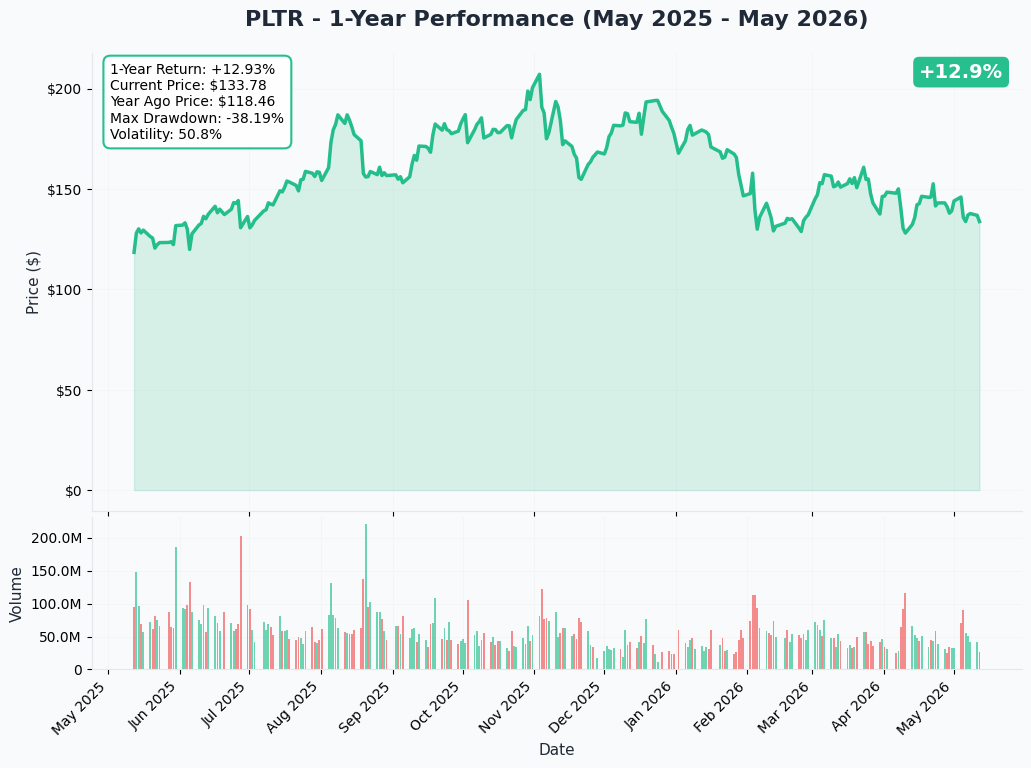
PLTR has been one of the most volatile large-cap AI names in 2026. After a significant correction from its late-2025 highs into the mid-$80s range in early February, shares staged a powerful recovery driven by the Q1 2026 earnings beat on May 5. The stock is currently trading near $136, consolidating just below the gamma resistance cluster at $135–$137 identified by the GEX model.
🎯 Gamma Support & Resistance Levels
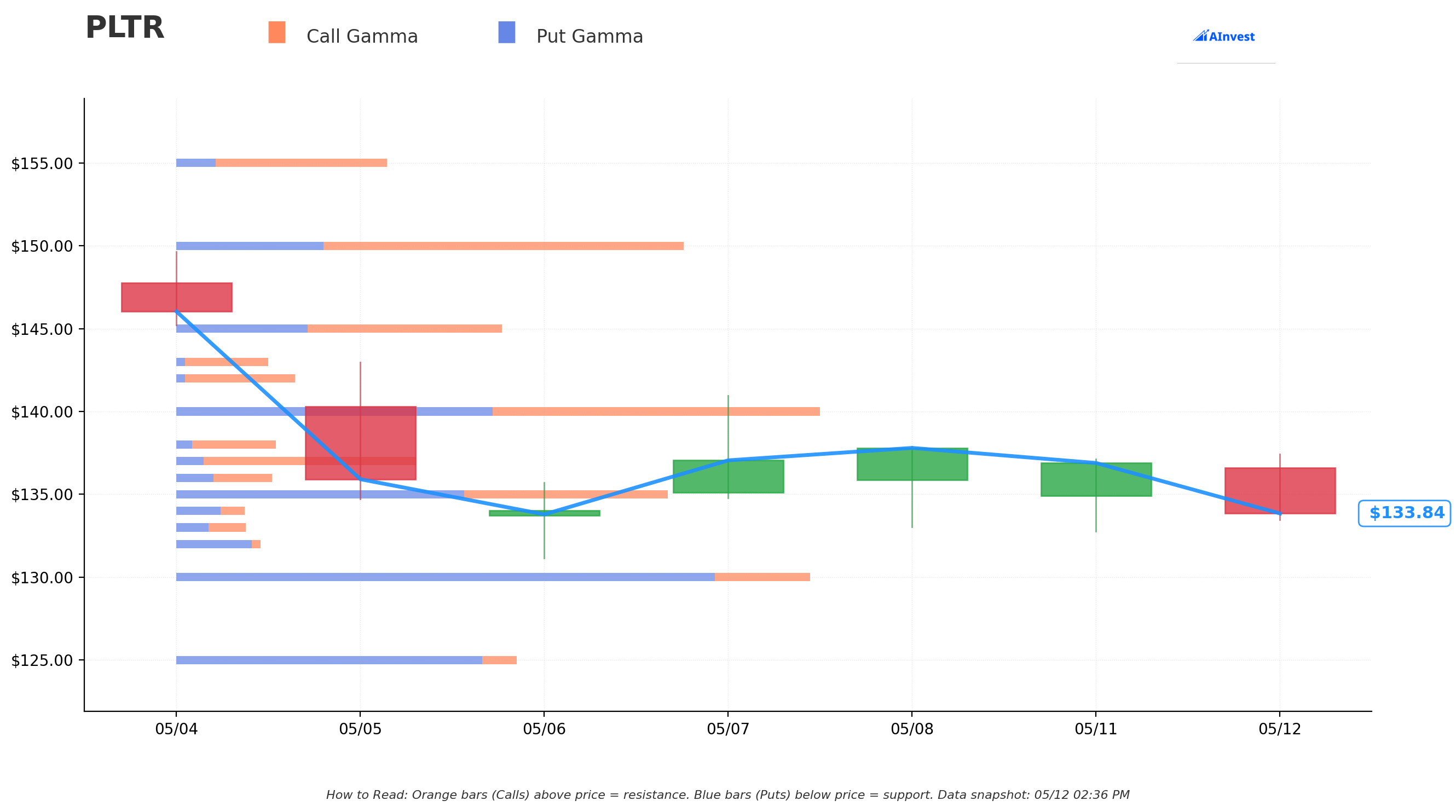
The gamma exposure (GEX) model — built from the live PLTR options open interest as of today's close — shows a tightly clustered battlefield around current spot. GEX data snapshot (spot $133.85 at model time):
Key Support Levels (Put GEX dominant):
| Strike | Net GEX | Total GEX | Distance from Spot |
|---|---|---|---|
| $130 | -27.85 (put-heavy) | 39.90 | -2.9% |
| $125 | -17.05 (put-heavy) | 21.40 | -6.6% |
| $120 | -15.28 (put-heavy) | 19.52 | -10.4% |
Key Resistance Levels (Call GEX dominant):
| Strike | Net GEX | Total GEX | Distance from Spot |
|---|---|---|---|
| $135 | -5.25 | 30.94 | +0.9% — immediate ceiling |
| $137 | +11.73 (call-heavy) | 15.12 | +2.3% |
| $140 | +0.70 (balanced) | 40.57 | +4.6% — major wall |
| $145 | +3.99 | 20.53 | +8.3% |
| $150 | +13.49 (call-heavy) | 32.04 | +12.1% — pre-strike hurdle |
| $155 | +8.38 (call-heavy) | 13.24 | +15.8% — the trade's strike |
GEX Market Bias: Bearish (net put GEX exceeds net call GEX at current snapshot)
Interpretation for the $155 call trade: PLTR faces a dense sequence of gamma resistance walls at $135, $140, $150, and $155. Each of these levels represents meaningful dealer hedging activity that can create "magnetic" price gravity — stocks tend to pin near high-GEX strikes into OPEX or get temporarily slowed when approaching them. The $140 level has the largest total GEX (40.57) and will likely act as the first significant test of any post-earnings rally. The $150 wall is the last major hurdle before the trade's strike. For the $155 calls to have value at expiration, PLTR needs to push through four sequential GEX resistance levels — achievable on a strong Q2 beat, but a significant ask in a low-volatility tape.
The nearest GEX support at $130 is 2.9% below current spot. If PLTR breaks below $133–$134 on a risk-off event, the $130 level acts as a magnetic floor, and the $125/$120 levels provide softer cushion below that.
📊 Implied Move Forecast
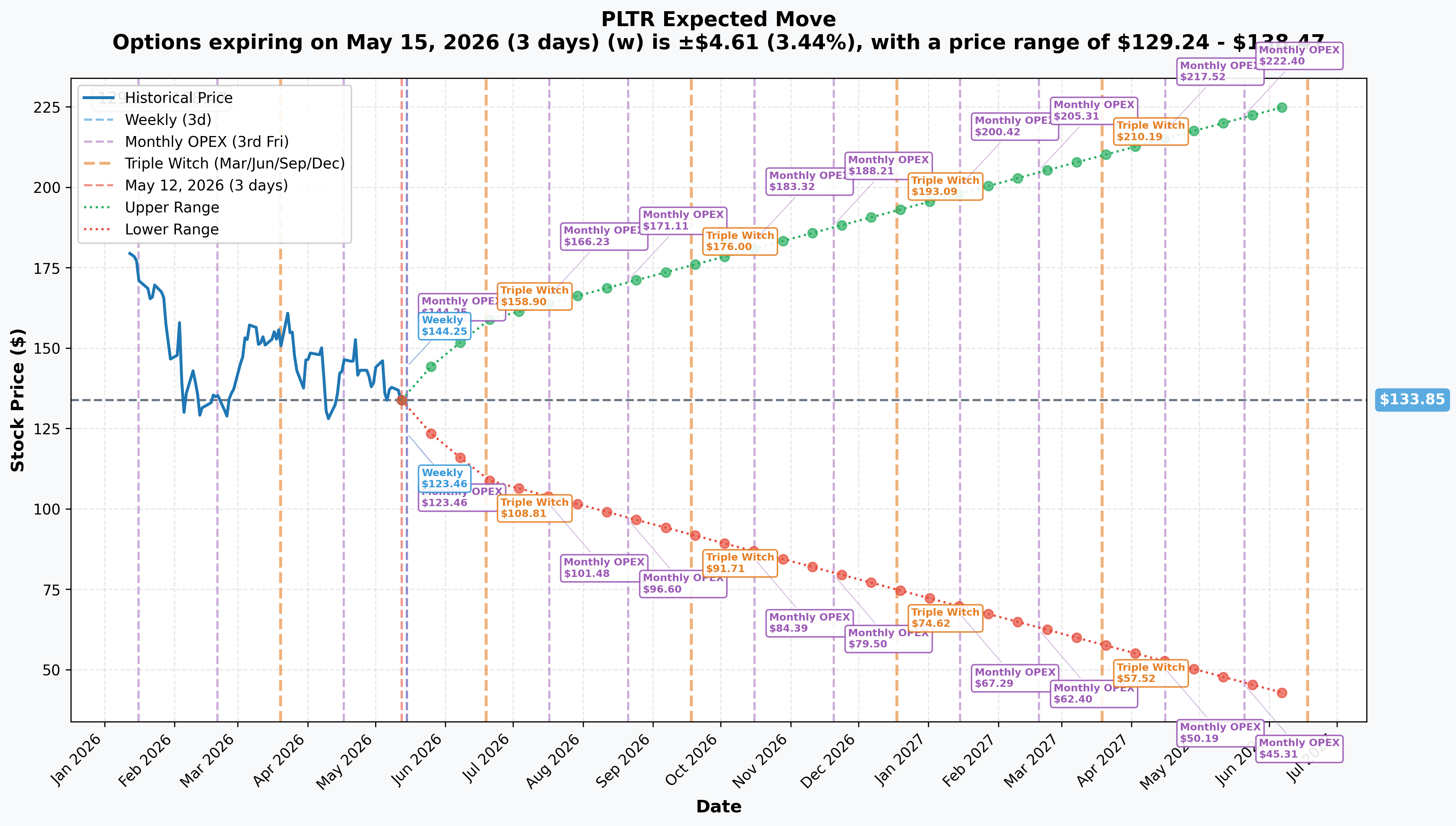
The options market's implied move forecast across upcoming OPEX dates provides critical context for whether the $155 call is realistically priced into the IV surface:
| OPEX Date | Type | Upper Range | Lower Range | Implied Move % |
|---|---|---|---|---|
| May 15, 2026 | Weekly / Monthly | $138.47 | $129.24 | ±3.4% |
| June 19, 2026 | Triple Witch | $158.71 | $109.00 | ±18.6% |
| July 17, 2026 | Monthly | $166.23 | $101.48 | ~24% |
| August 21, 2026 | Monthly | $171.11 | $96.60 | ~28% |
| September 18, 2026 | Triple Witch | $176.00 | $91.71 | ~31% |
Key insight for the trade: The implied move model puts PLTR's upper range at $176.00 by September 18 — comfortably above the $165.87 breakeven. The options market is already pricing the possibility of PLTR trading above breakeven by expiry as a central scenario, not a tail event. This is significant: the $155 call is sitting inside the implied upside range for the Sept 18 OPEX, meaning the premium paid ($10.87 per contract) is paying for a move the market considers within normal distribution.
The June 19 Triple Witch upper range of $158.71 is especially notable — the market is implying PLTR could briefly touch above the $155 strike as early as mid-June, providing potential early exit opportunities if IV remains elevated post-Q2 earnings catalyst.
Q2 earnings (early August) interaction: Q2 earnings fall inside the August 21 OPEX window, where the model shows a $171 upper bound. A post-earnings gap of 15–20% (in line with post-Q1 behavior) from a ~$140–$145 pre-earnings price would place PLTR in the $161–$174 range — directly in the profitable zone for this call.
🔍 Catalysts Inside the September 18 Window
All catalyst data sourced from research compiled May 12, 2026.
1. Q1 2026 Earnings — Blowout Beat Already in the Books
Palantir reported Q1 2026 results on May 5, 2026, delivering:
- Revenue: $1.63B vs. $1.54B consensus (+85% YoY)
- Adjusted EPS: $0.33 vs. $0.28 consensus
- US revenue: $1.282B (+104% YoY)
- US commercial revenue: $595M (+133% YoY)
- US government revenue: +84% YoY
- Q2 2026 guide: $1.8B vs. $1.68B consensus
- FY 2026 guide raised to $7.65–$7.66B (71% growth), with US commercial guide of 120% growth
- Adjusted FCF guide: $4.2–$4.4B
The Q1 print established a high bar for Q2 but also demonstrated that PLTR's commercial flywheel is accelerating, not plateauing. The stock's post-Q1 reaction — rallying from the mid-$80s into $136 territory — shows the multiple is willing to expand on execution.
2. Q2 2026 Earnings — The Central Catalyst (Early August, Inside Expiry) ⭐
Q2 earnings are expected in early August 2026, well before the September 18 expiry. Consensus heading into Q2 stands at approximately $1.68B, but Palantir's own Q2 guide is $1.8B — a 7% beat-over-consensus even before the quarter reports. Management has a pattern of sandbagging guides and raising them at the next print.
A Q2 report replicating the Q1 dynamic (guide-beat-raise) would:
- Confirm that 133% US commercial growth was not a one-quarter anomaly
- Force sell-side analysts to raise FY 2026 and FY 2027 estimates again
- Potentially catalyze a re-rating of the multiple (currently ~80x FY27 revenue), particularly if Nasdaq-100 inclusion is pending
This is the single largest binary event inside the September 18 window.
3. Citi Price Target Raised to $225 (May 7, 2026)
Citi raised its PLTR price target to $225 from $210 on May 7, 2026, following the Q1 print. The median analyst target sits at $200, with the range from $70 (bear case) to $260 (bull case). A $225 Citi target implies roughly 65% upside from current spot — and would represent a $31+ profit per contract on the $155 call if achieved by September.
4. AIPCon 10 — Expected June–July 2026
Palantir has run its AIPCon customer showcase events quarterly. AIPCon 9 was held on March 12, 2026, featuring live enterprise AI deployments and customer testimonials. AIPCon 10 is expected June–July 2026 and typically generates 3–10% stock moves on the day, with buy-side appetite for new customer win announcements and live AIP demos.
The bootcamp conversion rate of ~75% across 1,300+ sessions is the commercial growth engine behind the 133% US commercial number. AIPCon 10 is the likely venue for Q2 commercial momentum data and new enterprise logos.
5. NATO Maven Deployment + Army TITAN Program
NATO finalized procurement of Maven Smart System in late March 2026 in one of the fastest acquisition cycles in Alliance history — six months from engagement to contract. The system is expected to go live operationally within 30 days of contract settlement, with likely expansion announcements to additional allied forces through summer 2026.
The Army's TITAN targeting system program has three of ten prototypes delivered, with remaining units in testing through summer 2026. The gating 2027 full-rate production decision (estimated 100–150 units, multi-year program) is a significant upside catalyst if TITAN tests clear by Q3. Separately, the Pentagon consolidated 75 Palantir contracts into a single $10B umbrella deal in April 2026 — streamlining procurement and reducing contract-gap risk.
6. Nasdaq-100 Rebalancing Eligibility
PLTR transferred its listing to NYSE in November 2025 after a brief Nasdaq period. NYSE-listed stocks are eligible for the Russell 1000 Growth and other NYSE-anchored indices, and any formal index inclusion announcement would force passive funds to buy shares at scale — historically a 3–7% immediate price impact for large-cap additions.
💡 Three Trading Ideas
The following are analytical frameworks for consideration, not personalized investment advice. Each involves meaningful risk of loss.
Idea 1: Ride the Whale — Mirror the $155 Call (Moderate Risk)
Rationale: The simplest expression of conviction that the $22M whale is right. Buy the same September 18, 2026 $155 call at current market, sized to your risk tolerance.
Structure:
- Buy 1–5 PLTR Sep 18, 2026 $155 Call at approximately $10.87
- Total cost: $1,087–$5,435
- Breakeven: $165.87 at expiry
Entry context: Consider entering on a modest pullback toward $130–$132 (GEX support zone), which would reduce breakeven slightly and increase the option's leverage. Alternatively, enter at current levels if the Q2 setup is compelling and you want immediate delta exposure.
Exit triggers:
- Take partial profits if PLTR rallies to $150–$155 before Q2 earnings (IV expansion helps)
- Consider closing 50% before Q2 earnings to lock in gains and avoid binary event risk
- Stop loss: discretionary, but a drop below $120 (GEX support 3) materially reduces probability of success
Max loss: Full premium paid. Probability of profit at expiry: Roughly 25–35% based on current IV and the Sept 18 OPEX upper range of $176.
Idea 2: Bull Call Spread — Define Risk, Reduce Cost (Conservative)
Rationale: The $22M breakeven requires a 22% rally. If you believe in PLTR's direction but want to reduce capital at risk, a bull call spread captures upside while dramatically cutting the premium outlay.
Illustrative Structure (exact prices require live quote):
- Buy Sep 18, 2026 $140 Call (closer to spot, lower cost)
- Sell Sep 18, 2026 $170 Call (above breakeven of the whale trade)
- Net debit: estimated $8–$12 (vs. $10.87 for the outright $155)
- Max profit: $30 minus net debit — realized at $170 or above
- Max loss: Net debit paid — fully defined
Why this works: The $140/$170 spread captures the same Q2 earnings catalyst with a lower breakeven (~$148–$152 depending on actual fill) and lower maximum loss. The GEX resistance at $150 is a risk to the spread's full realization, but the probability of reaching max profit is materially higher than the outright $155 call.
Tradeoff: Capped upside above $170. If PLTR gap-opens to $185 on Q2 beat, the spread earns the max $30 while the outright call earns $29.13 per contract — nearly equivalent in the target zone, but with meaningfully better risk-adjusted probability.
Idea 3: Calendar or Diagonal — Harvest IV Ahead of Q2 Earnings (Sophisticated)
Rationale: PLTR IV tends to spike sharply heading into earnings. A calendar spread allows a trader to hold long September vega while selling near-term premium against it at elevated IV.
Illustrative Structure:
- Buy Sep 18, 2026 $155 Call (long vega, long theta decay hedge)
- Sell Aug 21, 2026 $160 or $165 Call (short near-term IV, above the Q2 earnings date)
Mechanics: The short August call collects premium from elevated pre-earnings IV. If PLTR does not reach $160–$165 by August 21 expiry, the short leg expires worthless and the September long remains in force at reduced net cost. If PLTR surges past $165 on Q2 beat, the diagonal's risk is capped loss on the short leg.
This strategy is more complex and requires active management. It is best suited for traders who understand vega risk, early assignment risk on the short leg (if deep ITM), and are comfortable adjusting the position around the Q2 earnings event.
⚠️ Risk Factors
No options analysis is complete without a serious examination of what can go wrong. The following risks are not hypothetical tail scenarios — several are visible in PLTR's current setup.
1. Extreme Valuation — 80x+ FY27 Revenue 🔴
At $136 spot with FY 2026 revenue guided to $7.65B, PLTR is trading at roughly 17.8x FY26 revenue. On analyst FY27 revenue estimates (~$11–12B), the multiple approaches 11–12x forward revenue — still premium but less extreme. However, on an earnings-adjusted basis, PLTR trades at 80x+ FY27 revenue on the compressed denominator used in some street models. The analyst bear-case price target is $70 — implying a 49% drawdown from current spot that would cause this call to expire worthless. Any guidance cut, growth deceleration, or macro-driven multiple compression could reset the stock violently. High-multiple stocks are structurally more vulnerable to rate hikes, risk-off events, and earnings misses than lower-multiple peers.
2. Insider Selling — $4B+ in Cumulative Sales Since 2024 🔴
CEO Alex Karp sold 493,025 shares in February 2026 under a Rule 10b5-1 plan, with $66M in that month alone. Cumulative Karp and Peter Thiel 10b5-1 sales since 2024 now exceed $4 billion. These are pre-scheduled and mechanical, but the pace creates a persistent supply overhang — the March 10, 2026 pullback was attributed directly to insider selling volume. Every point of upside must absorb ongoing insider supply.
3. AIP Renewal Cliff Risk — Late 2026 🟡
The AIP bootcamp-to-contract conversion rate of ~75% is impressive, but many of these contracts were signed in 2024–early 2025 on 12–24 month initial terms. The first major renewal wave hits in late 2026, testing whether customers who expanded aggressively in the AI hype cycle will renew at scale. AIP churn at renewal would directly impact US commercial revenue comps heading into FY27 and could deflate the multiple well before this call expires.
4. Government Concentration and Budget Risk 🟡
Government still represents nearly half of Palantir's total revenue. US government contracts are subject to continuing-resolution risk, budget sequestration, and political prioritization shifts. A change in defense spending priorities, a delay in FY27 appropriations, or a prolonged budget impasse could slow contract awards and pipeline conversion. The TITAN and Maven wins are large and durable, but they are ultimately dependent on ongoing political support for AI-forward defense spending.
5. Options-Specific Risks 🟠
- Time decay (theta): At 129 DTE, this position loses approximately $0.05–$0.08 per contract per day to time decay at current IV levels, accelerating as expiry approaches. A flat or slowly rising tape will erode value even if PLTR stays near $136.
- IV contraction: Post-earnings IV crush is a well-documented phenomenon. If Q2 earnings land in line with expectations (even a beat), IV on September options could contract 20–30%, reducing the option's value even if the stock moves up modestly.
- Binary event risk on Q2: A Q2 miss or guidance cut could cause a gap-down of 15–25%, leaving the $155 call deeply worthless with limited time to recover.
🧭 Bottom Line
The $22M block at the September 18, 2026 $155 call is one of the largest single-option premium prints in PLTR's recent history. Whether it is a fresh BTO or a short-call cover (BTC), the directional message is the same: a well-capitalized trader is expressing a high-conviction bullish view on PLTR through Q2 earnings and the summer catalyst stack, targeting a price above $165.87 by mid-September.
The bull case is credible: PLTR just delivered 85% revenue growth, guided to 71% for the full year, and has Q2 earnings (guided to beat consensus by 7% before the quarter even starts), AIPCon 10, NATO Maven deployment, and TITAN prototype completion all inside the expiry window. The implied move model puts the Sept 18 upper range at $176 — comfortably above breakeven — and the median analyst price target of $200 would generate a $34+ per-contract profit.
The bear case is equally credible: the stock trades at 80x+ FY27 revenue, faces $4B+ in insider selling pressure, and requires a 22% rally just to reach breakeven. The gamma resistance ladder at $140, $150, and $155 means the stock needs sustained fundamental buying to push through each level. A valuation reset, Q2 miss, or macro-driven multiple compression would leave this call expiring worthless.
For investors aligned with the bullish view: The $155 call offers leveraged upside at a defined, known maximum loss. The breakeven is achievable but demanding. Position sizing relative to total portfolio is the most important variable — the maximum loss scenario is a complete loss of premium.
Catalyst Score: 8.5/10 (per catalyst research — high density, large magnitude, meaningful probability of surprise inside the window).
📌 Disclosure
This analysis is for informational and educational purposes only. It does not constitute investment advice, a solicitation to buy or sell any security, or a recommendation. Options trading involves substantial risk of loss and is not appropriate for all investors. The loss of the entire amount invested is possible. Past performance of options strategies, individual securities, or the market is not indicative of future results. Unusual options activity may reflect hedging, institutional rebalancing, or closing of existing positions rather than directional speculation. Always consult a qualified financial advisor before making investment decisions. The author and publisher may hold positions in the securities discussed.
Options flow data sourced from real-time market feeds as of May 12, 2026. Gamma/GEX data from live options OI snapshot at 2:36 PM ET. Implied move data calculated from PLTR options chain as of market hours May 12, 2026. All catalyst information sourced from public filings, earnings releases, and news reports as cited inline.