🏗️ PRIM $1.3M Bullish Call Bet — Data-Center Builder Gets a $120 Strike Backed by a $399M Acquisition
📅 June 12, 2026 | 🔥 Unusual Activity Detected
✅ Updated 2026-06-15: Next-day OPRA OI confirms the open — open interest rose 167 → 2,756 (Δ +2,589, more than the 1,999 traded). The bullish $120 call position is confirmed on the books.
🎯 The Quick Take
At 14:20:35 today, a desk worked a $1.3M multi-leg auction on Primoris Services (PRIM), buying 1,999 August 2026 $120 calls on a stock trading at ≈$97.56 — a ≈23% out-of-the-money bet with a roughly 10-week runway to expiration. What gives this trade its teeth: the Street's average analyst price target of ≈$156 sits comfortably above that $120 strike, the newly closed $399.5M Paynecrest acquisition just dropped PRIM straight into the fast-growing data-center electrical market, and Q2 earnings are expected around August 3 — squarely inside the life of this call. The desk isn't making a casual bet; they're positioning for a clean recovery quarter to re-rate an infrastructure builder sitting on an $11.6B backlog and ≈$1.7B of data-center work under evaluation.
📊 Company Overview
Primoris Services (PRIM) is a Dallas-based engineering & construction company that builds the infrastructure America needs to keep the lights on — and now, the servers running:
- Market Cap: ≈$5.3B (≈54.25M shares outstanding)
- Sector / Industry: Industrials — Engineering & Construction / Critical Infrastructure Services
- What they do: Primoris provides specialized construction, fabrication, and maintenance services across two main segments: Utilities ($6.9B backlog — electric transmission/distribution, substation, gas distribution, communications) and Energy ($4.7B backlog — solar/renewables EPC, natural gas generation, pipeline, industrial). With the Paynecrest acquisition now closed, they've added a dedicated inside-the-fence data-center electrical arm. 2025 revenue was $7.57B, up ≈19% YoY.
- The big picture: PRIM is sitting at the intersection of three of the most powerful U.S. infrastructure spend cycles right now — power grid build-out, data-center construction, and the renewables ramp. That's not an accident; it's the whole thesis.
💰 The Option Flow Breakdown
The Tape — June 12, 2026 @ 14:20:35: 🤝 Multi-leg Auction
| Time | Buy/Sell | Call/Put | Expiration | Premium | Strike | Volume | OI | Size | Spot | Option Price | Option Symbol |
|---|---|---|---|---|---|---|---|---|---|---|---|
| 14:20:35 | BUY | CALL | 2026-08-21 | ≈$1.3M | $120 | 2,500 | 167 | 1,999 | $97.56 | $6.27 | PRIM20260821C120 |
Flow type: 🤝 Multi-leg Auction — this order was worked through an exchange price-improvement auction as part of a multi-leg structure, with a paired leg on the tape. It was not a panicked lit sweep. A desk routed this deliberately, negotiating execution through a facilitated mechanism. The $6.27 option price on a ≈$97.56 stock reflects the ≈23% out-of-the-money distance and the ≈10-week runway to August 21.
✅ RESOLVED — Next-Day OI Confirms the Open (2026-06-15)
| Snapshot | Open Interest |
|---|---|
| Pre-print baseline (EOD 2026-06-11) | 167 |
| Resolving (EOD 2026-06-12) | 2,756 |
| Δ | +2,589 (more than the 1,999 traded) |
Open interest ROSE by 2,589 — more than the 1,999 contracts traded — so the Aug-2026 $120 call opened as a fresh bullish position (with additional buying alongside it). The 12x size-vs-OI read is confirmed: this is a new bull position, BTO-confirmed.
🤓 What This Actually Means — Plain English
Let me break this down simply.
A long call is a leveraged bullish bet. Instead of buying PRIM stock directly (which at ≈$97.56 would cost about $9.8M for 100,000 shares of equivalent exposure), the desk bought the right — but not the obligation — to purchase PRIM shares at $120 anytime up to August 21, 2026. They paid $6.27 per share for that right, totaling ≈$1.3M across 1,999 contracts.
Here's the math that matters:
- The stock is at ≈$97.56. The $120 strike is ≈$22.44 away — a ≈23% move needed just to reach the strike.
- Breakeven at expiration: roughly $126.27 ($120 strike + $6.27 premium paid). The stock needs to climb ≈29% from today's level for this trade to be in the money at expiry.
- Maximum loss: the $1.3M premium paid. If PRIM is below $120 on August 21, the options expire worthless.
- Maximum gain: theoretically unlimited above the breakeven — every dollar above $126.27 is worth $199,900 across 1,999 contracts.
Why would anyone make this bet?
The answer is timing and catalysts. The desk is not just betting blindly — they're positioning for a specific event: Q2 earnings expected around August 3, right inside the option's window. If Primoris posts a clean recovery quarter that shows Paynecrest contributing, data-center bookings building, and the solar stumble behind them, the stock could re-rate sharply. The $156 average analyst target — and Guggenheim's $195 target — give you a sense of where the Street thinks this stock belongs if execution improves.
Why a call rather than stock?
- $1.3M in premium vs ≈$19.5M to buy the equivalent share exposure — massively capital-efficient.
- Defined maximum loss: $1.3M, no matter how far the stock falls.
- The binary nature of the August 3 earnings makes options appealing — you're either right or you're not, and you want leverage if you are.
The order type is BTO — Buy to Open. This is a fresh bullish position. The multi-leg auction mechanism means a paired leg exists on the tape; the desk was working a structured order, not just blindly hitting the offer.
Confidence on the open/close call: HIGH. Size 1,999 against prior OI of 167 is a 12x ratio — the size-vs-OI math is decisive. Next-day OI will confirm; the expected direction is strongly upward.
📈 Technical Setup / Chart Check-Up
YTD Performance
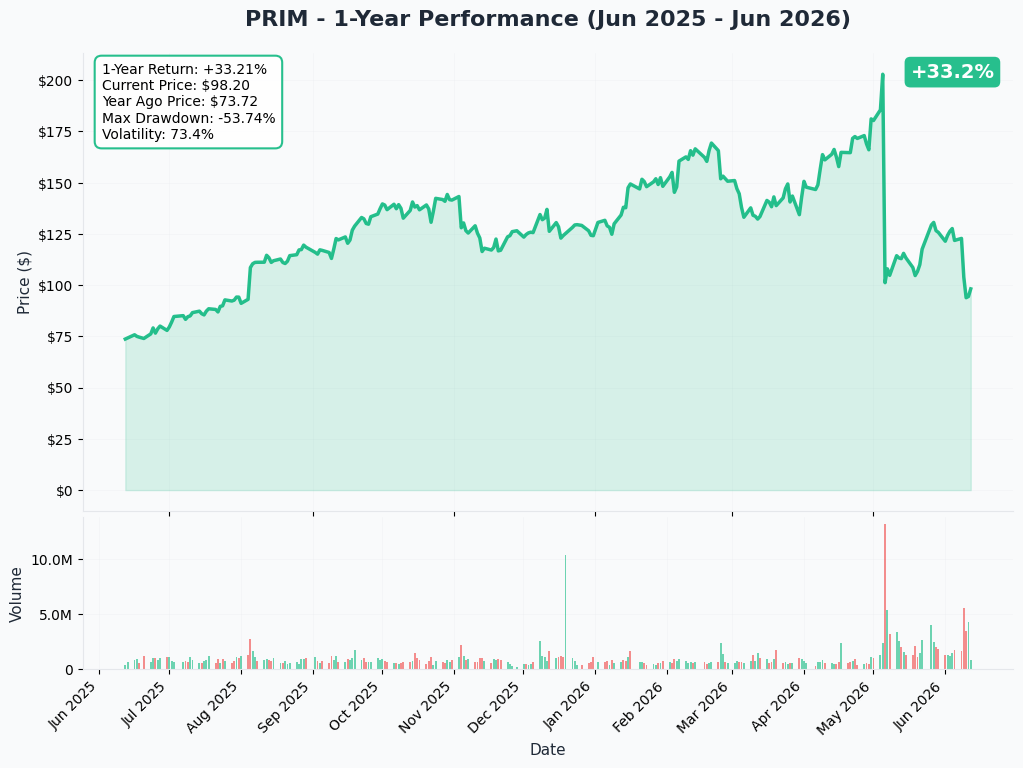
PRIM had a strong run into 2026, benefiting from infrastructure-spending optimism and the S&P 600 / S&P Composite 1500 index inclusion in December 2025. That momentum ran hard until the Q1 earnings report on May 5, 2026 revealed the ≈$110M solar-project cost overrun, triggering a sharp pullback and a wave of analyst target reductions. The stock has since stabilized in the high-$90s, finding its footing as the Paynecrest data-center narrative reasserted. Today's call buyer is stepping in at that stabilized level — roughly 20–25% below the pre-miss range — and betting the Q2 print starts the re-rating.
Key observations:
- 📉 Pulled back meaningfully after the May 5 solar miss
- 📊 Now consolidating at ≈$97–$98, with the post-miss selling pressure appearing to exhaust
- 🎯 Still ≈37% below the $156 average analyst target — a wide gap the desk is betting gets partially closed by August
Gamma-Based Support & Resistance
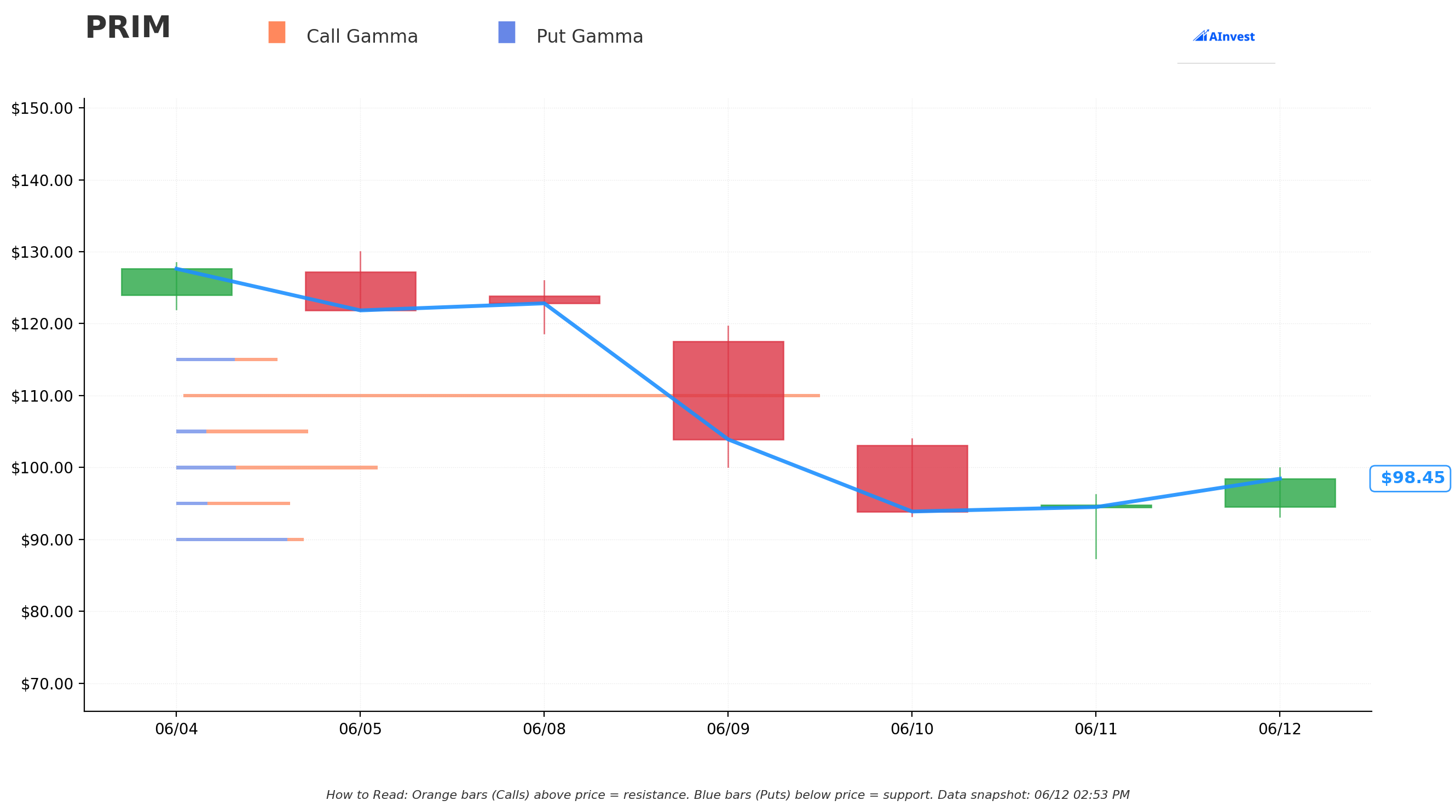
Current Price: ≈$98.20
PRIM is a thinly-optioned name — the options market here is not as deep as a mega-cap, and gamma levels are relatively modest in magnitude. That means fewer mechanical market-maker flows anchoring price, and bigger individual prints (like today's 1,999-contract call) carry more weight in the options market than they would in, say, AAPL. With that honest context, here are the key gamma levels from the data:
🟠 Resistance Levels (Call Gamma Above Price):
- $100 — Nearest Resistance. The $100 strike shows meaningful call gamma (the largest net call GEX of the strikes within reach). Options positioning creates natural selling pressure as PRIM approaches that round-number level. For the bull thesis to develop, the stock needs to clear and hold $100 — a level the desk is likely watching closely.
- $110 — Major Call Gamma Wall. This is the dominant gamma level in the chain — by far the largest total GEX reading in the data. Breaking through $110 would be a significant technical development; this is where the mechanical resistance is most concentrated between here and the $120 strike. Getting through $110 would clear the path meaningfully.
🔵 Support Levels (Put Gamma Below Price):
- $95 — Nearby Support. Put gamma concentrates here, providing a modest downside cushion. Market makers tend to buy the stock as it approaches this level to manage their delta exposure. If the stock dips below $95, the next meaningful floor is around $90.
- $90 — Deeper Support Floor. The $90 strike shows the most put gamma below current price. A move to this level would represent a meaningful re-test of the post-Q1 lows.
Translation for traders: PRIM needs to clear the $100 hurdle and then the $110 gamma wall before the $120 call starts gaining real intrinsic-value traction. Both are within the ≈37-day monthly implied move upper cone (see below), but the path is not without friction.
Implied Move Analysis
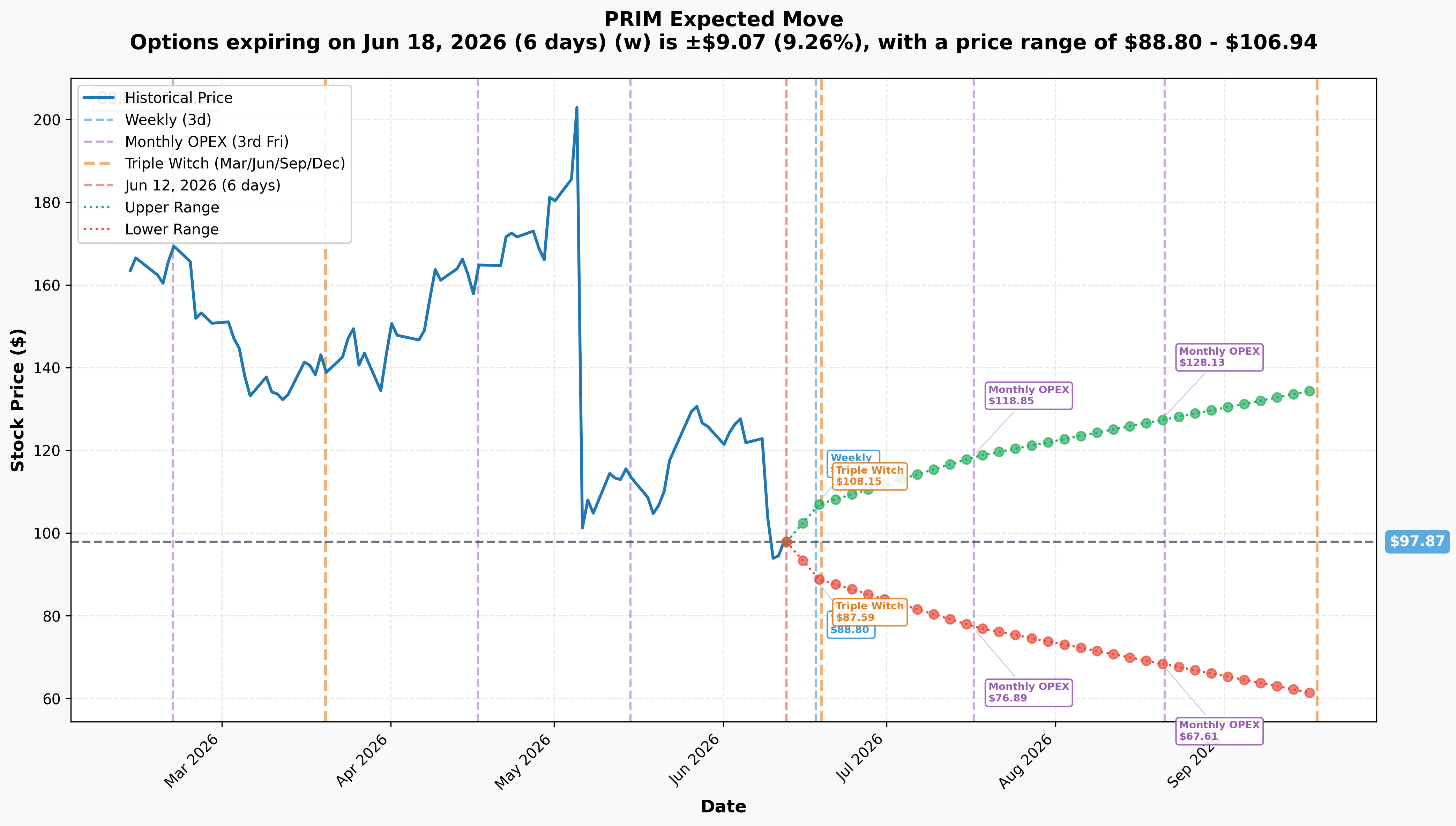
The options market is pricing real uncertainty into PRIM — no surprise for a mid-cap E&C name heading into an earnings print that needs to prove the Q1 stumble was a one-off:
- 📅 Weekly (exp 2026-06-18, 6 days): ±9.26% → Range $88.80 – $106.94
- 📅 Monthly OPEX (exp 2026-07-17, 35 days): ±21.17% → Range $77.15 – $118.59
- 📅 Quarterly (exp 2026-09-18, 98 days): ±37.78% → Range $60.90 – $134.84
- 📅 Aug-21 OPEX (the call's expiry): Upper range ≈$128.13, lower range ≈$67.61
The $120 call sits right at the top edge of the August 21 implied move cone. The options market is saying, in its own quantitative language: "getting to $120 by August 21 is possible, but it's the stretch scenario." Specifically:
- The monthly OPEX upper bound of $118.59 (July 17) caps out just below the $120 strike — the stock needs to run above the July cone upper bound to put the $120 call in the money by August.
- The August 21 upper cone of ≈$128.13 just barely covers the $120 strike with room. This is not a lottery ticket in the sense that the options market's own probability distribution places $120 within reach — but it is the high end of the range.
- The quarterly cone of $60.90–$134.84 shows how wide the distribution gets when you factor in the full three-month window — and why well-timed calls on binary events like earnings can be valuable even when struck far OTM.
The ≈23% out-of-the-money distance sounds scary, but within the context of a ±37.78% quarterly implied move, it's not as far as it looks on paper.
🎪 Catalysts
Already Happened — Building the Bull Case
Paynecrest Acquisition Closed May 1, 2026 — The Data-Center Pivot 🏢 Primoris closed the ≈$399.5M all-cash acquisition of Paynecrest Electric on May 1, 2026. Paynecrest is a leading electrical construction firm focused on industrial facilities and advanced manufacturing — and critically, ≈40% of Paynecrest's revenue comes from data centers. This acquisition doesn't just add revenue; it drops PRIM directly into the "inside-the-fence" data-center electrical market — the specialized electrical work done within a data-center campus, one of the fastest-growing and highest-margin subsectors in infrastructure construction.
$1.7B Data-Center Pipeline Under Evaluation 📡 Management flagged ≈$1.7B of data-center work under evaluation at the Q1 call — spanning site prep, power generation, utility infrastructure, and fiber construction. That pipeline converting even partially into the $11.6B backlog is a direct positive catalyst. With Paynecrest in the mix, PRIM now has both the capabilities and the relationships to win this work.
Utilities Segment Posted Double-Digit Growth The Utilities segment continues to outperform, driven by rising transmission and substation activity in Texas and the Southeast — the grid-hardening and grid-expansion story that isn't going away regardless of what happens with solar. Utilities backlog stands at $6.9B, up $476M YoY.
S&P 600 / Composite 1500 Index Inclusion (December 2025) PRIM was added to both indexes in late 2025, improving liquidity, broadening the institutional investor base, and lifting visibility. Index-driven buying provides a structural floor to the shareholder base.
Analyst Consensus Supports the $120 Strike 17 analysts cover the stock, averaging a ≈$156 price target — roughly 59% above today's spot and comfortably above the $120 call strike. Guggenheim raised its target to $195 (from $184) on April 20, 2026, explicitly reframing PRIM's role in the renewables and data-center buildout. Even after the post-Q1 wave of target reductions (UBS cut to $186, Mizuho to $135, Needham to $188, KeyCorp to $137), the bulk of the Street still sees the stock belonging above $120.
Recent Headwind — The Q1 Miss (Context for the Risk)
Q1 2026 Earnings — May 5, 2026 (The Stumble That Created This Opportunity) Q1 revenue came in at $1.56B (down 5.4% YoY), adjusted EPS $0.59 vs $0.98 expected, adjusted EBITDA $60.5M — down 39.1%. The culprit: a small set of solar projects with ≈$110M in combined headwinds (labor issues in new geographic markets, project redesigns, weather). Management cut FY2026 adjusted EPS guidance to $4.80–$5.00 and adjusted EBITDA to $480–500M. The bar is now reset lower — which can be a setup for recovery if Q2 clears it.
Upcoming Catalysts — The Runway the Call Is Buying
Q2 2026 Earnings — Est. August 3, 2026 (THE Catalyst) 📅 Consensus Q2 EPS is ≈$1.51 — nearly triple the Q1 adjusted EPS of $0.59 — reflecting the normal seasonal ramp in E&C and the expectation that the solar headwinds are behind the business. This print lands approximately 18 days before the August 21 call expiration, giving the options plenty of time to react. Key things to watch:
- First full Paynecrest quarter: does data-center revenue show up at scale?
- Any data-center backlog wins from the ≈$1.7B pipeline under evaluation
- Renewables re-acceleration: management guided ≈$2.3B renewables revenue for FY2026 with the delayed projects starting in Q3 — Q2 guidance commentary on the 2H trajectory matters
- Utilities transmission momentum continuing from the Q1 bright spot
Dividend Payment ≈July 15, 2026 (Record Date June 30) $0.08/share quarterly dividend declared — a minor cash-return signal but one that underscores management confidence in the near-term liquidity position.
Renewables 2H Re-Acceleration — Expected Starting Q3 Solar and renewables projects delayed from 1H are expected to begin construction in Q3, front-loading a significant volume ramp into the second half of 2026. The Q2 call will be the first opportunity to hear management's confidence level on this re-acceleration — and any positive tone shift will matter for the stock.
Data-Center Pipeline Conversions — Ongoing Any portion of the ≈$1.7B of data-center work under evaluation converting to firm backlog is a direct, measurable positive catalyst given the Paynecrest platform. Hyperscaler capex is at all-time highs; PRIM now has a dedicated team to pursue it.
Utility & Transmission Awards — Structural Tailwind Texas and Southeast grid hardening/expansion demand remains the most durable backlog driver. The backlog's resilience is explicitly recognized by analysts even amid macro uncertainty.
Storm-Restoration Upside — Unbudgeted Storm-restoration work is explicitly excluded from FY2026 guidance — an active hurricane or severe-weather season is pure upside not priced in by the Street.
🎲 4-Reader Interpretation
🚀 YOLO Trader
This is a high-conviction, high-leverage bet with a hard binary trigger: Q2 earnings August 3. The trade is already made in the structure you'd want — August $120 calls, defined risk, massive leverage if PRIM re-rates toward its analyst targets. If you want to ride alongside the desk, the same PRIM Aug-21 $120C is the vehicle. The $6.27 premium (≈$627/contract) keeps position sizing manageable. The stock needs ≈23% upside to the strike, ≈29% to the rough breakeven — not easy, but given the ≈$156 average PT and a clean Q2 as the trigger, it's not fantasy. Max risk: 100% of premium paid. Do not size beyond your "lose it all" comfort zone.
📊 Swing Trader
Watch the $100 gamma level as the first meaningful near-term signal. If PRIM breaks cleanly above $100 on volume with a positive catalyst (Q2 guidance pre-announcement, data-center backlog announcement, or anything that shifts the narrative off the Q1 miss), the $110 gamma wall becomes the next target. A more capital-efficient August play for the swing crowd might be a call spread — e.g., buying the Aug $100/$115 call spread to participate in the recovery without needing a full $120+ move. The August 3 earnings date is the binary event; make sure your position sizing accounts for the gap risk in both directions.
🛡️ Premium Collector
PRIM is a thinly-optioned name, which typically means elevated implied volatility relative to realized — good for premium sellers, but watch liquidity. Cash-secured puts at the $90–$95 level (the gamma support zone) can generate income while you wait for the recovery thesis to develop. The $95 put gamma level suggests market makers will defend that floor somewhat. Just be careful running into the August 3 earnings print — implied vol spikes ahead of binary events and the gap risk on a miss is real. Consider exiting or rolling short puts before earnings.
🌱 Entry-Level / Beginner
Here is what happened in plain English: someone paid ≈$1.3M for the right to buy Primoris Services stock at $120 per share before August 21, 2026. The stock is at ≈$97.56 today, so the stock needs to go up about 23% just to reach that $120 level — and even higher for the option buyer to profit. They're betting that the company's new data-center electrical business (bought for $399.5M earlier this year), a strong backlog, and a recovery earnings report on August 3 will push the stock back toward where analysts say it belongs — around $156. This is a shorter-dated, directional bet that lives or dies on the August 3 earnings. The most they can lose is the $1.3M they paid. If you're just learning options, this is an "OTM long call" — a high-leverage, defined-risk bullish bet where the buyer needs a significant move to profit.
⚠️ Risk Factors
Options trading involves substantial risk of loss and is not appropriate for all investors. Here are the specific risks for this trade:
The Q1 Solar Miss Could Repeat This is the single biggest risk. The ≈$110M Q1 solar headwind was a self-inflicted execution issue — preconstruction planning gaps, labor issues in new geographic markets, project redesigns and resequencing. If the same projects bleed into Q2, or if new projects hit similar snags, the recovery thesis is invalidated and the $120 call expires worthless. Simply Wall St noted the earnings miss alongside legal uncertainty — two fronts management needs to address cleanly.
Some Analysts Are Already Below the Strike Not all of the Street is bullish on the $120 level. Wells Fargo cut its target to $118 — below the strike price — and KeyCorp cut to $137 from $179. The range of analyst targets runs from $102 to $195; the low end does not reach $120. This isn't a unanimous conviction trade.
Renewables Revenue Depends on Tax-Credit Timing The FY2026 renewables revenue forecast of ≈$2.3B was already lowered on tax-credit clarity delays and project-start slippage. If policy timelines slip further, the 2H renewable volume ramp that underpins the bull case gets pushed into 2027 — outside the life of this call.
Energy Backlog Erosion Needs Reversing Energy backlog fell $780M YoY on award timing. For the long-term growth story to hold, this backlog needs to rebuild — and any Q2 commentary that suggests further erosion rather than stabilization will weigh on the stock.
The $120 Strike Requires ≈23% Upside in 10 Weeks At ≈$97.56 spot with $6.27 premium paid, the breakeven is roughly $126.27. PRIM needs a significant re-rating — not just an in-line earnings beat, but something that shifts sentiment from "damaged goods" to "back on track." That requires a clean Q2, positive data-center backlog news, and a recovery narrative the Street believes is durable.
Rate and Macro Sensitivity Large-project E&C demand is sensitive to financing costs for utility and renewable developers. Any macro deterioration that delays customer capex decisions could slow backlog conversion even if PRIM executes well operationally.
Thin Options Market Means Wider Bid-Ask Spreads PRIM is not a high-volume options name. The prior OI of 167 contracts on this specific strike is a clear signal. Wider bid-ask spreads mean entering and exiting similar positions costs more per contract than in a liquid large-cap name. Factor that into your cost basis if you're considering a similar trade.
What the OPRA Tape CANNOT Tell Us: We know the mechanism (multi-leg auction), size (1,999 contracts), premium ($6.27), and direction (BUY). We do not know the buyer's identity, their existing portfolio, whether this is a standalone directional bet or part of a larger hedged structure, or their stop-loss plan. The tape tells us what happened, not who or why beyond what the structure implies.
🎯 The Bottom Line
Here's the deal: a desk just made a structured, deliberate ≈$1.3M bullish bet on Primoris Services — an infrastructure E&C company sitting on an $11.6B backlog, a freshly deployed data-center electrical platform, and ≈$1.7B of data-center work in the pipeline — with the $120 strike aligned well below where the Street's average analyst sees fair value (≈$156).
The setup in plain terms: the stock got hit hard after a messy Q1 solar execution problem. The desk is betting that problem is a one-off, that the August 3 Q2 earnings print shows recovery, and that the broader data-center + transmission + renewables infrastructure story reasserts itself into the second half of 2026. The ≈$120 strike is the re-rating target — not a fantasy number, given the analyst consensus — but it requires both execution and narrative repair.
What to watch:
- 📅 Now → August 3: Any data-center backlog conversion news, analyst upgrades, or sector catalysts (hyperscaler capex announcements)
- 📅 June 30: Dividend record date — minor, but confirms financial stability
- 📅 August 3, 2026 (≈ after market close): Q2 earnings — THE binary event. Clean print with Paynecrest contributing + Q3 renewables ramp guidance = catalyst for re-rating. A repeat of the solar miss = option likely expires worthless.
- 📅 August 21, 2026: PRIM Aug-21 $120C expiration
- 📅 Tomorrow ≈06:30 ET: OPRA OI snapshot confirming the opening position (expected: OI rises from 167 to ≈2,100–2,166; may be somewhat less on partial transfer)
If you own PRIM stock: The $100 gamma level is the near-term signal to watch. A clean hold and close above $100 heading into earnings would set up a meaningful technical breakout attempt toward the $110 gamma wall. The August 3 date should be firmly on your calendar as a potentially large move event in both directions.
If you're on the sidelines: The setup has merit — a mid-cap infrastructure builder at the intersection of data-center, transmission, and renewables spend, trading significantly below consensus analyst targets after an execution stumble. The risk is front-loaded on August 3. If you want exposure, either wait for post-earnings clarity (knowing you may miss the initial bounce) or size conservatively into the run-up.
If you're skeptical (or bearish): The $90 gamma support is the level to watch for a breakdown. A miss on August 3 earnings with negative guidance commentary could push toward that level quickly. The near-term options market is pricing ≈9.26% weekly implied move — both directions are live.
A $1.3M multi-leg auction call on an infrastructure builder with a clean data-center story, a reset-lower guidance bar, and a binary catalyst perfectly timed inside the option window. Patient, structured, and concentrated on a single pivot point: August 3.
Disclaimer: Options trading involves substantial risk of loss and is not suitable for all investors. This analysis is for educational and informational purposes only and does not constitute financial advice or a recommendation to buy or sell any security. The PRIM August 2026 $120 call requires ≈23% upside just to reach the strike and expires worthless below $120 on August 21, 2026 — resulting in 100% loss of the $1.3M premium. Past unusual options activity does not guarantee future returns. Always conduct your own due diligence and consult a licensed financial professional before making trading decisions. Open/close classification is based on size-vs-prior-OI inference (size 1,999 vs OI 167); confirmation will come from next-day OPRA open interest data (≈06:30 ET).
Last updated: June 12, 2026
Last updated: 2026-06-15 — next-day OPRA OI resolved the open (OPEN confirmed).