🚀 VRT $1.4M Bullish Call Bet on AI Cooling Leader — Whale Targets $400 by September
📅 May 1, 2026 | 🔥 Unusual Activity Detected
🎯 The Quick Take
Someone just placed a $1.4M bet that Vertiv Holdings (NYSE: VRT) rockets 22% higher by September — scooping up the $400 calls expiring September 18, 2026 with 501 contracts against only 256 open interest. This isn't a hedge or a closing trade. This is a fresh, conviction-driven long call opened right after VRT's blockbuster Q1 2026 earnings report beat expectations by 16% — with the Investor Conference on May 19–20 just weeks away. Translation for us regular folks: a well-funded trader is loading up on AI cooling picks-and-shovels exposure right before a series of catalysts hits.
📊 Company Overview
Vertiv Holdings Co. (NYSE: VRT) is the pure-play picks-and-shovels leader in AI data center physical infrastructure:
- 🏭 Business: Designs, manufactures, and services power management systems (UPS, switchgear, 800 VDC architectures) and thermal/cooling infrastructure (precision air, liquid cooling, CDUs) for hyperscale AI factories
- 💰 Market Cap: ~$118–126B (range during April 2026)
- 🤖 AI Angle: Deep co-development partnership with NVIDIA on GB200 NVL72 reference architectures and 800 VDC power platforms — VRT is embedded at the hardware layer of every next-gen AI factory
- 📊 Revenue Run Rate: $13.5–$14.0B FY2026 net sales guided, +34% YoY, per Vertiv's Q1 2026 guidance update
- 🌐 Cooling Market Share: ~23% global precision cooling, supported by 4,000+ field engineers and legacy Liebert brand, per Introl competitive analysis
💰 The Option Flow Breakdown
📊 The Tape — May 1, 2026
| Time | Symbol | Buy/Sell | Type | Expiration | Strike | Volume | OI | Premium | Order Type | Vol/OI |
|---|---|---|---|---|---|---|---|---|---|---|
| 10:17:52 | VRT | BUY | CALL $400 | 2026-09-18 | $400 | 501 | 256 | $1.4M | BTO | 1.96x |
Spot at time of trade: $329.16 | Option Price: ~$28.09/contract
🤓 What This Actually Means
This is a textbook Buy to Open (BTO) — the trader PAID $1.4M in fresh premium to open a brand-new long call position. Not a hedge, not a close. A directional bet.
- 💸 Premium paid: $1.4M ($28.09 per share × 100 × 501 contracts)
- 📈 Strike: $400 — sitting approximately 22% above the $329.16 spot price
- ⏰ Expiration: September 18, 2026 — Triple Witch OPEX, 140 days out
- 📊 Volume signal: 501 contracts vs. 256 open interest — volume is 1.96x existing OI, meaning this single trade nearly doubled the open interest pool. This is a new opening position, not recycled flow.
- 🔥 Z-score: 19.39 (EXTREMELY UNUSUAL) — This trade is nearly 20 standard deviations above average VRT call activity. To put that in plain English: this type of outsized bet in VRT $400 calls happens maybe a few times a year at most.
What's the trader thinking?
With VRT at $329.16 and the $400 call priced at $28.09, the breakeven is $428.09 by September 18 — a 30% rally from today's spot needed for this to print money at expiration. That is a bold, high-conviction bet. The trader isn't playing a small bounce. They're positioning for VRT to make a new all-time high run fueled by the AI infrastructure buildout, the upcoming Investor Conference, 800 VDC launch, and NVIDIA Rubin cycle. They're paying a lot for optionality, and they know it.
Real talk: this isn't your neighbor Bob buying a lottery ticket. Someone put $1.4M on the table with a thesis, and that thesis has a dense near-term catalyst calendar behind it.
📈 Technical Setup / Chart Check-Up
YTD Performance
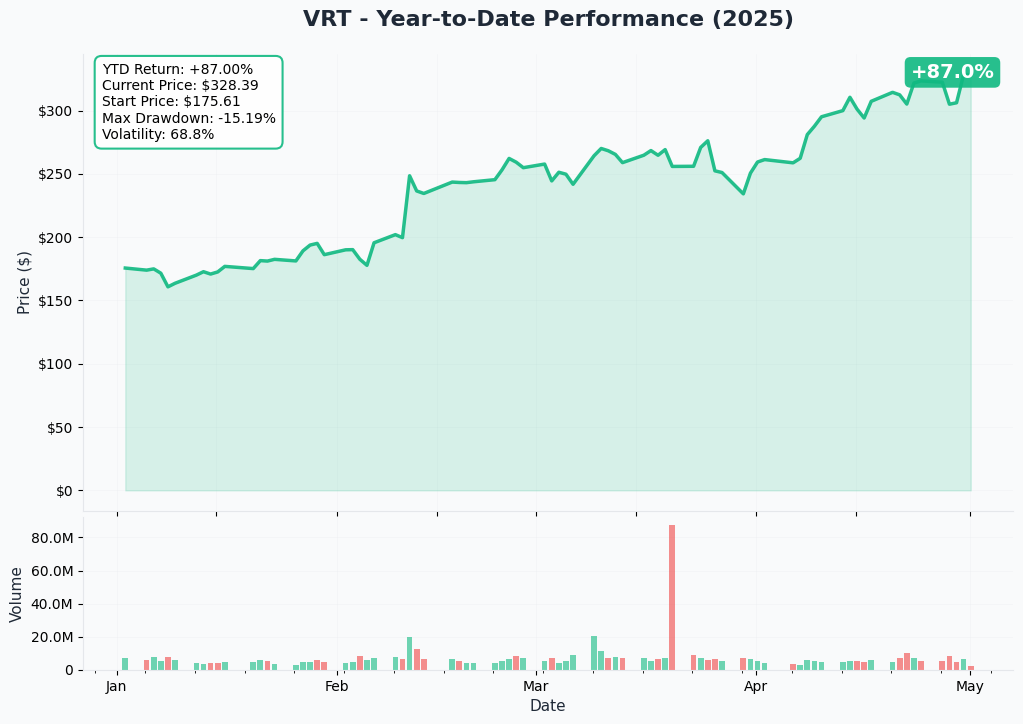
VRT has been one of the standout performers in 2026, rallying +60%+ YTD extending the AI infrastructure surge with the stock hitting a fresh all-time high of $330.30 on April 24, 2026 — just two days after the Q1 earnings blowout. Current price near $329 keeps VRT right at that all-time high zone.
Key observations:
- 🚀 Parabolic trend: VRT has been in a relentless grind higher as hyperscaler AI capex spending accelerates, with each earnings cycle validating the thesis
- 📈 Breakout above $300: The $300 level, a prior ceiling, is now structural support — the Q1 earnings gap confirmed the breakout
- 📊 All-time highs: $330.30 print on April 24 after JPMorgan (Stephen Tusa) and Morgan Stanley both raised price targets to $350 following the Q1 beat
- ⚠️ Extended territory: Stock has run 60%+ in a straight line — near-term consolidation at $310–$330 is the base case before the next leg
- 🎢 Volatility profile: As a high-beta AI infrastructure name, VRT can move 5–8% on a single catalyst; the implied move data below confirms options market is pricing in meaningful swings
Gamma-Based Support & Resistance Analysis
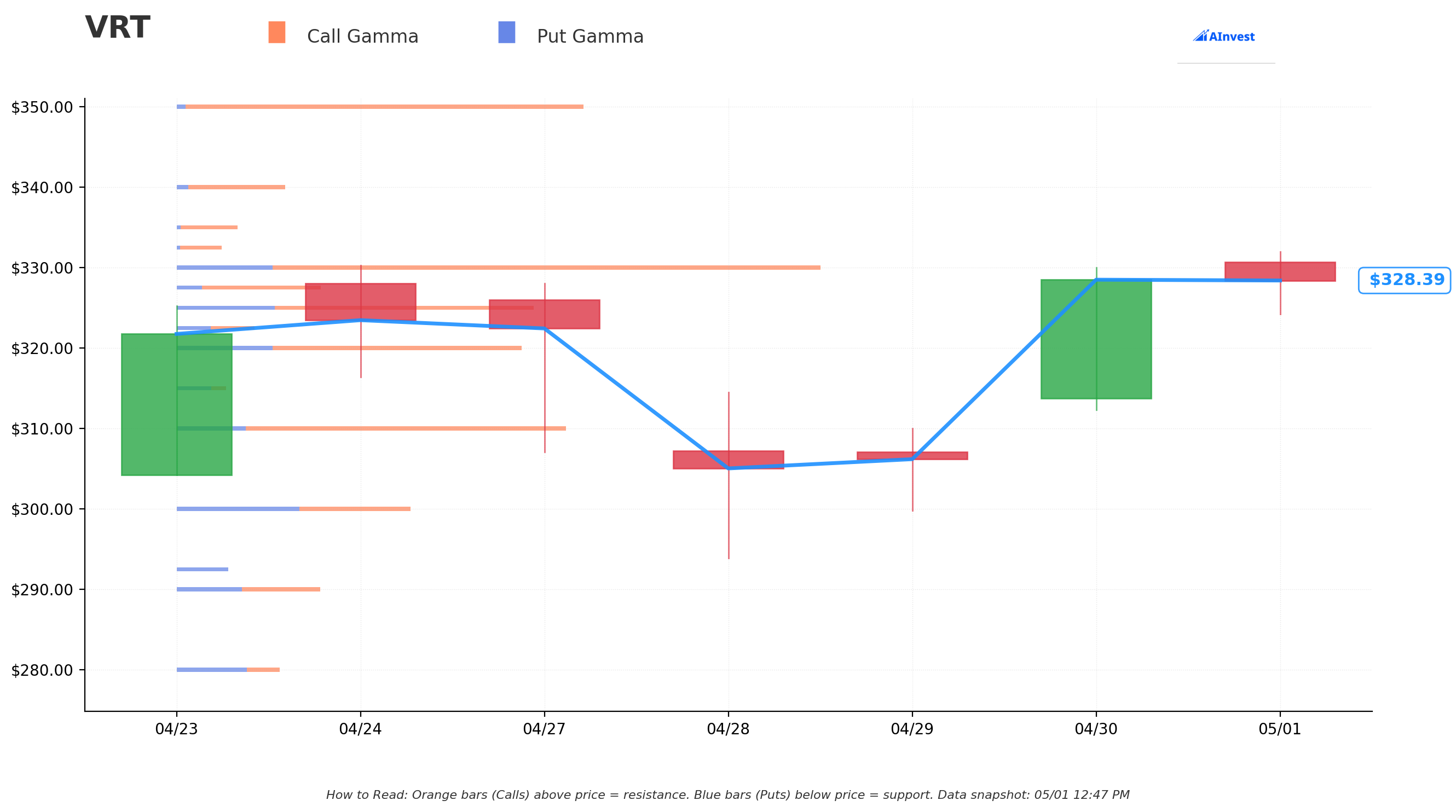
Current Price: $328.77
The gamma exposure (GEX) map reveals where market makers are most heavily positioned and where price action tends to get "sticky" or face mechanical pressure:
🔵 Support Levels (Put Gamma Below Price):
- $327.50 — Immediate gamma floor with 1.32B total GEX exposure. This is the first line of defense; VRT tends to find dip-buyers here during intraday weakness
- $325.00 — Secondary support with 3.14B total GEX — the strongest nearby put support level. Dealers are heavily long gamma here, which creates natural bid support as the stock approaches this zone. A $325 test is a buying opportunity in the near-term bull scenario
- $320.00 — Meaningful floor with 2.66B total GEX; 2.7% below current price. Clean break below $320 would signal short-term momentum is shifting
- $310.00 — Deep support at 3.47B total GEX; 5.7% below current price. This is where the real institutional buyer base sits — a $310 test would likely represent a strong re-entry zone for patient bulls
- $300.00 — Major structural floor at 2.11B total GEX and nearly balanced call/put gamma (net GEX essentially flat at -$0.07B). The $300 level has balanced two-sided interest and would represent a 9% pullback — an attractive entry point if macro deteriorates
- $290.00 — Extended floor at 1.28B total GEX; serves as a disaster-scenario support. Would require a significant macro shock or negative guidance revision to reach
🟠 Resistance Levels (Call Gamma Above Price):
- $330.00 — IMMEDIATE and STRONGEST resistance with 5.92B total GEX (4.36B net). This is the gamma wall VRT is running right into. Market makers are long enormous call gamma at $330 — they mechanically hedge by selling the underlying into rallies toward this level. The April 24 all-time high of $330.30 was essentially kissing this gamma ceiling and pulling back. VRT needs a sustained catalyst to push market makers to re-hedge above $330
- $340.00 — Secondary resistance at 0.99B total GEX. Once VRT clears $330 with conviction, $340 is the next meaningful ceiling — the Oppenheimer price target of $330 sits right at the first wall; JPMorgan/MS targets of $350 line up with the $350 resistance
- $350.00 — Heavy resistance at 3.77B total GEX. This is the analyst PT cluster zone (JPM, MS, Citi all have $350+ targets). A move to $350 would be a meaningful breakout and likely trigger a new leg of momentum
- $370.00 — Extended upside target at 1.57B total GEX; requires 12.5% rally from current levels
Net GEX Bias: Bullish — Total call GEX of 29.7B dwarfs total put GEX of 13.3B. Overall market maker positioning is tilted long, which provides a structural tailwind. However, the $330 gamma wall is the near-term ceiling that must be overcome.
What this means for the $400 call trade:
The whale buying $400 calls is betting VRT eventually punches through $330, $340, $350, and $370 resistance zones over the next 140 days. With the Investor Conference, 800 VDC launch, and NVIDIA Rubin ramp as potential catalysts, that is not an impossible scenario — but it requires multiple things to go right.
Implied Move Analysis
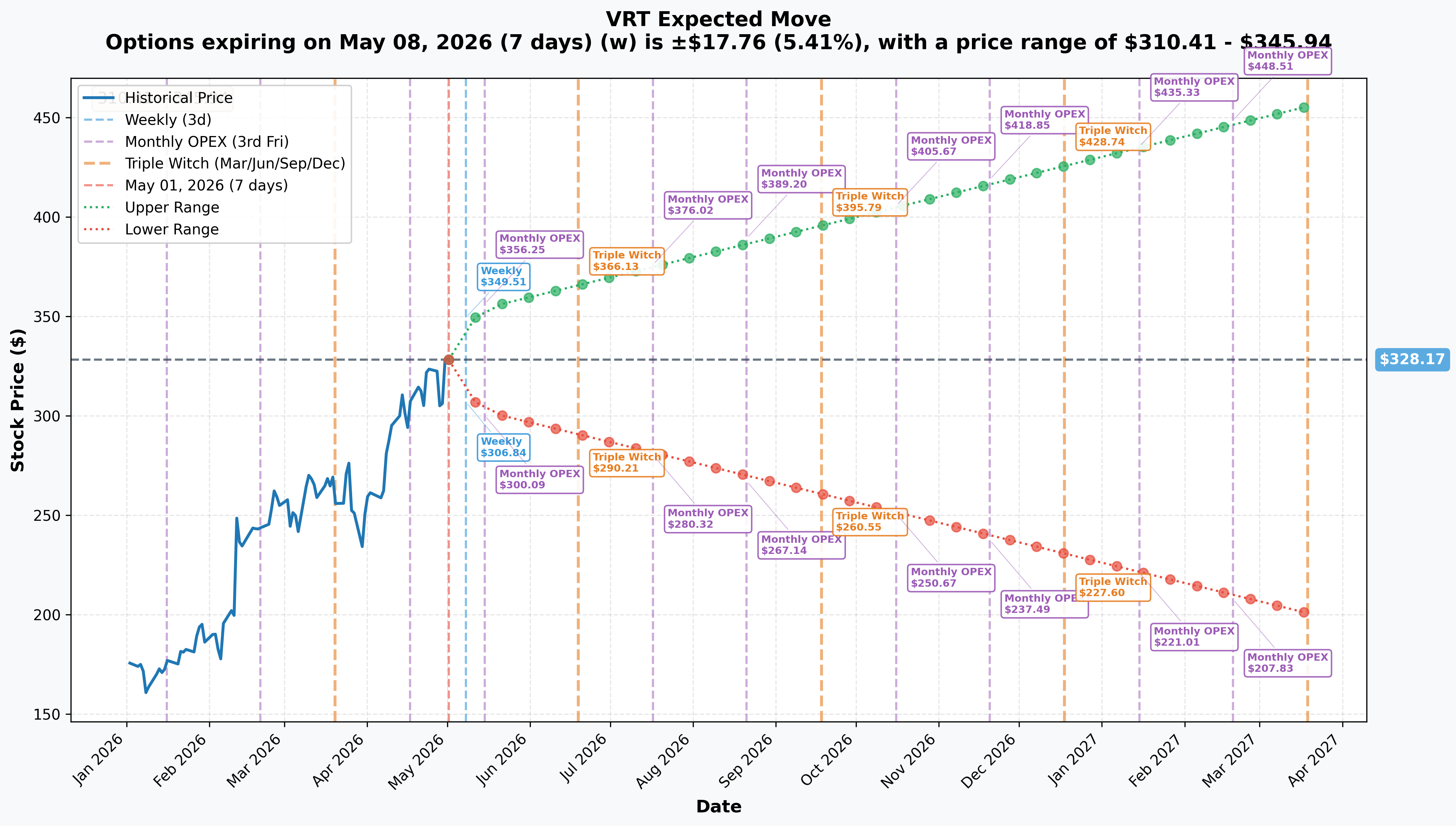
Options market pricing for upcoming expirations (from current $328.17 reference):
| Expiry | Type | Days Out | Implied Move | Upper Range | Lower Range |
|---|---|---|---|---|---|
| May 8, 2026 | Weekly | 7 days | ±5.41% / ±$17.76 | $345.94 | $310.41 |
| May 15, 2026 | Monthly OPEX | 14 days | ±7.95% / ±$26.10 | $354.27 | $302.07 |
| June 19, 2026 | Triple Witch | 49 days | — | $366.13 | $290.21 |
| July 17, 2026 | Monthly OPEX | 77 days | — | $376.02 | $280.32 |
| August 21, 2026 | Monthly OPEX | 112 days | — | $389.20 | $267.14 |
| September 18, 2026 | Triple Witch (THIS TRADE!) | 140 days | — | $395.79 | $260.55 |
| October 16, 2026 | Monthly OPEX | 168 days | — | $405.67 | $250.67 |
Translation for regular folks:
The options market is pricing a 5.4% move ($17.76) just by May 8 — that's a huge weekly implied move for a $118B+ market cap company. The May 19–20 Investor Conference is likely the trigger being priced in. The market expects fireworks around that event.
By September 18 expiration, the implied move model shows an upper range of $395.79 — tantalizingly close to the $400 strike where our whale is positioned. This is not a coincidence. The $400 strike sits just barely above the September implied-move upper bound, meaning the options market is acknowledging that $400 is within the realm of statistical possibility, but it requires a run that exceeds what the market currently prices in as "normal." The whale is betting the September range gets exceeded on the upside.
Key insight: The LEAP implied move upper for the March 2027 yearly expiry is $455.76, which means the options market sees $400+ as quite achievable over a longer time frame. The September 18 call is essentially trying to capture that long-term bull thesis in a more time-sensitive, leveraged window.
🎪 Catalysts
🔥 Recent Catalysts (Already Happened — Fueling the Bull Case)
Q1 2026 Earnings Blowout — April 22, 2026
Vertiv delivered a monster Q1 print that validated the entire AI infrastructure thesis:
- 📊 Revenue $2,650M, +30% YoY (23% organic, 4% M&A, 3% FX tailwind)
- 💰 Adjusted EPS $1.17 vs. $1.01 consensus — a +16% beat, +83% YoY growth
- 📈 Adjusted operating margin 20.8%, +430 basis points YoY — proof margins are expanding as volumes scale
- 🏦 Guidance raised to FY26 net sales $13.5–$14.0B (+34% YoY) and adj EPS $6.30–$6.40
- 📦 Record $15B backlog (+109% YoY), book-to-bill ~2.9x — nearly three dollars of new orders for every dollar shipped
A 2.9x book-to-bill is extraordinary. It means VRT's order pace is nearly triple its current shipping capacity. That backlog does not evaporate overnight and gives massive revenue visibility well into 2027, per The Motley Fool Q1 2026 earnings transcript and 24/7 Wall St backlog analysis.
Strategic Thermal Labs (STL) Acquisition — April 27, 2026
Just five days before this $1.4M options bet, Vertiv acquired Strategic Thermal Labs to deepen liquid-cooling capabilities at the server-side interface for AI/HPC workloads. This fills a capability gap in the thermal chain and cements Vertiv's end-to-end dominance from the chip-level CDU all the way to the building's heat rejection system.
NVIDIA 800 VDC Co-Development — Engineering Readiness Announced
Vertiv and NVIDIA announced engineering readiness for the 800 VDC power platform — centralized rectifiers, high-efficiency DC busways, and rack-level DC-DC converters — with product release scheduled for 2H 2026 to align with NVIDIA Rubin Ultra's 2027 rollout. This is not vaporware. Engineering readiness has been declared; products are on the way.
Analyst Price Target Wave — April 23–24, 2026
Following the Q1 beat, a wave of analyst upgrades followed:
- JPMorgan (Stephen Tusa): raised PT to $350 from $305, Overweight
- Morgan Stanley: raised PT to $350 from $285, Overweight
- Citi: raised PT to $353 from $340
- Oppenheimer: raised PT to $330 from $320, Outperform
Per MarketBeat consensus data, the average PT is now $335.59 with a high of $370 and a Strong Buy consensus — all below the $400 strike where our whale is positioned.
PurgeRite Acquisition Completed
Vertiv completed the PurgeRite acquisition expanding liquid-cooling commissioning and field-service capability, adding to the end-to-end service model that hyperscalers demand for mission-critical deployments.
🚀 Upcoming Catalysts (The Reasons for This Bet)
Vertiv Investor Conference — May 19–20, 2026 (18 DAYS AWAY!)
Vertiv's 2026 Investor Conference in Greenville, SC is the single most important catalyst between now and September 18 expiration. It is a two-day program expected to include:
- 📊 Long-term financial framework update (multi-year revenue and margin targets)
- 🏭 Manufacturing capacity roadmap (how quickly can they convert the $15B backlog?)
- ⚡ 800 VDC product reveal and commercialization timeline
- 🤖 AI total addressable market update tied to Rubin Ultra roadmap
- 🌡️ Liquid cooling adoption data and backlog composition breakdown
This is the event that could re-rate VRT's multiple meaningfully. If management guides to a higher long-term margin target or reveals a larger AI TAM, analyst models get revised higher and institutional money chases the stock through $350 and toward $370+.
800 VDC Power Portfolio Launch — 2H 2026
The 800 VDC platform release is scheduled for the second half of 2026. The first revenue contributions from this next-generation power architecture would be recognized within the September 18 option window. This is a new product category for Vertiv — centralized high-voltage DC distribution — that could meaningfully expand their share of wallet per AI factory deployment.
Q2 2026 Earnings — Late July 2026
The Q2 print falls before the September 18 expiration. Key metrics the market will focus on:
- 📦 Backlog: does it sustain above $15B or grow further?
- 📊 Book-to-bill: does 2.9x momentum hold?
- 💰 Adjusted operating margin: can they push toward 21%+?
- 🌡️ Liquid cooling mix: what percentage of thermal revenue is now DLC-based?
A strong Q2 print would likely be the fuel needed for VRT to challenge $370–$400.
ThermoKey Acquisition Close — Expected Mid-2026
The pending ThermoKey S.p.A. acquisition will add EMEA heat-rejection/heat-exchange capability, completing the end-to-end thermal chain from chip to building. This closes the final gap in VRT's liquid cooling product stack.
NVIDIA Rubin Ultra Ramp Visibility — 2H 2026
Hyperscaler order patterns for Rubin-class deployments will begin to crystalize in the second half of 2026. Vertiv's reference architecture role for NVIDIA Vera Rubin DSX and Omniverse DSX positions it as the default physical infrastructure supplier for the next NVIDIA compute cycle. Any early Rubin purchase order announcements would be a significant positive.
🎲 Price Targets & Probabilities
Using gamma levels, implied move data, and the catalyst calendar, here are the scenarios through September 18, 2026 expiration:
📈 Bull Case (30% probability)
Target: $390–$400+ | Options P&L: Profitable to home run
How we get there:
- 💪 May 19–20 Investor Conference delivers a multi-year upside surprise — management raises long-term margin framework from ~21% to 23%+ adjusted operating margin and quantifies $400 TAM for AI factory infrastructure
- 🚀 800 VDC platform launch in 2H 2026 captures immediate hyperscaler purchase orders — first revenue contribution beats internal estimates
- 🤖 Q2 2026 EPS beat sustains the pattern (Q1: +16% beat) with backlog continuing to grow toward $17–18B
- 📊 VRT breaks above $330 gamma wall convincingly, triggering technical momentum through $340 and $350 analyst PTs — momentum buyers chase the breakout
- 🌡️ Liquid cooling adoption accelerates beyond industry's 50% DLC penetration estimate — VRT's 23% precision cooling market share expands as the category grows
- 🧲 Implied move model shows upper range of $395.79 by September 18 — bull case puts VRT inside or at the $400 strike before any intrinsic value
Call P&L in bull case:
- VRT at $395 on Sept 18: calls worth ~$0 intrinsic minus premium decay (just below breakeven) — partial recovery
- VRT at $420 on Sept 18: calls worth ~$20/share → profit ~$3.8M on a $1.4M bet (170% gain)
- VRT at $450 on Sept 18: calls worth ~$50/share → profit ~$11.1M (690% gain)
Why 30%: Requires meaningful outperformance vs. current consensus PTs (all below $400) and a 30% rally from today's spot. High-magnitude catalysts are present but need to exceed already-elevated expectations. The gamma model's September upper range of $395.79 is below the $400 strike, meaning the market itself prices $400 as a slight above-consensus scenario.
🎯 Base Case (50% probability)
Target: $340–$370 range | Options P&L: Out of the money at expiration, partial value recovery possible
Most likely scenario:
- ✅ Investor Conference delivers solid but not blow-out guidance — margin framework in line with street, 800 VDC launch timeline confirmed but no surprises
- 📊 Q2 print meets expectations; backlog stays near $15B; book-to-bill moderates toward 2.0–2.5x as supply chains absorb some of the backlog
- 🌡️ Liquid cooling mix continues growing; 800 VDC product launches on time but initial revenues modest in 2H26
- 📈 VRT pushes through $330 gamma wall over the summer, runs to $350 analyst PT zone, consolidates in $340–$370 range by September
- 🎢 Implied move data shows September upper range at $395.79 — base case sees VRT reaching $355–$370 (within the gamma resistance cluster at $350 and $370) but stalling before $400
- ⚠️ At $370 on September 18, the $400 calls expire worthless — the $28.09 premium is lost in full
Reality check for retail traders:
The $400 call is 22% out of the money. Even in the base case where VRT has a great summer, the option expires worthless. The whale playing this trade is operating with a high-probability loss scenario baked in — but the max profit scenario (VRT at $450+) would be extraordinary. This is a high-gamma, low-probability-of-profit directional bet. Do not size into this type of trade as if it were a 50/50 proposition.
Probability at 50%: VRT's fundamentals support continued gains through $350–$370, but the 30%+ rally to $400 breakeven is a stretch for 140 days even with all catalysts hitting.
📉 Bear Case (20% probability)
Target: $290–$315 | Options P&L: Total loss of $1.4M premium
What could go wrong:
- 😰 Investor Conference disappoints — long-term margin targets remain unchanged or management flags execution challenges in liquid cooling ramp; stock gives back the post-earnings gains
- 🚨 Hyperscaler capex digestion — any announcements of paused data center buildout from Microsoft, Google, Amazon, or Meta hits VRT disproportionately given its concentrated end-market exposure
- 📉 Q2 2026 miss — if backlog growth stalls or margins compress due to supply chain costs, the 2.9x book-to-bill thesis gets questioned and multiples compress
- ⚠️ Insider selling overhang: 11 insider sales totaling ~$20.1M in the trailing 3 months with zero insider purchases is a yellow flag
- 🏢 In-house cooling competition from cloud operators (Microsoft, Google, Meta developing proprietary thermal management IP) erodes VRT's addressable market, per Quiver Quant risk analysis
- 💸 Valuation compression: at ~35x forward P/E, per Seeking Alpha valuation analysis, any guide-down would compress the multiple toward 25x, taking the stock toward $300 or below
Gamma support in bear case:
- $325 (3.14B total GEX) → First meaningful bounce zone
- $310 (3.47B total GEX) → Strong institutional buyer floor
- $300 (2.11B total GEX) → Near-balanced call/put gamma; structural support
Why 20%: VRT's $15B backlog, 2.9x book-to-bill, and NVIDIA partnership create a strong fundamental floor. A meaningful pullback requires a genuine demand shock or macro deterioration. However, the stretched valuation and insider selling warrant keeping the bear case at non-trivial probability.
💡 Trading Ideas
🛡️ Conservative: Wait for the Investor Conference Dip
Play: Watch the May 19–20 Investor Conference from the sidelines, then buy a modest stock or in-the-money call position on any post-event pullback to gamma support.
Why this works:
- ⏰ The Investor Conference is a binary event. Even with great news, VRT has already rallied 60%+ YTD — "sell the news" patterns are real. Institutional players often distribute into anticipated catalysts
- 📊 Implied move shows VRT could swing ±$17–$26 over the next 7–14 days. Waiting for the dust to settle costs you a few days of potential upside but dramatically reduces the risk of buying the top
- 🎯 A pullback to $310–$325 gamma support zone would represent a 3.5–5.7% drawdown from current levels — not unusual after a catalyst event — and would offer a far better risk/reward entry
- 📈 Stock exposure or a June/July in-the-money $320 or $325 call gives you the upside participation without the premium burn of the 22%-OTM $400 strike
- 🌡️ Look for confirmation signals at the conference: management raising the operating margin framework above 21%, announcing $400+ TAM quantification for 2027+, or revealing 800 VDC launch customer wins
Sizing suggestion: Risk only 3–5% of portfolio on any single entry. This is not a "set and forget" — set a mental stop loss at $300 (below major gamma support) and be willing to exit.
Risk level: Low to moderate | Skill level: Beginner-friendly
Expected outcome: Avoid potential 8–12% drawdown if conference disappoints. Get a superior entry price. Maintain full optionality for the summer rally thesis.
⚖️ Balanced: Bull Call Spread to the Analyst PT Zone
Play: Buy the September 18, 2026 $340/$370 call spread — let the whale carry the $400 lottery ticket while you target a high-probability win in the analyst PT range.
Structure: Buy the $340 call (September 18, 2026), sell the $370 call (September 18, 2026)
Why this works:
- 🎯 The $340–$370 range is exactly where the analyst consensus and gamma resistance line up. JPMorgan, Morgan Stanley targets at $350; Citi at $353; gamma resistance at $350 (3.77B GEX) and $370 (1.57B GEX) — you're selling at the wall
- 📊 A bull call spread is defined-risk: maximum loss is the net debit paid, maximum gain is the spread width minus net debit. No naked premium exposure
- 💰 Estimated net debit: roughly $8–$12 per spread depending on mid-market pricing (roughly 35–40% of the spread width). This is substantially cheaper than buying the outright $400 call
- 🏆 Max profit: $18–$22 per spread (spread width $30 minus net debit) if VRT closes at or above $370 on September 18
- ⚖️ Breakeven: approximately $348–$352 — a 6% rally from current levels. This is well within the base case range
- 📈 Probability of profit roughly 40–50% — far better than the outright $400 call's <25% in-the-money probability at expiration
- 🔑 The September 18 Triple Witch expiration also benefits from maximum open interest concentration — large institutional players roll or exercise positions at major expirations, creating more orderly price discovery
Entry timing: Consider entering after the May 19–20 Investor Conference resolves. If VRT sells off post-conference to $310–$325 support, the spread's net debit decreases (implied volatility may spike then crush) — you get better pricing on the spread.
Risk/Reward: Risk $8–$12 to make $18–$22 per spread (roughly 1.8:1 reward-to-risk) | Skill level: Intermediate
Position sizing: Risk no more than 2–4% of portfolio. Buy 5–20 spreads depending on account size.
🚀 Aggressive: Follow the Whale (Partial Position), Managing Size
Play: Replicate a scaled-down version of the whale's $400 call buy — but size it appropriately for a retail account so you can absorb a 100% loss without material portfolio damage.
Structure: Buy 1–5 contracts of the VRT September 18, 2026 $400 call at ~$28.09 per share ($2,809 per contract)
Why this could work:
- 🐋 The whale putting $1.4M into this single position is not doing it blindly. The timing — Q1 blowout earnings, $15B backlog, Investor Conference 18 days away, 800 VDC launch 2H 2026 — creates a dense catalyst schedule within the 140-day window
- 💰 September 18 is Triple Witch, meaning maximum open interest concentration and dealer gamma hedging flows — large moves into major expiries are common as dealers adjust hedges
- 🤖 The implied move model shows a September upper range of $395.79. The $400 strike is only $4.21 above that — meaning if VRT runs to the very top of its statistical range, you're nearly at breakeven, and any further upside is pure profit
- 🚀 Optionality value: if VRT delivers a blowout Investor Conference AND a strong Q2 print in late July, momentum could push toward $380–$400 organically. The call's delta will increase substantially as price approaches the strike, amplifying gains
- ⏰ 140 days of runway gives time for three potential catalysts to materialize: Investor Conference (May 19), Q2 earnings (late July), and 800 VDC launch (2H 2026 — within the window)
Why this could blow up (READ THIS CAREFULLY):
- 💸 Maximum loss is 100% of premium. If VRT is below $400 on September 18, 2026 — which is the most likely scenario — you lose every dollar you put in. A $329 VRT on expiration day means a total wipeout on this leg
- ⏰ Theta decay (time decay) will erode the option's value every single day, even if VRT is flat or slightly higher. At 140 days out with high implied volatility, theta burn accelerates as you approach expiration
- 🎢 The $400 strike requires a 22% rally from spot just to break even. That is not a base case move — it is an optimistic, multi-catalyst scenario
- ❗ If implied volatility (IV) contracts post-Investor Conference (which is very common after catalysts resolve), the option could lose 20–35% of value even if VRT moves slightly higher
Estimated P&L scenarios (per contract):
- VRT at $370 on Sept 18: option expires worthless → -$2,809 (100% loss)
- VRT at $400 on Sept 18: option at intrinsic value ~$0 (at-the-money) → -$2,809 (100% loss)
- VRT at $420 on Sept 18: option worth ~$20 → lose ~$809 per contract (-29%)
- VRT at $450 on Sept 18: option worth ~$50 → gain ~$2,191 per contract (+78%)
- VRT at $480 on Sept 18: option worth ~$80 → gain ~$5,191 per contract (+185%)
Breakeven: $428.09 on expiration day — a 30% rally from today's $329.16 spot
Risk level: HIGH — designed for 1–3% of portfolio maximum. Can lose all of it. | Skill level: Advanced | Probability of profit at expiration: approximately 20–25%
CRITICAL: Size this as you would a lottery ticket with a real thesis. One to five contracts is appropriate. Do not go in for $10,000+ unless you have a $500,000+ options account and full understanding of path dependency.
⚠️ Risk Factors
Do not get caught by these landmines:
-
📅 Investor Conference binary event (May 19–20, just 18 days away): VRT has rallied 60%+ YTD. The conference is the next major catalyst but also a "sell the news" risk. If management's long-term guidance meets rather than beats the elevated expectations, the stock could pull back 8–12% even on a technically positive presentation. The $330 gamma wall creates additional resistance precisely as VRT approaches the event.
-
💸 Valuation is stretched at ~35x forward P/E: Seeking Alpha notes VRT trades at a significant premium vs. NVDA/AVGO at ~25x. At $15B+ market cap and 35x earnings, any slowdown in the backlog conversion story results in multiple compression. You don't need a bad quarter — you just need a "less great" quarter to move the stock 10–15% lower.
-
❗ Insider selling with zero insider buying: SEC Form 4 filings show 11 insider sales totaling ~$20.1M in the trailing three months, with zero insider purchases. Management is cashing out. This is a yellow flag, not a red one — but when insiders who know the business best are consistently selling and not buying, it is worth noting.
-
🏢 In-house cooling development by hyperscalers: Quiver Quant flags that Microsoft, Google, Meta, and AWS are developing proprietary thermal management technology that could erode VRT's third-party demand share over a 2–4 year horizon. This is a slow-moving risk but a real one.
-
🔧 800 VDC execution risk: The 2H 2026 launch is a complex new product family requiring field-service certification for high-voltage DC systems. Any delay pushes first revenue recognition out of the September 18 window and into Q1 2027, potentially disappointing a market that's already pricing the launch.
-
🌍 EMEA softness and FX risk: The Q1 FX tailwind of 3% could reverse. Yahoo Finance Q1 highlights flagged some EMEA segment softness — if European data center capex moderates, VRT's geographic diversification story weakens.
-
🔄 Integration risk from three concurrent acquisitions: Strategic Thermal Labs, ThermoKey, and PurgeRite all require management bandwidth and execution focus. Running three integrations simultaneously while converting a $15B backlog is operationally demanding.
-
🎢 The $400 call has a high probability of expiring worthless: This is worth stating plainly. The breakeven is $428.09, requiring a 30% rally in 140 days. The most probable outcome for anyone buying these calls is a 100% loss. The whale can absorb that loss as part of a diversified book. Retail traders need to size accordingly.
🎯 The Bottom Line
Real talk: A well-funded trader just dropped $1.4M on VRT $400 calls betting the AI cooling thesis is still in the early innings — not the ninth. The timing is deliberate: Q1 2026 was a 16% EPS beat with a record $15B backlog and 2.9x book-to-bill, the Investor Conference is May 19–20, and the NVIDIA 800 VDC platform launch is 2H 2026. The September 18 Triple Witch expiration captures all of it in one window.
What this trade tells us:
- 🎯 Conviction-level positioning: 501 contracts vs. 256 open interest — this trade is nearly 2x the entire existing open interest pool. This is someone making a statement, not dipping a toe
- 💰 Premium paid upfront — $28.09/share. If they're wrong, they lose $1.4M. If they're right and VRT hits $450, they make roughly $11M on that single position. The whale's risk/reward math makes sense at their scale
- 📊 Z-score of 19.39 means this is not noise. This is deliberate, unusual, institutional-grade activity in a name that has already proven its earnings cadence
- ⚙️ The catalyst sequence is the cleanest it has been: Investor Conference → Q2 print → 800 VDC launch → Rubin Ultra ramp visibility — four distinct shots on goal within 140 days
If you own VRT stock:
- ✅ The whale's conviction BTO is a vote of confidence in the fundamental story — your long thesis is validated
- 📊 Watch the $330 gamma wall as your first test. A clean break above $330 with volume signals the next leg is starting
- ⏰ Mark May 19–20 Investor Conference as the key inflection point. If management raises the long-term framework, the stock likely races toward $350 and beyond
- 🛡️ Consider setting a mental stop at $300 — below that level, the near-term narrative has cracked and you want to reassess before the Q2 print
- 💡 If you want to add leverage exposure on top of your stock position, the balanced spread ($340/$370 calls) is far more efficient than chasing the $400 call at this price
If you're on the sidelines:
- ⏰ May 19–20 Investor Conference is the near-term hinge. Do not chase into the event — wait for the post-conference reaction. A dip to $310–$325 gamma support is a gift if the fundamental thesis holds
- 🎯 Look for confirmation at the conference: margin framework raised, 800 VDC launch customers revealed, backlog grows past $15B in Q2 guidance
- 📈 The implied move model shows VRT could be at $395.79 by September 18 in the upper range scenario. The stock does not need to hit $400 for bulls to win — $350–$370 is a solid outcome for stock holders and spread traders
- ⚠️ If you enter the $400 calls directly, limit this position to 1% of portfolio maximum. Treat it as a high-conviction speculative allocation, not a core holding
If you're skeptical:
- 👀 The $330 gamma wall is your tell. If VRT cannot clear $330 with conviction heading into the May 19 conference, momentum is stalling and the bear case probability rises
- 📉 A break below $310 gamma support (3.47B total GEX) would be a meaningful shift — below that level, the next major support is $300
- 🎯 Post-conference put spreads ($310/$290 or $300/$280) offer defined-risk downside exposure if the conference disappoints — but wait for the event to resolve before entering bearish positioning
Mark your calendar — Key dates:
- 📅 May 19–20, 2026 — Vertiv Investor Conference, Greenville SC (THE near-term catalyst — details here)
- 📅 Late July 2026 — Q2 2026 Earnings (backlog update, margin expansion, book-to-bill momentum check)
- 📅 2H 2026 — 800 VDC power portfolio commercial launch — first revenues from next-gen power architecture
- 📅 September 18, 2026 — Triple Witch OPEX; expiration of this $1.4M call position
- 📅 Late October 2026 — Q3 2026 Earnings (first quarter where 800 VDC/Rubin contributions may become visible)
- 📅 2027 — NVIDIA Rubin Ultra ramp; VRT reference architecture potentially drives a new ordering cycle
Final verdict:
Vertiv's fundamental story — record $15B backlog, 2.9x book-to-bill, NVIDIA 800 VDC co-development, STL acquisition deepening the thermal moat, and a dense catalyst calendar — is one of the most compelling pure-play AI infrastructure setups in the market. The $1.4M whale bet is a high-conviction directional call on that thesis playing out by September.
For retail traders: the whale's trade is real, the thesis is real, but the probability of the $400 call printing money is low. The smarter play is to participate in VRT's bull thesis through stock exposure or the more conservative spread strategy, then let time and catalysts do the work.
Be patient. Let the Investor Conference print. Then allocate.
Disclaimer: Options trading involves substantial risk of loss and is not suitable for all investors. This analysis is for educational and informational purposes only and does not constitute financial advice. Past option flow activity does not guarantee future results. The BTO classification reflects a new long position opened on the ask side — it does not imply directional certainty. The Z-score of 19.39 reflects the unusual size of this trade relative to recent VRT call history; it does not imply the trade will be profitable. The $400 call has a high probability of expiring worthless — approximately 20–25% chance of being in the money at September 18 expiration based on current implied move data. Always conduct your own research and consider consulting a licensed financial advisor before making any investment decisions. Position sizing appropriate to your risk tolerance and account size is essential.
About Vertiv Holdings Co.: Vertiv Holdings Co. is a global provider of critical digital infrastructure and continuity solutions for data centers, communication networks, and commercial/industrial environments. Headquartered in Westerville, Ohio, the company is the pure-play leader in AI factory physical infrastructure — power management, thermal/cooling systems, integrated rack and modular solutions — with a record $15B backlog as of Q1 2026 and a deep co-development partnership with NVIDIA spanning 800 VDC power architectures and Vera Rubin DSX AI factory reference designs.