Ainvest Option Flow Digest - 2026-08-07
🔄 Updated August 10, 2026 — the next-day open-interest test is in, and it went against us on five names. Of 40 legs, 11 expired August 7 and are permanently unresolvable; of the 29 that could be settled, 23 opened, 5 closed, 1 was a pure transfer. The decisive GLD fork we published landed on the side we argued against. SPY's $775 close, MCHP's September close, META's calendar and SKHY's bull call spread were all corrected. Details in each ticker's ✅ RESOLVED box and in the section replacing tomorrow's callout below.
≈$285.0M net premium across 13 names. The number that matters today is not the biggest one on the page — it is $227M of NVIDIA call trading that carries no view on NVIDIA at all, and a GLD package that cost $175,500 to move $57.6M of gold exposure.
⚡ Quick Read
Today's board is dominated by rolls and financing, not by fresh directional bets. Seven of the thirteen names are positions being moved rather than opened, and three are pure carry transactions dressed in options. Only 13 of 39 legs can be proven open from today's tape. There is essentially no lit sweeping anywhere — a single small SKHY leg is the only genuinely lit print on the entire board.
Three things worth your time:
- ⭐⭐ GLD — a gold bet placed yesterday, and a second, bigger one stacked on top for free. Two strikes sat flat near 800 and 350 contracts for weeks, then jumped to 28,629 and 31,667 overnight. We taped yesterday: both were bought at the ask — a long strangle. Gold then hit seven-week highs. Today those exact strikes are sold and wider ones bought, at a $175,500 credit. 🔄 We called this a roll; open interest says it was not. All four legs opened — the $460 call went 28,629 → 67,622 instead of collapsing toward zero. Yesterday's strangle was never retired. What actually printed is a self-financing double backspread that pays only below ≈$320 or above ≈$550.
- ⭐⭐ NVDA — $227M gross across four packages, and every single one is financing. All four pairs are $7.50 apart in strike and net to exactly $7.50. Every strike carries a delta between 0.9795 and 0.9922 — these are stock substitutes, not options. Combined package delta: ≈−7,358 shares. That is roughly $1.6M of directional exposure out of a quarter of a billion dollars of trading. And every leg expired today, nineteen days before NVIDIA's confirmed August 26 print.
- ⭐ SPY — two new strikes opened above a Monday position that did not actually close. The $775 strike sat flat near 2,500 contracts, then jumped +85,247 in one session; we taped August 4 and found the buying (71% weighted across). Today 82,908 of them trade at a size that fits inside the position — and $780 and $788 open at 138,230 contracts each, since confirmed. 🔄 But the $775 line did not come down: 89,368 → 90,973 on 136,560 contracts of volume. That is a transfer, not an exit — and it removes the main support for our roll-up lean, leaving the new vertical's direction less settled than we implied.
- ⭐⭐ MCHP — the Monday roll is being vindicated, and it is the same desk. On August 4 somebody rolled down and out (sold September $75 calls, bought December $65s), crystallising a ≈$102.6M realised loss. Then Microchip reported above expectations and raised guidance. The stock is +14.34% today. Today that desk sold 93.5% of what remained in September and added to December. A painful, patient adjustment that is now working. 🔄 One correction: the December leg opened to the contract (66,252 → 119,162), but the September line fell only 3,299 of a 52,920-lot sale — ≈94% transfer. 53,300 September $75 calls are still outstanding; that position was not retired.
- ⭐⭐ META — two trades, same name, opposite intent. At 13:30 a $9.9M calendar spread was hedged flat 61 seconds after it printed — a 44,000-share block against a package delta we computed independently at +45,360 shares, a 97.0% match. Then at 15:52, eight minutes before the close, $69.8M of January-2027 $750 calls printed as a single-leg floor block — and the equity tape shows 300 shares against +801,600 of delta. Completely unhedged. Same ticker, same session: one trade deliberately removed its direction, the other is nothing but direction.
- ⭐ GDX — a $40M gold-miner call purchase that says nothing about gold. Strikes $2.50 apart, net paid exactly $2.50, both deltas above 0.98, package delta +11,778 shares on a $23.66B fund. This is financing. On a day gold miners rose 6.12%, the largest trade in the name had no view on the metal whatsoever.
Two habits to take away from today. First, before reading anything into a two-strike trade, compare the net premium to the strike width. GDX paid $2.50 on a $2.50 spread; PLTR collected $5.00 on a $5.00 spread. When those match there is no market view in the trade — and with NVIDIA's four packages added, roughly $294M of today's notional falls into that bucket. Second, check the open-interest history before you read a big print. That single query is what turned GLD's four confusing legs into one clear story, and it is what proved META's package was hedged rather than bullish.
🔁 OI Review — Last Session's Provisional Flags, Now Resolved
Yesterday's board has been through the next-day open-interest test, and five of eighteen names came back meaning something different than they looked. All 35 legs from the August 6 session are settled: 22 opens, 5 closes, 8 flat or pure transfer. Three separate names — AMD, TLT and ECHO — printed ≈$87M of headline premium between them and created no new open interest at all.
🔄 Inversions
🔄 TTWO — the "$8.9M bear call spread sold into earnings" was a BULL call spread being CLOSED. Open interest collapsed on both strikes: September $270 call 27,182 → 6,025 (−21,157) and $310 call 28,250 → 6,603 (−21,647), each a bigger drop than the 19,905-lot print. Open interest only falls when both sides close, so the sale was a sell to close a long $270 call and the purchase a buy to close a short $310 call. Corrected: a bullish desk de-risking one day before a confirmed print, not a desk fading it. The $70.7M tail we published does not exist — there is no open short spread. Our own swing-trader note had named this branch: "if it turns out to be a close, the signal inverts entirely."
🔄 IGV — not a roll. A brand-new short calendar, and our published test called it. We staked the roll thesis on one falsifiable number: August-21 $100 open interest had to collapse toward ≈0–1,000. It went the other way — 19,308 → 38,739 (+19,431, 97.2% of the print) — and the pre-existing position was never touched. The November leg opened too (1,750 → 21,764). Corrected: long the August $100 call, short the November $100 call, $10M credit — a short (reverse) calendar betting back-month software volatility is expensive. Watch August 21: when the front-month long expires, what remains is a naked at-the-money short November call with uncapped upside risk.
🔄 AMD — $54.4M of 2028 LEAP calls that created zero new exposure. Open interest fell on both strikes: $760 call 2,351 → 1,498 (−853) and $860 call 2,744 → 2,526 (−218), on day volume of 2,001 and 2,018 — essentially just this package, so there is no ambiguity about attribution. A buy that reduces open interest is a buy to close. Corrected: at least 1,071 contracts of existing position were retired and the rest changed hands; no new long call exposure entered the market. Not bearish either — closing a short call removes a bearish obligation. The structural finding stands: two outright calls, not a vertical, proven by $14 of price difference across a $100 strike gap.
🔄 ECHO — nothing opened, and the direction was backwards. We called all five legs proven opens. The two large ones were transfers ($140 put flat at 2,700, $135 put −7) and the three small ones were closes ($125 put 396 → 34, $130 put 160 → 0 — the strike ceased to exist — September $145 put 187 → 8). Corrected on two counts: nothing was created, and because a sale that reduces open interest is a sell to close, what we described as "unmatched short puts carrying real downside risk" were long puts being sold to close — the opposite exposure. The financing arithmetic survives ($4.90 collected on a $5.00 width); the claim that any of it was new does not.
🔄 TLT — $20.4M of deep in-the-money puts, twenty contracts of net change. $110 put 7,776 → 7,776 (0), $107 put 500 → 500 (0), $120 put 140 → 140 (0), $105 put 2,626 → 2,646 (+20) — against 14,090 contracts printed. Corrected: a pure transfer. The position still carries −554,170 shares of short-duration delta and three FOMC meetings still sit inside the January expiry, but nobody expressed that view on August 6 — an existing position simply changed hands.
✅ Confirmations
- ⭐⭐ SNDK — the $286.5M put sale landed on the contract. We predicted 5,660 and open interest printed 5,660, up exactly 5,000 from 660. The unhedged, directional read stands. Both September strangle legs opened at roughly three times the flagged size (1,350 put +1,845 on a 675 print; 1,430 call +2,061).
- ⭐ GLD — a third straight confirmation. Both legs opened at ≈103% of the print ($410 call 14,868 → 72,065; $430 call 7,075 → 64,205), so other participants joined the structure. Gold upside is being sold in size on consecutive sessions by desks creating new short call exposure, not covering.
- MSFT — both legs new, and ≈124% of the flagged size ($525 call 1,914 → 31,459; $570 call 1,897 → 31,383). Two near-empty strikes became 31,000-lot lines; the $19M spread was not the only one put on.
- IBIT — roughly double what we flagged. The December-2028 $15 put went 1,312 → 66,083, so the 31,714-lot block we wrote about was only about half the day's opening buying at that strike. The bitcoin tail hedge is twice the size the headline implied.
- S — the cleanest print of the session. The December-2028 $30 put went 0 → 4,500: an empty strike now holding exactly the print size and nothing else. The $35 call confirmed at 98.9%.
- CELH (34 → 50,275 and 243 → 50,232, both ≈100%), ASX (74 → 10,094; 5 → 5,011), B (684 → 10,401), CRM (338 → 5,296, within four contracts of the prediction), ADBE (937 → 3,748) and DELL (74 → 670, exactly the predicted number) all confirmed opening.
- PANW opened at ≈186% of the flagged block (202 → 2,541), and UBER at 92.1% (4,699 → 10,687) — the narrowest margin on the board, exactly the thinner-margin outcome its ⏳ callout warned about, with ≈8% of the print matched against a closing counterparty.
What changed
The dollar totals are untouched — open interest never moves the cash. What moved is what those dollars mean. TTWO's $8.9M was an exit, not an entry. AMD's $54.4M, TLT's $20.4M and ECHO's $12.6M established nothing between them — ≈$87M of headline premium behind zero new exposure. IGV's $10M is a real new position, just a different one than we described. Against that, the two largest confirmed reads on the board held completely: SNDK's $286.5M put sale opened to the contract, and GLD's second-session bear call spread opened at more than full size.
The standing lesson, and this session proves it three times: size exceeding prior open interest is suggestive of an open, not proof of one. Eleven legs cleared that bar on August 6 and did not open. On negotiated floor blocks the premise behind that test — that the print is the only activity and neither side is closing — fails routinely. And a matching lesson for reading any flow scanner: "BUY" does not mean "opened." Buy-to-open and buy-to-close print identically; only the next morning's open-interest count separates them.
📊 At a Glance
| Ticker | Net Premium | Direction | Structure | Expiry Bucket | Proven Open? |
|---|---|---|---|---|---|
| MCHP | $69.85M debit | ⚠️ Roll, bullish-adjusting | Long call roll down & out | Quarterly / LEAP | Dec ✅ open · 🔄 Sep NOT retired |
| META | $79.70M debit | ⚠️ One hedged flat, one naked | Calendar + $69.8M naked LEAP call | Quarterly / LEAP | Mar ✅ · $750 ✅ (42%) · 🔄 Sep closed |
| SPY | $45.98M credit | ⚠️ New vertical; $775 not closed | $780/$788 vertical | Weekly + Quarterly | $780/$788 ✅ · 🔄 $775 transfer |
| SMH | $16.21M credit | 🐻 Upside sold | Short call, ≈29% OTM | LEAP (Jun-2027) | ✅ confirmed open (99.3%) |
| SKHY | $16.11M debit | 🐂 Net bullish | 5 legs, 3 timestamps | Quarterly / LEAP | 4 of 5 ✅ · 🔄 $180 closed |
| NVDA | $14.22M debit | ➡️ No view ($227M gross) | 4× deep-ITM financing spreads | 0DTE | ⛔ unprovable (expired) |
| SNDK | $10.73M credit | ➡️ Delta-neutral roll | Expiring call rolled out & up | Weekly | Buy ✅ (185%) · ⛔ sell leg expired |
| ADBE | $9.36M debit | 🐻 Downside bought | Put ladder, two strikes | Quarterly (Oct) | ✅ both confirmed |
| NN | $8.62M debit | 🐂 Bullish | Roll + call additions | Quarterly | ✅ all 4 confirmed |
| GDX | $6.85M debit | ➡️ No view | Deep-ITM financing spread | 0DTE | ⛔ unprovable (expired) |
| PLTR | $5.71M debit | 🐂 Roll up & out | Roll + financing pair | Quarterly + 0DTE | ✅ roll confirmed both legs |
| PCG | $1.51M debit | 🐂 Bullish | Long call, 11.5% OTM | Quarterly (Sep) | ✅ OPEN (178% of print) |
| GLD | $0.18M credit | ↔️ Long volatility | Double backspread (not a roll) | Monthly (Nov) | 🔄 all 4 OPENED (not a roll) |
Net total: ≈$285.0M (structural — long premium paid minus short premium collected; gross overstates spreads).
📈 One-Year Performance — All Thirteen Names
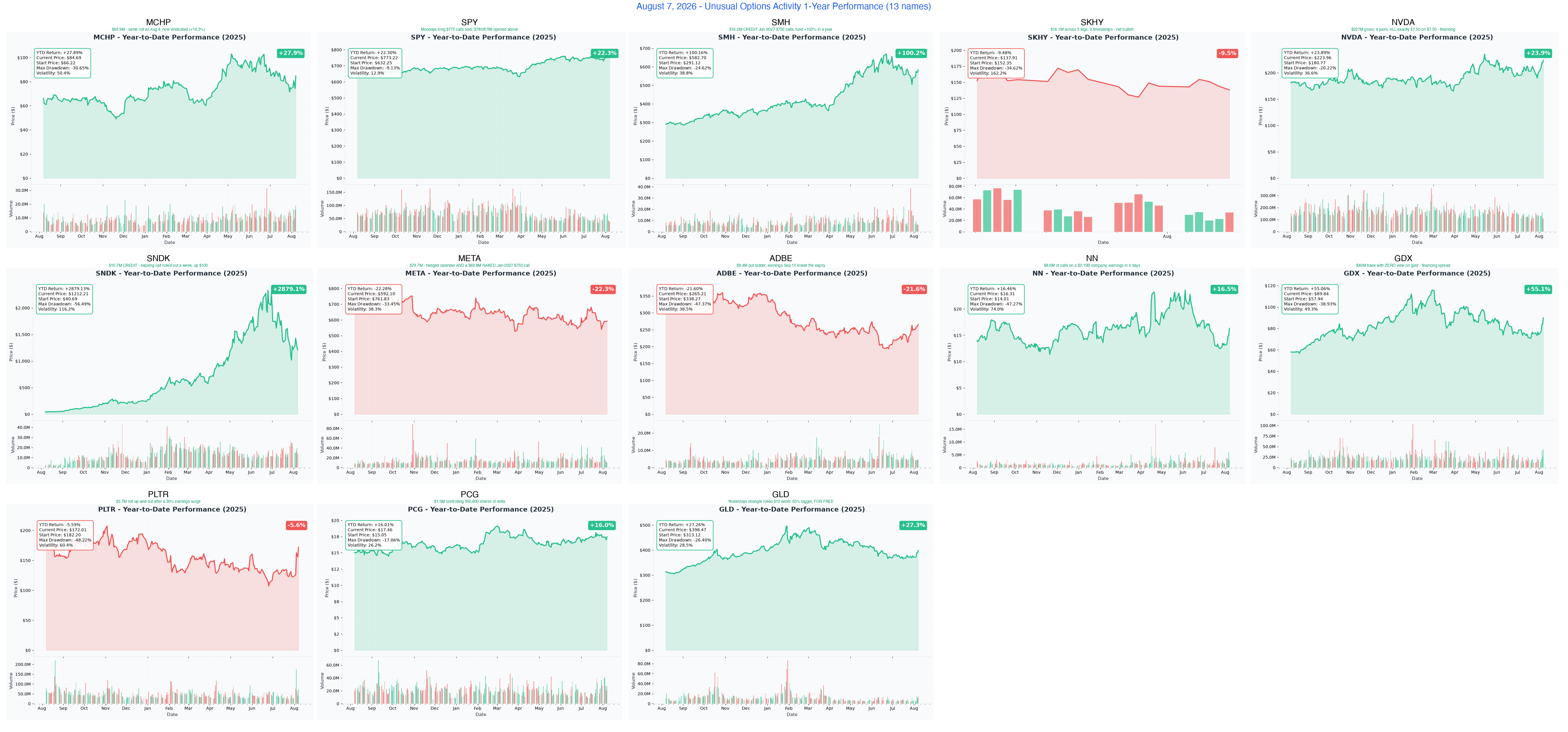
The grid tells its own story. SMH is +99.4% and SKHY is −10.5% — the same broad sector, opposite years. ADBE is −21.4% and somebody is buying more downside. META is −22.2%, which surprises people — and is the backdrop to a $69.8M naked bet on it reaching $750. GLD is +27.1% and sitting mid-range between $305 and $510 — exactly where a strangle makes sense. SPY is +22.2% and sits within ≈0.5% of its 52-week high. And PLTR is −5.8% on the year despite being up ≈30% since Monday, which is the single most useful correction to the headlines about it.
🗂️ By Expiry Bucket
⏱️ 0DTE (expires today) — $274M of notional, zero directional content NVDA $227.7M gross across four packages, GDX $39.6M, and half of PLTR ($26M) — all deep in-the-money financing spreads priced at exactly the strike width. None can be resolved by tomorrow's open interest; they simply expire. Read nothing into any of them. This is the single largest category on today's board, and it is the least meaningful.
📅 Weekly — SPY and SNDK SPY's August 14 expiry is deliberately clean: no FOMC meeting, and it ends before NVIDIA's confirmed August 26 print. A desk closing one strike and opening two above it chose a window with no scheduled event in it.
An expiring $800 call rolled out one week and up $100, for a $10.7M credit. Delta change: −2,530 shares. The directional exposure did not move; the holder took intrinsic value off the table after a guidance disappointment.
📆 Monthly / Quarterly — the real positions MCHP (Sep → Dec), ADBE (Oct, carries confirmed September 10 earnings), NN (Sep + Dec, carries confirmed August 11 earnings — four days away), PCG (Sep), PLTR (Dec).
GLD sits alone in November — and that expiry contains all three remaining FOMC meetings. A desk that just up-sized a long-volatility position by 65% into three rate decisions has a coherent reason to be there.
🏔️ LEAPs — SMH, SKHY and META June-2027 $750 calls sold on the semiconductor ETF; June-2028 $200 calls bought on SKHY; March-2027 $650 and January-2027 $750 calls bought on Meta. Ten to twenty-two months of time value — these are positions somebody intends to live with. Meta's $69.8M January call is the single largest unhedged directional bet on today's board.
📅 Catalysts, Matched to Their Expiries
Read this column carefully — a catalyst only matters if it lands inside the expiry that was traded.
| Ticker | Catalyst | Date | Inside the traded expiry? |
|---|---|---|---|
| NN | Earnings — confirmed | Aug 11, 2026 | ✅ Yes — both Sep and Dec |
| ADBE | Earnings — confirmed | Sep 10, 2026 | ✅ Yes — Oct 16 expiry |
| MCHP | Earnings — already reported, above expectations with raised guidance | Aug 6, 2026 | Drove today's +14.34% |
| PLTR | Earnings — already reported, blowout | Aug 3, 2026 | Drove the ≈30% surge |
| SNDK | Earnings — already reported, beat with disappointing guidance | Aug 5, 2026 | Stock −2.17% today, second down session |
| ⭐ NVDA | Earnings — confirmed | Aug 26, 2026 | ❌ No — every NVDA leg expired Aug 7. But it is inside SPY's Sep 18 put expiry |
| SPY | Index concentration: top 10 = 37.06% of the fund (StockAnalysis) | ongoing | NVDA 7.37% + META 1.85% are both on today's board |
| META | Earnings — already reported | Jul 29, 2026 | Sits before both expiries; no forward date published |
| GLD | Gold at seven-week highs ≈$4,300/oz on weak employment data, reduced hike expectations and central-bank buying (StockAnalysis) | Aug 7, 2026 | Drove today's +2.17% and the roll itself |
| PCG | Last quarter beat on higher rates and AI data-centre demand | Jul 23, 2026 | No forward date published |
| SMH / SKHY / GDX | No company-specific dated catalyst | — | Sector and macro driven |
| All | FOMC — held 3.50–3.75% on a 9–3 vote, three officials preferred a hike (Federal Reserve) | Jul 29 · next Sep 15–16 | ✅ Sep 15–16 sits inside every quarterly expiry here |
The Fed line deserves emphasis. Three officials wanted a rate increase. That is a hawkish tilt, and it is the single macro fact that touches every position on this page — most directly PCG (utilities are bond-like), GLD and GDX (higher real rates pressure gold) and NN (small unprofitable companies are the most rate-sensitive of all).
Worth flagging honestly: the gold-rally coverage cites reduced hike expectations, while the actual July FOMC record shows three officials wanting a hike. Those two things point opposite ways, and all three remaining meetings fall inside GLD's November expiry.
👥 For Four Kinds of Reader
🎲 The YOLO Trader
The honest answer is that today is a thin day for you. Most of this board is rolls and financing — positions being maintained, not conviction being expressed.
If the roll-up reading of SPY is right, its $780/$788 spread pays 6.7:1 for a +1.1% move in two weeks and sits above the entire gamma structure — genuinely attractive geometry, but you would be guessing at a direction we have told you is unresolved.
Otherwise: NN has a confirmed print in four days on a $2.19B company with thin dealer gamma and a chain pricing ±16.75% for the week. That is genuine explosive potential in both directions. And PCG's 54-cent calls are the cheapest entry on the page — which is another way of saying the market thinks they probably will not pay.
GLD's wings are genuinely cheap at $4.16 and $2.15 — but both sit outside the market's expected range through September, and a strangle's most common outcome is that both legs expire worthless. This desk can carry 92,625 of them; a retail account buying four is taking the same bet without the balance sheet.
What to avoid: do not chase NVDA, GDX, the PLTR 0DTE pair, or META because the dollar figures are large. NVIDIA's $227.7M is the biggest number on the page and the emptiest. The first two are financing and the third was hedged to flat delta. There is nothing directional to follow in any of them.
📈 The Swing Trader
The cleanest setup is MCHP — a dated catalyst has already landed, the stock is +14.34%, and a desk that took a nine-figure loss adjusting into it is now adding to the December leg rather than exiting. That is behaviour worth watching, not copying blindly.
Useful levels elsewhere: SKHY needs to clear $140–$145 before any of its call strikes matter. PCG has an unusually tight $17 support / $18 resistance corridor. ADBE is pinned in a $250–$280 gamma band with its put strikes far below all of it.
SPY has the cleanest map on the board: $770–$772 support, $773–$775 resistance, the index 0.5% off its high, and an expiry clear of both the FOMC and NVIDIA's print. Above $775 there is no gamma structure until well past $780.
On META, note that $650 sits in an empty corridor between the $600 and $700 gamma levels — little hedging friction if the stock gets there. The $750 strike is far beyond even that, and the stock is down 22% on the year: that bet needs +29.8% to break even by January.
The date to circle: August 11, when NN reports.
💰 The Premium Collector
Two sales today are worth studying, for opposite reasons.
SMH's $16.2M June-2027 $750 call sale is the textbook version — 29% out of the money, ten months of decay, and it printed as a stock-plus-options package, meaning a non-option leg exists that may well cover it. But note the chain's own range reaches $828. This premium is compensation for real risk.
SKHY's $130 put sale collected $36.95 for an obligation to buy at $130 — an effective entry near $93 on a name we could not source basic company data for. Understand what you are underwriting before you underwrite it.
On SPY, the $620 put is instructive: $2.7M collected for a strike 19.8% below spot that the September chain does not come within $118 of. That is what genuine index tail risk pays — a thin reward for an obligation that only bites in a crash.
And note the cautionary example: on GLD, the informed side is buying tails, not selling them — and up-sizing by 65% to do it, into three FOMC meetings.
🌱 The Beginner
Today's single most valuable habit takes five seconds: compare the net premium to the strike width.
GDX: strikes $2.50 apart, net paid $2.50. PLTR: strikes $5.00 apart, net collected $5.00. When those match, the trade is a financing transaction and the headline dollars tell you nothing about direction. Without that check, you would read $40M of "gold-miner call buying" as a bullish signal on gold. It is not one.
And META shows the same check cutting both ways in one session: its morning package had 44,000 shares against 45,360 of delta (hedged, no direction), while its afternoon block had 300 shares against 801,600 (unhedged, pure direction). Same ticker, same day — the only thing separating them is whether you looked.
The second habit: check the open-interest history before you read a big print. On GLD, two strikes sat flat near 800 and 350 contracts for weeks, then jumped to 28,629 and 31,667 overnight. That one pattern told us the position being sold today was bought yesterday — turning four confusing legs into one clear story.
The third habit: "BUY" does not mean "opened." Buy-to-open and buy-to-close print identically on the tape. Yesterday's OI review above shows five names where that distinction reversed the entire meaning of the trade. Only the next morning's open-interest count separates them — which is why every article carries a ⏳ callout.
✅ RESOLVED — The August 10 Snapshot on This Board
The tests we published have been run. Resolving OPRA open interest is timestamped August 10 and reflects the August 7 close. Of 40 legs: 11 expired August 7 and can never be settled; of the remaining 29, 23 opened, 5 closed, 1 was a pure transfer.
⭐ The most decisive test was GLD, and we got it wrong. We said there was no middle between a strangle roll and a fresh position, and named the numbers: ≈0–1,000 for the roll, ≈67,600 for the alternative. The $460 call printed 67,622. The $345 put rose to 70,659. All four legs opened; nothing was retired. Yesterday's strangle is still on the books and today's package sits on top of it — a self-financing double backspread that is flat between $345 and $460, loses ≈$29M at $335 and ≈$39M at $470, and only pays below ≈$320 or above ≈$550. The error was leaning on a strike-and-size match to identify a participant; that match identifies what traded, not who traded it.
🔄 SPY's $775 call went the third way. We predicted a fall to ≈6,500 on a genuine close and flagged a rise as the alternative. It did neither: 89,368 → 90,973 on 136,560 contracts of volume. A transfer. The $780/$788 legs opened at 101% and 101% of print as expected — and as promised, that still does not reveal which side of the vertical was bought. The $620 put opened at ≈39% of its print.
🔄 MCHP split. December opened to within ten contracts (66,252 → 119,162). September fell just 3,299 of a 52,920-lot sale — ≈94% transfer, against our published ≈3,700 target. 53,300 September $75 calls remain live with the stock at $85.
🔄 META's biggest question is answered, at reduced size. The January $750 call opened — but +13,513 against a 32,000 print, ≈42%. The direction is what we said; the magnitude is less than half the headline. And the September $650 leg fell 1,064, so it was covering, not the second day of short-building we described — which makes Trade 1 a roll out, not a fresh calendar.
🔄 SKHY was the largest cluster of questions and it reshaped the trade. Four of five legs opened. The fifth — the January $180 call — fell 7,225 → 3,115, so it was sold to close. That is a roll down from $180 to $160, not a bull call spread: the upside is not capped after all, making the position more bullish than we published.
✅ PCG, the coin-flip, landed hard on open — 97,135 → 146,981, +49,846 against a 28,000 print. ≈89% of the strike's entire day volume was opening flow, so our block was one piece of a larger build. ✅ PLTR is the cleanest confirmation on the board: September $155 fell 50,385 against a 50,000 sale, December $175 opened 99.5%. ✅ NN confirmed four for four. ✅ ADBE landed within 250 contracts of both published predictions. ✅ SMH opened 99.3% — though covered-versus-naked stays unknowable. ✅ SNDK's $900 call opened at ≈185% of the print.
⛔ And 11 legs will never be resolved — all six NVDA strikes, both GDX legs, PLTR's two financing legs and SNDK's $800 call expired on August 7. Each also traded below its prior open interest, so both routes to an answer were closed. It costs nothing: every one of them was identified as financing by the net-versus-strike-width test, which needs no open-close verdict.
The lesson this board delivered twice. A print that lands on strikes bought the day before, at a matching size, is genuine evidence — and it is equally consistent with somebody selling to that buyer. GLD and MCHP both broke that way. Only open interest separates "they closed it" from "it changed hands," and a flat result is as common as either.
⚠️ Risk, Patience and What This Is Not
This is a record of what large participants did, not a recommendation to do it with them.
Three specific cautions from today's board:
- Rolls are not signals. Four of nine names are positions being maintained. A roll tells you somebody still holds a view they held before — it is not a fresh decision you can time an entry against.
- Big premium is not big conviction. ≈$294M of today's notional carries no directional content at all — NVIDIA's $227.7M alone produced roughly $1.6M of exposure — and yesterday's review found ≈$87M more that created no position whatsoever.
- The unknowns are real and we have named them. We could not source company data or an earnings date for SKHY, and we said so rather than filling the gap with plausible-sounding numbers. On GLD we have given you both readings and the exact numbers that separate them rather than picking one and sounding certain. On SPY we could not locate the equity leg its marking implies, and we flagged that gap rather than filling it. Twenty-six of thirty-nine legs cannot be proven open or closed today, and we have marked every one.
Position sizing beats prediction. Every trade on this page is being made by a desk with more information, more capital and a longer horizon than a retail account — and yesterday's review shows several of those desks were doing the opposite of what the tape appeared to say. Wait for confirmation. Size so that being wrong is survivable.
Nothing in this newsletter is investment advice. Options carry substantial risk of loss, including total loss of premium paid.
Last updated: August 10, 2026 — ⏳ provisional open/close flags from the August 7 session resolved against the August 10 OPRA open-interest snapshot. Five names inverted (GLD, SPY, MCHP, META, SKHY); glance-table status column and per-ticker articles updated.