Ainvest Option Flow Digest - 2026-08-13 — A $72M Credit Where the Hedge Doesn't Hedge
✅ Updated 2026-08-14 pre-market — the next-day open-interest snapshot has resolved every ⏳ flag on this board. Fifteen of nineteen legs confirmed as opens. Two results changed a published read: HLT was an exit, not a new short (open interest 11,916 → 198), and ECHO created no position at all — the package was reversed the same afternoon, so all three lines finished flat. LAES's roll is confirmed and TLT's $87 leg opened, though a third of it was a transfer. Details are marked ✅ / ❗ throughout and in each ticker's article.
≈$172M net premium across 11 names — and one trade is 42% of it.
Today's board is small in names and enormous in a single position. A desk collected ≈$72.6 million selling 600,000 SPY puts in one negotiated package, in a structure where the protective leg does not actually protect. That is the trade to understand today, and we walk through the arithmetic below.
The rest of the board has an unusually consistent shape: every one of the 19 legs printed as a negotiated block — floor trades, crosses and price-improvement auctions. Not a single lit sweep. On a mid-priced block struck between two agreeing parties, the BUY and SELL labels are reported, not proven, and we say so throughout rather than dressing them up as conviction.
Two of today's names also came with a warning attached: their headline premium is not what it appears. ECHO's ≈$54.9M priced to a single forward with negative time value — plumbing, not a view. LAES's apparent ≈$2.7M was a roll that actually cost about $16,000.
And late in the session a genuine pattern appeared: two clinical-stage biotechs, both reporting earnings tomorrow, both drawing put buying today — KOD and ALMS. In each case the option's expiration and the trial readout it would seem to be about do not line up, and that mismatch is the most instructive thing on the board.
⚡ Quick Read
-
🪜 SPY — ≈$72.6M collected, and the long put does not cap the loss. Three December-18 put legs in one floor package: sold 300,000 $480s, sold 150,000 $610s, bought 150,000 $350s — 600,000 contracts, all proven new positions against tiny prior open interest. Per unit it is long 1× $350, short 2× $480, short 1× $610. Because it is short two for every one it owns, losses keep compounding below the long strike — roughly $2 for every $1 the market falls. Breakeven sits at $605.16 (−22.2%); at $480 the loss is ≈$1.88B, about 26× the credit; at $350, ≈$7.73B. No scheduled event in the window has precedent for a −22% move alone — but April 2025's −23% in seven weeks is barely a year old, and VIX at 14.70 is at the bottom of its three-month range, which is exactly when selling tails feels safest.
-
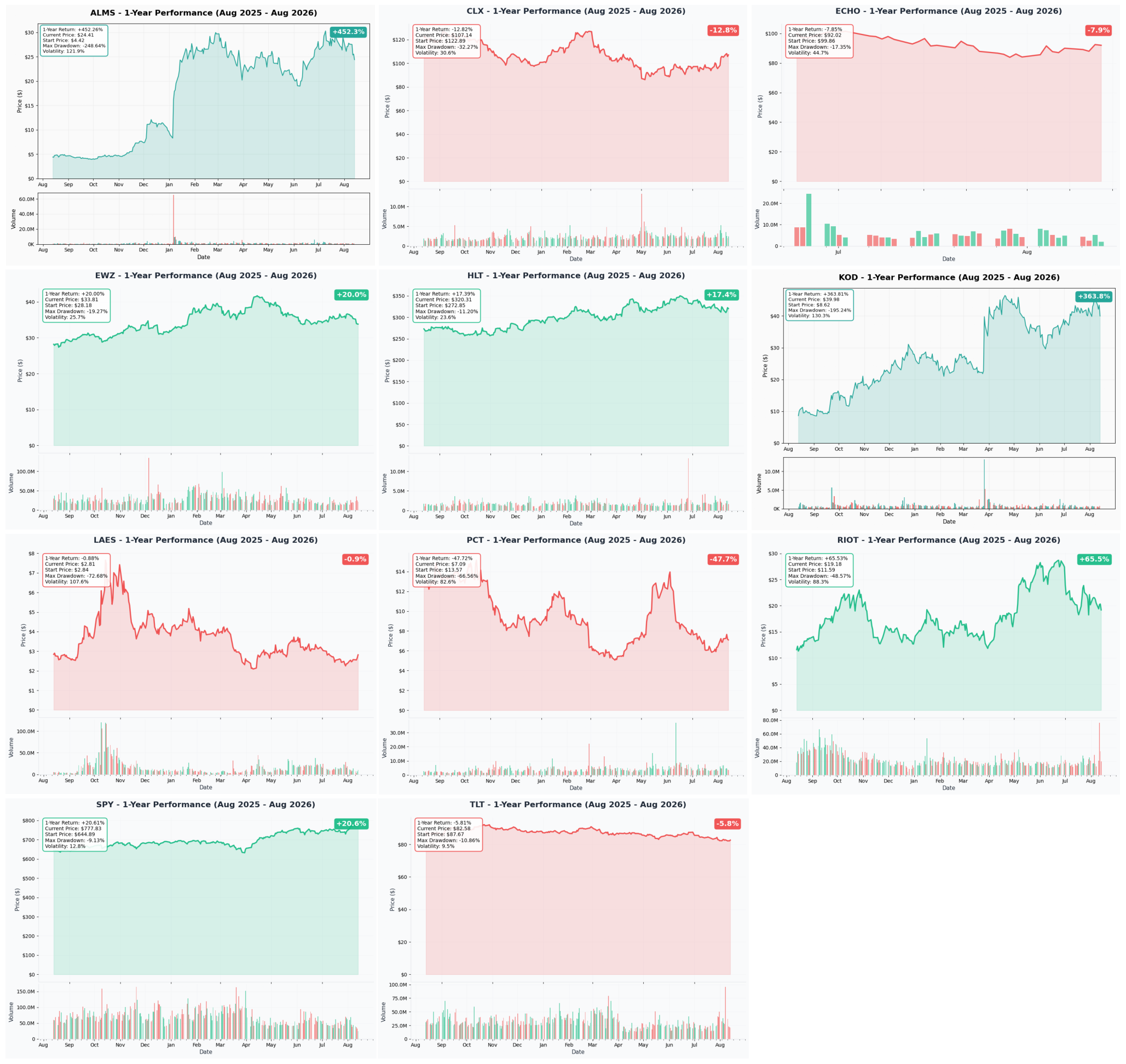
🛰️ ECHO — ≈$54.9M that carries no opinion at all, and the arithmetic proves it. Three deep in-the-money put strikes crossed at once, every one printing exactly $0.90 below its own intrinsic value. Solve for the forward price implied by each and you get $92.155, $92.160 and $92.179 — three strikes agreeing within 2.4 cents. One forward, zero time value: this is a parity-priced conversion, and the $0.90 is a spot-reference artifact. The sign also disproves the obvious theories — a special dividend or borrow squeeze would push the forward below spot, and a cash deal at $115 would force the $140 put to ≈$25, not $47.80. The tape mechanically excludes any deal above ≈$92.2. ❗ Resolved 2026-08-14: no position was created. All three lines came in exactly flat the next morning, and the intraday tape shows every leg re-printed at identical size at 15:45:15 — the package was put on and taken off inside the same session. Not a cancellation; a round trip. The "plumbing, not a view" read stands, but our claim that the legs were opening positions is withdrawn. Also worth knowing: ECHO is EchoStar — the ticker was renamed from SATS on June 24, which is why our own chart is misleading (it shows ≈−12% when the true 52-week change is +223%).
-
🏨 HLT — ❗ the ≈$29.2M call cross was an exit, not a new short. We published this with the open-versus-close question flagged as the central uncertainty, because size (11,850) came in just under prior open interest (11,916). The next morning settled it: open interest fell 11,916 → 198, a drop of 11,718 on a session where this cross was 11,850 of the strike's 11,858 total volume. Open interest only falls when a closing seller meets a closing buyer, so both sides were getting out — the SELL side was STC, not STO. Nobody took on the ≈$325M of short delta our original framing described; a long position of roughly a million share-equivalents was liquidated instead. The price decomposition still explains the motive: the strike was 6.7% in the money, so $21.57 of the $24.60 was intrinsic and only $3.03 time value — a leveraged share substitute bleeding rent, and someone stopped paying it.
-
📉 TLT — ≈$6.6M of 2028 calls, and at today's yields both expire worthless. The subtlety most coverage would miss: because TLT's 4.72% distribution yield exceeds the ≈3.625% funds rate, the January-2028 forward sits ≈1.6% BELOW spot. The buyer is not paid to wait — they pay to wait. Breakeven is $88.30, needing a 45–55bp fall to a 30-year near 4.70%, against consensus forecasting 5.00%. The 30-year currently sits at 5.21%, its highest since 2007, and the Fed held in July on a 9–3 vote with three dissents favouring a hike. The genuine hook: July payrolls came in at −23,000 with 103,000 of downward revisions — a shrinking payroll count is incompatible with hike dissents, and one of those signals has to break.
-
⛏️ RIOT — a put sold at 10:40 that was nearly offside by the close. 10,468 August-28 $20.50 puts sold for $1.47 with the stock at $20.30. By the close Riot was $19.245 — the breakeven is $19.03, leaving 21 cents, or 1.1%, of cushion. Nothing dramatic happened; just an ordinary −5% day on a 3.85-beta stock, with ±12.73% of implied move to August 21. Context: Riot's 20-year, ≈$9.1B AI-datacentre lease was disclosed August 10 — and the stock now trades below its pre-announcement close. Bitcoin at ≈$63,228 is ≈50% off its high, with Riot's all-in mining cost at 126.5% of production value.
-
🇧🇷 EWZ — 42,000 puts that expire four days before Brazil votes. Bought against prior open interest of 27 contracts — about as clean an open as exists. Brazil's presidential first round is October 4; this option dies September 30. A desk spending $2.23M did not miss an election by four days by accident: this is a bet on the pre-election volatility ramp, sellable into inflated pricing without spot ever reaching the strike — or a quarter-end hedge. Note the cheapest path to the −6.5% breakeven runs through the currency, not the equities: USD/BRL moving 5.1912 → ≈5.55 gets there with the Ibovespa unchanged.
-
🧴 CLX and ♻️ PCT — two put buys into windows with nothing scheduled. Clorox: 7,625 September $100 puts against prior open interest of 998, needing a 6.6% fall — with earnings and the ex-dividend both already past and the next of each falling outside expiry. What could deliver it? A precedent from May: the CEO-transition announcement took CLX down 6.42% in a session, and no successor timeline has been announced. PureCycle: 8,300 September $8 puts against prior open interest of 30, already in the money, with Q2 reported a week earlier and Q3 estimated seven weeks after expiry. Both are bets on the unscheduled.
-
🔐 LAES — a roll that cost about $16,000, not $2.7M. Identical size, same second, same $2 strike, adjacent expirations: that is one position being moved, not two being opened. The cost is the one-cent price difference — ≈$16,300 to carry ≈$1.35M of exposure four weeks further. And the reason is clean: SEALSQ has nothing scheduled before August 21 and three separate items dated to September, including an interim report the company has never filed earlier than September. ✅ Resolved 2026-08-14: it was a roll. August fell 16,554 → 6,824 while September built 345 → 16,632, essentially contract for contract — near leg down, far leg up, which rules out the "both legs opened" alternative. One correction: we predicted August would collapse toward ≈258, and it did not — 6,824 contracts remain outstanding into the August 21 expiry.
-
🧬 KOD and 🧪 ALMS — two biotech put trades whose expirations miss the data. Both companies report earnings tomorrow; neither trade can be about the trial result. Kodiak is a ≈$4.74M bear put spread — bought 6,000 October $40 puts, sold 6,000 October $15 puts, both proven brand-new opens against prior open interest of zero and four. The sold leg is the tell: it recovers under 3% of the cost while giving away the entire crash payoff. That is only rational because the Phase 3 PEAK topline is guided to December — two months after the October 16 expiry. The desk sold a tail that cannot happen in time. Alumis is simpler and starker: 4,276 September $20 puts at $4.40 against prior open interest of one, on a stock up more than fourfold in a year. The strike is below spot, so every cent is time value — ≈18% of the share price for five weeks — and the breakeven of $15.60 sits almost exactly on the market's own eight-day implied floor of $15.00. Its catalyst, the Phase 2b lupus readout, is guided only to "3Q 2026" — a quarter that ends September 30 against an option that dies September 18. Right idea, twelve days short.
The habit to take from today: check what the "protection" leg actually protects. SPY's long put looks like a floor and isn't. HLT's premium looks like income, is mostly intrinsic — and turned out to be proceeds from an exit rather than income at all. LAES's two legs look like $2.7M and cost $16,000. In all three cases the headline number and the real exposure are different things, and the difference is visible in about thirty seconds of arithmetic.
🔁 OI Review — Yesterday's Provisional Flags, Now Resolved
Wednesday's board has been through the next-day open-interest test, and the two biggest trades on it were never positions at all. All 44 legs resolved — 34 opened, 7 closed or did not open, 3 were transfers or exercises. Five of twenty-seven names inverted. The theme: three separate desks were caught rolling an existing hedge UP a strike — which on the tape is indistinguishable from opening a fresh spread. In two of the three, the published structure carried a downside tail that turned out not to exist.
🔄 Inversions
🔄 XLI — the crash tail never existed. We named the test in advance: "if $170 open interest falls by roughly 70,000 → it was a close → Reading B, no tail." It fell 80,261 → 49,881 (−30,380) while $175 rose 321 → 55,274 (+54,953) — 99.9% of its print. Confirmed: a hedge pulled from 8.7% below spot up to 6%. There is no naked short put and no open-ended tail below $152.97. Net put open interest across the two lines actually rose 24,573 — this desk's protection increased.
🔄 GLD — the $410 leg closed; there was no new bear call spread. $410 fell 69,848 → 39,341 (−30,507) while $415 rose 26,213 → 95,863 (+69,650). Restated as a strike roll up; order type corrects from STO to STC. The "betting gold stalls at its 200-day" premise is withdrawn.
🔄 KWEB — a roll out, and our most precise call. September $27 calls fell 32,719 → 24,228, taking the closing branch; the December $26 block landed at 24,207 against our published ≈24,098 — within 109 contracts. One thing has not changed, exactly as we said: the December block's direction remains unknown. Open interest proves contracts opened; it never reveals who was long.
🔄 SNOW — a change of exactly ZERO. We published three branches; open interest came in at 1,286 — identical to baseline, Δ = 0 against a 1,000-lot cross. ≈$15.1M changed hands and the market's net position did not move.
🔄 RDDT — a seventh session of the same roll. December-2028 924 → 1,403; September-2028 770 → 666. Correction: September's open interest fell, so that leg is the closing half, not an open.
💵 The two biggest prints were dividend mechanics, not bets
✅ OWL — ≈$97M, and 96% of the open interest vanished. We published the answer key: dividend capture required open interest "flat to sharply below" 142,881. It fell to 5,973 — down 95.8%. The contracts were exercised and extinguished, which is the entire point.
✅ VALE — 144,000 contracts traded, open interest moved 910. A genuine directional open would have added ≈144,000. It added −910, or 0.6% of the print. The bullish reading of a "144,000 calls bought" headline is ruled out by data, not merely unsupported.
✅ Confirmations and honest corrections
⭐ XLY landed inside 100 contracts on both legs (predicted ≈58,600 / ≈500; actual 58,574 / 427) — and the correction runs bearish: the desk moved protection 4.7% closer to spot. PANW, SLS, GBTC (exact to the contract), LYV, CRWV and META all confirmed as published.
Three corrections where direction held but size did not. PCG: only ≈25% of each print became new open interest — we wrote that the two-session campaign was "≈29,000 puts and 30,000 calls" and that the headline understated it. That is corrected; the honest figure is 22,248 puts and 16,293 calls. ONDS: the opposite error — actual 23,354 against our predicted ≈8,239, so that position is ≈3× bigger than we captured. HUM: the October leg came in ≈490 contracts light, so the star-ratings bet is smaller than the headline implied.
The standing lesson, taught three times yesterday: a hedge rolled up a strike looks exactly like a fresh spread on the tape. Only the next morning's open interest separates them — and when it does, the "risk" you thought you were reading often turns out never to have existed.
📊 At a Glance
| Ticker | Net Premium | Expiration Range | Catalyst inside the window | Option Play | What It Means |
|---|---|---|---|---|---|
| SPY | ≈$72.6M credit | Quarterly (Dec 18) | 3 FOMC, 4 CPI, 4 payrolls, midterms — back-loaded | Broken-wing put ladder | Short volatility — the long put does NOT cap the loss |
| ECHO | gross ≈$54.9M · net indeterminate | Monthly (Aug 21) | None — Q2 already reported Aug 3 | 3 deep-ITM put strikes at parity | A conversion — zero directional content; ❗ round-tripped same session, no position created |
| HLT | ≈$29.2M credit | Quarterly (Sep 18) | No earnings; ex-div Aug 21 (assignment irrational) | Sell 11,850 ITM $300 calls | ❗ An exit, not a short — OI 11,916 → 198 confirms a close (STC) |
| TLT | ≈$6.6M | LEAP (Jan 2028) | 11 FOMC meetings | Buy $83 + $87 calls | Needs a real bond rally — flat yields = worthless; ✅ both legs opened ($87 ≈66% new) |
| KOD | ≈$4.7M debit | Monthly (Oct 16) | Earnings Aug 14 — PEAK data is December, outside | Bear put spread $40/$15 | Both legs proven new — the sold leg proves the tail can't fire |
| RIOT | ≈$3.1M | Monthly (Aug 28) + Weekly (Oct 2) | Aug: nothing. Oct: Sep 15-16 FOMC | Sell $20.50 puts / buy $24 calls | The short put is already down to 1.1% cushion; ✅ both legs opened |
| EWZ | ≈$2.2M | Month-end (Sep 30) | 3 debates, Q2 GDP, probable Copom | Buy 42,000 $32 puts | Buys the election ramp — expires 4 days before the vote |
| ALMS | ≈$1.9M | Quarterly (Sep 18) | Earnings Aug 14; lupus data "3Q 2026" — may miss by 12 days | Buy 4,276 $20 puts | Proven open vs OI of 1; 100% time value, ≈18% of spot |
| CLX | ≈$1.2M | Quarterly (Sep 18) | Only the Sep 15-16 FOMC | Buy 7,625 $100 puts | Betting on the unscheduled — CEO search is the precedent |
| PCT | ≈$1.1M | Quarterly (Sep 18) | None — Q2 reported Aug 6 | Buy 8,300 ITM $8 puts | ≈105× sales, financing risk is the thesis |
| LAES | ≈$16K roll cost | Monthly (Aug 21) + Monthly (Sep 18) | Aug: nothing. Sep: 3 dated items | Same-strike calendar roll | Position maintenance — not $2.7M of new buying; ✅ roll confirmed |
✅ / ❗ = resolved on 2026-08-14. When published, the ⏳ rows marked legs where size sat at or below prior open interest, so open-versus-close could not be proven from that day's tape. The next-day snapshot has now settled all of them: HLT closed (a published read inverted), ECHO created no position, and LAES's roll and TLT's $87 leg both confirmed. Every other leg on the board opened.
Two notes on the premium column: ECHO's net is genuinely indeterminate — one leg's side came back blank from the feed, so only the gross is defensible. LAES is a roll, so its economic cost is the one-cent difference between legs, not the sum of them.
📅 Upcoming Catalysts — and Which Expiration Contains Them
A catalyst date and an expiration date are different things. This table keeps them apart.
| Date | Event | Which of today's expirations contains it |
|---|---|---|
| Aug 14 | Kodiak Q2 earnings | KOD Oct 16 |
| Aug 14 | Alumis Q2 earnings | ALMS Sep 18 |
| Aug 21 | Hilton ex-dividend ($0.15) | HLT Sep 18 — assignment economically irrational |
| Aug 23 | Brazil 1st presidential debate | EWZ Sep 30 |
| Aug 26 | NVIDIA earnings | SPY Dec 18 |
| ≈September | SEALSQ certification letter · Phase Two launch · H1 report | LAES Sep 18 — the reason for the roll |
| Sep 1 | Brazil Q2 GDP | EWZ Sep 30 |
| Sep 14 / Sep 27 | Brazil 2nd and 3rd debates | EWZ Sep 30 |
| Sep 15-16 | FOMC with projections | SPY Dec 18 · CLX Sep 18 · RIOT Oct 2 · TLT Jan 2028 |
| Oct 4 | Brazil presidential first round | ⚠️ Nothing — EWZ's Sep 30 expires 4 days early |
| ≈Oct 28 (est.) | Hilton Q3 earnings | ⚠️ Nothing — HLT's Sep 18 expires ≈6 weeks early |
| ≈Late Oct/Nov (est.) | Clorox Q1 FY27 · next ex-dividend | ⚠️ Nothing — CLX's Sep 18 expires first |
| Nov 3 | US midterm elections | SPY Dec 18 |
| ≈Nov 5 (est.) | PureCycle Q3 | ⚠️ Nothing — PCT's Sep 18 expires ≈7 weeks early |
| Nov 11 | EchoStar Q3 earnings | ⚠️ Nothing — ECHO's Aug 21 expires first |
| Dec 4 / Dec 8-9 / Dec 10 | Payrolls · FOMC with projections · CPI | SPY Dec 18 — all inside the final fortnight |
| December 2026 | Kodiak Phase 3 PEAK topline | ⚠️ Nothing — KOD's Oct 16 expires ≈2 months early |
Two entries above deserve separate treatment because their timing is guided to a period, not a date. Alumis's Phase 2b lupus topline is guided to "3Q 2026" — a quarter ending September 30, against an option expiring September 18. It is the one catalyst on this board that might land inside the window and might not, and there is no way to resolve that from the tape. Kodiak's PEAK topline is guided to "December 2026", which is unambiguously outside its October expiry.
Eight mismatches on an eleven-name board. In most cases the option expires before the event a reader would assume it was about — on EWZ that gap is four days, on ALMS twelve, and both look deliberate rather than careless.
👥 Four Ways to Read Today
🎲 The YOLO trader. The honest answer is that today's board offers you very little. The most convex instrument — SPY's $350 put at $0.34 — is the leg the professionals bought as partial cover, and it expires worthless in almost every scenario. RIOT's $24 call is the nearest thing to a lottery ticket, needing +33% in 50 days with no confirmed company catalyst inside, and we could not even verify whether the desk buying it was opening or closing. If you take one thing away: on a day when every print is a negotiated block, there is no urgency to copy.
📈 The swing trader. Three clean setups. KOD and ALMS both report tomorrow, and in both cases the thing to listen for is not the quarter but the guidance date — whether Kodiak still says December for PEAK, and whether Alumis narrows "3Q 2026" for its lupus readout. Neither chain offers you levels to lean on: both returned no material gamma support or resistance, and ALMS has no meaningful open interest below spot at all. EWZ has a dense, dated calendar — three debates, Q2 GDP, a probable Copom decision — and the cheapest path to a move runs through the currency, not the index. RIOT sits between Very Strong gamma resistance at $20 and support at $19, having just broken the former, with a ±12.73% implied move to August 21. Both are event-driven rather than trend trades, which is what the tape supports today.
💰 The premium collector. This is your board, and it is full of cautionary detail. SPY collected ≈$72.6M and risks ≈$1.88B at $480 — 26× the credit — with no genuine floor. HLT looked like ≈$29.2M collected with only $3.03 a share of actual time value — but the next-day open interest showed it was an exit, so that credit was proceeds, not income; the ≈$325M of short delta was never taken on by anyone. RIOT shows what happens next: a put sold at 10:40 with ≈6% of cushion had 1.1% left by the close of the same session. The common lesson is that the credit tells you almost nothing until you check the ratio, the intrinsic split, and the cushion relative to how far the stock actually moves.
🌱 The beginner. Learn one skill today: decompose the price before you read the story. Take HLT's $24.60 — subtract the $21.57 of intrinsic value and only $3.03 is genuine premium. Take ECHO's $47.80 against $48.70 of intrinsic and you get a negative number, which tells you immediately it is not a bet at all. Take LAES's two legs, differing by one cent, and the "$2.7M trade" becomes a $16,000 one. Take KOD's ≈$4.9M headline, subtract the leg that was sold, and it is a ≈$4.74M spread with a capped payoff. Big headline numbers are easy to find; the arithmetic that tells you what they mean takes about thirty seconds and changes the answer more often than not.
And a second skill, which today's two biotechs teach better than anything else on the board: check that the catalyst actually falls inside the expiration. Kodiak's make-or-break trial data is due in December against an option that dies in October. Alumis's is guided to a quarter that ends twelve days after its option expires. Being right about direction and wrong about timing pays exactly nothing — and matching the expiry date to the calendar is often the whole analysis.
⚠️ Before You Trade Any of This
Every leg on today's board was a negotiated block — floor trades, crosses and price-improvement auctions, nearly all filled at mid, taking no liquidity. There is a known counterparty on the other side of each, and that counterparty may be just as informed. The BUY and SELL labels on a mid-priced block are reported, not proven — there is no aggressor to measure.
Three names carry unresolved questions we are not going to paper over. ECHO's net premium is indeterminate because one leg's side came back blank. RIOT's October call had no retrievable open-interest history at all when we published — ✅ now resolved: OPRA published no open interest for that contract on any prior date, so there was nothing to close against and the call leg opened (the line stands at 12,729). And two of our own one-year charts conflicted with sourced data — ECHO's is genuinely misleading because of a June ticker change, and LAES's we could not reconcile. We flag all three rather than quote around them.
We correct ourselves in public. Today's review inverted five of yesterday's names, retired the labels on the two largest prints as dividend mechanics, and corrected three of our own size estimates — one of which (PCG) was too large and one (ONDS) too small.
✅ That snapshot has now landed. Four legs on this board carried ⏳, and the 2026-08-14 open interest resolved every one of them — plus one result nobody flagged in advance. HLT inverted: what read as ≈$29.2M of short delta was an existing long being sold out, and the article has been rewritten. ECHO created no position at all, which only the intraday tape could explain. LAES's roll and TLT's $87 leg confirmed, the latter with a third of its size matching closing holders. This is exactly why we publish the flag instead of the guess: a position being exited looks identical to a fresh bet until that data lands.
Last updated: 2026-08-14 — every ⏳ flag on this board resolved against the next-day OPRA open-interest snapshot. HLT's read inverted and its article was rewritten; ECHO's opening claim was withdrawn.
This is market analysis and education, not investment advice. Options carry substantial risk of loss, and uncovered short options carry theoretically unlimited risk.