Ainvest Option Flow Digest - 2026-08-11 — The Board Where Almost Nothing Is Scheduled, and the Four Trades Where Something Is
Last updated 2026-08-11 — four late names (TGT, CLX, VSAT, BIRK) added after first publication. Board total revised from ≈$202.8M / 12 names to ≈$337.1M / 16 names.
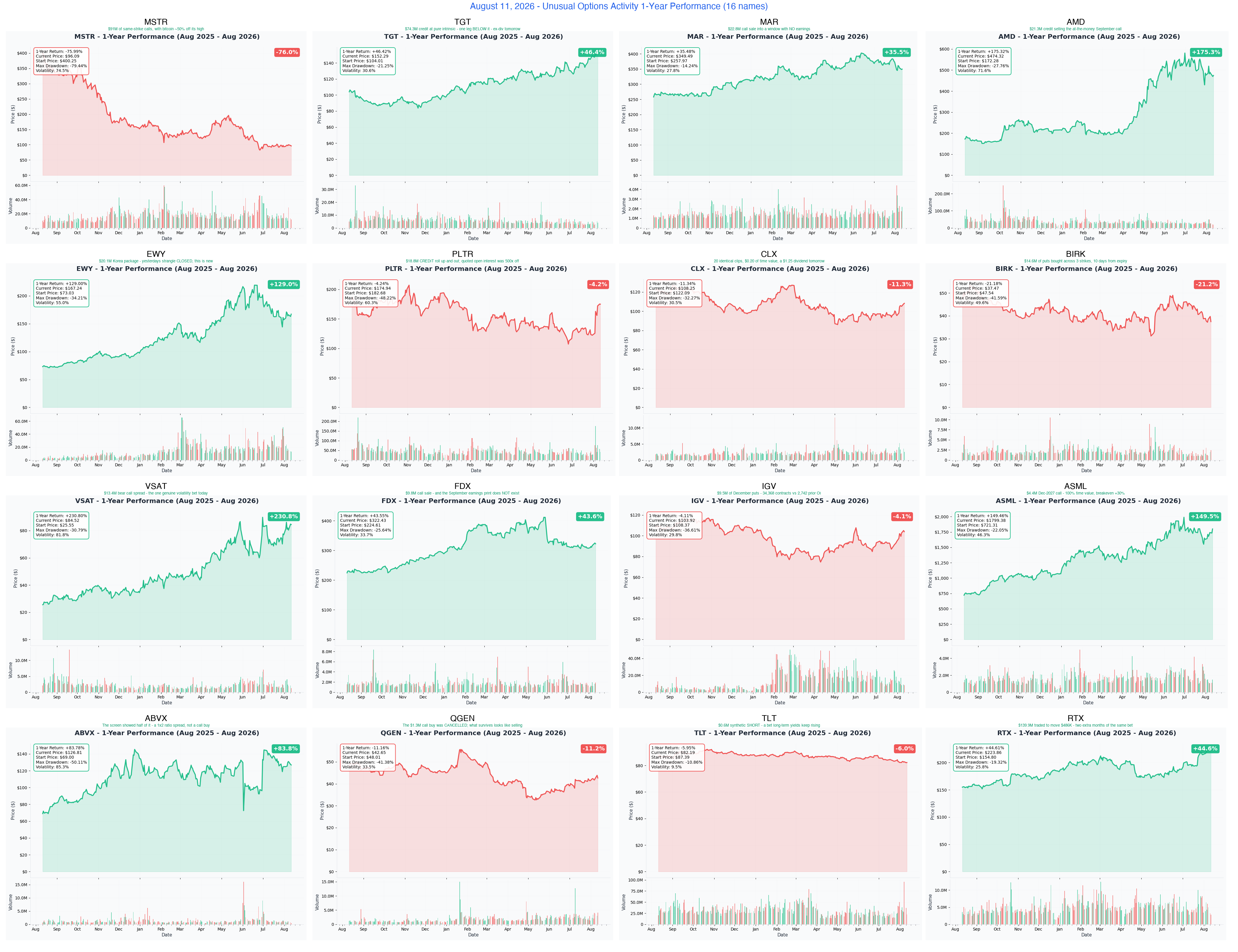
≈$337.1M net premium across 16 names. The pattern today is not a stock or a sector — it is a calendar. On name after name, big premium was sold into expirations that contain no earnings report at all: Marriott, AMD, FedEx and Qiagen are all short premium across windows where nothing is scheduled to happen. And in FedEx's case that is not an accident of timing — the September earnings print most calendars still show does not exist.
Then four late trades arrived and inverted the theme — they are all about dates, but dates that DO exist. Target and Clorox each sold deep in-the-money calls at essentially pure intrinsic value on the last session before an August 12 ex-dividend; Birkenstock bought a ladder of puts two days before a confirmed August 13 earnings print; and Viasat put on the one structure all day that genuinely takes a directional view. Same lesson from the opposite direction: find the date first, then read the trade.
⚡ Quick Read
-
📦 FDX — the best piece of homework on the board. A desk sold 10,000 September $330 calls for ≈$9.76M into a window that most earnings calendars say contains a FedEx print. It does not. FedEx moved its fiscal year end from May 31 to December 31, effective June 1, 2026 — there is a seven-month transition period, no June-August quarter, and the next report is October 28, company-confirmed on FedEx's own calendar, ≈40 days after this option expires. Several third-party calendars still project September 17-18. Anyone selling or buying this contract as an earnings play is trading a print that will not come.
-
🏨 MAR — ≈$22.75M of calls sold into a six-week hole. Marriott reported on August 3, eight days before this trade, and the next report lands ≈October 29 to November 4 — 6-7 weeks after the September 18 expiration. Marriott has not even announced the Q3 date, and that announcement itself comes after this contract expires. The only company event inside the window is the August 20 ex-dividend. Note the strike: $330 against a $348.47 stock, so the seller is capping upside below the current price, and consensus sits ≈15% above that strike.
-
🔴 AMD — ≈$21.3M collected, and both expirations expire before AMD next reports. The desk sold the September $470 call — essentially exactly at the money — and bought the August $500 call, a reverse diagonal that is short the expensive at-the-money time value. Q2 landed August 4; Q3 arrives ≈early November, ≈7 weeks past September 18. The one real volatility source inside the window is Nvidia's August 26 earnings — someone else's event.
-
✈️ RTX — ≈$139.9M traded to move ≈$486,430. Same strike, same size, two expirations: sell the December $125 call, buy the February-2027 $125 call. With the stock at $224.42 the $125 strike carries $99.42 of intrinsic value, so the December leg's entire time value was $0.91 and February's $1.61. The desk bought two extra months of identical exposure for roughly seventy cents a share. The February leg had prior open interest of zero — the cleanest certain open on the board.
-
🚨 QGEN — the trade we first picked up never stood. A $1.3M August call purchase surfaced on the flow screen at 10:33:24. The tape then shows a cancellation at 11:14:34 matching that print on both size and price. What actually survives is two 10,000-lot crosses at $1.00 — and both printed at or near the bid, not the ask. So the surviving flow looks like selling, not the bullish buying the screen implied. The quoted open interest was wrong too: the screen said 40, the tape says 45,759.
-
🇰🇷 EWY — yesterday's Korea strangle came off, and today a new one goes on. Monday's 11,250-lot October $165/$130 package closed overnight — the call fell 25,142 → 13,839 and the put 30,785 → 19,246. Today a fresh 10,000-lot version of the same two strikes prints again, this time with a paired stock leg attached, which means the options alone no longer express a clean view. And the calendar bites: SK hynix reports October 27 and Samsung October 29 — both after the October 16 expiration. That is ≈44.6% of the fund's weight delivering its biggest scheduled catalyst after these contracts are gone.
-
📉 TLT — a genuine directional bet, and the rare name whose window is full. Buying the $82 put and selling the $82 call at the same strike and expiry is a synthetic short — delta ≈ −1.00, almost no time-decay or volatility exposure. Because a long-bond ETF falls when yields rise, this is a bet that long-term yields keep going up, with the 30-year already at ≈5.24%. Unlike most of today's board, the September window is dense: two CPI prints, payrolls, and the September 15-16 Fed meeting with a fresh dot plot, two days before expiry.
-
🛡️ IGV — 34,368 December puts bought against 2,742 of prior open interest. A proven, unambiguous new hedge — ≈$9.5M, struck ≈13.8% below spot. The insight is what the fund actually is now: Palo Alto, Microsoft, Palantir and CrowdStrike are ≈37% of it, versus ≈17.5% in classic subscription software. This is a momentum-unwind hedge wearing a software-ETF label, and the $90 strike only starts paying on a full round-trip of the summer rally.
-
🧬 ABVX — the flow screen showed half the trade. It surfaced a $3.16M purchase of 2,000 December $140 calls. Scanning the full chain found the other leg at the same millisecond: 4,000 December $200 calls SOLD at the bid. That makes it a 1×2 call ratio spread for ≈$2.16M net — a position that wants Abivax to rise to $200 and not through it, since above ≈$249 the extra short call turns the loss open-ended. And the calendar fits today's theme: no confirmed binary event lands inside December — the only company-guided item is an NDA submission pencilled to "Q4 2026", which is a quarter, not a date, and a filing in the last two weeks of December would satisfy the guidance and miss the option entirely.
-
💵 TGT and 🧴 CLX — two desks, one mechanic, and it is the best lesson on the board. Both sold deep in-the-money calls priced at essentially pure intrinsic value on the last cum-dividend session before an August 12 ex-date. Target's January $75 call printed eight cents BELOW intrinsic; Clorox's August $95 call carried ≈$0.20 of time value against a $1.25 dividend — a 6.3× ratio. When a dividend dwarfs the remaining time value, rational call holders exercise early and short holders get assigned. Clorox's twenty identical 1,020-lot clips in fourteen minutes is the textbook signature. Neither trade says anything about where the stock goes — and if assignment runs through the Clorox position tonight, its August 21 expiration never arrives. Tomorrow's open interest at the $95 strike is the arbiter, and we have published the falsifiable prediction.
-
🩴 BIRK — ≈$14.6M of puts bought two days before a confirmed earnings print. 27,000 contracts across three August 21 strikes, in two floor clips. The company confirmed the August 13 pre-market report back on July 15, so these are earnings contracts, not a vague hedge. The cost is the story: ≈$3.9M of pure time value for ten days spanning one print, and ≈1.9M shares of short delta — ≈3.6% of a float that is only 53.75M shares, because L Catterton controls ≈60–65%. With short interest at ≈21% of that float, a good print squeezes as violently as a bad one falls. The options market is pricing ±9.24%; the last report took the stock to ≈$31.
-
🛰️ VSAT — the only genuine directional structure all day. A bear call spread collecting ≈$13.4M on a $35-wide spread, so ≈$30.8M of risk against it. Breakeven ≈$90.62 — and the 52-week high of $93.03 sits just ≈$2.40 above it. This position needs a stock that is +145.8% year to date on 1.2% LOWER revenue to stay below a level it already reached this year. One caution we will not bury: both legs printed just under existing open interest (12,618 against 12,721 and 12,675), so if this is a position being closed, the entire bearish reading inverts.
The habit to take from today: check whether the expiration actually contains the event before you assume the trade is about it. Five separate desks put on positions in windows with nothing firmly on the calendar. That is a deliberate, repeatable choice — and the mirror image is the warning for anyone copying them: you are being paid for time, not for a view, and the payment stops the moment something unscheduled happens.
✅ RESOLVED 2026-08-12 — Tuesday's ⏳ Flags, Settled by This Morning's Open Interest
The ≈06:30 ET OPRA snapshot timestamped August 12 (reflecting the August 11 close) is in. Every ⏳ flag on this board is now resolved. Baseline is the August 11 snapshot, which reflects the August 10 close — before these prints.
Seven of sixteen names inverted. That is a high rate, and it is worth saying plainly: on a board this heavy with negotiated blocks printed at or near prior open interest, the trade-day tape genuinely could not tell opening from closing — and more often than not, it was closing.
🔄 Inversions — a published provisional label flipped
| Ticker | Leg | Baseline → Resolving (Δ) | Verdict | What changed |
|---|---|---|---|---|
| QGEN | Aug-21 $45 call | 45,759 → 27,509 (−18,250) | 🔄 CLOSE (STC) | 91% of the print retired. No new short was opened — the ≈$2.0M was realised liquidating an existing long. |
| VSAT | Dec-18 $80C / $115C | 12,721 → 6,369 (−6,352) / 12,675 → 6,647 (−6,028) | 🔄 CLOSE, both legs | An existing bear call spread came off. The ≈$30.8M max-risk framing and the "betting Viasat's rally stalls" thesis are withdrawn in full. |
| EWY | Oct-16 $130P / $165C | 19,246 → 13,763 (−5,483) / 13,839 → 8,595 (−5,244) | 🔄 CLOSE, both legs | Not new Korea exposure — a second consecutive session of unwinding. The stock leg accompanied an exit, not an entry. |
| BIRK | Aug-21 $47.50P / $37.50P | 9,002 → 3,020 (−5,982) / 9,209 → 3,102 (−6,107) | 🔄 CLOSE (the $40P opened, 203 → 9,045) | Net put open interest across the three strikes fell 3,247. This was a re-strike into the $40 line, not 27,000 contracts of fresh downside into earnings. |
| MSTR | Aug-21 $95 call | 47,089 → 36,278 (−10,811) | 🔄 CLOSE (the Oct-16 $95C opened, 592 → 44,846) | A roll out in time at one strike, not a doubled-up two-expiration bet. The genuinely new money is the ≈$63.09M October leg. |
| MAR | Sep-18 $330 call | 10,495 → 8,034 (−2,461) | 🔄 NOT AN OPEN | No new short-call interest was created. The premium-harvest-into-an-empty-calendar reading does not apply — a long got out. |
| AMD | Aug-21 $500 call | 13,291 → 11,417 (−1,874) | 🔄 NOT AN OPEN (the Sep-18 $470C opened, 1,262 → 9,479) | The "cheap August tail cover" was never bought. What survives is a short-call roll down and out — a less hedged posture, not a more protected one. |
✅ Confirmations — the published read held
| Ticker | Leg | Baseline → Resolving (Δ) | Verdict |
|---|---|---|---|
| TLT | Sep-18 $82P / $82C | 114,053 → 141,224 (+27,171) / 8,474 → 57,409 (+48,935) | ✅ Both legs OPEN. The unresolved put leg cleared the +20,000 threshold; the call leg drew 2.4× the block. Synthetic short confirmed, and larger than described. |
| RTX | Feb-27 $125C / Dec-18 $125C | 0 → 6,952 (+6,952) / 7,074 → 2,021 (−5,053) | ✅ Roll confirmed on both legs. The February leg opened from literal zero; the December leg closed 73% of the print. |
| IGV | Dec-18 $90 put | 2,742 → 52,572 (+49,830) | ✅ OPEN — and ≈45% bigger than we captured. ≈97% of the strike's day volume became new open interest; premium figures in the article are floors. |
| ABVX | Dec-18 $140C / $200C | 200 → 2,210 (+2,010) / 236 → 4,247 (+4,011) | ✅ Both legs OPEN, within ≈11 contracts of the published prediction. The 1x2 ratio spread is real at full size. |
| FDX | Sep-18 $330 call | 640 → 10,669 (+10,029) | ✅ OPEN (STO), 29 contracts above prediction, with no transfer absorption. |
| ASML | Dec-2027 $1,900 call | 6 → 106 (+100) | ✅ OPEN (BTO) — exact to the contract. |
⚠️ Neither branch — resolved into something we did not publish
| Ticker | Leg | Baseline → Resolving (Δ) | What actually happened |
|---|---|---|---|
| CLX | Aug-21 $95 call | 3,369 → 27 (−99.2%) | The dividend-capture call was right, and this is the number we told you to watch. But it was market-wide: every Clorox call with less time value than the $1.25 dividend was exercised across both expirations, while out-of-the-money calls and all puts were untouched. Consequence: the two ⏳ September $95 prints are retired as unresolvable — the exercise wave, not this desk, drove that strike to 18. And one published prediction was simply wrong: we said the September $70 call would "rise toward ≈1,002 and hold" because no ex-dividend sits inside the September window. It went to zero. An ex-date prices early exercise across the whole chain, not just the front expiration. |
| TGT | Jan-27 $80C / $75C, Dec-18 $80C | 10,708 → 10,375 (−333) / 183 → 18 / 186 → 3 | No leg opened, and two legs we called proven opens were both wrong. We predicted ≈5,183 and ≈5,186; both strikes collapsed to near zero in the same ex-dividend exercise wave. The lesson is a real limitation of the size-versus-open-interest rule: a trade printing far above prior open interest does not guarantee surviving open interest when an exercise deadline sits the same night. The article's dividend-structure thesis is confirmed and strengthened; open-versus-close on this desk's own side is unresolvable. |
| PLTR | Aug-21 $140 call | 20,777 → 20,616 (−161) | Neither branch. We published "falls by up to 10,890 if a close, rises if a fresh short" and leaned toward close. Open interest moved 1.5% of the print — the contracts transferred to a new owner instead of retiring. The October $170 leg did open (5,649 → 14,499, 81% of size). One thing genuinely changes: the crowded August $140 line was not reduced — 20,616 contracts still sit there into expiration. |
What this board actually teaches. Eleven of these sixteen names printed at or below prior open interest, which is why so many carried a ⏳ in the first place — and of those, the closing branch won far more often than the opening one. When a negotiated block lands on a strike that already has a comparable position sitting on it, the base rate favours position management over new conviction. The headline premium is real money changing hands either way; what it is not is proof that someone just took a view.
🔁 OI Review — Monday's Provisional Flags, Now Resolved
Monday's board has been through the next-day open-interest test, and seven of twenty names came back meaning something different than they looked. All 54 legs resolved — nothing expired, nothing failed to pull. 37 opened, 13 closed, 4 were transfers. The theme is blunt: a large BUY is not a position. Five separate legs printed as purchases while the strike's open interest went down.
🔄 Inversions
- 🔄 SNDK — a $436.6M day that contained ≈$15.6M of actual new position. We published the falsifiable branch — "falls back toward ≈660 means it closed." Open interest printed 660, exactly. It was a close, not a quarter-billion-dollar short. The $132.0M June-2027 call moved 5,911 → 5,910 — one contract, a pure transfer. Only the smallest and only lit trade added new exposure. $436.6M of headline premium, ≈3.6% of it new.
- 🔄 EWY — the "long strangle" was a strangle being closed. Both strikes landed within ≈60 contracts of our published closing-branch numbers. Order type on both legs corrects from BTO to BTC.
- 🔄 GLD — the "self-financing bullish" September spread was an unwind. The $400 and $425 calls fell −17,962 and −18,028 — a 66-contract difference across a 55,070-lot print, the signature of one two-legged position being retired. Corrected: the desk closed long September upside and opened short spreads on top.
- 🔄 SE — the December bull spread was taken off the day before earnings. The $97.5 call fell 2,635 → 360, exactly −2,275, the print size. Of ≈$22.17M, only the ≈$11.27M October package was new money.
- 🔄 SPY — this one corrected us, not the classifier. We called the $780 print a buy-to-close and predicted open interest would fall toward ≈85,531. It rose 2,275. "Mostly someone covering a short" is retracted as a stated fact and reframed as a transfer.
- 🔄 SPHR — the long leg never opened; the package is ≈4.6-to-1 short-to-long, more exposed than we published. 🔄 COIN — the August leg was not new bullish money; every framing of it as a bet on clearing $160 is withdrawn.
✅ Confirmations
- ⭐ MSFT — the roll confirmed on both ends, and then some. The $550 calls opened to 55,221 against a predicted ≈30,500-34,498 — 168% of the package's own size, meaning other desks were buying the same strike alongside it.
- ROCK resolved to the contract (0 → exactly 4,500); SPCX was one contract off; CXW, TSM, CVNA, DOCU, GFS, QQQ and AAPL all confirmed as written.
⚠️ Direction right, magnitude overstated
Five names confirmed their published direction while retiring far less than their print size — DASH retired only 1,371 of 10,000 (≈14%), GLW 4,071 of 10,000 (≈41%), and AAPL, SE and SKHY around half. "The position came off" and "1,371 contracts came off" are very different statements.
The standing lesson, taught five times over on Monday: a BUY with falling open interest is a close. The tape prints "BUY" either way. Only the next morning's open interest separates new conviction from an exit — and when it comes back flat, the honest answer is "it changed hands."
📊 At a Glance
| Ticker | Net Premium | Expiration Range | Catalyst inside the window | Option Play | What It Means |
|---|---|---|---|---|---|
| TGT | ≈$74.3M credit | Monthly (Dec 18) + Monthly (Jan 15 2027) | Ex-dividend Aug 12 — tomorrow; Q2 ≈Aug 19 and Q3 ≈Nov 18, both estimated | Sell Jan-27 $80C + $75C, buy Dec-26 $80C | Pure intrinsic, one leg BELOW it — a dividend/financing package, no view → ✅ dividend read CONFIRMED — but no leg left surviving OI; both "proven opens" missed |
| CLX | ≈$32.0M credit | Monthly (Aug 21) + Quarterly (Sep 18) | Ex-dividend Aug 12 — tomorrow, $1.25; no earnings in either window | Sell 20,400 ITM $95 calls in 20 identical clips | ≈$0.20 of time value vs a $1.25 dividend — assignment is the base case → ✅ assignment CONFIRMED — the entire ITM call book went to ≈0 overnight |
| BIRK | ≈$14.6M | Monthly (Aug 21) | Earnings Aug 13 — company-confirmed, 8 days inside the window | Buy 27,000 puts across $47.5 / $40 / $37.5 | ≈$3.9M of time value for one print; ≈3.6% of the float in short delta → 🔄 INVERTED — only the $40 leg opened; $47.5 & $37.5 CLOSED, net put OI fell |
| VSAT | ≈$13.4M credit | Monthly (Dec 18) | Fiscal Q2 ≈Nov 3-6 (estimated); ViaSat-3 F3 service entry | Bear call spread: short $80 / long $115 | The one real directional bet — breakeven ≈$90.62 vs a $93.03 52-week high → 🔄 INVERTED — both legs CLOSED; no new short-vol position exists |
| MSTR | ≈$91.0M | Monthly (Aug 21) + Monthly (Oct 16) | None before Aug 21; investor Q&A Aug 17 | Same-strike $95 calls, two expirations | Direction genuinely unresolved — we will not assert it → 🔄 INVERTED — Oct opened, Aug CLOSED: a roll out, not a two-expiration bet |
| MAR | ≈$22.8M credit | Quarterly (Sep 18) | None — only the Aug 20 ex-dividend | Sell 9,850 ITM $330 calls | Premium harvest into an empty calendar → 🔄 INVERTED — OI fell; no new short was opened |
| AMD | ≈$21.3M credit | Monthly (Aug 21) + Quarterly (Sep 18) | Hot Chips Aug 23-25; Nvidia earnings Aug 26 | Reverse diagonal: sell Sep $470 / buy Aug $500 | Short at-the-money time value; no AMD earnings in either window → 🔄 PARTLY INVERTED — Sep short opened; the Aug $500 "cover" was not a new long |
| EWY | ≈$20.1M | Monthly (Oct 16) | Bank of Korea Aug 27 | Long $165 call + long $130 put, shares attached | Yesterday's strangle closed; this one is new and hedged → 🔄 INVERTED — both legs CLOSED; second straight session of unwinding |
| PLTR | ≈$18.8M credit | Monthly (Aug 21) + Monthly (Oct 16) | None — Q3 ≈Nov 2, after expiry | Roll up & out: $140 → $170 | Continuation, not new money; sold leg was ≈all intrinsic → ⚠️ Oct opened (81%); the Aug $140 leg transferred, it did not retire |
| FDX | ≈$9.8M credit | Quarterly (Sep 18) | No earnings — ex-dividend ≈Sep 7-9 only | Sell 10,000 $330 calls | The September print does not exist this year |
| IGV | ≈$9.5M | Quarterly (Dec 18) | All 10 top holdings report; 3 FOMC meetings | Buy 34,368 $90 puts | A momentum-unwind hedge, proven open |
| ASML | ≈$4.4M | LEAP (Dec 2027, ≈16 months) | 5 quarterly reports; FY2027 report falls after expiry | Buy 100 $1,900 calls | 100% time value, breakeven ≈+30% |
| QGEN | ≈$2.0M credit | Monthly (Aug 21) | None — every dated event is behind it | 2 crosses at $1.00, printed at the bid | The captured buy was cancelled → 🔄 INVERTED — a long was CLOSED (OI −18,250); no new short |
| TLT | ≈$0.6M credit | Quarterly (Sep 18) | 2 CPI, payrolls, FOMC Sep 15-16 | Synthetic short at the $82 strike | A bet long-term yields keep rising → ✅ both legs opened; call OI +48,935 — 2.4× the block |
| ABVX | ≈$2.2M | Quarterly (Dec 18) | No confirmed binary — an NDA submission guided to "Q4 2026" | 1×2 call ratio spread: long $140 / short 2× $200 | Wants the stock to reach $200, not blow through it |
| RTX | ≈$0.5M | Monthly (Dec 18) + Monthly (Feb 2027) | Q3 ≈Oct 20 in both; Q4 + FY2027 guidance only in February | Same-strike calendar roll out | ≈$140M traded to buy two extra months → ✅ roll CONFIRMED on both legs |
⏳ = at least one leg where size sat below prior open interest, so open-versus-close could not be proven from the trade-day tape. These flags are now resolved — see the ✅ RESOLVED section above. The August 12 ≈06:30 ET snapshot settled every one of them: 7 of 16 names inverted, 6 confirmed, and 3 resolved into something neither branch described.
📅 Upcoming Catalysts — and Which Expiration Actually Contains Them
Read this carefully: a catalyst date and an option expiration date are different things, and today most of these trades expire before the event a reader would assume they are about.
| Date | Event | Which of today's expirations contains it |
|---|---|---|
| Aug 12 | July CPI | TLT Sep 18 |
| Aug 12 | Clorox ex-dividend, $1.25 | CLX Aug 21 — and it is why the trade priced the way it did |
| Aug 12 | Target ex-dividend, $1.16 | TGT Dec 18 and Jan 2027 |
| Aug 13 | Birkenstock fiscal Q3 earnings (company-confirmed) | BIRK Aug 21 — 8 days inside the window |
| Aug 17 | Strategy investor Q&A | MSTR Aug 21 |
| Aug 20 | Marriott ex-dividend | MAR Sep 18 — the only company event in that window |
| Aug 23-25 | Hot Chips (AMD presenting MI400) | AMD Sep 18 — misses Aug 21 by two days |
| Aug 26 | Nvidia earnings | AMD Sep 18; EWY Oct 16 — not AMD's own event |
| Aug 27 | Bank of Korea decision | EWY Oct 16 — the only confirmed high-impact event there |
| Sep 4 / Sep 11 | Payrolls / August CPI | TLT Sep 18 |
| Sep 15-16 | FOMC + fresh dot plot | TLT Sep 18 — two days before expiry |
| Oct 20 (est.) | RTX Q3 earnings | RTX Dec 18 and Feb 2027 |
| Oct 27 / Oct 29 | SK hynix and Samsung Q3 | ⚠️ Nothing — EWY's Oct 16 expires 11-13 days too early |
| Oct 28 | FedEx earnings (confirmed) | ⚠️ Nothing — FDX's Sep 18 expires ≈40 days too early |
| ≈Oct 29 – Nov 4 | Marriott Q3 earnings | ⚠️ Nothing — MAR's Sep 18 expires 6-7 weeks too early |
| ≈Nov 2 (est.) | Palantir Q3 earnings | ⚠️ Nothing — PLTR's Oct 16 expires ≈2.5 weeks too early |
| ≈Early Nov (est.) | AMD Q3 earnings | ⚠️ Nothing — AMD's Sep 18 expires ≈7 weeks too early |
| ≈Aug 19 (est.) | Target fiscal Q2 earnings | TGT Dec 18 and Jan 2027 |
| ≈Nov 3-6 (est.) | Viasat fiscal Q2 earnings | VSAT Dec 18 — the only report inside that window |
| ≈Nov 4 (est.) | Clorox fiscal Q1 earnings | ⚠️ Nothing — CLX's Sep 18 expires ≈7 weeks too early |
| Dec 8-9 | FOMC with projections | IGV Dec 18; RTX Feb 2027 |
| ≈Feb 4 2027 (est.) | Viasat fiscal Q3 — the December quarter | ⚠️ Nothing — VSAT's Dec 18 expires ≈48 days too early |
| ≈Early Mar 2027 (est.) | Target's HOLIDAY quarter (fiscal Q4) | ⚠️ Nothing — both TGT expirations are long gone |
| ≈Late Jan 2027 | RTX Q4 + first FY2027 guidance | RTX Feb 2027 only — this is what the roll bought |
Nine mismatches on one board, and two of the new ones are the most instructive. Viasat's December-quarter results are a February event because its fiscal year ends March 31 — a calendar-year reporter would have fit two prints inside that expiration; Viasat fits one. And Target's holiday quarter is fiscal Q4, which does not even end until ≈late January 2027 and reports ≈early March. Anyone treating a December or January Target option as "the holiday trade" has the calendar wrong by a full quarter.
In almost every case the option expires before the event a reader would naturally assume it was about. That is not sloppiness by the desks — for the sellers it is the entire point. Birkenstock is the exception that proves it: there, the desk deliberately bought the window that does contain the print.
👥 Four Ways to Read Today
🎲 The YOLO trader. The late board handed you a cleaner setup than QGEN: BIRK's puts expire eight days after a confirmed earnings date, which is at least an honest binary. But price it properly — ≈$3.9M of that ≈$14.6M is pure time value, the market is only pricing a ±9.24% move, and with short interest at ≈21% of a 53.75M-share float a good print can squeeze as hard as a bad one falls. Being right on direction and still losing is entirely possible here. The older temptation is QGEN — a cheap, near-dated call on a diagnostics name. Two problems: the print that made it look exciting was cancelled, and what survives printed at the bid, which looks like selling. On top of that the stock's beta is 0.62 and there is nothing scheduled before expiry. If you want convexity today, ASML's December-2027 call is the intellectually honest version — but it is 100% time value with a breakeven ≈30% above spot, so size it as money you can lose entirely.
📈 The swing trader. TLT is the only clean directional statement on the board, and it comes with a dense calendar to trade around: CPI on the 12th, payrolls on the 4th, and the Fed on the 15th-16th. Note what the structure tells you — a synthetic short has almost no volatility or decay exposure, so this desk wanted direction and nothing else. The counter-case is real: July payrolls came in at −23,000 with heavy downward revisions. Do not confuse a well-constructed trade with a correct one.
💰 The premium collector. Read TGT and CLX before anything else, because they teach the trap you are most likely to fall into: writing a covered call the day before an ex-dividend. Both desks sold deep in-the-money calls carrying almost no time value on the last cum-dividend session — Clorox collected ≈$0.20 of extrinsic against a $1.25 dividend it was about to forfeit on assignment. If you overwrite for income, check the ex-date first; a call with no time value left is not income, it is a share sale waiting to be exercised. And VSAT shows the other edge: a bear call spread collecting ≈$13.4M risks ≈$30.8M — ≈2.3× the credit — on a stock up ≈146% this year, with a breakeven only ≈$2.40 below its own 52-week high. Capped risk is not small risk. Beyond those, today is your board — MAR, AMD, FDX and QGEN are all sellers, and all four picked windows with no earnings. That is the professional version of what you do. But look at what they are being paid: MAR's $22.75M headline contains only ≈$4.6M of actual time value once you strip out the $18.47 of intrinsic. And the risk is not symmetric — MAR's consensus target sits ≈15% above the strike they sold, and AMD sold an at-the-money call on a stock up ≈109% this year. An empty calendar removes the scheduled risk, not the unscheduled kind.
🌱 The beginner. Learn one idea today: check whether the option expires before or after the event. FedEx is the perfect teacher — a September contract that most calendars claim contains an earnings report, on a company that moved its fiscal year so the report does not happen until October 28. Anyone who bought or sold that contract "for earnings" was wrong about the basic facts. Before you react to any flow headline, find the expiration date, find the earnings date, and put them in order. Also learn the ⏳ symbol in our table: it means we genuinely do not know yet, and saying so is the honest answer.
⚠️ Before You Trade Any of This
Every leg on today's board was negotiated — floor blocks, crosses, or a price-improvement auction. On the two dividend trades the point goes further: TGT and CLX both printed at parity, and a block struck at intrinsic value has no aggressor at all. Nobody lifted an offer or hit a bid, so the BUY/SELL labels on those two are reported, not proven. There is a known counterparty on the other side of each one, and that counterparty may be just as informed. This is not urgent buying or panic selling.
We correct ourselves in public. Today QGEN's headline trade turned out to have been cancelled, and yesterday's review retracted our SPY read outright. The screen's open interest was wrong by more than 500× on Palantir and by three orders of magnitude on Qiagen — we caught both against the tape, and it changed the verdict in three names. If a number here differs from what you see on a flow screen, that is usually why.
✅ Updated 2026-08-12 pre-market — the snapshot landed, and it settled every ⏳ flag on this board. Clorox's August $95 strike was the number we told you to check: it printed 27 contracts, down from 3,369 — assignment ran straight through the position overnight, exactly as described. Across the board 7 of 16 names inverted, 6 confirmed, and 3 landed on neither branch we published. See the ✅ RESOLVED section near the top for the full leg-by-leg table. The standing lesson holds: a big headline premium is not a position until the next morning's open interest says it survived. Position for being wrong, not for being right.
This is market analysis and education, not investment advice. Options carry substantial risk of loss, and uncovered short options carry theoretically unlimited risk.