Ainvest Option Flow Digest - 2026-08-12 — The Two Biggest Trades Weren't Bets At All
✅ Updated 2026-08-13 pre-market — this board's own ⏳ flags have now been resolved. All 44 legs across all 27 names returned data from the 2026-08-13 OPRA snapshot — zero failures. 5 of 27 names inverted (GLD, KWEB, SNOW, XLI, RDDT). The two biggest prints on the board — OWL ≈$97M and VALE ≈$64M — both resolved as dividend mechanics, not positions, exactly as pre-registered. See the new ✅ RESOLVED section below, and each ticker's article for the full open-interest table.
≈$339.2M net premium across 27 names — and the two largest trades on it carry no opinion about anything.
OWL at ≈$97.0M and VALE at ≈$64.0M are dividend plays, not directional bets — ≈$161M of delta-neutral plumbing, both running into the same August 13 ex-dividend date. In each case deep in-the-money calls changed hands below their own intrinsic value in enormous size, as repeated floor clips, in the final hour of the last session on which a call holder could exercise and still collect the dividend. A reader seeing "$97M of calls bought" and inferring conviction would be badly misled. We explain the mechanic below, because it is one of the most useful things a retail trader can learn to recognise.
Both were also badly misrepresented by the flow screen, and only the tape resolved them: OWL's feed showed 20 of 40 prints; VALE's showed 22 repeated snapshots of a single working order that would have summed to ≈$59M of imaginary blocks.
On mechanism, the rest of the board was remarkably uniform: 37 of 38 remaining legs printed as negotiated blocks — floor trades, crosses, or price-improvement auctions — nearly all at the midpoint, taking no liquidity. On those, the BUY and SELL labels are reported, not proven. Exactly one trade broke the pattern, and it is worth knowing which: ONDS was the day's only lit sweep, sold straight into the bid.
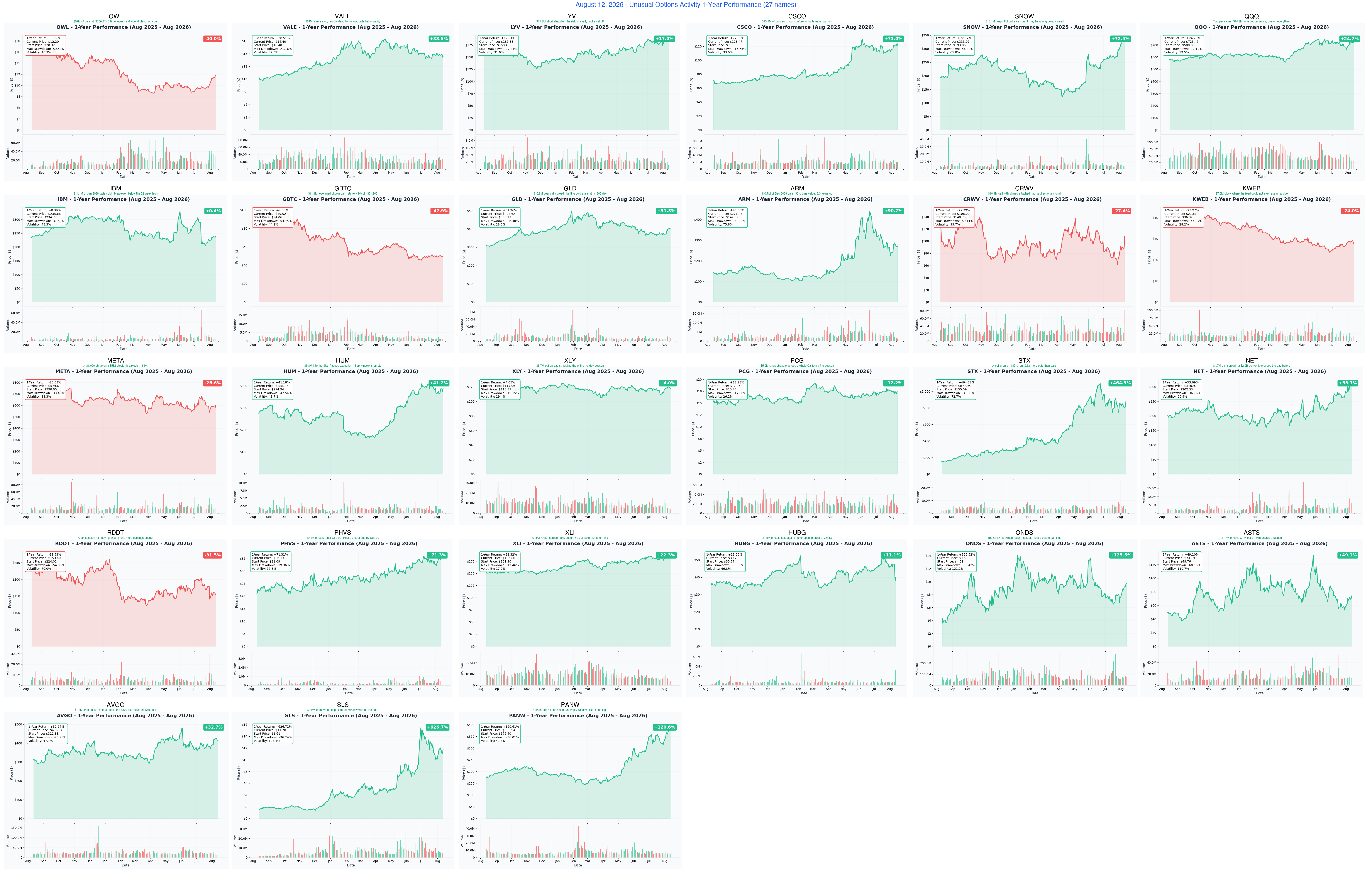
⚡ Quick Read
-
🌐 CSCO — ≈$15.1M of puts sold about five hours before tonight's earnings. Cisco reports fiscal Q4 after the close today, and the options market agrees: it is pricing ±9.83% over two days, against only ±14.49% over five weeks. That shape is what an earnings print looks like in options prices. Read the trade correctly, because "SOLD PUTS" reads backwards to most people — selling a $140 put against a $123.09 stock obligates the desk to buy Cisco at $140, and the ≈$30.25 collected puts the effective entry near $109.75, ≈10.8% below today's price. It is a bullish financing structure on a $70.0M obligation. The uncomfortable part: consensus sits at $132.59, $7.41 BELOW the strike they committed to. And because Cisco's fiscal year ends in late July, tonight also carries the first FY2027 guidance.
-
🥇 GLD — a ≈$10.78M credit that is far tighter than it sounds. Selling the September $410/$415 call spread risks ≈$16.86M. Translated into metal — and you need this to judge it — the $410 strike is ≈$4,455–4,460 an ounce, breakeven ≈$4,480, and maximum loss ≈$4,510–4,515. Gold sits at $4,420 and is today testing a 10-week high near $4,450, one session's range below the short strike, after +10.46% in a month. Maximum loss triggers on a +2.2% move. The most defensible read: gold's 200-day average at ≈$4,500 sits between the breakeven and the max-loss point. Note the shape of the window too — the first three and a half weeks are nearly empty, then payrolls, CPI and the FOMC all land in the final fortnight, exactly when the position is most exposed.
-
🏢 IBM — ≈$14.1M collected for selling calls 28% out of the money, and that number oversells the safety. IBM closed at $306.13 on July 7 and $329.23 on June 2, and its 52-week high of $332.46 sits ABOVE the $328.11 breakeven. So this seller is not betting against a far-fetched rally — they are betting IBM never reclaims its own summer price at any point in the next 17 months. The backdrop is a crash, not a rally: a July 14 pre-announcement on an IBM Z shortfall took the stock −25.21% in one session. Analysts sit well below the strike (consensus $244–265, zero Strong Buys).
-
🩺 HUM — the money went where the event is. Three purchases of the same $400 strike, ≈$6.81M — and two-thirds of it went into the October expiration, the one containing the CMS Star Ratings release, with Medicare open enrollment opening October 15, exactly one day before expiry. The September window contains zero scheduled catalysts. One caveat we will not bury: CMS has not published a confirmed Star Ratings date. And note what these are — all three printed with shares attached, so the options alone do not express a clean directional view.
-
🛡️ PANW — a short call rolled OUT of an empty window and INTO the year's biggest print. ≈$33.4M of gross premium traded for a net credit of ≈$0.29M. The August $300 call carries $1.43 of time value against $82.87 of intrinsic — a share substitute about to expire into nothing. The November $320 carries $22.88. Palo Alto's fiscal Q4 is company-confirmed for September 1 — eleven days AFTER the August expiration. And here is the trap: some calendars still show an estimated August 17 date that would put earnings inside the August contract. It is stale and wrong.
-
🛒 XLY — ≈$6.65M positioned across the whole holiday season, and the expiration date is the clever part. The December window covers Black Friday and Cyber Monday but expires before Super Saturday, before Christmas, and before the December retail sales report. So it is not a bet on the final receipts; it is a bet on the market forming an opinion about the holiday. The tightest fit: November retail sales releases December 16, two days before expiry. Before copying it, know what you would own: Amazon is 25.21% of this fund and Tesla 14.82% — 40.03% combined.
-
⚡ PCG — ≈$5.24M collected for staying calm through a California fire season. A short strangle at $17/$18 makes money if PG&E simply trades quietly and loses if it breaks out either way — short volatility, not directional. The problem is the window: the entire remaining 2026 wildfire season sits inside it with no roll point, into a season already showing 18%-of-average snowpack and an active 57,363-acre fire at 4% containment, with the $21B state wildfire fund already expected to be exhausted. Sobering detail: the true package breakevens are $14.38 and $20.62, and PG&E's own 52-week low of $14.30 sits below the lower one.
-
🏭 XLI — the most misread structure on the board, so read the sizes. 55,000 puts bought at $175 against 70,000 sold at $170 — deliberately unequal, which makes it a ratio spread, not a vertical, leaving it net short 15,000 puts. It makes its maximum ≈$25.55M at exactly $170 — about 13 times the ≈$1.96M paid — with an upper breakeven at $174.64 and a lower one all the way down at $152.97 (−17.8%). The crash tail is real but far out. And the Fed is the whole thesis: July's meeting held rates 9-3 with three members dissenting FOR a hike, with ≈77% odds priced for September.
-
🧬 PHVS — the cleanest new position on the board. ≈$2.08M of October puts bought against prior open interest of exactly zero. Pharvaris has guided three times that its Phase 3 topline arrives by September 30 — sixteen days before expiry. Now the part most would get wrong: the FDA decision is April 23, 2027, roughly six months AFTER expiry. A thesis about approval risk is in the wrong expiration; a thesis about the readout is in exactly the right one.
-
🚚 HUBG — ≈$1.89M of calls sold against prior open interest of ZERO, and it is not a freight trade. Hub Group is a delinquent filer mid-restatement, redoing FY2023, FY2024 and three quarters of 2025 after a $77M understatement, having lost its CFO and COO in May. September 14 — four days before expiry — is simultaneously its target to file the overdue reports and the expiry of the exchange's listing exception. The stock fell −19.77% in a single session yesterday on 18.8× volume. That is why a five-week option costs 8% of the share price.
-
☁️ NET — the trade that probably is not a trade at all. A ≈$4.67M June-2027 $300/$450 call spread looks like a bold call for +45%. But Cloudflare priced a $2.175B convertible note the day before, and this printed with shares attached — so the most parsimonious reading is convertible-related hedging flow, not a directional bet. We flag it as a strong hypothesis rather than fact: the strikes do not match the convert's $496.94 conversion price. Either way, $450 sits ≈13% above the highest published Street target.
-
💵 OWL and VALE — ≈$161M, and the most useful lesson on the board. Both go ex-dividend tomorrow, August 13. Both saw deep in-the-money calls trade below intrinsic value in the final hour of the last day an exercise could capture the payout. Blue Owl: 428,280 contracts, ≈$97.0M, 40 floor prints, time value NEGATIVE $0.0046 against a $0.23 dividend. Vale: 144,000 contracts, ≈$64.0M, 24 prints, time value NEGATIVE $0.024 against a ≈$0.40 dividend — early exercise beats holding by 13–17×. Here is the mechanic in one sentence: when a dividend is worth more than an in-the-money call's remaining time value, rational holders exercise, and market makers trade enormous volume among themselves right before the deadline to harvest the dividends that inattentive holders forfeit. Both traded 3–4× the entire prior open interest at their strikes. Neither says a single thing about where the stock goes.
-
⚡ ONDS — the only lit sweep of the day, and it was sold ≈24 hours before earnings. A ≈$1.87M naked call sale, printed at the bid, into a company reporting tomorrow at 8:30 a.m. ET with ≈44% of its float sold short. Because it took liquidity, this is the one name where the aggressor read genuinely applies — a real seller, not a negotiated transfer. The seller's case is decent: through the best operating stretch in company history the stock is −3.5% year to date, because share count is +287%. The counter-case is real too — every published target sits above the strike.
-
🎤 LYV — ≈$15.2M collected on a short straddle, and the risk is a rally. Selling both the $180 call and the $180 put is a bet the stock goes nowhere; it profits only inside a ≈±13.7% band. The counterintuitive part: the upper breakeven of $205.35 is only ≈1.7% above consensus and BELOW the $210–$215 targets four banks published in the last three weeks, with 18.21% short interest to accelerate a move. The antitrust breakup — the one event big enough to break the band — is calendared into 2027, outside this expiration.
-
💾 STX — a collar on a stock that has already run, and the window is empty. Selling 706 September $1,050 calls to help fund 1,832 September $780 puts — 2.6:1 weighted toward protection. What makes it notable: the September window contains zero scheduled company events (earnings ≈Oct 28, ex-dividend Sep 24, both after expiry), so this is insurance against unscheduled risk. Context: 18 Strong Buys, zero Sells, and ≈$144.5M of insider selling with no purchases — management hedging the way this collar does.
The habit to take from today: before you read intent into a trade, ask what it is FOR. The two biggest prints on this board — ≈$161M between them — were mechanical dividend captures with no view attached. Of the rest, all but one was a negotiated block with a known counterparty who agreed the price in advance. Size tells you scale; mechanism and pricing tell you purpose. A deep in-the-money call trading below its intrinsic value the day before an ex-dividend date is plumbing, not conviction — and once you can spot that, you stop misreading the largest numbers on any given day.
🎯 Today's Pattern: Three Options That Expire Just Before the Proof
Three separate long-dated trades, in three unrelated names, all expire just before the report that would settle their own thesis. Once you see it, you cannot unsee it:
| Ticker | Expiration | The report that would settle it | Gap |
|---|---|---|---|
| AVGO | Feb 19, 2027 | Fiscal Q1 2027 — the first delivered quarter of the ">$100B AI revenue" year. It ends inside the window | reports ≈13 days after |
| META | Jan 21, 2028 | FY2027 results — whether ≈$270B of 2026-27 capital spending paid off, plus the FY2028 capex guide | lands ≈1 week after |
| IBM | Jan 21, 2028 | Q4/FY2027 — full-year results and next-year guidance | lands ≈5 days after |
The lesson: a long-dated option is not the same as owning the thesis. You can be right about where a company ends up and still hold a contract that expires before anyone can prove it. On IBM the asymmetry favours the seller — the option dies just before the news that could hurt them. On META it works against the buyer, who is underwriting a capital-spending programme whose verdict arrives a week too late. Worth noting too: CSCO and IBM used the identical January-2028 expiration from opposite sides, and the research found no company-specific reason for that date — it is most likely just the longest-dated standard listing.
✅ RESOLVED — This Board's Own ⏳ Flags, Now Settled
Added 2026-08-13 pre-market. Resolving OPRA snapshot timestamped August 13 (reflects the August 12 close); baseline is the August 12 snapshot (reflects the August 11 close).
All 44 legs resolved — zero pulls failed. 34 opened, 7 closed or did not open, 3 were transfers or exercises. Five names inverted.
🔄 Inversions — 5 names
🔄 GLD — the $410 leg CLOSED. There was no fresh bear call spread. September $410 call 69,848 → 39,341 (−30,507) against 55,292 sold — 55% of the print extinguished — while $415 rose 26,213 → 95,863 (+69,650). We published the falling branch explicitly. Restated: a call strike roll up from $410 to $415. No new short obligation was created, and no net credit was collected for fresh upside risk.
🔄 XLI — the crash tail never existed. November $170 put 80,261 → 49,881 (−30,380) against 70,000 sold; $175 rose 321 → 55,274 (+54,953). We named the rule in advance: "if $170 OI falls → it was a close → Reading B (roll-up, no tail)." Reading B confirmed — an existing hedge pulled from 8.7% below spot to 6% below spot. No naked short leg, no open-ended tail below $152.97. The entire ratio-spread risk analysis is withdrawn.
🔄 KWEB — a roll, not a premium-collection short. September $27 call 32,719 → 24,228 (−8,491): the closing branch. The ≈$2.1M was realised liquidating a long, not collected for new risk. And the December block landed at 24,207 against our published prediction of ≈24,098 — within 109 contracts, the most precise call of the session. December direction remains unknown, exactly as we said open interest would never settle.
🔄 SNOW — a change of exactly ZERO. March-2027 $200 call 1,286 → 1,286 against a 1,000-lot cross. We published three branches; the transfer branch landed to the contract. ≈$15.1M changed hands and the market's net position did not move. No short opened, no long closed — and therefore no directional inference available at all.
🔄 RDDT — thesis confirmed, one label retired. December-2028 924 → 1,403 (+479), September-2028 770 → 666 (−104) — the roll continued for a seventh consecutive session, on the exact branch published. Correction: the September leg's provisional BTO label is retired; its open interest fell, so that leg is the closing half.
✅ The two biggest prints were not positions
✅ OWL — 96% of the open interest vanished. August $10 call 142,881 → 5,973 (−136,908, −95.8%) against 428,280 traded. We published a two-branch answer key; the dividend branch required a fall, the financing fallback required a jump into the hundreds of thousands. It fell 96%. The contracts were exercised and extinguished. The BTO label is retired — almost nobody holds this position this morning.
✅ VALE — 144,000 traded, open interest moved 910. September $10 call 35,230 → 34,320 (−910), or 0.6% of the print. A real directional open would have added ≈144,000 contracts. The bullish reading is ruled out by data, not merely unsupported. The neighbouring $12 call collapsed 15,663 → 1,957 (−13,706) in the same early-exercise wave.
✅ Confirmations worth naming
✅ XLY — the most precisely-resolved trade of the session. $112.50 put predicted ≈58,600, actual 58,574 (within 26). $107.50 put predicted ≈500, actual 427 (within 73), retiring 99.3% of the print. The roll-up branch confirmed — which means the desk got more bearish, not less. Consequence worth noting: the ≈55,000 contracts that made $107.50 a "crowded line in the sand" were largely this desk's own, and they are now gone.
✅ PANW — roll confirmed both legs: Nov $320C +1,966 (the exact print size), Aug $300C 2,680 → 1,734 (−946). ✅ SLS — calendar roll confirmed: Oct $10P −3,012, Jan-2027 $10P +8,025. ✅ GBTC — exact to the contract: 9 → 9,509 against 9,500 bought, on a published ≈9,509. ✅ LYV — put leg exact: 71 → 6,071 on a published ≈6,071.
⏳ Confirmed on direction, WRONG on size — corrections
PCG — this is the correction that matters. Both legs opened, but only ≈25% of each print became new open interest: $17 put +5,622 on 20,000 sold (predicted ≈36,600, actual 22,248), $18 call +4,429 on 20,000 (predicted ≈31,900, actual 16,293). Our claim that the two-session campaign was "roughly 29,000 puts and 30,000 calls" and that the headline understated the total is corrected — the honest outstanding position is 22,248 puts and 16,293 calls.
ONDS — the position is ≈3x larger than we captured: predicted ≈8,239, actual 23,354. The full day's 23,000-contract volume opened. HUM — the October leg came in ≈490 contracts light (76% of size); September ran 148%. QQQ — Nov $725P captured 91%; the other three legs landed at 99.3–100.1%.
What changed
Three of the five inversions were the same trade shape: an existing hedge or long rolled up a strike, which on the tape is indistinguishable from a freshly-opened spread. In every case the giveaway was identical — the short leg printed at or below its own prior open interest — and in every case this letter said so before the snapshot landed. Two of those three would otherwise have been published as risk-bearing new positions carrying tails that do not exist.
The board's second lesson is about magnitude, not direction: PCG, ONDS, HUM and QQQ all confirmed on direction and missed on size — PCG by roughly 75% of the print. A confirmed "OPEN" verdict is not a confirmation of the headline premium. Only the change in open interest is.
🔁 OI Review — Last Session's Provisional Flags, Now Resolved
Tuesday's board has been through the next-day open-interest test, and seven of sixteen names came back meaning something different than they looked. All 30 legs resolved — nothing expired, nothing failed to pull. 12 opened, 13 closed or did not open, 5 were transfers or unresolvable. Eleven of those sixteen names printed at or below prior open interest — that is why they carried a ⏳ — and when the snapshot landed, most turned out to be position management, not new conviction. Two more were swept by something else entirely: a dividend.
🔄 Inversions
🔄 QGEN — the cleanest inversion, and it retires the whole premise. Open interest on the August $45 call fell 45,759 → 27,509, −18,250 — 91% of the 20,000 printed, extinguished. Neighbouring strikes did not move. The ≈$2.0M was realised liquidating a long, not collected for taking on new risk. Order type corrects from STO to STC.
🔄 VSAT — inverted completely, exactly as we warned. Both legs halved in near-lockstep: the $80 call 12,721 → 6,369, the $115 call 12,675 → 6,647 — one two-legged package unwound as a unit. An existing bear call spread came off; a new one was not put on. Withdrawn in full: the ≈$30.8M of capital at risk and the "someone is betting Viasat's rally stalls" thesis.
🔄 EWY — a second consecutive session of unwinding. Neither leg opened: the $130 put 19,246 → 13,763, the $165 call 13,839 → 8,595. Across three snapshots ≈55% of the put line and ≈66% of the call line retired in two sessions. Order type corrects from BTO to BTC on both.
🔄 BIRK — the "27,000-contract put ladder" was a re-strike, and net downside exposure FELL. Only the $40 leg opened (203 → 9,045). The two biggest-premium legs closed: $47.50 put 9,002 → 3,020 and $37.50 put 9,209 → 3,102. Net across all three strikes: 18,414 → 15,167. Two days before earnings, this was ≈9,000 new puts at $40 paid for by retiring ≈12,000 puts at higher strikes.
🔄 MSTR — a roll out in time, not a two-expiration bet. October $95 calls opened 592 → 44,846; August $95 calls fell 47,089 → 36,278. The genuinely new money is the ≈$63.09M October leg — stop adding the two legs into one commitment.
🔄 MAR — no new short was opened, so the premium-harvest story collapses. The September $330 call fell 10,495 → 8,034 against 9,850 sold. Nobody collected premium to hold new risk here — a long got out.
🔄 AMD — the tail cover was never bought, which makes the trade less hedged. The September $470 short opened (1,262 → 9,479); the August $500 leg went the other way (13,291 → 11,417). It restates from "reverse diagonal with cheap tail cover" to a short-call roll down and out — more premium-hungry and less protected than we published.
✅ Confirmations
- ⭐ TLT — both legs opened, and the strike drew far more than the block. The put leg cleared with room (114,053 → 141,224), and the call leg printed 8,474 → 57,409 — ≈2.4× the block's worth of new short calls at one strike in a session. The synthetic short is confirmed and larger than described.
- RTX — February opened from literal zero → 6,952; December fell 7,074 → 2,021. Honest refinement: we predicted ≈125, so ≈1,896 transferred rather than retired.
- ⭐ IGV — the hedge is ≈45% bigger than we captured. 2,742 → 52,572 — ≈97% of the strike's day volume became new open interest. Every premium figure in that article is a floor: closer to ≈$13.6–13.8M than the ≈$9.5M headline.
- ABVX within ≈11 contracts of prediction; FDX 29 above; ASML exact to the contract (6 → 106).
💵 The dividend wave — where the calendar, not the desk, moved the numbers
Clorox and Target both went ex-dividend on August 12, making Tuesday the last cum-dividend session. Every call whose time value sat below the dividend was exercised overnight.
✅ CLX — we named the exact number to watch, and it printed. The August $95 open interest came in at 27 contracts, down from 3,369 — −99.2%. Market-wide: August $90 946 → 9, August $100 2,656 → 11, while every put was untouched. Dividend-capture confirmed. Two honest consequences: the two ⏳ September prints are retired as unresolvable, and one prediction was simply wrong — we said the September $70 call would rise toward ≈1,002. It went to zero.
⛔ TGT — no leg opened, and two legs we called proven opens were both wrong. We predicted the January $75 call would jump toward ≈5,183 and the December $80 toward ≈5,186. They printed 18 and 3. This ≈$146.5M package left no surviving open interest at any strike.
The lesson, and it is a real limitation of our own rule: an ex-dividend date prices early exercise across the whole chain, and a trade printing far above prior open interest does not guarantee surviving open interest when an exercise deadline falls the same night. The size-versus-open-interest test must be suspended for deep-in-the-money calls on the last cum-dividend session.
📊 At a Glance
| Ticker | Net Premium | Expiration Range | Catalyst inside the window | Option Play | What It Means |
|---|---|---|---|---|---|
| OWL | ≈$97.0M | Monthly (Aug 21) | Ex-dividend TOMORROW, $0.23 | 428,280 deep-ITM calls at NEGATIVE time value | ✅ RESOLVED: exercised — OI −136,908 (−95.8%). Dividend play confirmed |
| VALE | ≈$64.0M | Quarterly (Sep 18) | Ex-dividend TOMORROW, ≈$0.40/ADR | 144,000 deep-ITM calls below parity | ✅ RESOLVED: transfer — 144,000 traded, OI moved 910. Dividend confirmed |
| LYV | ≈$15.2M credit | Quarterly (Dec 18) | One earnings report; antitrust remedies fall in 2027 | Short straddle at $180 | Short volatility — and the risk skews UP |
| IBM | ≈$14.1M credit | LEAP (Jan 2028) | 5 reports inside; the 6th lands after | Sell 5,000 $300 calls | Breakeven sits below the 52-week high |
| STX | ≈$5.1M | Quarterly (Sep 18) | Nothing scheduled inside | Collar: short $1,050C / long $780P, 2.6:1 | Insurance on a ≈+185% run |
| RDDT | ≈$4.5M | LEAP (Sep 2028) + LEAP (Dec 2028) | ≈8 vs ≈9 reports — the roll buys exactly one | Same-strike LEAP calendar roll | ✅ RESOLVED: roll continued a 7th session (Dec +479 / Sep −104) |
| ONDS | ≈$1.9M credit | Long-dated (Mar 2027) | Earnings TOMORROW 8:30am | ⚡ Sell 7,647 $12 calls — lit sweep, at the bid | The only lit trade today; ≈44% short float |
| ASTS | ≈$1.7M | Monthly (Feb 2027) | Launches inside; FY verdict lands after | Buy 1,950 $125 calls, shares attached | 69% out of the money; direction unproven |
| CSCO | ≈$15.1M credit | LEAP (Jan 2028) | Earnings TONIGHT; 6 reports inside | Sell 5,000 $140 puts | Bullish financing — effective entry ≈$109.75 |
| SNOW | ≈$15.1M credit | Long-dated (Mar 2027) | Q2 Sep 2 confirmed | Sell 1,000 deep-ITM $200 calls | 🔄 RESOLVED: PURE TRANSFER — OI flat at 1,286, Δ = 0 |
| QQQ | ≈$14.2M (two packages) | Monthly (Oct 16) + Monthly (Nov 20) | Oct = semis only; Nov = >55% of index weight | Risk reversal and bull call spread | Two bullish structures; Oct strike ≈2.9% above the record high |
| IBM | ≈$14.1M credit | LEAP (Jan 2028) | 5 reports inside; the 6th lands after | Sell 5,000 $300 calls | Breakeven sits below the 52-week high |
| GBTC | ≈$11.1M | Quarterly (Dec 18) | 3 FOMC, 4 CPI, midterms | Buy 9,500 deep-ITM $40 calls | Leveraged bitcoin with a floor; strike ≈ bitcoin $51,900 |
| GLD | ≈$10.8M credit | Quarterly (Sep 18) | Payrolls, CPI, FOMC — all in the last 2 weeks | Bear call spread $410 / $415 | 🔄 RESOLVED: $410 leg CLOSED (−30,507) — a roll up to $415, not a new spread |
| ARM | ≈$10.7M | LEAP (Dec 2028) | 9 reports; nothing near expiry | Buy $250 + $500 calls | ≈92% time value; needs +42% and +116% |
| CRWV | ≈$10.1M | Quarterly (Dec 18) | One report, ≈Nov 10, unconfirmed | Buy 5,000 $110 calls, shares attached | Delta-hedged — not a directional signal |
| KWEB | ≈$9.1M | Quarterly (Sep 18) + Quarterly (Dec 18) | ≈55% of fund weight reports by Aug 27 | 22,000 Dec calls — side unknown | 🔄 RESOLVED: Dec OPENED (+22,109, within 109 of forecast); Sep CLOSED (−8,491). Direction still unknown |
| META | ≈$7.4M | LEAP (Jan 2028) | 5 reports; the capex verdict lands after | Buy 2,200 $1,020 calls | Breakeven +81%, above every Street target |
| HUM | ≈$6.8M | Quarterly (Sep 18) + Monthly (Oct 16) | Star Ratings + Oct 15 enrollment; Sept empty | Buy $400 calls ×3, shares attached | Money went to the October event; direction unproven |
| XLY | ≈$6.7M | Quarterly (Dec 18) | The whole holiday season; Dec 16 retail sales | Bear put spread $112.5 / $107.5 | ✅ RESOLVED: roll-up confirmed — $107.50 CLOSED to 427 (−54,496). More bearish, not less |
| PCG | ≈$5.2M credit | Monthly (Jan 2027) | The entire fire season | Short strangle $17 / $18 | Short volatility — undefined risk both sides |
| NET | ≈$4.7M | Long-dated (Jun 2027) | 3 reports, none confirmed | Bull call spread $300 / $450, shares attached | Likely convertible hedging, not a directional call |
| PHVS | ≈$2.1M | Monthly (Oct 16) | Phase 3 topline guided by Sep 30 | Buy 4,000 $30 puts | Prior open interest zero — a certain new position |
| XLI | ≈$2.0M | Monthly (Nov 20) | 2 FOMC, 3 ISM, 4 production prints | RATIO put spread 55k / 70k | 🔄 RESOLVED: $170 leg CLOSED (−30,380) — hedge roll-up, NO crash tail |
| HUBG | ≈$1.9M credit | Quarterly (Sep 18) | Sep 14 filing + listing deadline | Sell 6,060 $40 calls | Prior open interest zero; naked, into a binary |
| AVGO | ≈$1.3M credit | Monthly (Feb 2027) | 2 reports; the AI proof lands after | Risk reversal: short $370P / long $490C | Synthetic long — but the put side is 44% larger |
| SLS | ≈$1.2M | Monthly (Oct 16) + Monthly (Jan 2027) | Nothing before Oct; everything after | Same-strike calendar roll | ✅ RESOLVED: calendar roll confirmed (Oct −3,012 / Jan +8,025) |
| PANW | ≈$0.3M credit | Monthly (Aug 21) + Monthly (Nov 20) | Aug: nothing. Nov: Sept 1 earnings | Short call roll up & out | ✅ RESOLVED: roll confirmed (Nov +1,966 / Aug −946) |
✅ All ⏳ flags on this board were resolved by the 2026-08-13 ≈06:30 ET OPRA snapshot — see the ✅ RESOLVED section above. (⏳ originally marked a leg whose size sat at or below prior open interest, so open-versus-close could not be proven from that day's tape.)
📅 Upcoming Catalysts — and Which Expiration Actually Contains Them
A catalyst date and an option expiration date are different things. This table keeps them apart on purpose.
| Date | Event | Which of today's expirations contains it |
|---|---|---|
| Aug 12 (tonight) | Cisco fiscal Q4 + first FY2027 guidance | CSCO Jan 2028 |
| Aug 13 | Blue Owl AND Vale both go ex-dividend | OWL Aug 21 · VALE Sep 18 — the reason both traded |
| Aug 13, 8:30am | Ondas Q2 earnings (company-confirmed) | ONDS Mar 2027 |
| Aug 13 | Cloudflare convertible settles | NET Jun 2027 |
| Aug 18 / Aug 20 | Industrial production · Alibaba earnings | XLI Nov 20 · KWEB Sep 18 |
| Aug 26 | Nvidia earnings | QQQ Oct 16 and Nov 20 |
| Aug 27-29 | Jackson Hole | GBTC Dec 18; QQQ Oct 16 |
| Sep 1 | Palo Alto fiscal Q4 (company-confirmed) | PANW Nov 20 — ⚠️ misses Aug 21 by 11 days |
| Sep 2 | Snowflake fiscal Q2 · Broadcom fiscal Q3 | SNOW Mar 2027 · AVGO Feb 2027 |
| Sep 4 / Sep 11 | Payrolls · CPI | GLD Sep 18 |
| Sep 14 | Hub Group filing + listing deadline | HUBG Sep 18 — 4 days before expiry |
| Sep 15-16 | FOMC + dot plot | GLD Sep 18 — two days before expiry; XLI Nov 20 |
| by Sep 30 | Pharvaris Phase 3 topline (company-guided) | PHVS Oct 16 — 16 days of buffer |
| Early Oct (est.) | CMS Star Ratings — date NOT confirmed | HUM Oct 16 |
| Oct 15 | Medicare open enrollment opens | HUM Oct 16 — one day before expiry |
| Oct 27-28 | FOMC | QQQ Nov 20; XLI Nov 20 — ⚠️ QQQ's Oct 16 misses it |
| Nov 3 | US midterm elections | GBTC Dec 18; XLY Dec 18 |
| ≈Nov 18 (est.) | Nvidia fiscal Q3 | QQQ Nov 20 — two days before expiry |
| Nov 26-30 | Thanksgiving / Black Friday / Cyber Monday | XLY Dec 18 |
| Dec 8-9 | FOMC with projections | XLY, GBTC, CRWV Dec 18 |
| Dec 12-15 | ASH Annual Meeting | SLS Jan 2027 |
| Dec 16 | November retail sales — the holiday verdict | XLY Dec 18 — two days before expiry |
| ≈Feb 2027 | Cloudflare FY2027 guidance | NET Jun 2027 |
| ≈Oct 28 – Nov 5 (est.) | Humana Q3 earnings | ⚠️ Nothing — HUM's Oct 16 expires too early |
| ≈Early Mar 2027 | Broadcom fiscal Q1 — the AI proof | ⚠️ Nothing — AVGO's Feb 19 expires ≈13 days early |
| Apr 23, 2027 | Pharvaris FDA decision | ⚠️ Nothing — PHVS's Oct 16 expires ≈6 months early |
| ≈Late Jan 2028 | IBM Q4/FY2027 · Meta FY2027 capex verdict | ⚠️ Nothing — both Jan 21 contracts expire days early |
👥 Four Ways to Read Today
🎲 The YOLO trader. ARM's December-2028 $500 call is the purest lottery ticket here — but price what you are buying: ≈92% of that package is time value and the upper leg needs +116.4%. The intellectually honest version is the $250 leg, which needs a round trip rather than a new high. META is the other candidate and it is harder still: +81% to a ≈$2.69T market cap, above every published target. PHVS at least has a dated binary — Phase 3 topline by September 30 — but its breakeven is −28.8%, and a trial miss would not zero the company.
📈 The swing trader. The two most tradeable calendars are GLD and QQQ, and they are opposites. GLD's event risk is all crammed into the final two weeks after three and a half quiet ones. QQQ's October spread expires before the October Fed meeting and before the late-October mega-cap earnings, which is exactly why the same desk also put on a November structure. When you copy an expiration, check what it does and does not contain. Note the counter-signal on both: the implied ranges do not currently reach the strikes these trades need.
💰 The premium collector. The richest board in a while — CSCO, IBM, SNOW, GLD, PCG, HUBG and PANW are all sellers — but read what each is actually short. PCG is short volatility across a whole fire season with no roll point, and its 52-week low sits below the package breakeven. CSCO sold puts into an earnings print tonight, on a 17-month obligation. IBM's breakeven sits below its own 52-week high. HUBG sold naked calls against prior open interest of zero, four days before a binary filing deadline, the day after the stock fell 20%. The one genuinely favourable observation: PCG's two short strikes sit exactly on the two strongest gamma levels — that helps, until it doesn't.
🌱 The beginner. Learn one idea today: mechanism is not conviction. Every trade on this board was a negotiated block — a broker matched two parties who agreed the price in advance. Nobody chased, nobody panicked. A $15M block is $15M changing hands between two parties who already agreed, so the positioning is informative but the aggression is not, because there wasn't any. Then learn the second: check whether the option expires before or after the event. Today gave three long-dated trades that expire just before the report that would prove them right or wrong — and one, Palo Alto, where a widely-shown earnings estimate is simply stale.
⚠️ Before You Trade Any of This
Not one leg on today's board was a lit sweep. All 35 printed as floor blocks, crosses or price-improvement auctions, nearly all at mid — taking no liquidity at all. There is a known counterparty on the other side of every one, and that counterparty may be just as informed. The BUY and SELL labels on a mid-priced negotiated block are reported, not proven — a block struck between two agreeing parties has no aggressor to measure.
Three names carry no directional signal at all. CRWV, HUM and NET printed with paired equity legs, so the options are hedged and the direction of the option is not the direction of the position. And on KWEB's 22,000-lot December block the feed could not assign a side at all — we do not know whether it was bought or sold, and we will not guess. Two more — SNOW and GBTC — are deep in-the-money share substitutes carrying so little time value that they behave like stock.
We correct ourselves in public. Today's review inverted seven of yesterday's sixteen names, retired two more into a dividend exercise wave, and retracted one prediction outright.
✅ Resolved 2026-08-13 pre-market. The nine legs on this board that carried ⏳ — size at or below prior open interest — have all been settled by the next-day open-interest snapshot. Five names inverted, and two of them (GLD, XLI) turned out to carry no new risk at all where we had described a fresh spread. See the ✅ RESOLVED section near the top. Position for being wrong, not for being right.
This is market analysis and education, not investment advice. Options carry substantial risk of loss, and uncovered short options carry theoretically unlimited risk.
Last updated: 2026-08-13 (pre-market) — the next-day OPRA open-interest snapshot resolved all 44 legs on this board. Five names inverted (GLD, KWEB, SNOW, XLI, RDDT); the two largest prints (OWL, VALE) resolved as dividend mechanics rather than positions; PCG's two-session campaign size was corrected downward. Glance-table status cells, the ⏳ legend and the closing callout were updated, and a ✅ RESOLVED section was added.