📊 Ainvest Option Flow Digest — 2026-08-04
Fifteen names, ≈$508M net — $152M of premium sold into tomorrow's earnings, a $10M print that got cancelled, and a $24M call sale that wasn't bearish at all
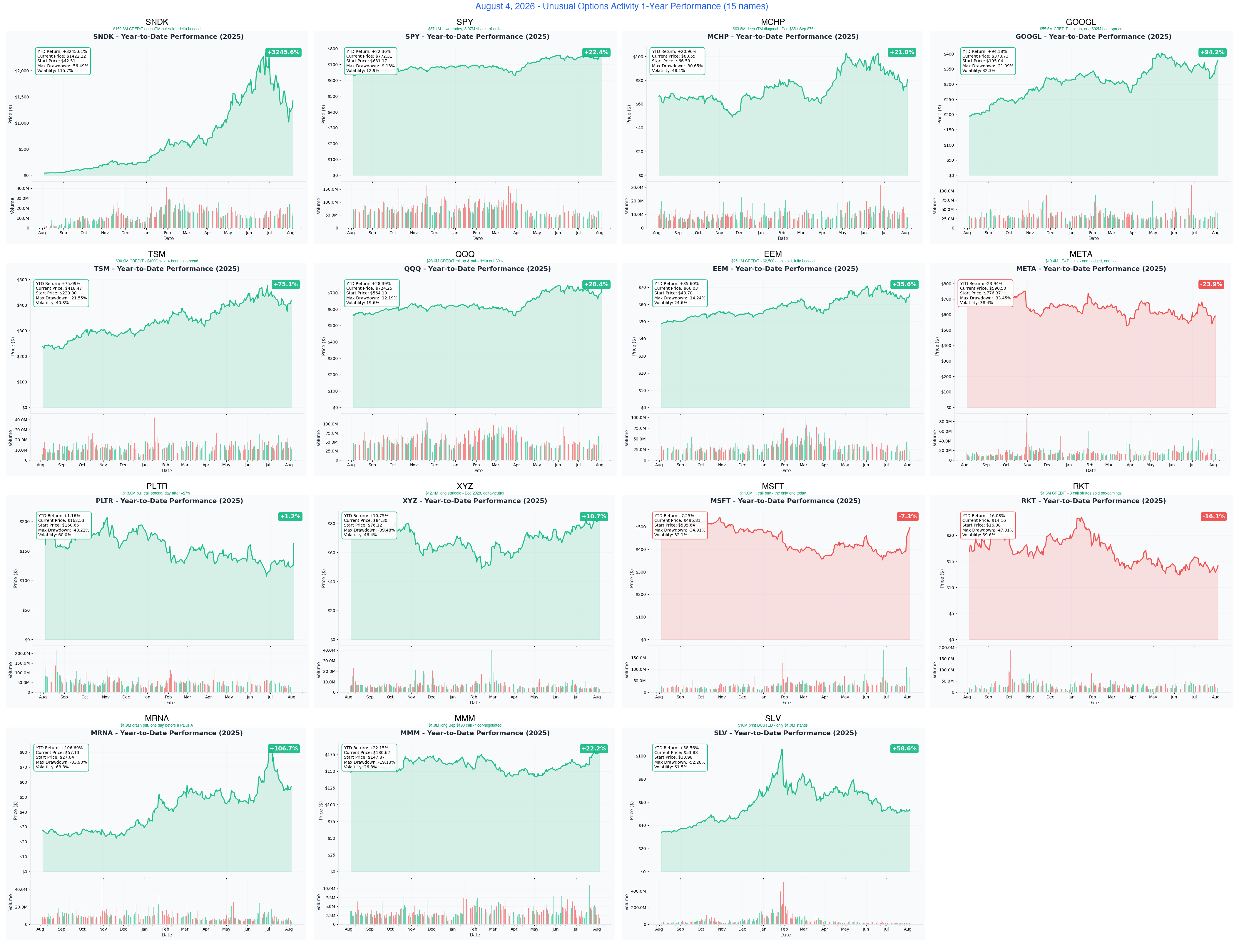
🔄 Updated 2026-08-05 pre-market — the next-day open-interest check on this board is complete. 33 legs tested: 21 opened, 7 closed, 3 partial, 2 inconclusive. Three published reads inverted — SPY's Aug-21 $775 call was a short being covered, not fresh buying; TSM's "new bear call spread" was an existing bull call spread being closed; META's Jan-2028 $1,000 call was a buy-to-close. MCHP's roll-down-and-out was confirmed (≈$102.6M realized loss now proven). GOOGL's $375 check came back inconclusive — we predicted a fall and open interest rose. Every ticker article below carries a ✅ RESOLVED box with the numbers. The resolved detail is in the section that replaced the old ⏳ callout at the bottom of this issue.
🎯 Quick Read
Tuesday's board was small in name count and unusually rich in lessons. Six of fifteen names collected net premium, nine paid — but the two biggest credits are not what they look like, and the biggest single headline never actually happened.
- ≈$508M net across 15 names. Only one trade all day was genuinely lit and took liquidity. Everything else was negotiated — crossed, auctioned, or worked on the exchange floor.
- ⭐⭐ SPY is now the day's biggest commitment at $87.1M — and three of the reported figures were wrong. A second package hit at 14:00:35: 55,272 August-21 $775 calls and 71,854 $785 calls, $71.2M, carrying ≈3.97 million shares of delta ≈ $3.06B of exposure. The $775 call's prior open interest was reported as 5; the tape says 82,982 — which turns a provable new position into an unprovable one. Five prints were reported; there were nine. And the "ABOVE ASK" tag is misleading: these were stock-plus-options floor packages, where the option leg is priced as part of the whole trade, and implied volatility barely moved — not what happens when somebody consumes real depth. One honest gap: the stock leg never showed up. Zero qualified-contingent prints and just 362,008 shares traded in the window against a 3.97-million-share delta. If it is hedged this is a volatility purchase; if not it is $3.06B of directional upside. We do not know which. 🔄 RESOLVED 2026-08-05: the $775 leg's open interest fell 26,302 — that $43.1M was a short being covered, not fresh buying. Only the $785 leg ($28.1M, OI +75,443) is new length, which also shrinks the missing-hedge gap considerably.
- ⭐⭐ SNDK sold $152.6M of premium the day before earnings — and hedged the direction out. Two prints of the January-2027 $1,650 put at $555, ≈2.5 minutes apart. The strike is $221 in the money against a $1,428.72 stock, so $333.72 of that $555 is pure time value — that is what was actually sold. A deep in-the-money put sale usually reads as a bullish synthetic long; this one is delta-neutral. The equity tape shows 105,000 shares against a 104,550-share delta equivalent — a 0.4% match. SanDisk reports tomorrow (company-confirmed) with an Investor Day eight days later. They sold the volatility into two dated binaries and took no side on the outcome. ✅ RESOLVED 2026-08-05: it opened (OI +1,017) — but only ≈37% of the print created new contracts; the rest changed hands with exiting holders.
- ⭐⭐ GOOGL banked ≈$76.7M in four trading sessions — and we can prove it from the prior tape. The October $375 strike sat under 1,000 contracts of open interest for six weeks. Then on July 29 it traded 55,544 contracts — two floor prints of 26,900 and 18,830 that both lifted the offer (87% and 93% across the spread) at a weighted $7.27 — and open interest jumped +54,206. Today that desk sold 42,550 of them at a weighted $25.31 and bought 42,550 October $410 calls. That is ≈$18.04 a share of realised gain, ≈$76.7M, rolled up 33 points rather than cashed out. Delta falls from ≈0.558 to ≈0.330 — a bullish holder trimming risk after a big win, not a bet against Alphabet. ⚠️ RESOLVED 2026-08-05 — INCONCLUSIVE: we predicted the $375 open interest would fall to ≈12,800; it rose to 66,176. The package created ≈zero net open interest, which is compatible with the roll and with a fresh short. The roll is still the better-evidenced read, but it now rests on the July 29 tape alone — the ≈$76.7M gain is contingent on it.
- META bought two long-dated calls — and only one is a directional bet. The January-2028 $1,000 call came with 52,800 shares of stock attached, covering ≈94% of its delta; the January-2027 $700 call came with nothing. One buys convexity, the other buys direction. Do not read it as "$19M of bullish call buying". 🔄 RESOLVED 2026-08-05: the Jan-2028 $1,000 leg's open interest fell 1,789 — it was a buy-to-close, a short call being covered, not a moonshot. The $700 leg opened, but only ≈37% of it was net-new.
- ⚠️ The $10M silver trade was cancelled four minutes after it printed. SLV showed 30,009 March-2027 $70 calls at 11:13:00. At 11:17:48 a cancellation for the identical size and price hit the tape. The stock tape confirms it independently: the only silver block in the window is 75,000 shares, which hedges 3,000 contracts — not 30,009. What actually stands is ≈$1.0M. Busts are uncommon but real, and this is exactly why a single snapshot of the tape is never enough. ✅ RESOLVED 2026-08-05: open interest rose only +2,643, not ≈30,000 — the bust is confirmed independently by the open-interest record.
- ⭐ EEM's $24M call sale is not a bet against emerging markets — and the stock tape proves it. 62,500 December $68 calls were sold across five clips, and every single clip has a matching stock block within 1.4%: 3,000,000 shares bought against 62,500 contracts at ≈0.49 delta. Five for five is not coincidence. This is a delta-neutral premium sale. Anyone reading the headline as bearish has it backwards.
- QQQ banked $28.6M and cut its risk by 60%. Sell the deep in-the-money August 7 $690 calls, buy the September 4 $735s. Delta drops from ≈1,760,000 shares to ≈710,000. A big credit here means de-risking, not a bearish turn. Read the delta, not the dollars. And the new expiry captures the August 26 NVIDIA print that the old one would have missed.
- TSM sold another 5,000 $400 calls — and this morning's open-interest check says Monday's identical sale was a close. Open interest fell 21,661 → 16,725 overnight, and 16,725 is exactly today's starting point. The same reading is available again: a long being liquidated, not a new ceiling. Inferred, not proven. 🔄 RESOLVED 2026-08-05: confirmed — the $400C closed (OI −5,078). And the bigger correction: open interest fell on both Aug-21 legs too, so the "new bear call spread" was actually an existing bull call spread being closed. The $44.4M tail was risk being retired, not taken on.
- ⭐ MSFT is the only trade today where urgency is the right word. Somebody reached across the spread and paid the offer for 8,020 September $510 calls — $10.99M, 100% across the bid-ask spread — and implied volatility rose 1.38% through the print. Aggressor side and volatility agree. That is a clean, confirmed buy.
- PLTR bought a bull call spread the day after a 27% earnings pop, not before it. $12.96M for the March-2027 $165/$200 spread, both legs proven new. Max profit $29.04M, but breakeven is +10.9% and the full payout needs +26.2%.
- XYZ (Block) bought a straddle expiring in December 2028 — $12.07M for the right to be paid if Block moves a long way in either direction. Net delta +14,180 shares, essentially neutral. It is a bet on movement, not on direction.
- ⭐⭐ MCHP looks like the mirror image of Alphabet — a probable roll DOWN and out, with ≈$102.6M of loss taken to buy more time. The position history tells it: the September $75 strike held 381 contracts until May 8, when 108,203 traded at a weighted $29.22 — the day MCHP touched $105.91, its high. The stock then fell ≈28% to $71.24, and that option is now worth $10.57. Today, with Microchip recovered to $80.88, the desk sold 55,000 of them and bought 55,000 December $65 calls — deeper in the money, three months further out, more delta per contract. Where GOOGL rolled a winner up, this rolls a loser down. Same mechanic, opposite circumstances. It is inferred rather than proven — the May prints were multi-leg, so the aggressor read is soft — but note they are also adding five times over to a December position started July 31 near the low. Also worth knowing: the September leg's prior open interest is quoted as 7,000; the tape says 108,624 — the second such open-interest discrepancy today. ✅ RESOLVED 2026-08-05: confirmed — September $75C open interest fell 52,047 (≈95% of the print). The roll-close and the ≈$102.6M realized loss are now proven, not inferred. A fresh short would have pushed OI toward ≈163,624.
- MMM is the quiet one on the board — 6,000 September $190 calls for $1.79M against prior open interest of 1,672, so it is a genuine new position. It was negotiated on the exchange floor at the midpoint, which means the "BUY" tag carries no urgency signal: a mid-priced floor block tells you far less than the label suggests. It needs +7.1% in 45 days on a large-cap industrial.
- Two names sold premium straight into a confirmed catalyst. RKT sold three call strikes across three expiries two days before a company-confirmed August 6 earnings print, and MRNA bought a cheap crash put one day before an FDA decision.
The honest frame: today's board is a catalogue of ways a headline number can mislead — a print that was cancelled, a sale that was hedged, a credit that was really a risk reduction, and a close dressed as a sale. The dollar figure is the least informative thing about any of them.
🔁 OI Review — Last Session's Provisional Flags, Now Resolved
Monday's board was the biggest one we've checked: 46 legs across 24 names, and every one has now been through the next-day open-interest test. The verdict: 41 opened, 2 closed, 2 partial, 1 permanently unresolvable. Three published reads inverted — and this time the tape fooled us in both directions.
🔄 Inversions
🔄 GOOGL — it was never a bear call spread. We published a $5.49M-credit bear call spread with a protective $410 wing and a capped $10.0M maximum loss. Open interest at the $410 strike fell 13,475 → 6,863. Only 543 contracts traded there all day outside the block, so at least ≈6,910 of the 7,750 bought were closing an existing short $410 call. Corrected: a desk rolled its short call DOWN from $410 to $390. There is no long wing, so the capped loss never existed — and the ceiling on Alphabet moved from ≈10.9% above spot to ≈5.5% above.
🔄 TSM — the $14M call sale was a long holder walking away. We flagged it as genuinely unprovable and published both outcomes. Open interest fell 21,661 → 16,725. Corrected: sold to close. That $14.0M is exit proceeds, not premium collected for accepting new risk, and no new ceiling was placed over TSM.
🔄 VST — not a roll. Both legs opened. We read ≈$55M of gross premium in deep in-the-money $195 puts as a short put being pushed five months out. Open interest rose by exactly 5,400 on both legs. Corrected: a brand-new $195 put time spread opened for a $3.32M credit two days before Vistra reported. Nothing was closed.
⚠️ One material revision
KKR — a short put rolled UP, not a spread built from scratch. The $95 short leg opened as published. The $90 put's open interest fell 27,367 → 21,802, so between ≈5,565 and ≈10,282 of the 15,000 bought were closing an existing short. The bullish lean survives and arguably strengthens — but the $5.25M capped-loss figure assumed a floor the data does not support.
✅ Confirmations
- AMZN — the November $240 call came back ≈100% fresh (26,796 → 34,053 against a 7,250-lot print). The day's cleanest bullish read is confirmed on both legs.
- PANW — the roll is now proven, not inferred: the August 7 call fell 2,349 → 1,388 while the September 4 leg rose 10 → 932.
- SKHY — both ratio legs resolved opening within ≈2% of forecast. The uncapped risk above ≈$271 was taken Monday, not inherited.
- MRVL and SMH — all legs opened; the ≈$249M-of-delta ladder was genuinely established.
- NKE, FISV, PDD, CRWV, AZN, IONQ, POWL, RDDT, HOOD, PG, INFY — all confirmed opening at 86% to 150% of print.
⚠️ Partial
MO — the January $62.50 put opened cleanly, but the September $70 call added only 1,548 contracts against a 7,500-lot sale (≈21%). The collar stands, but four-fifths of that print was existing open interest changing hands. "Confirmed open" and "all of it was new" are different claims.
❓ One we cannot resolve — and a correction to our own method
MSFT's August $460 call is permanently unresolvable, and we should not have promised otherwise. We said a rise in open interest would prove a fresh short and "flip the entire read." That assumed our 7,435-lot print dominated the strike. It did not — the strike traded 53,456 contracts across more than 1,400 prints that day. The arithmetic permits a full close, a full open, or anything between, and no future snapshot changes that. The roll read stands on structure, not open interest. Going forward: when a strike's day volume dwarfs the print, we will say up front that the check will be inconclusive rather than promise a verdict.
📌 One anomaly worth naming
SPY's crash-insurance butterfly opened at exactly twice its printed size — on all three legs. Open interest rose +300,057 / +600,147 / +300,023 against prints of 150,000 / 300,000 / 150,000, holding the 1:2:1 ratio perfectly at 2.00×. Public tape volume matched only 1×, and seven other strikes in the same expiry behaved normally, which rules out a data glitch. Open interest cannot rise by more than the contracts that trade — unless positions were created somewhere the public tape never saw. Most plausible explanation (inferred, not proven): a second identical package cleared away from the tape. What is certain: that crash-hedge program is roughly twice the $25.35M we reported.
What changed, and the standing lesson
Pre-check, Monday read as ≈$218M net with fourteen of twenty-four names collecting premium. Post-check the dollars are unchanged — open interest never moves the cash — but GOOGL's and TSM's credits are no longer compensation for newly accepted risk; they are what a desk received for unwinding risk it already had.
The standing lesson: a big credit does not tell you somebody sold risk, and a big buy does not tell you somebody bought exposure. Monday produced nine legs that printed below their prior open interest — the genuinely ambiguous cases — and they split almost evenly: four opened, three closed, one partial, one unresolvable. That is what a coin flip looks like, and it is why we refuse to assert an order type on those legs on the day.
📋 At a Glance
| Ticker | Net Premium | Expiration | Bucket | Catalyst inside the expiry? | Option Play | What It Means |
|---|---|---|---|---|---|---|
| ⭐⭐ 💾 SNDK | $152.63M credit | Jan-15-2027 | LEAP-ish | ✅ Earnings tomorrow Aug 5 (confirmed) + Investor Day Aug 13 | Deep-ITM put sold, delta-hedged | Volatility sale — $333.72/share of time value, direction hedged out; ✅ opened, but only ≈37% net-new |
| ⭐ 🔎 GOOGL | $55.65M credit | Oct-16-2026 | Monthly | ⚠️ Q3 earnings not confirmed, likely late Oct — after expiry | Roll up, 42,550/side, $375 → $410 | ⚠️ De-risking after a win — ≈$76.7M banked, but the OI check came back inconclusive |
| 📱 META | $19.39M debit | Jan-15-27 / Jan-21-28 | LEAP / LEAP | ⚠️ Q3 date not confirmed; ≈2 and ≈6 prints inside | Two OTM LEAP calls — one hedged, one not | 🔄 One open, one close — the Jan-28 $1,000 leg was a buy-to-close (OI −1,789); the $700 leg opened ≈37% |
| 🌏 TSM | $30.17M credit | Aug-21-26 / Sep-18-26 | Monthly / Monthly | ✅ Monthly revenue ≈Aug 10 inside Aug-21; ❌ Q3 earnings estimated Oct 15, after both | $400C sale (confirmed close) + close of an existing bull call spread | 🔄 An exit, all of it — OI fell on all three legs; no new bearish position was opened |
| 🧩 QQQ | $28.61M credit | Aug-07-26 → Sep-04-26 | Weekly → Weekly | ✅ NVIDIA ≈Aug 26 (estimated) lands inside Sep-04, after Aug-07 dies | Roll up and out, $690 → $735 | De-risking — banks $28.6M, cuts delta 60% |
| ⭐ 🌏 EEM | $25.09M credit | Dec-18-26 / Jan-15-27 | Quarterly / LEAP-ish | ✅ FOMC Sep 15–16 and Dec 8–9 both inside | 62,500 calls sold, fully delta-hedged + a risk reversal | Neutral premium sale — the stock tape proves it isn't bearish |
| ⭐⭐ 🦅 SPY | $87.11M debit | Aug-14-26 / Aug-21-26 | Weekly / Weekly | ✅ Aug 7 jobs, Aug 12 CPI, Aug 13 PPI, Aug 19 FOMC minutes; ❌ Sep FOMC and midterms are after | Two trades — a 10-day auction + a $71.2M Aug-21 call package | 🔄 Part short-covering — the $43.1M $775 leg closed a short (OI −26,302); only the $785 leg is new length |
| 🅱️ XYZ | $12.07M debit | Dec-15-2028 | LEAP | ✅ Earnings tomorrow, Aug 5 (confirmed) — plus ≈10 more prints inside | Long straddle at $115 | Long volatility — a bet on movement, not direction |
| 🔮 PLTR | $12.96M debit | Mar-19-2027 | LEAP-ish | ✅ Q3 ≈Nov 9 (estimated) and Q4 both inside | Bull call spread $165/$200 | Bullish but capped — bought after a +27% day |
| ⭐ 💻 MSFT | $10.99M debit | Sep-18-2026 | Monthly | ⚠️ Ex-dividend Aug 20 inside; ❌ earnings estimated Oct 27, after expiry | Long $510 call — the day's only lit trade | Bullish, confirmed — paid the offer, volatility agrees |
| 🏠 RKT | $4.27M credit | Oct-16-26 / Nov-20-26 / Jun-17-27 | Monthly / Monthly / LEAP | ✅ Earnings Aug 6 (confirmed) — inside all three | Three call strikes sold, laddered | Premium harvest into a confirmed print, 2 days out |
| ⭐ 🔌 MCHP | $63.80M debit | Sep-18-26 / Dec-18-26 | Monthly / Quarterly | See article — legs straddle different windows | Roll down & out — CONFIRMED — $75 Sep → $65 Dec | ✅ Conviction extended — the ≈$102.6M realized loss is now proven (Sep $75C OI −52,047) |
| 🏭 MMM | $1.79M debit | Sep-18-2026 | Monthly | ⚠️ Q3 earnings ≈late Oct — after expiry | Long $190 call, floor-negotiated | Bullish, modest — needs +7.1% in 45 days |
| 💉 MRNA | $1.88M debit | Jan-15-2027 | LEAP-ish | ✅ FDA decision tomorrow, Aug 5 | Long $37 put, ≈34% below spot | Cheap insurance — smallest ticket on the board |
| ⚠️ 🥈 SLV | $1.01M debit | Mar-19-2027 | LEAP-ish | ✅ FOMC Sep 15–16 and Dec 8–9 inside | Long $70 call — the $10M print was CANCELLED | Read the correction — ≈$1.0M is what actually stands |
Net, not gross. Every figure above is net — premium paid minus premium collected. EEM's eight legs gross far more than the $25.09M credit shown; TSM's spread grosses $17.2M and nets $11.9M. Gross numbers make small trades look enormous.
🔍 Three Worth Your Time
⚠️ SLV — the $10M trade that never happened
At 11:13:00 ET, 30,009 March-2027 $70 calls printed at $3.35 — a stock-plus-options cross worth ≈$10.05M. At 11:17:48, a cancellation for the identical size and price hit the tape. The trade was broken.
The equity tape settles it independently. If 30,009 contracts had really traded with a stock hedge attached, we would expect roughly 750,000 shares alongside. The only silver block in the window is 75,000 shares at $53.76 — which hedges 3,000 contracts at ≈0.32 delta. The busted print left no footprint; the surviving one did.
What actually stands: 3,000 contracts, ≈$1,005,000. Not $10M.
This is the most useful thing on today's board precisely because it is unglamorous. Exchanges break trades — for erroneous prices, for clear errors, for a handful of reasons — and the cancellation arrives after the original print has already circulated. The only defence is re-reading the tape, and the only honest response when you find one is to say so. Tomorrow morning gives you a falsifiable test: if open interest at that strike rises ≈3,000 (7,708 → ≈10,700), our read is right. If it rises ≈30,000, we were wrong and you should hold us to it.
⭐ EEM — five clips, five stock blocks, and a headline that means the opposite of what it says
Somebody sold 62,500 December-2026 $68 calls across five prints between 10:16 and 10:45 — ≈$24.25M of premium collected. Read alone, that looks like a large bet against emerging markets.
It isn't, and the stock tape proves it:
| Option print | Contracts sold | Delta-equivalent shares | Stock block, same second | Match |
|---|---|---|---|---|
| 10:16:38 | 30,000 | 1,459,800 | 1,440,000 | 1.4% |
| 10:17:37 | 5,000 | 243,250 | 240,000 | 1.3% |
| 10:18:30 | 15,000 | 729,900 | 720,000 | 1.4% |
| 10:45:05 | 7,500 | 364,950 | 360,000 | 1.4% |
| 10:45:19 | 5,000 | 243,300 | 240,000 | 1.4% |
| Total | 62,500 | 3,041,200 | 3,000,000 | 1.4% |
Five for five, each within 1.4%, each in the same second as its option leg. This is a delta-neutral premium sale — the seller bought stock to cancel out the directional risk of the calls, keeping only the volatility and time-decay exposure. They are not expressing a view on emerging markets at all.
Worth knowing while you are here: EEM is a semiconductor fund wearing an emerging-markets label. Information technology is 45.26% of the index, and TSMC plus Samsung plus SK hynix are ≈30.9% of it. Taiwan is 27.34%, South Korea 23.72%, and China only third at 19.03% — with Tencent and Alibaba together just 4.33%, less than a third of TSMC alone.
⭐ MSFT — the one trade today that actually took liquidity
Every other name on this board was negotiated — crossed, auctioned, or worked on the exchange floor. Microsoft was different. At 10:06:21 somebody bought 8,020 September-2026 $510 calls at $13.70, paying the offer outright — 100% across the bid-ask spread, $10.99M, against prior open interest of only 6,637.
We check that kind of claim against implied volatility, because an aggressor who lifts the offer pushes volatility up as they consume depth. It rose 1.38% through the print. Aggressor side and volatility agree, which is as clean a confirmation as this tape offers.
The context deserves equal billing. Microsoft rose +27.3% across four sessions after its July 29 report — +15.51% on July 30 alone. It is also still down ≈5–7% over twelve months and ≈10% below its 52-week high, sitting ≈24% above its 50-day average. This is a recovery rally inside a longer downtrend. Buying calls after a 27% four-day run is a very different proposition from buying them before it, and the September expiry does not contain an earnings print — Microsoft's next report is estimated for October 27 and has not been confirmed.
📅 Upcoming Catalysts — and Which Expiry Each One Lands In
⚠️ A catalyst only matters to a contract that is still alive when it happens. Two trades today expire before their own company reports.
| Date | Event | Status | Which expiration it lands inside |
|---|---|---|---|
| Aug 5, 2026 | MRNA — FDA decision on mRNA-1010 seasonal flu | ✅ Scheduled | MRNA Jan-15-2027 |
| Aug 5, 2026 (after close) | XYZ (Block) Q2 earnings | ✅ Company-confirmed | XYZ Dec-15-2028 — plus ≈10 later prints |
| Aug 6, 2026 (after close) | RKT Q2 earnings | ✅ Company-confirmed | RKT Oct-16, Nov-20 and Jun-17-2027 — all three |
| Aug 7, 2026 | July jobs report · QQQ's $690 call expires | ✅ Confirmed | SPY Aug-14; ⚠️ QQQ's sold leg dies this day |
| ≈Aug 10, 2026 | TSM July monthly revenue (window Aug 7–12) | 🟡 Estimated | TSM Aug-21 — inside |
| Aug 12, 2026 | July CPI | ✅ Confirmed | SPY Aug-14, TSM Aug-21, MSFT Sep-18 |
| Aug 13, 2026 | July PPI | ✅ Confirmed | SPY Aug-14 — one day before expiry |
| Aug 20, 2026 | MSFT ex-dividend $0.910 | ✅ Confirmed | MSFT Sep-18 |
| Aug 5, 2026 (1:30pm PT) | SNDK fiscal Q4 earnings | ✅ Company-confirmed | SNDK Jan-15-2027 |
| Aug 13, 2026 | SNDK Investor Day | ✅ Company-confirmed | SNDK Jan-15-2027 |
| ⭐ Aug 26, 2026 | NVIDIA earnings + PCE + GDP — three at once | 🟡 NVIDIA not confirmed | QQQ Sep-04 (the whole point of the roll); ❌ after SPY's Aug-14 |
| Aug 27–29, 2026 | Jackson Hole | ✅ Confirmed | MSFT Sep-18, QQQ Sep-04 |
| Sep 4, 2026 | August jobs report | ✅ Confirmed | QQQ Sep-04 — same day as expiry |
| Sep 11, 2026 | August CPI | ✅ Confirmed | MSFT Sep-18, TSM Sep-18 |
| Sep 16, 2026 | TSM ex-dividend NT$7.00 | ✅ Company-confirmed | TSM Sep-18 |
| ⭐ Sep 15–16, 2026 | FOMC + dot plot — a live hike is on the table | ✅ Confirmed | MSFT Sep-18, TSM Sep-18, EEM Dec-18, RKT Oct-16 |
| ≈Oct 15, 2026 | TSM Q3 earnings | 🟡 Estimated, not confirmed | ❌ After both TSM expiries |
| ≈Oct 27, 2026 | MSFT FY27 Q1 earnings | 🟡 Estimated, not confirmed | ❌ After the Sep-18 expiry |
| ≈late Oct 2026 | GOOGL Q3 earnings | 🟡 Estimated, not confirmed | ❌ After GOOGL's Oct-16 expiry |
| ≈late Oct 2026 | META Q3 earnings | 🟡 Estimated, not confirmed | META Jan-2027 and Jan-2028 |
| Oct 27–28, 2026 | FOMC | ✅ Confirmed | EEM Dec-18, RKT Nov-20, PLTR Mar-2027 |
| Nov 3, 2026 | US midterm elections | ✅ Confirmed | RKT Nov-20, EEM Dec-18; ❌ after SPY's Aug-14 |
| ≈Nov 9, 2026 | PLTR Q3 earnings | 🟡 Estimated, not confirmed | PLTR Mar-19-2027 |
| Dec 8–9, 2026 | FOMC + final 2026 projections | ✅ Confirmed | EEM Dec-18, PLTR Mar-2027, RKT Jun-2027 |
A note on rates, because it cuts against what most readers assume: the Fed held at 3.50–3.75% on July 29 with three dissents in favour of a hike, and the market prices roughly 81% cumulative odds of at least one hike by December. Core producer prices are running 5.1% year over year against core CPI at 2.6%. Anyone writing "rate cuts" into a trade thesis this week is arguing against the current pricing.
👥 Four Ways to Read This Board
🎲 The YOLO Trader
SPY's $775 call is the shortest fuse here — 10 days, needing +1.50% just to break even. That is $15.9M controlling ≈$1.12B of index exposure, which is exactly the leverage that makes these attractive and exactly what makes them expire worthless. Note what we cannot tell you: the print was an auction, not a sweep, and the usual volatility confirmation does not apply. Direction leans buy. It is not proven.
MRNA is the lottery ticket — a $37 put, ≈34% below spot, ahead of an FDA decision tomorrow. Before you copy it, learn the base rate: the stock fell 7.22% after a unanimous 9-0 advisory vote in its favour, and fell 5.35% after beating on both lines on July 31. This name sells good news. A binary tomorrow also means volatility crush — you can be right on direction and still lose.
📈 The Swing Trader
PLTR's March-2027 spread is the cleanest multi-month structure on the board, and both legs are proven new positions. But the entry matters: it was bought the day after a +27% move, breakeven is +10.9%, and the maximum payout needs +26.2%. Thirteen of thirty-five analysts are Hold or Sell, and the target range runs $80 to $255.
MSFT is the highest-conviction confirmed buy, but it carries no earnings catalyst inside its expiry — you would be trading momentum and the ex-dividend, not an event.
💰 The Premium Collector
EEM is the professional version of what you do, and the difference is instructive: they sold 62,500 calls and immediately bought 3,000,000 shares to neutralise the direction. They are harvesting time decay and volatility, not betting the fund won't rise. Most retail overwriting skips that second step and quietly takes directional risk it never intended.
RKT is the cautionary one. Three call strikes sold, all proven new, two days before a company-confirmed earnings print — with 136 million shares short and a beta of 2.18. Roughly $19.5M of short-delta exposure into a binary. That is a deliberate choice by someone who can carry it. Ask honestly whether you can.
XYZ is you on the other side — somebody paid $12.07M to own volatility for two and a half years. Worth understanding what they see that a seller doesn't.
🌱 The Beginner
Today's board is close to a free lesson in why the headline number is the least useful part of a trade:
- SLV — a $10M print that was cancelled. The number was real for four minutes.
- EEM — a $24M call sale that isn't bearish, because of stock you'd never see in the options data alone.
- QQQ — a $28.6M credit that means less risk, not a bearish turn.
- TSM — an $18.3M "sale" that is most likely somebody leaving a position they already had.
Four large numbers, four meanings that only appear once you check the tape, the stock, the delta and yesterday's open interest. If you take one habit from this issue, make it this: before you act on a flow headline, ask what the position's delta is and whether open interest confirms anything opened at all.
✅ RESOLVED — The Next-Day Open-Interest Check on This Board (updated 2026-08-05)
The ≈06:30 ET OPRA snapshot reflecting the August 4 close has published. All 33 legs on this board have been tested. Result: 21 opened, 7 closed, 3 partial, 2 inconclusive — with three published reads inverted.
🔄 Inversions — three reads flipped
🔄 SPY — the $43.1M Aug-21 $775 call was short-covering, not fresh buying. Open interest fell 82,982 → 56,680 (−26,302) against a 55,272-contract print. Contracts are only destroyed when both sides close, so that leg was a buy-to-close. Only the $785 leg (4,062 → 79,505, +75,443) is genuinely new upside. The "≈$3.06B of new directional exposure" framing overstated it — a large share of that delta was old exposure being retired, most likely already hedged, which also shrinks the missing-hedge puzzle we flagged. The Aug-14 $775 call confirmed open (2,721 → 87,968).
🔄 TSM — it was not a new bear call spread. It was an existing BULL call spread being closed. Open interest fell on both Aug-21 legs — $425C 11,575 → 6,553 (−5,022), $475C 12,289 → 6,271 (−6,018) — with barely 300 contracts of non-package volume across both strikes all day. Selling the $425 closed a long; buying the $475 closed a short; that forces the pre-existing position to have been long-$425 / short-$475. The $44.4M "maximum loss" describes risk that was retired, not created, and the −684,588-share package delta is long exposure being removed, not short exposure added. The Sep-18 $400 call also confirmed a close (16,725 → 11,647, −5,078), the third such close in that strike this week. The whole TSM session was an unwind.
🔄 META — the $8.0M Jan-2028 $1,000 call was a buy-to-CLOSE. Open interest fell 15,440 → 13,651 (−1,789) against a 2,200-contract print, with 87 contracts of other volume all day. That was a desk covering a short call, not paying for a moonshot on META reaching $1,000. The Jan-2027 $700 call did open, but only +1,460 on a 4,000-contract print (≈37%) — the rest changed hands with exiting holders.
⚠️ One inconclusive — and we said we'd tell you
⚠️ GOOGL — we predicted the $375 open interest would fall to ≈12,800. It rose to 66,176. That specific prediction was wrong, and the "this check should be conclusive" claim was wrong with it. The arithmetic: only 11,730 contracts of non-package volume traded at the strike, which bounds the package's own contribution to between −939 and +22,521 — meaning it created approximately zero net open interest. That is the signature of one side opening while the other closes, and open interest cannot say which side was which. The roll read is not refuted — the July 29 accumulation tape (55,544 contracts at a weighted $7.274, 87–93% across the offer, no companion leg) is unchanged and still favors it. But the ≈$76.7M realized gain now rests on that pre-trade evidence alone, not on a confirmed open-interest test. The $410 leg did confirm open (2,426 → 54,688).
✅ Confirmations
- MCHP — the roll down and out is PROVEN, and so is the ≈$102.6M loss. September $75C 108,624 → 56,577 (−52,047, ≈95% of the print); December $65C 11,235 → 66,239 (+55,004). A fresh short would have driven OI toward ≈163,624. It didn't. Note the quoted prior OI of 7,000 would have produced a confidently stated, exactly backwards conclusion.
- QQQ — the roll is confirmed. Aug-07 $690C 36,346 → 26,975 (−9,371): a sell-to-close. The de-risking read holds and the "net short 1.05M shares" alternative is dead. Sep-04 $735C 319 → 26,997.
- SLV — the bust is independently confirmed. OI rose only 7,708 → 10,351 (+2,643). Had the 30,009-lot stood, OI would have jumped to ≈37,700. It did not. The surviving 3,000-lot opened.
- EEM — all four legs opened. $68C 17,098 → 79,844 (+62,746, ≈100.4%); Dec $70C 63,014 → 68,765 (+5,751); the two Jan-2027 risk-reversal legs opened at ≈77% and ≈76% net-new.
- RKT — three for three, essentially one-for-one. +13,525 / +10,803 / +10,801 against prints of 13,500 / 10,800 / 10,800.
- PLTR — both spread legs opened at ≈95% net-new (+11,384 / +11,479).
- XYZ — the straddle opened one-for-one (+2,000 / +2,004).
- MSFT — 6,637 → 15,760 (+9,123) on an 8,020-contract print; other buyers opened alongside it.
- MMM — 1,672 → 8,354 (+6,682). MRNA — 508 → 5,404 (+4,896, ≈98%).
- ⚠️ SNDK — opened, but only about a third of it. 2,797 → 3,814 (+1,017) against a 2,750-contract print. The sell-to-open direction is confirmed; the net-new short-put inventory is ≈1,017 contracts, not 2,750.
What changed, in one paragraph
The dollar totals are unchanged — open interest never moves the cash. What changed is what those dollars mean. SPY's $43.1M and META's $8.0M were not purchases of new exposure; they were obligations being retired. TSM's $30.2M credit was not compensation for newly accepted risk; it was a desk being paid to leave positions it already held. Of the fifteen names on this board, four were net position exits dressed as headline flow (TSM, plus the closing legs of SPY, META and QQQ), and one — MCHP — was a nine-figure loss being crystallised to extend a thesis. The standing lesson holds and got sharper: "bought" on the tape can mean opened a bet or closed an obligation, and only the next morning's open interest separates them.
⚠️ Risk & Reality Check
A large trade is evidence that somebody with capital took a position. It is not evidence that they are right, and it is never a recommendation.
What today should make plain: four of the ten headline numbers on this page mean something materially different from what they appear to say, and one of them describes a trade that was cancelled. The institutions behind these prints hedge with stock you cannot see in the options data, carry positions for years, and can absorb losses that would end a retail account. Copying the strike and expiry without the hedge, the size discipline, or the balance sheet is not following smart money — it is taking the same risk without the same protection.
Three specific cautions from this board:
- Short-dated options are unforgiving. SPY's call has 10 days and needs +1.50%. Time decay does not negotiate.
- A confirmed catalyst cuts both ways. RKT sold premium two days before earnings and MRNA bought protection one day before an FDA decision — both are deliberate risk positions, not free money.
- Volatility crush is real. After a binary event, implied volatility collapses. You can call the direction correctly and still lose money on the option.
Position sizes you can hold through a bad week, and the patience to skip a setup you do not understand, will do more for your results than any single flow alert. Nothing here is investment advice.