Ainvest Option Flow Digest - 2026-08-10 — The Trade We Published, and Then the Tape Cancelled
✅ Updated 2026-08-11 pre-market — every ⏳ flag in this issue is now resolved by the next-day OPRA open-interest snapshot, and seven names inverted: COIN, EWY, GLD, SE, SNDK, SPHR, SPY. The headline correction: SanDisk's $289M put was a CLOSE, not a new short (open interest fell to exactly 660), and its $132M call was a pure transfer (open interest moved by one contract) — so of ≈$436.6M in SNDK premium, roughly $15.6M was an actual new position. EWY's "long strangle" was a strangle being closed. GLD's "bullish" September call spread was being unwound. SE's December bull spread was being taken off. SPY's short-cover story did not hold — that strike's open interest rose. See the ✅ / 🔄 verdicts in the At a Glance table and each ticker's RESOLVED box.
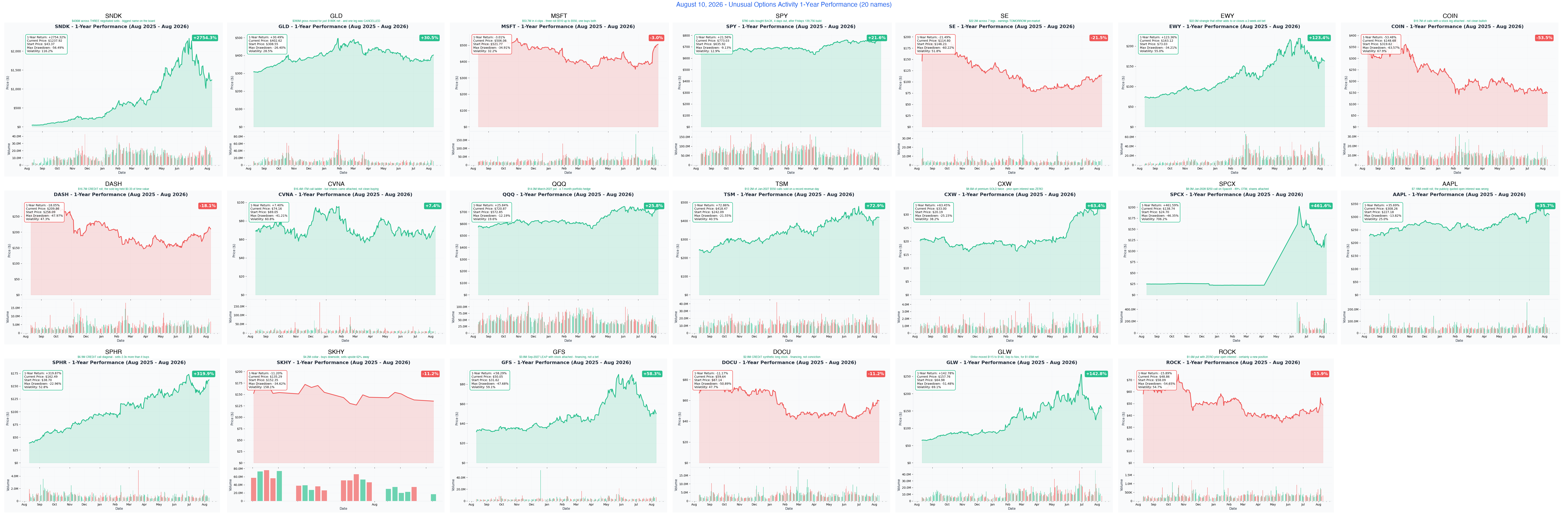
≈$738.0M net premium across 20 names. SanDisk alone accounts for ≈$436.6M across three separate negotiated trades, and gold moved ≈$390M of gross premium for almost no net cost. But the most useful thing on this page is smaller than either: a trade we published this morning turned out to have been cancelled, re-priced, and flipped direction — and the tape is the only reason we know.
⚡ Quick Read
-
🧩 SNDK — ≈$436.6M across THREE separate negotiated sells, and the arithmetic changes the story on the biggest one. 5,000 January-2027 $1,660 puts crossed at $578.00 with the stock at $1,245.28. The strike sits ≈$415 above the stock, so $414.72 of that $578 is intrinsic value — ≈$207.4M of the headline, versus only ≈$81.6M of actual time value. And the open-interest history is blunt: that strike sat at ≈660 contracts for weeks, jumped to ≈5,660 on Thursday/Friday, and today ≈5,000 trade. Matching size, days apart. The leading read is that a position opened last week is being closed or transferred, not a fresh quarter-billion-dollar bet. It could not be proven that day — size sat below open interest — which is exactly why we did not call it conviction. The next-morning snapshot settled it: open interest fell 5,660 → 660, exactly −5,000. It was a close. Late in the session a third trade landed: 2,500 June-2027 $1,020 calls sold at $528 for ≈$132.0M, a floor block. Note the mirror image — that call is ≈$232 in the money yet more than half its price is time value ($295.56 of $528), the exact opposite of the put's split. Resolved: its open interest moved by a single contract — a pure transfer, neither an open nor a close. Three large negotiated sells in one name in one session; we cannot prove they are the same desk and will not claim it.
-
⚡ The one genuinely aggressive trade all day was small. Also in SanDisk: 1,767 August-28 $1,300 calls sold at the bid for ≈$15.55M, against prior open interest of just 168. That is a proven new short, and it is the only print on the entire board that took displayed liquidity. Forty-eight of today's fifty-three legs were negotiated blocks with a known counterparty on the other side, and four more were price-improvement auctions. When someone sells near-dated upside calls into a stock up ≈355% year-to-date, that is worth more attention than a headline twenty times its size.
-
🔄 MSFT — ≈$53.7M worked in four clips, and the fourth breaks the pattern. Three of them sell the October $510 call and buy the $550 — a roll up. The open-interest history says why that matters: the $510 line went from 253 to 52,671 contracts on August 4, so this desk built that position barely a week ago and is already moving it higher. Then the 12:48:06 clip does something different — it buys both strikes. Worth knowing before you read "MSFT $110M of calls" anywhere else. And the calendar bites: Microsoft's next earnings is expected ≈October 28, about twelve days AFTER this contract expires. This position does not own the print.
-
🔄 SPY — a "$22M call buy" that is largely somebody covering a short. 60,000 August-14 $780 calls were bought — but that strike exploded from 5,775 to 145,531 contracts on Friday's session. Roughly 139,756 opened Friday; today's buyer is buying them back. The order type resolves as a buy-to-close at high confidence. These expire in four days, which leaves almost no room for the open-interest test to settle anything.
-
🔁 Three separate desks ran the same play: roll up and out. AAPL (≈$7.18M credit), DASH (≈$16.70M credit) and GLW (≈$1.65M debit) each sold a deep in-the-money near-dated call and bought a higher strike further out. In every case the sold leg was almost pure intrinsic value — Corning's $115 call priced at $48.01 against $48.01 of intrinsic value, exactly zero time value. Corning's desk moved its strike from $115 to $140 and its expiry from September to November for a net ≈$1.65M against ≈$98M of gross trading. That is the trade of the day for anyone learning how professionals reposition.
-
📅 SE — ≈$22.17M placed across seven legs, one day before a confirmed earnings print. Sea Limited reports tomorrow, Tuesday August 11, pre-market, and the options market is pricing an ≈19.1% move. Three October legs are proven fresh opens buying movement in both directions; a September $120 call matches its prior open interest exactly and looks like a close; a December $97.50/$145 call spread is a genuine directional structure. Note carefully: buying options the day before a print means paying elevated volatility that collapses the next morning.
-
🥇 GLD — ≈$390M of gold premium moved for almost no net cost, and it is the same desk as Friday. Friday we predicted the November $460 call would land near 67,600 if it was a fresh position. It printed 67,622. Then at 15:27 a second package landed: a long September $400/$425 call spread costing ≈$51.24M, financed almost exactly by a short $420/$445 spread at twice the size that brought in ≈$51.42M. Net cost of moving ≈$243M of September gold exposure: ≈$180,000. A third spread, short September-4 $410/$430, collected another ≈$26.82M. One leg — the $425 call — printed below the bid, the only leg on the whole board to do so, and the clearest sign of genuine seller urgency today.
-
🚨 The correction: a trade we published this morning was CANCELLED. GLD's 13:37:56 November $330 put — 34,722 contracts, ≈$6.15M, which we described as a sale — carries a matching cancellation on the tape at 15:26:56. It was re-reported as two prints totalling exactly 34,722 at $1.81 and $1.82, on the BUY side. Busted, re-priced, direction flipped. This makes the structure safer, not riskier: with the $330 put bought rather than sold, November is a defined-risk condor — short the $340/$330 put spread and short the $460/$470 call spread — instead of the naked tail-selling we first described. We would rather tell you this than quietly change the page. It is also the single best argument for checking the tape before trusting any flow headline, including ours.
-
🇰🇷 EWY — ≈$22M of Korea volatility, and we honestly cannot tell which way. A 11,250-lot October $165 call / $130 put strangle crossed. But both strikes were built in the same two sessions two weeks ago ($165 call 740 → 23,781; $130 put 6,795 → 31,047), and today's size sits below both. So this either adds to that strangle or takes it off — opposite conclusions, and only tomorrow's open interest separates them. We are not guessing.
The habit to take from today: compare the option's price to its intrinsic value before you read anything into the dollar figure. Corning's $115 call carried $0.00 of time value. DoorDash's $145 call carried $0.33. Apple's $275 call carried $0.16. Those three legs alone account for ≈$127M of "premium" that contains almost no opinion about anything. A big number is not a big bet.
🔁 OI Review — Last Session's Provisional Flags, Now Resolved
Friday's board has been through the next-day open-interest test, and five of thirteen names came back meaning something different than they looked. Of 40 legs, 11 expired Friday and can never be settled; of the 29 that could be, 23 opened, 5 closed, 1 was a pure transfer.
🔄 Inversions
- 🔄 GLD — we published a two-branch test and it landed on the branch we argued against. The $460 call was supposed to collapse toward ≈0–1,000 on a roll, or rise toward ≈67,600 on a fresh position. It printed 67,622. All four legs opened — nothing was retired. Corrected: a self-financing double backspread, flat between $345 and $460, paying only below ≈$320 or above ≈$550.
- 🔄 SPY — Monday's long calls were not sold out; they changed hands. 89,368 → 90,973, up 1,605 on 136,560 contracts of volume. A pure transfer. That removes the main support for reading the new vertical as a roll-up, leaving its direction less settled, not more.
- 🔄 MCHP — the September line was never retired. We predicted 56,599 → ≈3,700. It printed 53,300 — down only 3,299 of a 52,920-lot sale, ≈6%. The rest was transfer, and 53,300 September $75 calls remain live.
- 🔄 SKHY — the "bull call spread" was a roll down, and the upside is not capped. The January $180 call fell 7,225 → 3,115, so it was sold to close a long. Same $5.10 net cost, more delta, no short call capping anything. More bullish than we published.
- 🔄 META — a roll out, not a calendar. The January $750 call landed at 258,969 — net open, but only ≈42% of the print. Roughly 18,500 contracts changed hands between existing holders, so the $69.8M headline overstates the new money by more than half.
✅ Confirmations
- ⭐⭐ PCG — the coin-flip landed hard on OPEN, 97,135 → 146,981 (+49,846) against a 28,000 print. A leg published as "unprovable" is now the cleanest directional open of the session.
- PLTR — the cleanest roll on the board. September $155 fell 50,385 against a 50,000-lot sale; December $175 opened at 99.5%.
- NN went four for four; ADBE landed within 250 contracts of both predictions; SMH opened at 99.3%; SNDK's $900 call opened at ≈185% of its print.
The standing lesson, and Friday taught it three times: a matching strike and size identifies what traded, not who traded it. A large print landing on strikes bought the day before is genuine evidence — and it is equally consistent with somebody selling to that buyer. Only the next morning's open interest separates "they closed it" from "it changed hands", and a flat result is as common as either.
📊 At a Glance
| Ticker | Net Premium | Expiration Range | Catalyst inside the window | Option Play | What It Means |
|---|---|---|---|---|---|
| SNDK | ≈$436.6M | Weekly (Aug 28) + LEAP (Jan 2027) | Investor Day Aug 13; Micron Sep 22; SNDK Q1 ≈Nov 5 | Deep-ITM put sold (cross) + lit call sold | ✅ Resolved: the $289M put was a CLOSE (OI −5,000, to exactly 660); the $132M call was a pure transfer (OI −1). Only the ≈$15.6M lit call sale was new |
| MSFT | ≈$53.7M | Monthly (Oct 16) | Ex-div Aug 20; Maia 300 unveil ≈Sep (reported) | 3 clips roll $510→$550; 1 clip buys both | ✅ Resolved OPEN + CLOSE: $550C 3,998 → 55,221, $510C 52,786 → 26,490. Roll up confirmed. Earnings lands ≈12 days AFTER expiry |
| SPY | ≈$39.8M | Weekly (Aug 14) + Monthly (Nov 20) | CPI Aug 12; PPI Aug 13; retail sales Aug 14 | Hedged call sale + two Aug-14 call prints | 🔄 Resolved: not bullish, but not a proven cover either — $780C OI rose 2,275 (transfer), $775C OI fell 8,038. The Nov $700C sale opened |
| GLD | ≈$40.1M | Weekly (Sep 4) + Quarterly (Sep 18) + Monthly (Nov 20) + LEAP (Jan 2027) | July CPI Aug 12 (inside both September expiries); dot plot Dec 8-9 (Jan 2027 only) | 3 call spreads + a defined-risk Nov condor | 🔄 Resolved: the Nov condor opened, but the Sep $400/$425 "long" spread was being CLOSED (both legs −18,000). More premium-selling than bullish |
| SE | ≈$22.2M | Weekly (Sep 11) + Monthly (Oct 16) + Quarterly (Dec 18) | Q2 earnings TOMORROW, Aug 11 pre-market | Long-vol package + two positions being closed | 🔄 Resolved: the Oct long-vol legs opened (+7,300 each); the Dec bull spread was being CLOSED ($97.5C to 360, −2,275 exactly); Sep $120C ≈50% closed |
| EWY | ≈$22.0M | Monthly (Oct 16) | Nvidia Aug 26; Bank of Korea Aug 27 | Strangle closed, not opened | 🔄 Resolved: an exit. Both legs' OI fell ≈100% of print size ($165C −11,303; $130P −11,539). The July strangle came off |
| COIN | ≈$19.7M | Monthly (Aug 21 + Oct 16) | CLARITY Act cloture Sep 15; FOMC Sep 16 | Two long call legs, with shares attached | 🔄 Resolved: Oct $150C opened (345 → 9,858); Aug $160C OI fell 1,501 — not new bullish money |
| DASH | ≈$16.7M credit | Quarterly (Sep 18) + Monthly (Nov 20) | NJ worker rules Oct 1; Q3 ≈Nov 4 (est.) | Roll up & out | ✅ Resolved: Nov $170C opened exactly (+10,008). But the Sep $145C only retired 1,371 of 10,000 — ≈86% transferred |
| CVNA | ≈$16.4M | Monthly (Aug 21) — 11 days | J.P. Morgan Auto Conference Aug 12 — the only one | ITM call ladder $65/$67/$69, shares attached | Looks like ask-side buying; it's a hedged cross |
| QQQ | ≈$14.0M | Quarterly (Mar 2027, ≈7.3 months) | 5 FOMC meetings; 8 CPI prints; midterms Nov 3 | Long-dated ITM put | Portfolio insurance, not a crash call |
| TSM | ≈$12.3M credit | LEAP (Jan 2027) | 5 monthly revenue prints; Q3 ≈Oct 15 (est.) | Short OTM call ≈30% above spot | Premium collection — not a bearish bet |
| CXW | ≈$8.6M credit | Quarterly (Mar 2027, ≈19 months) | Federal contract and appropriations decisions inside the window | Short $28/$32 puts + short $35 call, twice, shares attached | A range bet on a stock up ≈76% YTD. Prior OI 0/0/1 — certain opens |
| SPCX | ≈$8.0M | LEAP (Jan 2028, ≈1.45 yrs) | Final unlock tranche Dec 8; ≈12.9B shares through mid-2027 | Far-OTM $250 call, ≈89% above spot, shares attached | A supply-overhang timing bet, not a clean lottery ticket |
| AAPL | ≈$7.2M credit | Monthly (Aug 21 + Oct 16) | CEO handoff Sep 1; product event ≈Sep 9 | Roll up & out (auction) | ✅ Resolved: $275C CLOSE (−1,904), $310C OPEN (+2,653). Roll confirmed on both legs |
| SPHR | ≈$6.9M credit | Monthly (Nov 20) + Monthly (Feb 2027) | Venue and residency news; next earnings inside the Feb window | Call diagonal — long leg didn't open | 🔄 Resolved: Feb $180C opened exactly (2 → 9,101); Nov $150C OI fell 2,008. Surviving ratio is ≈4.6-to-1 short-to-long, not 2.3 |
| SKHY | ≈$4.2M | LEAP (Jan 2027) | Memory-cycle prints and Korean supply news inside the window | Collar: long $120 put / short $220 call | Protection bought and upside sold — the shape of somebody who already owns it |
| GFS | ≈$3.8M | LEAP (Sep 2027) | 4 earnings prints; CHIPS award definitization | Deep-ITM LEAP call with shares attached | Financing/stock substitute — no clean view |
| DOCU | ≈$2.8M credit | LEAP (Jan 2028, ≈1.45 yrs) | 6 earnings inside the window; next Sep 3 | Synthetic long stock (long call + short put) | Financing at ≈4.3%/yr carry, not conviction |
| ROCK | ≈$1.6M | Quarterly (Sep 18) | FOMC Sep 15-16; housing starts Sep 17 — one day before expiry | Long slightly-ITM put | Prior open interest 0 — the one certain open on the board |
| GLW | ≈$1.7M | Quarterly (Sep 18) + Monthly (Nov 20) | Citi TMT conf Sep 9; Q3 ≈Oct 27 (est.) | Roll up & out | ✅ Resolved: Nov $140C OPEN (+12,811); Sep $115C CLOSE — but only ≈41% retired (−4,071 of 10,000) |
✅ / 🔄 = resolved 2026-08-11 pre-market. Every provisional ⏳ flag from this session has been settled by the next-day OPRA open-interest snapshot; ✅ means our published read held, 🔄 means it inverted. Full per-leg detail is in each ticker's ✅ RESOLVED box and in _OI_RESOLUTION_NOTES.md.
🔄 Seven names inverted: COIN, EWY, GLD, SE, SNDK, SPHR and SPY. The single biggest correction: SNDK's $289M put was a close, not a new short, and its $132M call was a pure transfer — of $436.6M in headline premium, ≈$15.6M was an actual new position. EWY's "long strangle" was a strangle being closed. GLD's "bullish" September call spread was being unwound. SE's December bull spread was being taken off. And SPY's short-cover story did not hold — the strike's open interest rose instead of falling.
📅 Upcoming Catalysts — and Which Expiration Actually Captures Them
Read this column carefully: a catalyst date and an option expiration date are different things, and several of today's trades expire before the event everyone assumes they are about.
| Date | Event | Which of today's expirations contains it |
|---|---|---|
| Aug 11 (tomorrow, pre-market) | Sea Limited Q2 earnings | All three SE expirations (Sep 11, Oct 16, Dec 18) |
| Aug 12 | July CPI | SPY Aug 14 weekly |
| Aug 12 | Carvana CFO at the J.P. Morgan Auto Conference — the ONLY event inside CVNA's 11-day window | CVNA Aug 21 |
| Aug 13 | SanDisk Investor Day | SNDK Aug 28 weekly |
| Aug 20 | Microsoft ex-dividend | MSFT Oct 16 |
| Sep 3 | Docusign Q2 FY2027 earnings (listed, not yet company-confirmed) | DOCU Jan 2028 |
| Sep 17 | Census housing starts — one day before ROCK's expiration | ROCK Sep 18 |
| Dec 8 | SpaceX final lockup tranche; ≈12.9B shares unlock through mid-2027 | SPCX Jan 2028 |
| Dec 8–9 | FOMC with a fresh dot plot | GLD Jan 2027 (not GLD Nov 20) |
| Aug 14 (8:30 ET, pre-open) | July retail sales — on expiration morning | SPY Aug 14 weekly |
| Aug 26 | Nvidia earnings | EWY Oct 16; SPY Nov 20; QQQ Mar 2027 |
| Aug 27 | Bank of Korea decision | EWY Oct 16 |
| Sep 1 | Apple CEO handoff | AAPL Oct 16 (not Aug 21) |
| Sep 15–16 | FOMC + CLARITY Act cloture vote | COIN Oct 16; QQQ Mar 2027 |
| Oct 1 | New Jersey worker-classification rules | DASH Nov 20 (not Sep 18) |
| Oct 28 | Microsoft Q1 FY2027 earnings (estimated) | ⚠️ Nothing — MSFT's Oct 16 expires ≈12 days too early |
| Oct 29 | Gibraltar Q3 earnings (estimated) | ⚠️ Nothing — ROCK's Sep 18 expires ≈41 days too early |
| Oct 28 | Carvana Q3 earnings (estimated) | ⚠️ Nothing — CVNA's Aug 21 expires ≈68 days too early |
| Oct 28–29 | SK hynix and Samsung Q3 | ⚠️ Nothing — EWY's Oct 16 expires ≈12 days too early |
| Nov 3 | US midterms | SPY Nov 20; QQQ Mar 2027 |
Five mismatches worth internalising: EWY's strangle expires before the two earnings reports that drive ≈41% of the fund. AAPL's October contract captures the CEO change and the product event but expires ≈13 days before earnings. MSFT's October contract expires ≈12 days before Microsoft reports. CVNA's August contract expires ≈68 days before Carvana reports. TSM's January LEAP expires ≈6 days before the call carrying first FY2027 capex guidance. In every one of these cases, buying "the earnings trade" on that expiration would not actually own the earnings — and four of the five are names where somebody big just put real money on that exact contract.
👥 Four Ways to Read Today
🎲 The YOLO trader. The temptation today is SPY's four-day $780 calls — and they are the single worst thing on this page to copy, because the size is a short being covered, not a bull opening a position. At-the-money options with four days left lose value faster than anything else here, and you would be buying what somebody else is exiting. If you want today's genuine aggression, it is the small SanDisk call sale — and selling naked calls on a stock up ≈355% is how accounts get destroyed. Sit this one out or size it as a lottery ticket you can lose entirely.
📈 The swing trader. The three rolls are your material. AAPL, DASH and GLW all say the same thing: desks that were already right are staying long but moving their strikes higher and their dates further out. That is a continuation posture, not a fresh entry signal, and it comes with a known counterparty on the other side. The cleanest expression is not copying the option — it is noting that GLW's desk chose November $140 and DASH's chose November $170, and watching whether price respects those levels. Wait for tomorrow's open interest before you trust any of it.
💰 The premium collector. TSM is your trade of the day, and it is instructive: a desk collected ≈$12.25M selling a strike ≈30% above spot with five months to run — and the implied-move data says the January range tops out around $532, still below the $550 strike. That is what selling a genuine tail looks like. The counter-example is SE: with a confirmed print tomorrow and an ≈19.1% implied move, selling premium there is picking up coins in front of a scheduled event. Elevated volatility before earnings is not free money — it is priced that way for a reason.
🌱 The beginner. Learn one idea from today and you are ahead: an option's price is intrinsic value plus time value, and only the time value contains an opinion. Corning's $115 call cost $48.01 and had $48.01 of intrinsic value — $0.00 of opinion. It behaves like owning the shares. That is why a "$48M call sale" was not bearish and why a "$289M put sale" is not a quarter-billion-dollar conviction. Before you react to any flow headline, ask what the stock price is, what the strike is, and how much of the premium is just the difference. Also learn what the ⏳ symbol in our table meant: we genuinely did not know yet, and saying so is the honest answer. It has since been replaced with ✅ or 🔄 — and this time, seven of twenty flipped.
A second lesson, free, from DOCU: buying a call and selling a put at the same strike and the same expiry is not two trades — it is synthetic long stock. It behaves like owning the shares, including the full ride down. Today's package works out to an effective entry of ≈$64.90 against a ≈$60.27 stock over ≈1.45 years, which is almost exactly what it costs to borrow money for that long. That is the tell: this is a desk financing a stock position, not predicting a rally. If you can spot that shape, you will never mistake it for a moonshot bet again.
⚠️ Before You Trade Any of This
Forty-eight of today's fifty-three legs were negotiated blocks — a broker matched a buyer and a seller away from the public order book. Four more were price-improvement auctions. There is a known counterparty on the other side of every one of them, and that counterparty may be just as informed. This is not urgent buying or panic selling; it is two parties who already agreed on a price.
We cannot see everything, and we say so. The tape does not reveal who traded, why, or whether shares sit against an option position. Seven of today's packages — COIN, GFS, MSFT, CVNA, SPCX, CXW and SPY's $700 call — came with a stock leg attached, which means the option alone does not express a view at all. CVNA is the sharpest example: all three legs printed at the ask, which reads as urgent buying until you see the shares that came with them. And on eleven of twenty names, at least one leg could not be proven open or close from the trade-day tape — all of which the next-morning snapshot has since resolved, seven of them against our published read.
The next-day open-interest snapshot has now settled every ⏳ flag in this issue — see the ✅ / 🔄 verdicts in the glance table above, and each ticker's RESOLVED box. It inverted seven of twenty names this time, one better than Friday's five of thirteen only in proportion. Position size for being wrong, not for being right.
This is market analysis and education, not investment advice. Options carry substantial risk of loss, and uncovered short options carry theoretically unlimited risk.